
AI for Appointment Booking: The 2026 Guide for Australian Businesses

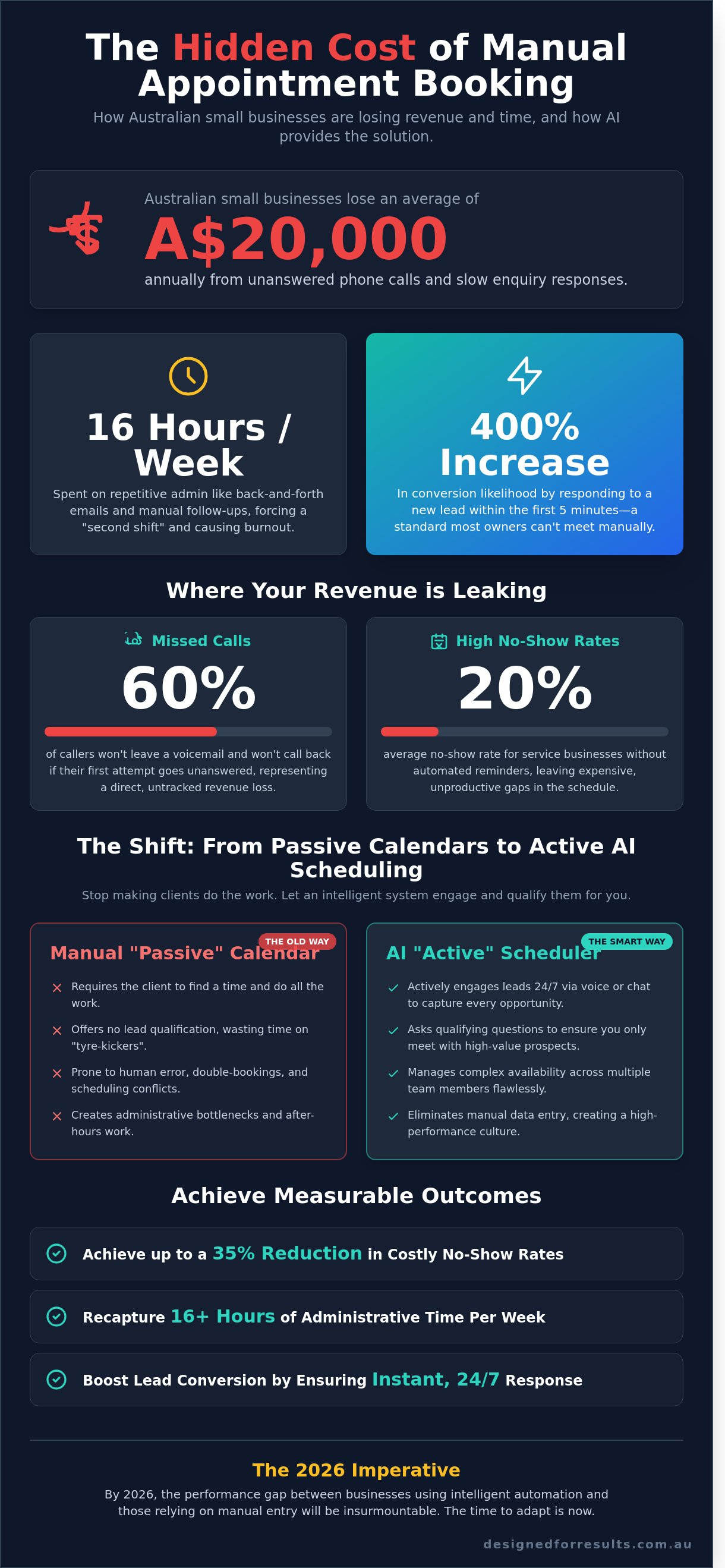
It's frustrating to watch potential revenue slip away because you're tied up with existing clients. This guide provides the clarity you need to eliminate administrative bottlenecks and achieve measurable outcomes, such as a 35% reduction in no-show rates. We will examine the practical steps to deploy an automated calendar that operates without manual intervention, ensuring your customer experience remains professional. You'll discover the specific strategies required to reclaim your time and drive consistent revenue through superior lead response and leadership capability.
The Cost of Manual Appointment Management in Australian Businesses
AI for appointment booking is a system that uses natural language processing to qualify leads and schedule meetings without human intervention. It serves as a digital gatekeeper, ensuring that every enquiry is handled with precision. For an Australian business, the transition to ai for appointment booking represents a move from reactive chaos to structured efficiency.
Identifying Revenue Leaks in Your Current Booking Process
The Shift from Passive Calendars to Active AI Scheduling
Core Technologies for AI Appointment Booking: Voice vs. Chat
Implementing ai for appointment booking requires a clear understanding of the two primary delivery methods: voice and chat. These technologies serve distinct functions in the customer journey and solve different operational bottlenecks. Choosing the correct modality depends on how your Australian business currently interacts with its client base. While some industries rely on phone communication to build immediate rapport, others benefit from the high-speed efficiency of text-based interactions on a website. In specialized sectors like healthcare, combining automation with professional services such as ClicFone Télésecrétariat ensures that every patient inquiry is managed with both efficiency and expert care. For practitioners wanting to stay abreast of the broader landscape of wellness fads and medical news, you can discover More Than Medication as a resource for the latest Australian health trends.
A May 2023 report from Export Finance Australia indicates that AI adoption in Australian businesses is accelerating as owners seek to recapture lost time and improve service delivery. The success of these tools rests on natural language understanding (NLU). This technology ensures the AI interprets intent rather than just keywords, allowing it to maintain your professional brand voice without the robotic limitations of previous generations of automation.
AI Voice Agents: Handling High Call Volumes
Conversational Chatbots: Converting Website Traffic
Measuring the ROI of Automated Scheduling Systems
Calculating the true value of ai for appointment booking requires a focus on hard data rather than abstract benefits. Australian business owners often find themselves trapped in a cycle of manual administrative work that limits their ability to scale. By quantifying the time recovered and the revenue captured through increased accessibility, the financial case for automation becomes clear.
Efficiency Gains and Overhead Reduction
Comparing the cost of a digital system against hiring additional staff reveals a stark contrast. A full-time administrative employee in Australia typically requires a salary of A$55,000 or more, plus superannuation and insurance. Automation provides a scalable solution that handles thousands of bookings without increasing payroll. It removes the risk of human error and double bookings, ensuring your calendar remains accurate without constant oversight. This allows your current team to dedicate their energy to billable tasks and high-level client service.
Improving the Customer Journey and Brand Perception
Modern Australian consumers value speed and autonomy. A frictionless booking experience allows clients to secure their spot in seconds, matching the convenience they experience with major global brands. Providing instant confirmations and easy rescheduling options reduces the cognitive load on the customer. Following up automatically after an appointment ensures the relationship continues beyond the initial service. This level of consistency establishes a professional image that signals your business is organised, reliable, and ready to deliver results. You can learn more about how these systems integrate with your operations at bespoke AI automation.
Integrating AI Booking into Your Existing Business Workflow
An isolated calendar is an operational liability. For Australian businesses, ai for appointment booking must function as a fully integrated component of the wider technical stack to deliver measurable ROI. This integration ensures that every confirmed booking triggers a sequence of automated events that removes the business owner from the administrative loop. When your booking system operates in a silo, you still face the burden of manual data entry and fragmented communication.
CRM Implementation and Data Synchronisation
A booking system only reaches its full potential when it communicates directly with your central database. Effective crm implementation allows your booking tool to feed data directly into a central hub, maintaining a single source of truth for every client interaction. You need to map the data flow from the initial enquiry through to the final service delivery. This structure ensures that when a client updates their contact details or project requirements during the booking process, the information reflects across all departments instantly.
Designing the Automated Onboarding Sequence
The client experience begins the moment they click the confirm button. Implementing robust lead follow up systems ensures that prospects receive immediate SMS confirmations and welcome emails. This immediate response reduces "no-show" rates and establishes professional authority from the outset. You can automate the collection of necessary documents, such as signed contracts or site photos, by embedding digital forms within the confirmation sequence.
This level of transparency is essential for high-ticket service industries; to see how a leading contractor manages these stages, you can visit Rod Cameron Pools and review their detailed breakdown of project expectations.
A 2023 study found that 67% of Australian small business owners spend over five hours per week on repetitive administration. By automating the transition from booking to onboarding, you reclaim this time for high-level management and service delivery. The system handles the "grunt work" of chasing signatures and verifying information, allowing you to walk into every meeting fully prepared with the necessary data already organised in your CRM.
Stop losing your evenings to manual scheduling and administrative follow-ups. Book a consultation to see how we can automate your business workflow.
Professional AI Implementation with Designed For Results
Off-the-shelf software often forces an Australian business to change its established processes to fit the tool. We take the opposite approach. We build custom systems that integrate with your existing workflow. Generic tools lack the nuance required for complex service schedules and local market expectations; for instance, a specialized workshop like Eurotech Automotive requires precision scheduling to manage expert technicians and high-end vehicle parts effectively. Our process begins by auditing your current operations to find where time is leaking. We look for the 15 to 20 hours a week spent on manual data entry or after-hours admin. By identifying these efficiency gaps, we build a clear roadmap for automation that targets your biggest pain points first.
A professional implementation ensures your system remains stable as you scale. We don't just "set and forget" your technology. We provide ongoing support and performance monitoring for every deployed AI agent. This ensures the tone and accuracy of your booking system meet your standards. If a business experiences a 30% increase in lead volume, the AI handles the surge without additional overhead. This level of reliability allows owners to focus on high-level management instead of micro-managing a calendar.
Bespoke AI and Automation Strategy
Australian businesses face unique market conditions where labour costs are high and client expectations for immediate response are rising. A 2023 industry report indicated that 67% of customers expect a response to an inquiry within 10 minutes. We develop solutions that provide this level of engagement 24/7. Our focus remains on measurable outcomes; we aim to reduce booking friction and capture revenue that would otherwise go to a competitor. Implementing smart AI solutions allows you to maintain professional standards without burning out your staff. Every system we build reflects the specific operational needs of your business, ensuring that technology serves your goals rather than becoming another task to manage.
Next Steps for Your Business Automation
A managed system provides the peace of mind that your administrative tasks are handled with precision. It eliminates the need for late-night quoting and scheduling sessions. You can finally step away from the day-to-day admin and look at the bigger picture. If you're ready to stop the admin cycle and see real efficiency gains; lets chat about your specific needs and how we can help you reclaim your time.
Securing Your Competitive Edge in 2026
Moving beyond manual scheduling is no longer optional for Australian businesses facing rising operational costs. By 2026, the gap between businesses using automated systems and those stuck in administrative cycles will widen significantly. Implementing ai for appointment booking allows you to capture leads around the clock while removing the burden of repetitive data entry from your evenings. Successful implementation relies on deep integration with your existing tools, such as Xero and your CRM, to ensure every booking translates into a measurable revenue outcome.
Designed For Results specialises in automation for Australian SMEs, focusing on practical transitions that give business owners their time back. We understand the specific pressures of the local market and provide the technical expertise required to connect your front-end booking system with your back-end financial workflows. Stop losing billable hours to administrative friction and start focusing on high-value leadership. Our team ensures your technology works for you, allowing you to scale without increasing your headcount.
Book your free automation strategy call with Designed For Results to review your current workflow. It's time to reclaim your schedule and focus on what you do best.
Frequently Asked Questions
How does AI handle complex scheduling requests or reschedules?
AI systems process complex requests by cross-referencing multiple data points simultaneously. If a client needs to reschedule, the AI identifies a new slot that fits the business's availability and the client's preference, updating all synced calendars in under 2 seconds. This prevents double bookings and ensures the schedule remains accurate without manual intervention.
The logic handles multi-staff availability and buffer times between appointments automatically. It applies your specific business rules to every interaction, ensuring that shifts and breaks are respected while the client receives an immediate resolution to their request.
Will an AI booking agent sound natural to my Australian clients?
Is AI for appointment booking secure for sensitive client data?
Security is a priority for ai for appointment booking systems, which typically employ AES-256 encryption for data at rest and TLS 1.2 for data in transit. Most reputable platforms comply with the Australian Privacy Principles (APPs) and the Privacy Act 1988, ensuring that sensitive client information remains protected. These systems also allow for precise access controls, limiting data visibility to authorised personnel only.
Can I integrate my existing calendar (Google or Outlook) with AI booking?
AI booking tools integrate directly with Google Calendar and Microsoft Outlook via secure API connections. This synchronisation happens in real-time, meaning the AI sees a new appointment the moment it's added to your personal schedule. It eliminates the need for manual data entry and ensures that your availability is always current across all platforms.
What happens if the AI cannot answer a specific client question during booking?
When an AI encounters a query outside its programmed knowledge base, it initiates a seamless handoff to a human team member. The system captures the context of the conversation and alerts the business owner via SMS or email immediately. This ensures the client receives an accurate answer while allowing the owner to manage exceptions only, rather than every routine booking.
How much time does it typically take to implement an AI booking system?
Implementing a standard AI booking system typically requires 5 to 10 business days for full configuration and testing. This timeframe includes integrating existing calendars, setting up service parameters, and training the AI on your specific business rules. More complex deployments involving custom integrations may extend this period to 21 days to ensure all technical alignments are verified.
Does my business need a full CRM to use AI for appointment booking?
Australian businesses don't require a full CRM to utilise ai for appointment booking. Many AI tools function as standalone solutions or connect directly to simple spreadsheets and email platforms. However, connecting the AI to a CRM can improve client history tracking, as 72% of service-based businesses report better lead conversion when booking data flows directly into a centralised customer database.
Can the AI collect payments or deposits at the time of booking?
AI booking agents facilitate secure payment collection by integrating with gateways like Stripe or PayPal. You can configure the system to require a deposit or full payment in A$ before a booking is confirmed on the calendar. This process reduces no-shows and secures revenue upfront, automating a task that previously required manual invoicing and follow-up.
