
CRM Strategy for Business Growth: A 2026 Guide for Australian SMEs

Your customer database should function as an active sales agent. Sales teams using AI report an average growth of 83%. Developing a clear crm strategy for business growth is a fundamental requirement for any organisation that intends to scale without the owner becoming a permanent bottleneck. It's a choice. Success in the current market is the result of deliberate operational planning and disciplined execution.
You likely recognise the frustration of losing a lead because a follow-up was delayed or spending your Sunday night processing manual admin. This article provides the methodology to transform static records into an automated system that handles lead follow-up and document generation with total precision. We will examine how to achieve real-time pipeline visibility and ensure your business remains compliant with the mandatory Privacy Act changes arriving in December 2026. You can recover your time while building a system that produces predictable revenue.
Defining the Role of CRM in Australian Business Growth
A CRM functions as the central nervous system for managing every customer interaction and data point within an organisation. It serves as a single source of truth that captures communication history, purchase patterns, and lead status in one accessible location. This systematic approach to Customer Relationship Management (CRM) allows an Australian business to move beyond guesswork and base its growth on verifiable data. With the Australian CRM market reaching an estimated AUD 2.9 billion in 2025, the adoption of these systems has become a standard requirement for maintaining a competitive edge.
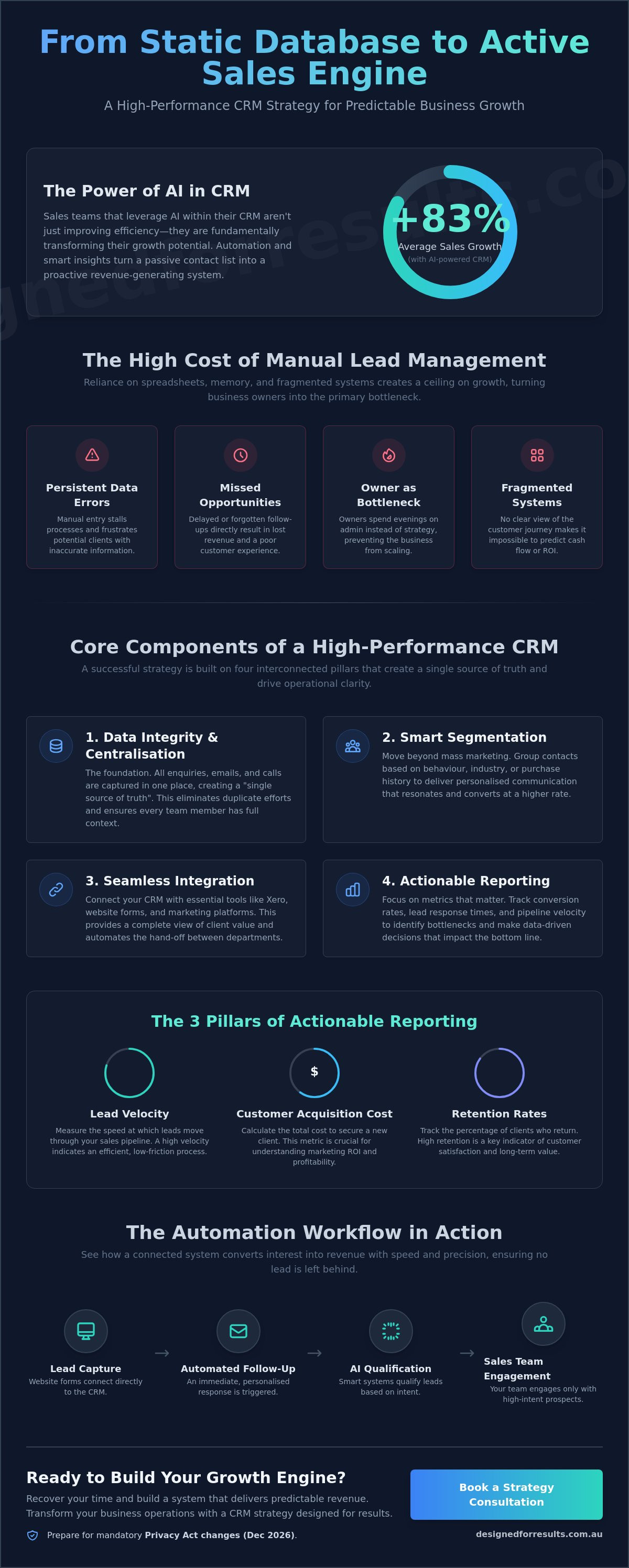
Growth requires a transition from manual record-keeping to systematic lead management. Relying on spreadsheets or memory to manage prospects creates an immediate ceiling on what a business can achieve. Implementing a robust crm strategy for business growth eliminates the "speed to lead" gap by ensuring every enquiry receives an immediate response. Sales teams utilizing AI within their CRM report an average sales growth of 83%, a metric that highlights the difference between a static database and an active execution system. Successful implementation results in a transparent sales pipeline that identifies exactly where revenue leaks occur, allowing managers to fix broken processes before they impact the bottom line.
Shifting from Data Storage to Active Revenue Management
A CRM functions as a dedicated tool for driving sales and replaces the outdated digital rolodex. Centralise all client communication to ensure no lead remains unaddressed during peak periods or staff absences. Real-time data provides the clarity needed to make informed decisions about resource allocation and marketing spend. By integrating bespoke automation into the CRM, businesses can trigger follow-up sequences based on specific user behaviours. This ensures that the customer journey remains consistent and professional without requiring the owner to intervene in every transaction.
Identifying the Bottlenecks of Manual Lead Management
Manual data entry creates persistent errors that stall the sales process and frustrate potential clients. Reliance on memory for follow-ups leads to missed revenue opportunities and a fragmented customer experience. These inefficiencies often force business owners to spend their evenings catching up on administrative tasks, effectively becoming a bottleneck that prevents the business from scaling. Fragmented systems prevent a clear view of the customer journey, making it impossible to predict future cash flow or identify which lead sources provide the highest return on investment. Systematic automation removes these hurdles by standardising how data is captured and processed.
Core Components of a High-Performance CRM Strategy
High-performance systems rely on the quality of the information they process. Data integrity serves as the fundamental foundation for any scalable business system. Without accurate inputs, automation becomes unreliable and reporting becomes meaningless. A comprehensive whole-business CRM strategy ensures that every department operates from the same set of facts. This alignment is critical for a successful crm strategy for business growth, as it allows for precise execution across the entire customer lifecycle.
Segmentation moves beyond generic mass marketing. It allows for personalised communication that resonates with specific customer profiles based on their past behaviour or industry needs. When your CRM identifies these nuances, you can deliver relevant offers that increase conversion rates. Integration with existing tools like Xero ensures financial and sales data remain synchronised. This connection provides a complete view of client value, allowing you to prioritise high-yield accounts without manual cross-referencing. If you want to see how these systems work in practice, you might book a consultation to discuss your specific requirements.
Effective management requires reporting that focuses on actionable metrics. Track conversion rates and lead response times to identify specific areas for improvement. Monitoring these indicators allows you to pivot quickly when a campaign underperforms or a sales stage becomes a bottleneck. Focus your reporting on the following pillars:
- Lead Velocity: The speed at which prospects move through your pipeline.
- Customer Acquisition Cost: The total spend required to secure a new client.
- Retention Rates: The percentage of clients who return for additional services.
Centralising Customer Data for Operational Clarity
Collect every enquiry, email, and phone call in one accessible location. This provides team members with immediate access to the latest client notes, preventing the frustration of repetitive questions or lost information. Maintaining a single source of truth eliminates duplicate efforts and ensures the customer experience remains professional. It's about creating a system where the business functions smoothly regardless of who is in the office.
Integrating Sales and Marketing Workflows
Connect website forms directly to the CRM to trigger immediate action. This removes the delay between a prospect showing interest and a salesperson responding. Automate the hand-off between marketing leads and sales appointments to maintain momentum. Use smart AI solutions to qualify leads before they reach a human staff member, ensuring your team only spends time on high-intent opportunities. This approach maximises efficiency and directly impacts revenue growth.
Accelerating Growth Through CRM Automation and AI
Execution determines the success of any crm strategy for business growth. While the previous sections established the need for data integrity, automation is what converts that data into revenue. Automation handles repetitive tasks with a level of consistency that human staff cannot replicate. This shift allows your team to focus on high-value client interactions rather than manual data entry or basic scheduling. When a system manages the mundane, the business gains the capacity to scale without increasing headcount proportionally.
AI assistants now manage initial enquiries and book appointments directly into calendars with zero manual intervention. These tools qualify prospects based on specific criteria, ensuring that your sales team only speaks with high-intent leads. Predictive analytics further enhance this process by identifying which leads are most likely to convert based on historical patterns. By prioritising these opportunities, you maximise the return on every marketing dollar spent. It's a logical progression from simply storing information to using it as a tool for active expansion.
Automating the Lead Follow-Up Sequence
Deploy instant SMS and email responses to every new enquiry. Speed is the primary factor in conversion; a delay of even thirty minutes can result in a prospect moving to a competitor. Establish multi-channel nurture sequences that keep your business top-of-mind throughout the decision-making process. These sequences operate in the background, providing value and building trust while you focus on current projects. You can also set up triggers for database reactivation to win back past clients who haven't engaged with your services recently.
Leveraging AI for Predictive Customer Insights
Analyse customer behaviour to anticipate future needs and service requirements before the client even asks. AI can summarise long call transcripts and highlight key action items, ensuring nothing is missed during the onboarding process. Implementing smart AI solutions allows your business to handle after-hours enquiries through voice agents, providing a professional point of contact 24 hours a day. This level of responsiveness improves the customer journey and provides the owner with the freedom to step away from the business without missing opportunities.
Implementing Your CRM Strategy for Scalable Results
Implementation is the point where strategic planning meets operational reality. Audit current manual processes to identify exactly where time is being wasted. Many Australian business owners remain trapped in administrative loops because they haven't quantified the hours lost to repetitive tasks like manual data entry or quote generation. Mapping the ideal customer journey from the first touchpoint to the final invoice provides the necessary blueprint for your crm strategy for business growth. This exercise reveals hidden bottlenecks and ensures that every digital interaction serves a specific revenue-generating purpose.
Select a CRM platform that supports no-code integrations and future AI expansion to ensure long-term viability. The 2026-27 Federal Budget has made the $20,000 instant asset write-off permanent for businesses with a turnover under $10 million, which significantly lowers the financial barrier to adopting these technologies. Choosing a system that connects seamlessly with your existing financial and marketing tools prevents the creation of data silos. Establish strict data entry protocols from day one to maintain system health. Clean data is the only foundation for the reliable reporting required to make high-level management decisions.
Ready to remove yourself as the bottleneck? Book a strategy call to discuss your custom automation roadmap.
Mapping Your Business Processes for Automation
Document every step of your current sales and onboarding workflow with clinical precision. Identify repetitive administrative tasks that software can handle, such as sending initial enquiry responses or triggering internal approval notifications. Simplify complex processes before attempting to automate them. Automating an inefficient or broken process only accelerates the production of errors. Clarity in your workflow ensures the technology supports your operational goals rather than complicating your daily management tasks.
Training Teams for System Adoption
Focus training sessions on how the system makes the staff member’s job easier. Adoption often fails when employees view a CRM as a surveillance tool rather than a productivity aid. Appoint a system champion within your organisation to manage ongoing data integrity and provide immediate peer support. Review system usage regularly to ensure the CRM remains the primary tool for all work. Consistent use across the business is the only way to achieve the operational efficiency promised by a bespoke automation implementation.
Achieving Measurable Outcomes with Designed For Results
Designed For Results specialises in custom CRM implementations specifically for Australian service-based businesses. We recognise that a crm strategy for business growth is only as effective as its execution. Our focus remains on reducing the heavy burden of manual administration and drastically increasing your speed to lead. By automating enquiry responses and lead qualification, we ensure your business responds to prospects within seconds. We bridge the gap between complex technology and practical business application, ensuring your systems support your goals rather than creating new technical hurdles. Every solution is built to give business owners their evenings back while producing measurable revenue growth.
Success in a competitive market requires more than just software. It requires a disciplined approach to how data flows through your organisation. We provide the technical expertise to turn your customer database into a high-performance execution system. This allows you to scale your operations without a linear increase in staff costs or administrative overhead. Our methodology focuses on clarity and results, ensuring that every automation we deploy has a direct impact on your bottom line.
Bespoke CRM Implementation and Automation
We design systems that integrate seamlessly with your existing software stack, from accounting platforms to marketing tools. Our bespoke AI automation services cater to advanced workflow needs, such as automated contract generation and internal approval chains. This process ensures your CRM functions as an active asset from day one. You receive a system that proactively manages your sales pipeline and customer onboarding without constant manual oversight, allowing you to focus on high-level leadership.
Ongoing Management and Performance Optimisation
Technology requires consistent maintenance to remain effective as market conditions change. Our monthly managed services ensure your automations continue to perform at peak efficiency as your business scales. We provide regular reporting to track the return on investment of your technology spend, giving you clear visibility of conversion rates and lead volume. This data-driven approach removes the guesswork from your expansion plans. If you are ready to remove yourself as the bottleneck in your business, let’s chat about how we can automate your growth.
Take Decisive Action Toward Operational Freedom
Transitioning your customer database into a high-performance system is the most effective way to eliminate manual bottlenecks and reclaim your schedule. You must move beyond simple data storage to an active execution system that prioritises speed to lead and consistent follow-up. Implementing a disciplined crm strategy for business growth ensures your organisation remains competitive, scalable, and fully compliant as the 2026 Privacy Act changes take effect. Precision in your data management is the only path to predictable expansion.
Designed For Results specialises in Australian SME automation with a focus on measurable ROI and significant time recovery for business owners. We provide no-nonsense, jargon-free implementation that bridges the gap between complex software and practical business outcomes. You don't have to spend your evenings on repetitive administration when a systematic solution can manage the workload for you. Our team ensures your technology investment translates into recovered hours and increased revenue from day one.
Book your free automation strategy call with Designed For Results
Building a scalable business is a matter of deliberate planning and execution. Start your transition today and secure the future of your organisation.
Frequently Asked Questions
How does a CRM strategy directly contribute to business growth?
A well-defined strategy provides the structural methodology needed to manage leads systematically. It eliminates missed opportunities by ensuring every enquiry is tracked and addressed through a standardised process. This consistency increases conversion rates and allows for a scalable sales environment where revenue increases are the result of deliberate planning rather than chance.
Can a small business benefit from a CRM without needing complex AI?
Basic workflow automation often provides the highest initial return for smaller operations. Automating repetitive tasks like data entry and appointment scheduling saves hours of administrative time each week. A solid crm strategy for business growth focuses on operational efficiency first, with AI being an optional addition for more advanced lead scoring or predictive insights as the business expands.
What is the most common mistake Australian businesses make during CRM implementation?
Treating the software as a static database rather than an active execution tool is the most frequent error. Many businesses simply import their contacts and fail to map their sales processes or automate follow-up sequences. This results in a digital filing cabinet that adds administrative weight without driving new revenue or improving the customer journey.
How long does it typically take to see an ROI from a new CRM strategy?
Operational efficiency gains are usually visible within the first 30 days of implementation. By automating lead capture and initial follow-ups, owners immediately recover time previously spent on manual admin during evenings. Revenue-based ROI typically follows within 90 days as the improved speed to lead and consistent nurture sequences start converting a higher percentage of enquiries into paid clients.
Is it possible to automate lead follow-up without losing the personal touch?
Effective automation uses specific customer data to tailor communications rather than sending generic messages. By using merge tags and behavioural triggers, you can send timely, relevant emails or SMS that address the prospect's specific requirements. This ensures the customer feels heard and valued while the system handles the logistical burden of maintaining constant contact.
What are the essential features an Australian SME should look for in a CRM?
Prioritise robust automation capabilities, seamless integration with local tools like Xero, and clear pipeline visibility. Compliance features for the updated Privacy Act arriving in December 2026 are also mandatory. The system must allow you to manage data access requests and maintain transparency regarding any automated decision-making processes used in your crm strategy for business growth.
How do we ensure our team actually uses the CRM system?
Demonstrate how the system reduces their daily workload and eliminates frustrating manual tasks. Adoption increases when staff see that the CRM acts as a productivity aid rather than a surveillance tool. Appointing an internal champion and providing structured, role-specific training ensures the system remains the primary source of truth for all business operations.
Can a CRM help with managing existing clients as well as new leads?
A CRM is a vital tool for client retention and database reactivation. You can set up automated triggers for follow-up calls, feedback requests, or loyalty offers based on the client's last purchase date or interaction history. Maintaining a systematic relationship with your existing base is often more cost-effective than acquiring new leads and directly contributes to long-term operational stability.
