
How to Automate Your Sales Pipeline: A Practical Guide for Australian Businesses

A 2023 study found that Australian business owners spend an average of 19 hours every week on administrative tasks, frequently sacrificing their evenings to manage manual data entry. You built your business to deliver high-value services and deserve to focus on that mission rather than acting as a full-time administrator. When you automate sales pipeline workflows, you eliminate the bottlenecks that cause 44% of leads to go cold within the first 24 hours. Speed-to-lead is a critical performance indicator, yet it's the first thing to suffer when you're busy on-site or in meetings.
You understand that consistent follow-up is the key to closing deals, but the reality of manual tracking often leads to missed opportunities and lost revenue. This guide demonstrates how to replace those repetitive tasks with a system that functions without your constant manual intervention. We'll examine the specific automation tools and logical sequences that reclaim your time and improve conversion rates. You'll learn how to build a professional sales process that provides a superior customer journey while allowing you to focus on high-level business management.
The Impact of Automating Your Sales Pipeline on Business Growth
Manual lead management carries a heavy price that rarely appears on a balance sheet. When you rely on memory or spreadsheets to track enquiries, you create a leaky pipeline that drains potential revenue. Australian business owners often find themselves trapped in a cycle of reactive tasks, losing hours to repetitive data entry and manual email drafting. This administrative burden prevents you from focusing on high-level leadership and client acquisition. By choosing to automate sales pipeline processes, you transform your sales workflow into a high-performance asset that operates independently of your physical presence.
Addressing the Human Cost of Manual Follow-Ups
Fatigue is a silent killer of sales performance. Research from the Harvard Business Review indicates that sales teams lose 25% of their productivity to administrative tasks. For a small business owner in Australia, this often translates to late-night sessions at the kitchen table managing quotes and follow-ups. Manual systems are inherently fragile; a single missed email can result in a lost contract worth A$5,000 or more. Implementing bespoke AI automation ensures every lead is captured, tracked, and nurtured without requiring your constant oversight. You transition into a leadership role where systems manage the outcomes and protect your personal time.
Defining Speed to Lead for Modern Sales
Speed is the primary currency of the digital marketplace. Data from LeadConnect shows that 78% of customers buy from the first business to respond to their enquiry. If your response takes more than five minutes, your chances of qualifying that lead drop by 80%. Automated systems allow you to contact every lead within seconds, even if the enquiry arrives at 2:00 am on a Sunday. This immediate engagement builds trust and sets a professional standard that competitors cannot match. Consistent follow-up ensures your brand remains top-of-mind, turning cold enquiries into predictable revenue streams. When you automate sales pipeline stages, you guarantee that no lead is ignored, regardless of how busy your team becomes. Success becomes a product of intentional engineering rather than luck.
Mapping Your Current Sales Process for Automation
Success in sales requires a clear blueprint. Start by documenting every touchpoint from the initial website enquiry to the moment the final contract is signed. Australian businesses often lose momentum because their processes live in the owner's head rather than on paper. You must identify exactly where manual intervention creates friction. A 2023 study found that businesses responding to leads within five minutes are 100 times more likely to connect with the prospect. If your team manually checks emails every three hours, you've already lost the lead.
Distinguish between high-value human interactions and repetitive administration. A discovery call requires empathy and professional judgment. Sending a follow-up email or updating a CRM record does not. By isolating these administrative tasks, you can automate sales pipeline activities that typically consume 15 hours of a manager's week. Establish clear triggers, such as a lead moving from 'Discovery' to 'Proposal Sent,' to initiate the next sequence without manual input.
- List every manual email sent during the sales cycle.
- Identify the exact moment a lead becomes "cold" due to lack of follow-up.
- Define the specific data points needed to move a prospect to the next stage.
Auditing Lead Sources and Entry Points
Review every channel where prospects find you. This includes website forms, LinkedIn messages, and phone enquiries. Many Australian businesses manage these via separate browser tabs or paper notes, which leads to fragmentation. Consolidate these into a single digital environment. Implement an automated confirmation response for every entry point to ensure the prospect feels heard immediately. You can explore bespoke AI automation to bridge these gaps and ensure no enquiry is ignored during busy periods or after hours.
Structuring Your Sales Stages
Define a logical progression for your prospects. A standard sequence moves from New Enquiry to Booked Call, then to Proposal Sent and finally Won. Use status updates in your CRM to trigger specific nurture sequences. For instance, if a proposal remains unsigned after 48 hours, an automated reminder should be dispatched. Maintain real-time visibility through a centralised sales dashboard. This allows you to see exactly where deals are stalling without digging through your inbox at 9:00 PM on a Tuesday.
Selecting the Right Tools for Sales Pipeline Automation
To automate sales pipeline activities effectively, your technology stack must operate as a unified ecosystem. Fragmented applications create data silos that force business owners back into manual data entry. Start by selecting a CRM that serves as the central brain of your operations. This platform should act as the single source of truth for every lead, quote, and customer interaction. For many Australian businesses, 20% of staff time is lost searching for information across disjointed systems. Centralising this data ensures you never lose track of a prospect.
Integration is the next priority. Use no-code tools like Zapier or Make to connect your CRM with other essential applications. This connectivity allows data to flow between your website, email, and project management tools without human intervention. In the Australian market, compatibility with accounting software like Xero is non-negotiable. Automating the transition from a "won" deal to a Xero invoice can save hours of administrative work during your evenings, directly improving your bottom line and recovery time.
Deploying AI chatbots provides a significant advantage for lead qualification. These tools operate 24/7, capturing the 40% of leads that typically arrive outside of standard AEST business hours. By the time you start work in the morning, the AI has already greeted the prospect, gathered their requirements, and determined if they meet your ideal client profile.
The Central Role of the CRM
Invest in a CRM to provide the foundation for all further scaling. Moving away from manual tracking prevents the data decay that occurs in spreadsheets, which research from the University of Hawaii suggests contain errors in 88% of cases. Utilise bespoke AI automation to customise your CRM environment to your specific service workflows. This intentional setup ensures that your data remains accurate and your sales team stays focused on closing rather than filing.
Distinguishing Between Simple Automation and AI
Effective systems categorise tasks by complexity. Use simple if-this-then-that logic for straightforward transitions, such as sending a follow-up email immediately after a quote is downloaded. For more nuanced interactions, deploy smart AI solutions to handle lead qualification and sentiment analysis. This technology distinguishes between a "just looking" enquiry and a high-intent prospect. Maintaining this balance ensures your business remains efficient while providing the high-touch professional service your clients expect.
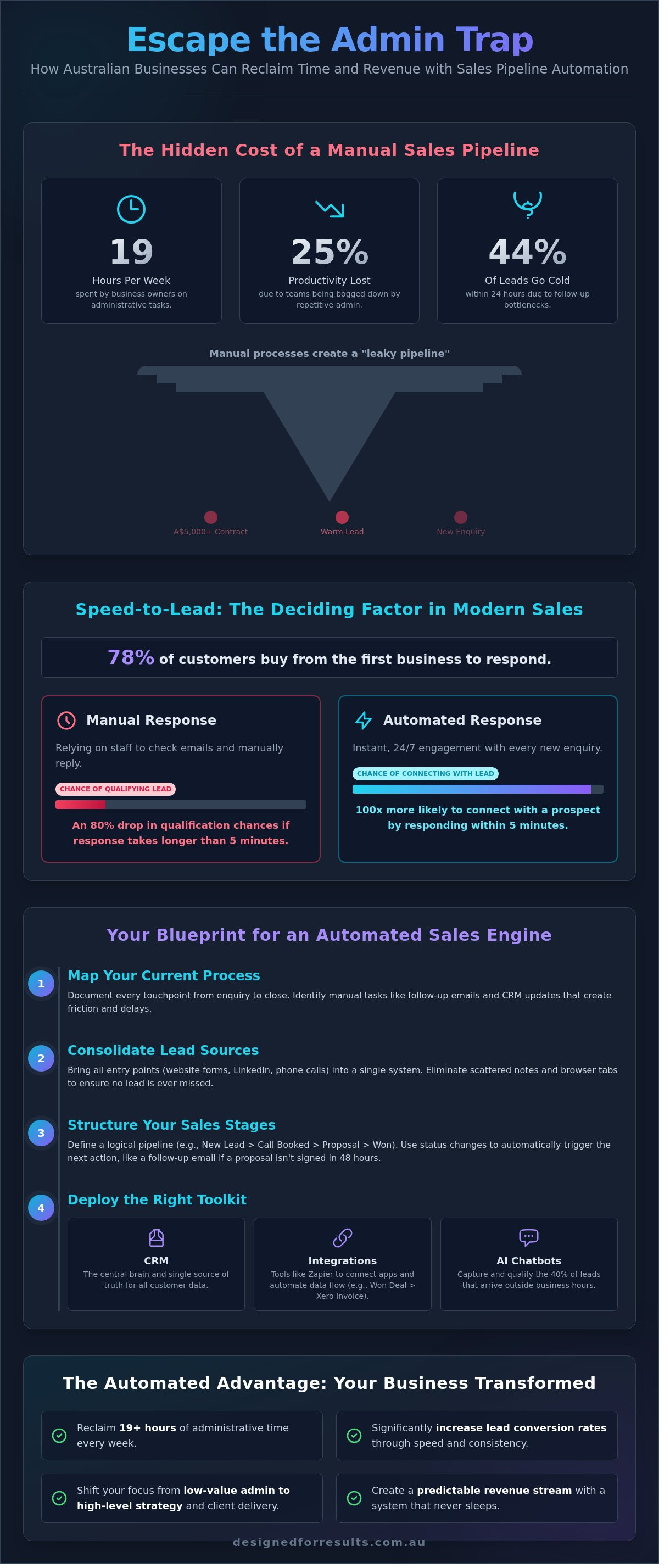
A 5-Step Guide to Implementing Sales Automation
Transitioning from manual oversight to a streamlined system requires a structured approach. When you automate sales pipeline activities, you remove the human error that leads to missed opportunities. Australian businesses often lose 25% of potential revenue simply through slow response times or forgotten follow-ups. Implementing these five steps ensures your sales process runs with precision, regardless of your current workload.
Automated Lead Capture and Qualification
Manual data entry wastes roughly 5.5 hours per week for the average sales professional. Replace static contact pages with integrated website forms that segment leads based on their specific needs and budget. Use automated scoring to prioritise high-value prospects so your team focuses on A$10,000 opportunities before A$500 ones. Delivering an immediate lead magnet, such as a whitepaper or pricing guide, builds authority and provides value before a human ever picks up the phone.
Scheduling and Follow-Up Sequences
Eliminate the "email tennis" of finding a meeting time. Use appointment booking tools with automated reminders and reschedule options to reduce no-show rates by up to 29% based on 2023 industry benchmarks. Build multi-channel nurture sequences using email and SMS to stay top-of-mind. Utilise database reactivation campaigns to engage leads that went cold six months ago. These systems ensure no prospect is left behind while you focus on high-level management tasks.
Document Generation and Client Onboarding
Administrative delays kill momentum at the closing stage. To effectively automate sales pipeline transitions, trigger contract generation directly from your CRM deal data. This allows you to send a professional proposal within seconds of a verbal agreement. Implement e-signatures to remove physical friction and automate follow-ups for outstanding quotes. Once the deal is signed, trigger an automated welcome sequence that collects necessary documents and sets expectations, ensuring a seamless transition from prospect to client.
Stop losing hours to repetitive admin and start scaling your output. Explore our bespoke automation solutions to reclaim your time and improve your bottom line.
Optimising Your Automated Pipeline for Long-Term Results
Implementation is only the first step. To effectively automate sales pipeline workflows, you must treat the system as a dynamic asset. Monitor performance through real-time dashboards. This ensures every lead moves through the funnel without friction. Australian businesses frequently see a 12% rise in conversion rates when they refine messaging based on actual customer replies. Adjusting your sequences based on data ensures your brand remains professional and responsive while you focus on high-level decision-making.
Measuring Performance and Outcomes
Track conversion rates, time-to-close, and revenue per lead to identify bottlenecks. If data shows leads stall at the quote stage, adjust your automated follow-up sequence immediately. When you automate sales pipeline stages, you gain the visibility needed to ensure your technology stays aligned with your revenue targets. Using real-time dashboards allows you to spot issues before they impact your cash flow. A service business can often reduce its sales cycle by 10 days through consistent data-driven adjustments.
- Conversion Rates: Monitor the percentage of leads moving from enquiry to a closed deal to identify weak points in your messaging.
- Time-to-Close: Track the duration from the initial touchpoint to the final invoice to ensure your automation is accelerating the process.
- Revenue per Lead: Measure the total value generated relative to your marketing spend to confirm your systems are yielding a high return.
Partnering for Continuous Improvement
System stability requires ongoing maintenance to prevent broken automations or API errors. Managed services provide the oversight needed to scale operations without increasing your administrative headcount. You can grow your volume by 40% while keeping your current team focused on high-value tasks. This shift allows you to reclaim your evenings and stop performing repetitive admin after hours.
Transitioning from a manual operator to a leader of an automated enterprise requires a clear path forward. You should chat with a specialist to develop a tailored roadmap for your specific needs. This approach removes the burden of manual follow-ups and ensures your business operates with precision. Consistent monitoring and expert support turn your pipeline into a reliable source of revenue that functions independently of your daily involvement.
Drive Measurable Revenue Outcomes
Mapping your workflow identifies the specific bottlenecks that drain your daily capacity. Following a structured 5-step implementation removes the burden of manual data entry and ensures every lead receives a response within 5 minutes. When you automate sales pipeline activities, you stop spending your evenings on administrative tasks and focus on high-value client work. Designed for Results specialises in Australian SME automation with a strict focus on measurable revenue outcomes. We provide 100% no-code solutions that your team can manage independently to handle all future system updates. Capture every opportunity and regain control over your schedule. Book your free automation strategy call today to discuss how to streamline your sales process. You've built a strong business; now it's time to give it the efficiency it needs to perform.
Frequently Asked Questions
How much does it cost to automate a sales pipeline for a small business?
A basic automation setup typically costs between A$50 and A$300 per month in software subscription fees. Professional implementation by an expert usually ranges from A$2,500 to A$7,500 depending on the complexity of your current workflows. These costs are often recovered within 90 days through the reduction of manual administrative hours and improved lead conversion rates.
Can I automate my sales pipeline without being a technical expert?
You can manage most modern systems using intuitive drag and drop interfaces that require no coding knowledge. Tools like Zapier connect over 6,000 different applications, allowing you to link your email, calendar, and CRM seamlessly. Most Australian business owners find they can handle daily adjustments after a single 2 hour training session on their chosen platform.
Will automation make my sales process feel impersonal to my customers?
Automation actually enhances personalisation by ensuring you never forget a client's name or their specific service requirements. You can use dynamic tags to insert custom details into emails, which leads to 72% of consumers only engaging with marketing messages tailored to their interests. It removes the risk of human error and frees your time for high value phone calls.
How long does it typically take to implement a fully automated sales system?
A standard implementation requires 4 to 8 weeks from the initial mapping phase to the final go-live date. You'll spend the first 14 days defining your sales stages and the remaining time building workflows and testing integrations. This structured timeline ensures your team has enough time to adapt to the new digital processes without disrupting your daily operations.
What is the best CRM for an Australian service-based business?
HubSpot and Pipedrive are the most effective options for the Australian market due to their local support teams and GST compliant billing. Pipedrive is excellent for simple, visual sales tracking and starts at approximately A$22 per user monthly. HubSpot provides a more robust, all-in-one platform that scales effectively as your business grows beyond 15 employees.
Can I integrate my sales automation with Xero or MYOB?
Direct integration with Xero or MYOB is standard practice and allows your system to generate invoices the moment a deal is marked as won. This connection saves the average business owner 5 hours of manual data entry every week. To automate sales pipeline workflows effectively, you must ensure your CRM supports two-way syncing to keep your financial records and lead status aligned.
Is AI necessary for sales pipeline automation or is basic automation enough?
Basic automation is sufficient for 80% of service-based businesses that simply need to move leads from an initial enquiry to a sent quote. AI is a powerful addition for larger operations that need to analyse lead sentiment or predict future revenue based on 24 months of historical data. Most businesses should master basic triggers and sequences before investing in advanced AI capabilities.
What happens if the automation fails or a lead gets stuck?
You should build "exception notifications" that alert a staff member via email or SMS if a lead remains in one stage for more than 48 hours. This manual safety net ensures that technical glitches or data entry errors don't result in lost revenue. Regularly auditing your automate sales pipeline settings every quarter will help you identify and fix bottlenecks before they impact your bottom line.
