
Lead Generation Chatbot: The 2026 Guide for Australian Businesses

Imagine it's 7:45 PM on a Tuesday in Brisbane. Instead of sitting down to dinner, you are manually responding to basic website enquiries and filtering out tyre-kickers who will likely never book. This reactive cycle is a significant design flaw that forces you to choose between your personal life and your bottom line. Integrating a lead generation chatbot into your digital presence corrects this by capturing and qualifying every prospect the moment they arrive.
You probably feel that being "too busy" is simply the price of success in the Australian service sector. We agree that your time is too valuable to be consumed by repetitive admin and evening quoting sessions. This guide shows you how to capture and qualify leads 24/7 so you can stop chasing paperwork and finally get your time back. We will explore how intentional automation allows you to increase revenue without hiring more staff, ensuring your business remains professional and responsive every hour of the day.
Key Takeaways
- Stop losing revenue to static contact forms by deploying a proactive digital assistant that captures interest the moment it happens.
- Identify whether your business requires sophisticated AI or simple, effective automation to streamline lead capture without unnecessary complexity.
- Implement a lead generation chatbot to act as a first-tier filter, automatically qualifying prospects and booking quotes to eliminate time spent on low-value admin.
- Map a seamless customer journey that moves prospects from their first click to a booked appointment by removing the manual bottlenecks currently stalling your progress.
- Transition from fragmented 'DIY' tools to a fully integrated system designed to reclaim your evenings and return your focus to high-level leadership.
Why Static Contact Forms Are Costing Your Business Money
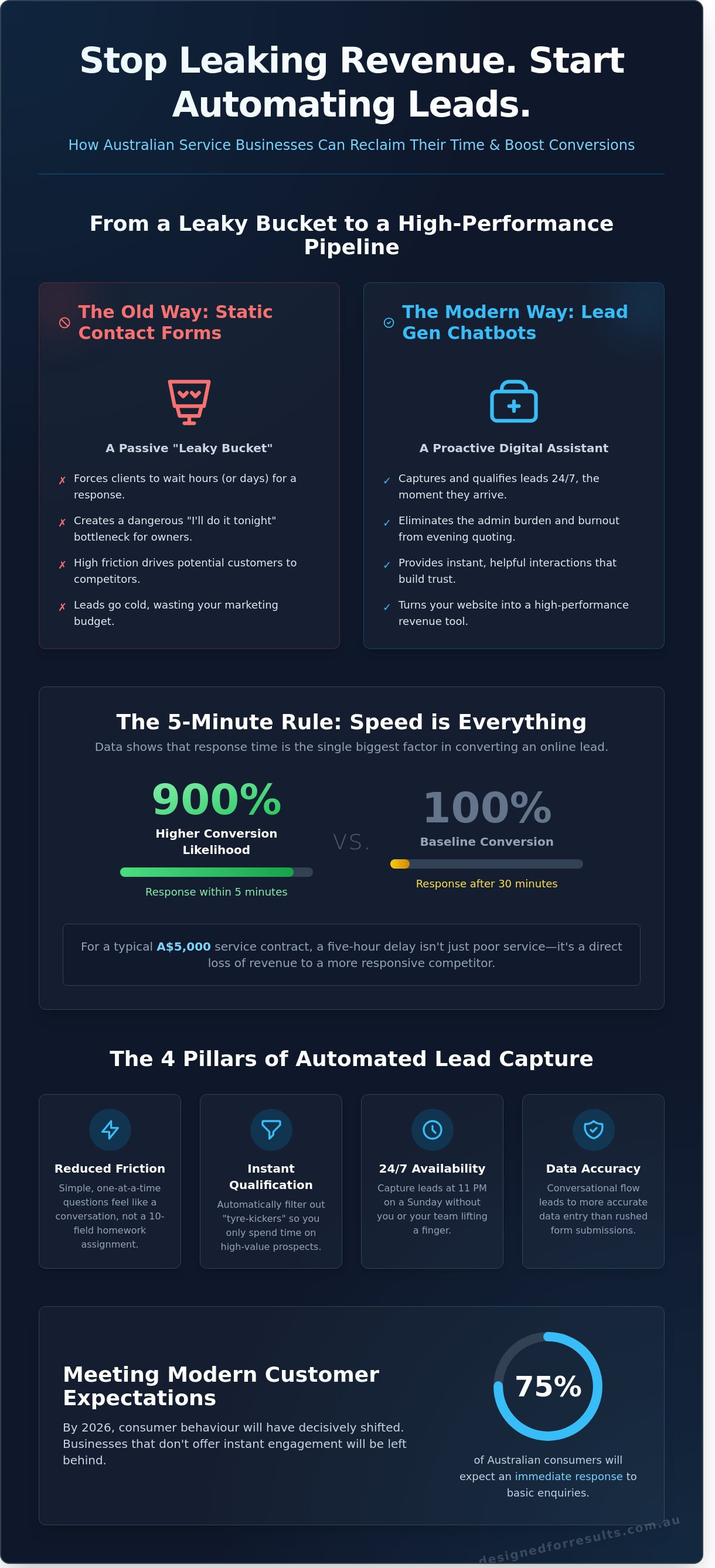
Static contact forms represent a structural failure in modern customer acquisition. They act as a passive "leaky bucket," forcing potential clients to wait hours or even days for a response that might never arrive. In contrast, a lead generation chatbot functions as a proactive, 24/7 digital assistant that captures intent at the exact moment a prospect is ready to buy. Most Australian businesses rely on "Contact Us" pages that require the user to do all the heavy lifting. This friction kills conversions. When a prospect fills out a form, they are essentially shouting into a void and hoping for an echo. This uncertainty drives them to continue their search, often landing on a competitor's site within seconds.
To understand the technology behind these tools, we can look at what is a chatbot and how it has evolved from basic scripts into sophisticated lead capture systems. Data from InsideSales indicates that businesses responding to a lead within five minutes are 900% more likely to convert that prospect than those who wait 30 minutes. In the Australian service sector, where competition is fierce, a five-hour delay is often the difference between winning a A$5,000 contract and losing it to a more responsive business. If your system relies on manual human intervention to start a conversation, you are leaving money on the table every single day.
The Hidden Cost of the 'I'll Do It Tonight' Mentality
Relying on manual follow-ups creates a dangerous bottleneck for Australian business owners. When you spend your day on a job site or in back-to-back meetings, leads inevitably go cold. Many owners attempt to compensate by performing admin and quoting between 7 PM and 10 PM. This habit leads to rapid burnout and poor decision-making. Being "too busy" to respond is not a badge of success; it is a symptom of a broken system. Every lead that sits in an inbox for eight hours represents lost revenue and a wasted marketing budget. Automation ensures that the initial qualification happens instantly, removing the burden of repetitive administrative tasks from your evening schedule. This allows you to focus on high-level execution rather than playing catch-up with basic enquiries.
How Modern Customers Prefer to Engage in 2026
Consumer behaviour has shifted decisively toward messaging-first communication. By 2026, 75% of Australian consumers will expect an immediate response to basic enquiries before they commit to a service. A long contact form feels like a homework assignment, driving potential customers straight to your competitors who offer a more streamlined experience. A lead generation chatbot builds trust by providing instant, helpful interactions that guide the user toward a solution. This approach respects the customer's time while allowing the business to filter high-value prospects without human intervention. Consider these benefits of conversational engagement:
- Reduced Friction: Customers answer simple questions one at a time rather than facing a daunting 10-field form.
- Instant Qualification: The system identifies "tyre kickers" immediately, saving you from wasting time on low-value quotes.
- 24/7 Availability: Leads are captured at 11 PM on a Sunday without you lifting a finger.
- Data Accuracy: Conversational interfaces often result in more accurate data entry than rushed form submissions.
Intentional system design transforms your website from a static brochure into a high-performance tool for revenue generation. By replacing passive forms with active engagement, you align your business with the expectations of the modern Australian market. Success in 2026 requires moving away from accidental growth and toward a model where every interaction is engineered for speed and clarity.
Understanding Lead Generation Chatbots: AI vs. Rule-Based Systems
Success in lead capture is never accidental. It's the result of intentional design. Australian businesses often lose 25 percent of potential revenue simply because they lack the capacity to respond to enquiries after 6:00 PM. A lead generation chatbot solves this by acting as a digital gatekeeper that operates 24/7. You don't always need a complex neural network to achieve this outcome. Often, a well-structured automated flow is the most efficient path to increasing your bottom line and reclaiming your evening hours.
Strategic alignment requires you to match the technology to your specific customer journey. If your primary pain point is a high volume of basic questions, simple automation provides the highest return on investment. If your service involves complex, high-trust consultations, a more nuanced approach is necessary. Every interaction must be engineered to move the prospect closer to a transaction without creating friction or unnecessary administrative overhead for your team.
Rule-Based Bots: The Decision Tree Approach
These systems operate on logic-based frameworks. They guide users through a pre-set path to collect vital data like names, phone numbers, and specific service requirements. If you run an electrical or landscaping business, a rule-based bot can handle booking requests or basic quoting by asking three or four qualifying questions. This predictable structure ensures you only spend time on leads that meet your criteria. While these bots lack a "human" feel, they excel at eliminating the repetitive admin tasks that distract you from core work. They're reliable, cost-effective, and easy to deploy. A basic rule-based setup might cost between A$500 and A$2,000, depending on the complexity of the integration with your existing CRM.
AI-Powered Agents: Conversational Intelligence
Sophisticated smart AI solutions use Natural Language Processing (NLP) to understand intent rather than just identifying keywords. These agents handle complex queries and nuance that a simple decision tree might miss. They build rapport by mimicking human conversation, which is critical for high-ticket service businesses where trust is the primary currency. Recent research on chatbot effectiveness indicates that AI-driven interactions can significantly improve user engagement by providing immediate, relevant answers that feel personal. This level of intelligence allows you to scale your leadership capability without hiring additional administrative staff. It transforms your website from a static brochure into an active sales representative that understands the subtle differences in prospect needs.
Choosing between these two systems depends entirely on your operational goals. If your goal is to filter out low-quality leads quickly, a rule-based bot is often superior because it enforces a strict qualification process. If you want to provide a premium, white-glove experience that handles objections in real-time, AI is the better investment. Both options focus on one outcome: getting your time back. By automating the initial touchpoint, you ensure no lead is ignored while you are on-site or at home with your family. This focus on intentionality separates high-performance businesses from those struggling with accidental growth. If you're ready to stop the evening admin grind, you can optimise your lead capture process today to ensure every enquiry is handled with professional precision.
Eliminating the Admin Burden: How Chatbots Qualify and Book Leads
Accidental growth often leads to a chaotic calendar. Many Australian business owners find themselves trapped in a cycle of "busy-ness," responding to low-value enquiries at 8 PM instead of focusing on high-level strategy. A lead generation chatbot changes this dynamic by functioning as a high-performance filter for your sales pipeline. It replaces the manual triage process with an automated system designed to identify high-intent prospects before they ever reach your inbox. This is about intentional design. You're building a system that values your time as much as your expertise.
Deploying this technology ensures that your leadership capability isn't wasted on tyre-kickers who have no intention of buying. Industry data from 2023 suggests that 47% of service-based leads are lost simply because the business took more than 24 hours to respond. By implementing a bot, you capture interest instantly. This isn't just about speed; it's about strategic alignment. The bot handles the repetitive administrative tasks that currently distract you from core operations, allowing Australian businesses to reclaim up to 15 hours of their working week. You stop being the bottleneck in your own sales process.
Automated Lead Qualification Frameworks
Design your bot to ask the specific questions you usually reserve for a discovery call. Effective frameworks focus on three critical pillars: budget, timeline, and project scope. For instance, if a prospect's budget is below A$2,500 and your premium service starts at A$6,000, the bot can provide a helpful resource or a lower-tier product link instead of booking a meeting. This protects your time from low-value enquiries. You set the deal-breaker criteria based on your specific business model. When a lead meets your high-performance standards, the bot pushes their data directly into your CRM, such as HubSpot or Pipedrive. This eliminates manual data entry and ensures that every record is accurate and actionable from the moment it's created.
Seamless Booking and Calendar Integration
The transition from conversation to commitment must be frictionless. A sophisticated lead generation chatbot integrates directly with tools like Calendly or local Australian CRM systems to book site visits or consultations in real time. This creates a "conversation to calendar" workflow that strikes while the lead is hot. There's a distinct professional relief in waking up to a Monday morning calendar pre-filled with three qualified appointments, all of which were secured while you were offline. This is the difference between accidental growth and engineered success. You aren't just chasing leads; you're managing a system that delivers measurable outcomes without your constant intervention. It ensures your customer journey is professional, prompt, and focused on conversion.
Stop performing admin during your evening hours. Use automation to ensure that by the time you speak to a prospect, they've already been vetted for financial fit and project readiness. This strategic shift moves you from being a reactive worker to a proactive leader. By removing the burden of initial vetting, you focus your energy exclusively on closing deals with leads that are ready to buy. This is how you get your time back while simultaneously increasing your revenue. It's about working on the business, not just in it, by using logical frameworks to drive growth.
A 5-Step Checklist for Implementing Your First Chatbot
Deploying a lead generation chatbot is not about adding a flashy widget to your website; it is about intentional engineering to reclaim your evenings. When you automate the initial touchpoint, you stop the leak of potential revenue that occurs when you are too busy to answer the phone. Use this five-step checklist to move from manual chaos to a streamlined, automated system.
- Isolate your primary bottleneck. Review your sales process from the last 90 days. For most Australian service businesses, the bottleneck is the 6:00 PM to 9:00 PM window. This is when enquiries peak, but owners are often busy with family or manual quoting. If you are losing leads because you cannot respond within five minutes, your bot must prioritise lead capture during these hours.
- Architect the customer journey. Document every step from the first Google search click to the final booked quote. Your chatbot should act as a digital concierge that guides the user through this path. If your current process requires a phone call for a basic price estimate, automate that data collection first.
- Choose your infrastructure. Decide whether your business needs a simple off-the-shelf platform or bespoke AI automation. While basic platforms handle standard FAQs, bespoke solutions are required if you need the bot to perform complex calculations or interface with custom inventory systems.
- Develop a brand-aligned script. Your bot should sound like a professional member of your Australian team, not a generic template from a Silicon Valley startup. Use the specific terminology your customers use. If you don't use the word "commence" in person, don't let your bot use it online.
- Commit to iterative testing. Monitor the first 50 interactions closely. Data from 2023 indicates that businesses that refine their bot's logic based on real user drop-off points see a 22% increase in conversion within the first month.
Mapping the Conversational Flow
Start your design process with a physical notepad and pen rather than jumping straight into a software dashboard. Visualising the logic on paper allows you to see the "dead ends" in a conversation before they frustrate a potential client. Your priority is the "hook"-the very first question the bot asks. Instead of a passive "How can I help?", use a high-value prompt like "Would you like a rapid quote for your renovation project?" This immediately establishes value. Every branch of the conversation must lead to a clear call to action, such as booking a site visit or downloading a pricing guide.
Integrating with Your Existing Tech Stack
Efficiency is lost when data remains siloed in a chat app. Your lead generation chatbot must "talk" directly to your CRM or email marketing software to be effective. When a high-value lead provides their details, an automated notification should reach your phone instantly. This removes the burden of manual data entry, which can save a business owner up to five hours of admin every week. Avoid "software bloat" by only integrating tools that serve a specific purpose. A lean tech stack is easier to maintain and ensures that your lead data flows accurately from the website to your quote sheet without human intervention.
Stop letting "busy-ness" limit your business growth. Contact Designed for Results to build a lead engine that works while you sleep.
Custom Automation: The Path to Getting Your Time Back
Many Australian business owners fall into the trap of treating automation as a weekend DIY project. They sign up for a platform, drag a few boxes around, and wonder why the leads aren't flowing. This approach fails because it prioritises the tool over the objective. Building a high-performing lead generation chatbot requires more than a software subscription; it demands a deep understanding of your customer’s psychology and your internal workflows. Professional implementation isn't a cost. It's an investment in your personal freedom and the scalability of your business.
A "bot" is just a script. A system is a cohesive process that bridges the gap between a stranger's curiosity and a confirmed booking. When you move beyond basic templates, you stop reacting to your business and start directing it. Most service-based businesses in Australia lose approximately 22% of potential revenue simply because they take longer than four hours to respond to an initial enquiry. Automation eliminates this latency entirely. It ensures that every prospect receives an immediate, high-value interaction, regardless of whether it's 2 PM on a Tuesday or 11 PM on a Sunday.
Why Design Matters More Than Software
The software you choose is secondary to the logic behind it. A poorly designed lead generation chatbot can actually damage your brand by creating friction for the user. Professional consultants identify the efficiency gaps you've likely grown accustomed to. They see the manual data entry that takes you thirty minutes every morning and the follow-up emails that you often forget to send. Our philosophy at Designed for Results is built on intentionality. Success is never an accident. It's the result of precisely designed interactions that guide a user toward a specific outcome without wasting their time or yours.
Taking the First Step Toward Automation
Start by auditing your calendar. Calculate how many hours you spend each week on repetitive tasks like qualifying leads, scheduling quotes, or sending follow-up messages. If you're like the average Australian business owner, this figure often exceeds 10 hours per week. Over a year, that's 520 hours stolen from your family, your hobbies, or your high-level business planning. If your time is valued at A$150 per hour, you're effectively spending A$78,000 annually on manual labour that a machine could do better.
The path to getting your time back begins with a decision to stop being the bottleneck in your own business. You don't need to be a technical expert to benefit from these tools. You simply need a partner who understands how to align technology with your specific measurable outcomes. Stop spending your evenings hunched over a laptop doing admin that doesn't move the needle. Reclaim your nights and ensure your business continues to grow while you're offline.
Ready to see how custom automation can transform your operations? Let's chat about your business automation and build a system that works as hard as you do.
Design Your Business for 24/7 Performance
Stop letting manual lead management dictate your evening schedule. Relying on static contact forms in 2026 is an expensive oversight that costs Australian businesses up to 50% of potential conversions due to delayed response times. By implementing a bespoke lead generation chatbot, you transition from reactive admin to proactive growth. These systems don't just capture data; they qualify prospects and book appointments directly into your calendar while you focus on high-value service delivery.
We specialise in Australian SME automation that delivers measurable outcomes and genuine time recovery. Success isn't accidental; it's the result of intentional systems designed for your specific business journey. You don't always need complex AI to see a return. Often, a well-constructed automation is all it takes to eliminate repetitive tasks and ensure no lead goes cold while you're on the tools or with your family.
Ready to get your time back? Book your free automation strategy call today.
Take the first step toward a more efficient operation and start seeing the results your hard work deserves.
Frequently Asked Questions
Will a lead generation chatbot make my business feel impersonal?
A lead generation chatbot actually enhances the personal connection by ensuring every prospect receives an immediate response. By designing your bot to reflect your brand's unique voice, you eliminate the 4-hour delay that typically kills conversion rates in the service sector. Australian businesses often lose 30% of potential revenue because they're too busy on-site to answer the phone. Automation bridges that gap, providing a professional first point of contact while you focus on high-value delivery.
How much time can I actually save by automating my lead capture?
You can save upwards of 12 hours per week by automating your lead capture and initial qualification process. Instead of spending your evenings manually entering contact details or chasing basic information, a lead generation chatbot handles the data entry instantly. Research shows that businesses using automated qualification reduce their administrative overhead by 40%. This allows you to stop working at 8:00 PM and reclaim your personal time while your business continues to capture opportunities.
Do I need to be 'tech-savvy' to manage a chatbot for my business?
You don't need technical expertise to manage a modern automation system. Most platforms use intuitive interfaces that focus on the customer journey rather than complex code. We focus on strategic alignment, ensuring the technology serves your business goals without creating a new administrative burden. Once your system is designed and deployed, it operates autonomously. You simply receive qualified leads in your inbox, ready for a final conversation or site visit.
What is the difference between a simple chatbot and an AI voice agent?
A simple chatbot operates through text-based logic, guiding users through a predefined flow of questions on your website. In contrast, an AI voice agent uses natural language processing to handle entire phone conversations, mimicking human speech patterns. While a chatbot is excellent for capturing data at 2:00 AM, a voice agent can manage inbound enquiries and outbound follow-ups. Both tools are essential for Australian businesses looking to scale without hiring additional administrative staff.
Can a chatbot handle complex quoting for service-based businesses?
Chatbots excel at handling complex quoting by following a logical decision tree based on your specific pricing variables. By asking five or six targeted questions, the system can generate a preliminary estimate for an Australian business in under 60 seconds. This removes the quoting bottleneck that often stalls growth. You maintain control by setting the parameters, ensuring the bot delivers accurate figures that reflect your high-performance culture and operational costs.
How do I know if my business is ready for AI automation?
Your business is ready for automation if you're currently missing more than 15% of inbound enquiries or spending over 5 hours a week on repetitive data entry. If your growth has plateaued because you're too busy to follow up, you have a design problem, not a capacity problem. Implementing these tools is a deliberate choice to move away from accidental growth toward a model where your time is spent on leadership and strategy.
What happens if the chatbot can't answer a customer's question?
When a chatbot encounters a query outside its programmed scope, it executes a seamless handoff to a human team member. The system captures the user's details and the context of the question, then alerts you via SMS or email. This ensures no prospect is ignored. By designing this fail-safe, you maintain professional standards while ensuring that 85% of standard enquiries are handled without your direct intervention.
Is it expensive to implement a custom lead generation system in Australia?
Implementing a custom lead capture system for an Australian business typically starts from A$1,500 for a basic setup. When you consider that a single missed lead in the service sector can be worth A$3,000 or more, the ROI is often achieved within the first 30 days. It's an investment in your leadership capability. You aren't just buying software; you're purchasing a system that generates measurable outcomes and buys back your time.
