
Why Use a CRM? The Strategic Engine for Intentional Business Growth in 2026

Accidental growth is the greatest threat to a sustainable Australian business. While a sudden influx of leads feels like success, it often exposes the structural cracks of manual processes, leaving you buried in spreadsheets at 8 PM while high-value opportunities slip through the cracks. When you question why use a crm, you're really asking how to stop the drain on your leadership capability, especially when missed follow-ups can cost a service-based business upwards of A$15,000 in lost annual revenue.
Mastering this technology is no longer about digital filing; it's about engineering a high-performance culture where every lead is captured and nurtured by design. This article demonstrates how to reclaim your personal time through strategic automation and transform your sales pipeline into a predictable revenue engine for 2026. We'll explore the logical frameworks required to transition from reactive chaos to a single source of truth that secures your bottom line and improves the customer journey.
Key Takeaways
- Shift from accidental growth to intentional engineering by replacing fragmented spreadsheets with a strategic engine designed for scale.
- Reclaim your evenings and eliminate administrative bottlenecks by automating lead follow-ups and repetitive manual workflows.
- Understand why use a crm to establish a single source of truth that ensures strategic alignment across your sales and service teams.
- Move beyond gut-feeling decisions by leveraging measurable data to drive accurate sales forecasting and improved revenue outcomes.
- Discover how professional implementation removes the technical burden, allowing your Australian business to deploy sophisticated systems with ease.
Beyond the Spreadsheet: Why Manual Systems Stifle Australian Business Growth
Success is not a variable of chance. It is a direct result of strategic alignment and operational precision. Most Australian business owners operate within a framework of accidental growth, relying on sheer grit and long hours to manage customer interactions. This approach creates an invisible ceiling. Relying on spreadsheets and memory to manage a customer lifecycle is not a strategy; it is a liability. A CRM acts as the strategic engine that transitions a business from reactive chaos to intentional engineering. It provides the leadership capability required to scale without sacrificing service quality or customer satisfaction.
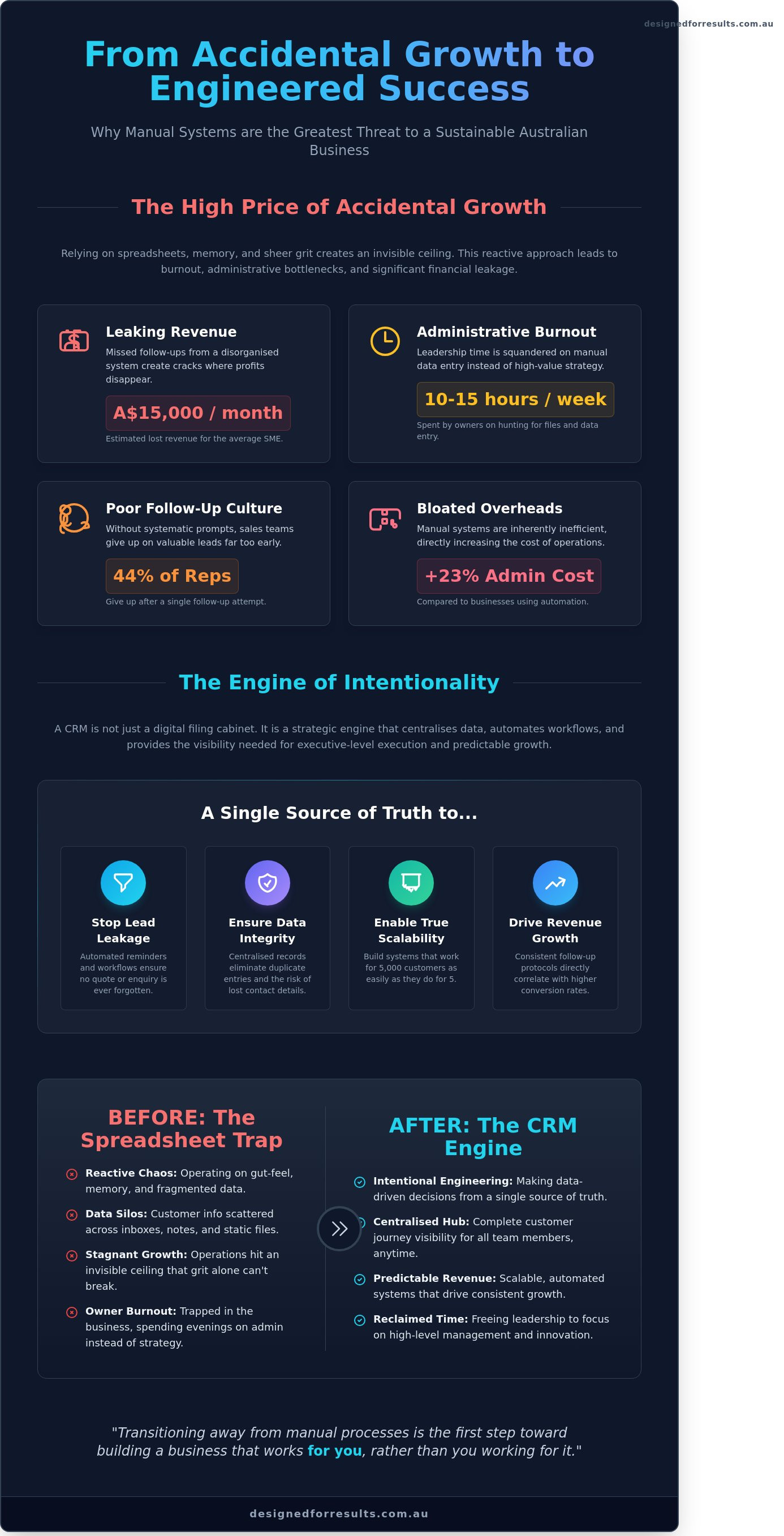
The primary barrier to high performance is often the hidden cost of lead leakage. When follow-up systems are manual, revenue disappears through the cracks of a disorganised inbox. Industry data indicates that 44% of sales representatives give up after a single follow-up attempt. In the Australian service sector, this lack of persistence results in an estimated A$15,000 in lost revenue per month for the average SME. Manual data entry is not just a tedious chore. It is a structural flaw that prevents executives from seeing the bottom line clearly. Every hour spent on a spreadsheet is an hour stolen from high-level management and strategic decision-making.
The High Price of Accidental Growth
Managing a business through sticky notes and mental lists leads to inevitable burnout. Many owners find themselves trapped in the cycle of evening paperwork, often starting administrative tasks at 8:30 PM after the day's operational work is done. This administrative burden is a symptom of a system that cannot scale. Spreadsheets are static documents in a dynamic market. A 2024 analysis of Australian service businesses showed that those relying on manual systems spend 23% more on administrative overhead than those using automation. When you consider why use a crm, the answer lies in reclaiming that time and reinvesting it into activities that drive measurable outcomes. Growth that is not designed is rarely sustainable; it is merely a precursor to operational collapse.
What a CRM Actually Is in 2026
Modern technology has moved beyond simple contact management. To understand What is CRM? in the current landscape, you must view it as a centralised hub for data and automation. It is a sophisticated tool for relationship engineering. It allows service-based SMEs to prioritise high-value leads and ensure every customer journey is consistent and professional. The decision regarding why use a crm becomes simple when you realise it is the only way to maintain a high-performance culture at scale. This technology is no longer the exclusive domain of global corporations. It is a necessity for any Australian business that values its time and its bottom line. By moving data from disparate silos into a single source of truth, you create the clarity needed for executive-level execution.
- Lead Leakage: Automated reminders ensure no quote or enquiry is forgotten.
- Data Integrity: Centralised records eliminate the risk of duplicate entries and lost contact details.
- Scalability: Systems that work for five customers will work for 5,000 without increasing your evening workload.
- Revenue Growth: Consistent follow-up protocols directly correlate with higher conversion rates and increased A$ per lead.
Intentional business design requires the right tools. Transitioning away from manual processes is the first step toward building a business that works for you, rather than you working for it. The shift from accidental growth to engineered success starts with the implementation of a system designed for results.
The Engine of Intentionality: How CRM Centralises Your Customer Journey
Stop relying on memory or fragmented spreadsheets to manage your growth. When your data is scattered across post-it notes, individual email inboxes, and disconnected calendars, your business operates on luck rather than logic. An Australian business owner often spends 10 to 15 hours every week on manual data entry or hunting for lost files; time that should be spent on high-level strategy. Centralising your customer journey through a CRM transforms your operation from a reactive scramble into an engineered engine of growth.
Establishing a single source of truth is the first step toward professional maturity. It ensures that every interaction, from the first website enquiry to the final invoice, is logged in one accessible location. This visibility eliminates the internal friction that kills productivity. You no longer need to ask "where is that file?" or "who spoke to this lead last?" because the system provides the answer instantly. Understanding why use a crm starts with acknowledging that manual systems eventually hit a ceiling; centralisation is the only way to break through it.
A Single View of the Customer
Centralising data prevents the embarrassing double-handling of leads that plagues many service-based businesses. There is nothing more damaging to your brand than two different staff members calling the same prospect with conflicting information. A CRM provides a chronological history of every touchpoint, allowing any team member to step in and provide expert service without missing a beat. This level of detail enables you to deliver personalised customer experiences at a national scale, ensuring your clients feel valued rather than processed. To take this further, integrating Designed For Results bespoke AI automation can trigger immediate, tailored follow-ups based on this central data, ensuring no lead ever goes cold while you're busy on-site.
Breaking Down Departmental Silos
Strategic alignment occurs when your sales, marketing, and service teams work from the same live data set. In many Australian businesses, marketing generates leads that sales never sees, or sales promises deliverables that the service team can't fulfill. A CRM bridges this gap by making project notes and invoices transparent across the organisation. This visibility fosters a high-performance culture where accountability is built into the workflow. When everyone sees the same pipeline, the focus shifts from individual tasks to measurable outcomes and ROI across the entire customer lifecycle. This transparency ensures that every department is pulling in the same direction, driven by data rather than assumptions.
Success is a product of design, not an accident of effort. If you find yourself stuck doing paperwork in the evenings because your team can't find the information they need during the day, your systems are failing you. Implementing a CRM isn't just about buying software; it's about reclaiming your time and ensuring every customer interaction is intentional. If you're ready to stop the administrative leak, consider optimising your business systems to build a foundation that supports sustainable, scalable growth.
Reclaiming Your Evenings: Automating Admin and Lead Follow-Up
Australian business owners often find themselves trapped in a cycle of evening paperwork, spending upwards of 15 hours a week on repetitive administrative tasks. This "shadow shift" erodes leadership capability and prevents strategic alignment with long-term goals. A CRM functions as the central nervous system of your organisation, triggering automated workflows that execute the heavy lifting of your daily operations. By shifting these tasks from human memory to digital logic, you transition from a state of accidental growth to one of intentional engineering.
A primary reason why use a crm is to establish a high-performance culture where no task falls through the cracks. Automation handles the mundane, allowing you to focus on high-level strategy and client relationships. Modern systems now incorporate AI-driven lead qualification to further refine this process. Instead of manually vetting every enquiry, the CRM uses specific data points to score prospects based on their intent and budget. This ensures your sales team prioritises opportunities with the highest measurable outcomes, rather than wasting time on low-value leads.
Automated workflows manage several critical functions that typically drain your time:
- Immediate lead distribution to the correct team member based on expertise.
- Automatic task creation for project milestones once a contract is signed.
- Personalised status updates sent to customers at specific trigger points.
- Seamless data synchronisation between your marketing and sales platforms.
Automated Lead Follow-Up Systems
Research indicates that 50% of sales go to the vendor who responds first. Despite this, many Australian businesses take over 24 hours to reply to a digital enquiry. Automated nurture sequences eliminate this lag entirely. These "set and forget" systems send immediate acknowledgements and scheduled follow-up emails that keep your brand top-of-mind. Integrating these sequences with smart AI solutions like intelligent chatbots ensures no quote request ever goes cold, even at 2:00 AM on a Sunday. This level of responsiveness is a hallmark of a business designed for results.
Financial and Xero Integration
Manual invoicing and payment tracking are significant bottlenecks for service-based Australian businesses. Linking your CRM directly to Xero transforms your financial workflow from a manual chore into a streamlined asset. When a deal reaches the "closed-won" stage, the CRM automatically generates the required invoice in Xero, pulling all relevant client data and project costs without human intervention. This eliminates double-handling and has been shown to reduce clerical errors by up to 40% in small to medium enterprises.
This specific integration is a compelling answer to why use a crm in the local market. It provides real-time visibility into your cash flow and gives the business owner their evenings back. You stop acting as a data entry clerk and resume your role as a strategic leader. By removing the friction of administrative overhead, you create the capacity for sustainable growth and improved customer journeys. Every minute saved on an invoice is a minute earned for business development or family time.
Turning Data into Strategy: Measurable Outcomes and ROI
Relying on a gut feeling to steer an Australian business is a high-risk strategy that often leads to stagnant growth. Strategic leaders understand that sustainable success is engineered through intentionality and precise data. Transitioning to a centralised system allows you to replace intuition with clinical insight. This shift is a primary reason why use a crm; it transforms raw information into a strategic asset that dictates where you should invest your time and capital.
Data-driven decision making enables accurate sales forecasting. When you can see the historical velocity of your deals, you can predict future revenue with 25% greater accuracy than traditional methods. This foresight allows you to manage cash flow effectively, ensuring you have the resources to hire staff or invest in equipment exactly when needed. You stop reacting to the market and start dictating your own pace of growth.
A well-implemented CRM identifies your highest-value accounts instantly. Instead of treating every lead with the same level of intensity, you can prioritise opportunities that promise the highest ROI. A 2023 report by Nucleus Research indicated that every A$1.00 invested in CRM technology returns an average of A$8.71. For a service-based business, this ROI manifests in reduced administrative overhead and a significant increase in lead conversion rates.
Visualising Your Sales Pipeline
Visual clarity is the antidote to operational chaos. A CRM dashboard provides a real-time view of exactly where money is sitting in your pipeline. If you have A$75,000 worth of quotes pending, you need to know which stage they are stuck in. Identifying these bottlenecks allows you to refine your sales process. You might discover that 40% of your leads stall after the initial quote. This measurable outcome highlights a specific need for automated follow-up sequences to bridge the gap between interest and commitment.
Customer Lifetime Value and Retention
Profitability is built on retention rather than constant acquisition. CRMs help you calculate Customer Lifetime Value (CLV) by tracking every transaction and interaction over years. You can identify the 20% of customers who generate 80% of your revenue. Engineering long-term loyalty becomes a systematic process rather than a happy accident. Automated reminders can trigger proactive retention calls every 90 days, ensuring your business stays top-of-mind. This proactive approach prevents the A$15,000-per-year client from quietly slipping away to a competitor due to a lack of engagement.
- Eliminate manual tracking: Save up to 12 hours of administrative labour per week by automating data entry.
- Strategic alignment: Ensure your sales and marketing teams are chasing the same high-value targets based on hard evidence.
- Scalable systems: Build a framework that allows your business to grow without increasing your personal workload.
Success is a product of design. By leveraging CRM data, you create a high-performance culture where every action is backed by evidence and every dollar spent is tracked for performance. You gain the freedom to step back from the daily grind because you have a system that monitors the health of your business for you. It is time to stop guessing and start executing with precision.
Ready to stop losing money to inefficient processes? Discover how to engineer your business for measurable growth today.
Designing Your Success: CRM Implementation Without the Technical Burden
Many Australian business owners hesitate to adopt new technology because they fear the "technical tax." They worry that a CRM will become another expensive tool that requires 40 hours of training and a dedicated IT department. This hesitation is understandable but costly. When you operate without a centralised system, you effectively pay a hidden tax in the form of lost leads and wasted evenings. In 2023, research showed that Australian service businesses lose an average of A$12,500 annually per employee due to administrative inefficiencies and poor lead tracking.
The primary reason why use a crm is to move from accidental growth to intentional engineering. You don't need to be a coder to achieve this. You need a system designed to mirror your specific workflow. Success isn't a product of luck; it's the result of a structured roadmap that replaces manual chaos with automated control. This foundation is also essential for the next wave of efficiency. Without a clean, structured CRM, you cannot deploy AI voice agents or advanced automation. These tools require a "source of truth" to function, and that source is your CRM.
Why DIY CRM Implementation Often Fails
The "software-only" trap is a common pitfall for the time-strapped manager. Buying a subscription to a popular platform is easy, but 63% of CRM implementations fail when businesses treat the platform as a simple software purchase rather than a strategic overhaul. Out-of-the-box settings rarely fit the nuances of an Australian service business. If your system doesn't account for your specific quoting process or follow-up cadence, your team will eventually revert to spreadsheets. Success requires strategic alignment between your business goals and your technical architecture.
The Managed Path to Automation
You shouldn't have to spend your weekends watching YouTube tutorials on database configuration. The most effective way to scale is to partner with experts who handle the technical heavy lifting. This allows you to focus on high-level management and leadership capability. Learning about Designed For Results reveals a methodology focused on measurable outcomes rather than hollow enthusiasm. We bridge the gap between complex software and your daily operations, ensuring your CRM serves your business rather than demanding your time.
We transform your workflow through a disciplined engineering process. We identify your repetitive tasks, such as sending quote reminders or booking confirmations, and build automated triggers that handle them instantly. This shift can save a small business owner up to 15 hours per week, effectively giving you two full workdays back. Understanding why use a crm becomes clear when you see your revenue increase because no lead was left to rot in an unread email folder. It is about creating a high-performance culture where every action is tracked and every opportunity is maximised.
Stop letting manual paperwork dictate your schedule. If you are ready to move away from the burden of repetitive admin and toward a business that runs with precision, it's time to act. Let’s chat about your automation roadmap and design a system that delivers the freedom and growth you originally started your business to achieve.
Engineer Your Intentional Growth Strategy
Accidental growth is a liability in the 2026 Australian market. Relying on manual spreadsheets and evening paperwork creates a glass ceiling that limits your revenue and exhausts your leadership capability. Transitioning to a centralised system isn't just about data storage; it's about engineering a high-performance culture where no lead is forgotten and every customer touchpoint is intentional. When you consider why use a crm, the answer lies in the 241% average ROI reported by businesses that successfully integrate automation into their sales pipelines.
Designed For Results specialises in high-value AI and CRM setups tailored for the Australian service sector. As specialists in Australian SME automation, we focus on measurable business outcomes, ensuring your technology stack serves your bottom line rather than adding to your technical burden. By automating repetitive admin and lead follow-ups, you reclaim your evenings and position your business for scalable, intentional success. Stop leaving your results to chance and start designing your future.
Book your free automation strategy call today
Frequently Asked Questions
How much does it cost to implement a CRM for a small Australian business?
Entry-level CRM subscriptions typically range from A$20 to A$75 per user each month. For a small Australian business with five employees, expect an initial setup and training investment between A$1,500 and A$5,000 to ensure the system is designed for your specific workflows. This intentional expenditure eliminates the hidden cost of lost leads, which frequently exceeds A$2,000 in monthly missed revenue for unorganised service providers.
Is a CRM only for large sales teams, or can a solo owner benefit?
Solo owners often gain the most leverage from a CRM by automating the administrative burdens that force them to work late into the night. You don't need a massive team to justify the technology; you need a system to ensure your growth is engineered rather than accidental. A CRM acts as a digital assistant, maintaining strategic alignment with your prospects while you focus on high-level service delivery.
How long does it typically take to see a return on investment from a CRM?
Most Australian businesses achieve a measurable return on investment within 4 to 6 months of a successful rollout. Data from 2023 shows that businesses implementing automated lead capture reduce their administrative overhead by 25% within the first 90 days. This efficiency creates immediate capacity, allowing you to increase your quote volume without hiring additional staff or sacrificing your personal time.
Will my team find it difficult to learn how to use a new CRM system?
Modern platforms are built with intuitive interfaces, but proficiency depends on a structured training framework. Your team will likely master the essential functions within 2 to 3 weeks if the implementation is handled with professional rigor. Resistance usually evaporates once staff realise the system removes two hours of repetitive data entry from their daily schedule, allowing them to focus on high-performance outcomes.
Can a CRM integrate with my existing Australian accounting software like Xero?
Leading CRM platforms offer native integrations with Xero to synchronise your financial data with customer records automatically. This connection reduces manual data entry errors by 40% in typical service-based workflows. By linking your sales pipeline directly to your accounting software, you ensure your business operates with total financial visibility and intentionality.
What is the difference between a CRM and a simple lead tracking spreadsheet?
A spreadsheet is a static graveyard for data, while a CRM is a dynamic engine for revenue. Spreadsheets cannot trigger reminders or automate communications, which explains why 70% of leads in manual systems eventually go cold. When considering why use a crm, the answer lies in its ability to transform a passive list into an active, automated process that captures every opportunity without manual intervention.
Do I need AI features in my CRM right away, or can I start with basic automation?
Start with basic automation to master your core business logic before exploring complex AI capabilities. Approximately 85% of the immediate time-savings for Australian businesses come from simple triggers like automated quote reminders and task assignments. You can introduce AI later to analyse customer sentiment once your foundational data is clean and your processes are performing at a high level.
How does a CRM help with following up on quotes and leads automatically?
A CRM uses logic-based triggers to send personalised follow-up messages the moment a prospect stalls in your pipeline. For example, the system can send a text or email 48 hours after a quote is issued if it hasn't been signed. This ensures you maintain a high-performance culture of responsiveness even when you're busy on-site, meeting the expectations of the 60% of Australian consumers who choose the first business to respond.
