
Workflow Automation Examples for Australian Service Businesses in 2026

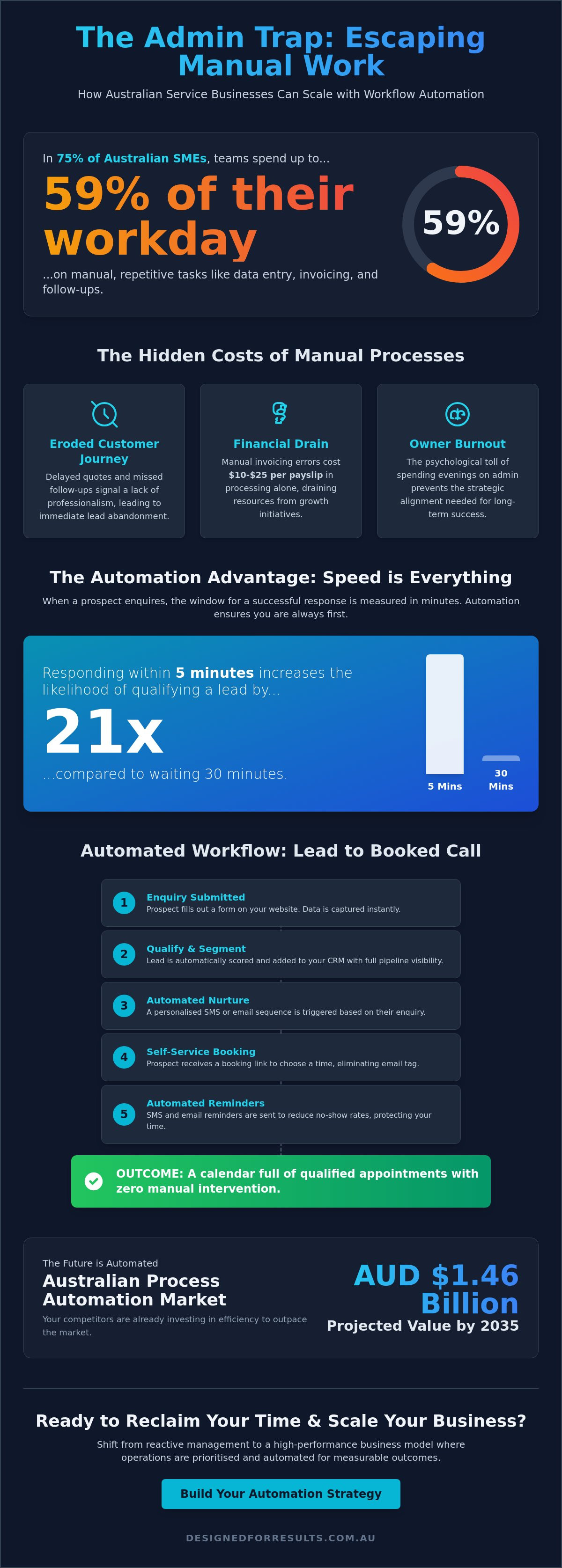
Did you know that manual, repetitive tasks consume up to 59% of the workday for teams in three-quarters of Australian small businesses? This inefficiency is often the silent barrier to scaling, as owners find themselves trapped in a cycle of evening invoicing and repetitive data entry. By reviewing these workflow automation examples for service businesses, you can shift from reactive management to a model where your operations are prioritised for high performance and measurable outcomes.
It's common to feel that your growth is limited by your own capacity to handle the admin. You deserve an Australian business that operates with precision, converting leads instantly and onboarding clients without your constant intervention. We'll show you how to implement systems that improve your speed to lead, maintain compliance with the December 2026 privacy regulations, and ensure your sales pipeline remains visible at all times.
This guide covers practical applications from automated contract generation to e-invoicing, providing a clear path to reclaiming your time and increasing your revenue.
The Reality of Manual Admin in Australian Service Businesses
Growth often creates a paradox. As service businesses scale, the volume of manual data entry, lead follow-ups, and document drafting increases proportionally; this effectively caps the owner's ability to focus on high-level management. This is the admin trap. Instead of profit margins expanding with revenue, they are squeezed by the cost of additional manual labour or the owner's own vanishing time. In 2026, relying on manual processes is no longer a neutral choice; it is a direct competitive disadvantage. The Australian process automation market is projected to reach AUD 1,457.89 million by 2035, indicating that your competitors are already investing in efficiency to outpace the market.
The year 2026 marks a shift in how Australian business operations are valued. With 75% of SME finance leaders reporting that manual, repetitive tasks consume between 20% and 59% of their team's time, the opportunity cost is staggering. By examining workflow automation examples for service businesses, leaders can identify where their specific bottlenecks reside. Shifting away from manual data entry allows for a high-performance culture where staff focus on client outcomes rather than moving data between spreadsheets and CRM systems.
The Hidden Costs of Repetitive Tasks
Repetitive tasks do more than just waste hours. They erode the consistency of the customer journey. A delayed quote or a missed follow-up signal a lack of professionalism that can lead to immediate lead abandonment. Beyond the financial loss, the psychological toll on owners who spend their evenings on contract drafting is significant. This exhaustion prevents the strategic alignment necessary for long-term success. Manual errors in invoicing or payroll, which can cost $10 to $25 per payslip in processing alone, further drain resources that should be allocated to growth.
Automation vs. AI: Choosing the Right Tool for the Task
Distinguishing between simple automation and artificial intelligence is critical for effective design. Logic-based automation handles predictable, "if-this-then-that" sequences. This usually involves a workflow application that moves data from a website form into a CRM or triggers an email after a booking. AI is reserved for complex decision-making, such as transcribing client calls or generating custom proposal content based on specific deal data. Most Australian businesses find that 80% of their bottlenecks are solved through robust workflow automation examples for service businesses without needing complex AI. The goal is to ensure technology serves the bottom line without adding unnecessary layers of complexity.
Lead Management Examples: Capturing and Qualifying Enquiries Automatically
Speed defines the winner in the Australian service sector. When a prospect submits an enquiry, the window for a successful response is measured in minutes. Manual entry into a CRM is a bottleneck that risks lead abandonment. These workflow automation examples for service businesses focus on capturing data instantly and initiating a response before the prospect moves to a competitor. Responding within five minutes increases the likelihood of qualifying a lead by 21 times compared to waiting half an hour.
Efficiency begins with a direct connection between your website forms and your CRM. This ensures every lead is accounted for with full pipeline visibility. You should align processes with business goals by ensuring your digital entry points are engineered for immediate action. Automated systems allow for the immediate segmentation of leads based on the data they provide, ensuring your marketing efforts stay relevant and targeted from the first touchpoint.
Lead Capture to Booked Call Workflow
Moving a lead from a form submission to a confirmed appointment requires zero manual intervention. Upon submission, an automated workflow triggers a personalised SMS or email nurture sequence based on the specific service requested. Integrating a booking system allows the prospect to select a time immediately, which eliminates the friction of manual scheduling and the endless email chains often required to find a suitable slot. SMS reminders are then sent automatically to reduce no-show rates, ensuring your calendar remains full of qualified appointments. This approach gives the owner their time back while maintaining a professional customer journey. If you are struggling with lead follow-up, discussing your pipeline visibility with a specialist can help identify where your current system is failing.
Lead Scoring and Intelligent Routing
Not every enquiry is a high-value lead. Automated qualification filters protect your team's time by assessing prospects based on budget, urgency, or service type before they ever reach your inbox. High-priority enquiries are automatically routed to the most qualified team member, while lower-priority leads receive automated nurture content or are directed to self-service resources. Implementing smart AI solutions like conversational chatbots can further refine this process by answering common questions and qualifying leads 24/7. This ensures your human resources are reserved for high-value strategic activity rather than basic screening and repetitive administrative tasks.
Operational Efficiency: Automating Client Onboarding and Project Workflows
Winning a new client should be a moment of celebration, yet for many Australian businesses, it signals a surge in administrative burden. The transition from "Closed Won" to project delivery is where service quality often falters due to manual delays. By implementing workflow automation examples for service businesses, you can eliminate the lag between a signed contract and the start of work. Automation handles the creation of internal project folders, the provisioning of communication channels, and the notification of team members instantly. This ensures your high-performance culture is maintained through structured execution rather than haphazard manual checklists.
Efficiency in onboarding is not just about speed; it's about accuracy. Manually drafting contracts or proposals from scratch invites errors that can damage your professional reputation. When deal data is pulled directly from your CRM into bespoke automation solutions, the risk of data entry mistakes disappears. This level of intentionality in your process design ensures that every project starts with a clear, error-free foundation, allowing your team to focus on delivery rather than correcting administrative oversights.
The Automated Onboarding Sequence
Initial engagement sets the tone for the entire client relationship. An automated onboarding sequence triggers a welcome pack and briefing questionnaire the moment a payment is confirmed. Using conditional logic, the system sends specific instructions tailored to the service purchased. This reduces the time-to-value for new clients, providing them with immediate clarity on the next steps without the owner needing to send a single manual email. It's a scalable way to ensure every client receives a consistent, high-quality experience.
Document Collection and Approval Workflows
Chasing missing documentation is a primary cause of project delays and frustration. Automated workflows manage this by sending scheduled reminders to clients for IDs, signed agreements, or project briefs. This system keeps the momentum of a project high while freeing your staff from the role of administrative debt collectors. Key benefits include:
- Automated Contract Generation: Use CRM data to populate legal documents, reducing drafting time from hours to seconds.
- Internal Approval Steps: Insert mandatory quality control checks before project milestones are released to the client.
- Centralised Data: Sync all collected documents directly to the client's record to ensure a single source of truth for the team.
This structured approach removes the need for "evening admin" and allows projects to move through your pipeline with measurable efficiency. By automating these repetitive administrative tasks, you reclaim the capacity to grow your Australian business without sacrificing your personal time.
Financial and Back-Office Automation: Reclaiming Your Evenings
Manual financial administration is a silent drain on leadership capability. Many Australian business owners find themselves reconciling accounts or chasing payments long after the workday has ended. With professional bookkeeping services costing between $50 and $120 per hour, the financial cost of manual entry is high. These workflow automation examples for service businesses focus on engineering a back office that operates with precision, ensuring that financial data flows seamlessly from your CRM to your accounting software without human intervention. This shift allows you to focus on high-performance culture rather than data entry.
The regulatory environment in 2026 also demands greater efficiency. By July 1, 2026, at least 30% of invoices received by Non-Corporate Commonwealth Entities must be processed via the Peppol e-invoicing network. Adopting automated financial workflows now ensures your Australian business remains compliant with these evolving standards. Moving away from manual invoicing reduces the risk of human error and ensures your GST reporting and BAS lodgements are based on accurate, real-time data.
Xero and CRM Integration for Seamless Invoicing
Connecting your CRM directly to Xero eliminates the need to duplicate data between your sales pipeline and your ledger. When a project milestone is marked as complete, the system triggers an invoice automatically. This process ensures that your "days sales outstanding" (DSO) remains low by removing the lag between work delivery and billing. Automated payment reminders further support your cash flow by prompting clients for payment on overdue accounts. You can reclaim your evenings by letting these systems handle the repetitive follow-up work that typically consumes your personal time.
Automated Feedback and Reputation Management
Growth is a product of consistent client satisfaction and visible social proof. Systematising your review requests ensures that you never miss an opportunity to build your online reputation. By triggering a Google Business Review request exactly 24 hours after service delivery, you capture client sentiment while the positive experience is fresh. This workflow can also include a private feedback loop, allowing you to address any concerns before they become public reviews. This structured approach to reputation management includes:
- Review Request Automation: Send SMS or email prompts automatically upon project completion.
- Negative Feedback Filtering: Route low-score feedback to an internal approval workflow for immediate resolution.
- Social Media Distribution: Automatically share five-star reviews to your social channels to showcase client success.
Managing these back-office tasks through automation ensures your business maintains its professional reputation without requiring your constant intervention. It transforms your financial and administrative processes into a reliable system that supports, rather than hinders, your strategic goals.
Designing Your Automation Strategy: Implementation and Next Steps
Executing a transition to automated operations requires a systematic approach. You should begin by conducting a comprehensive audit of your current manual bottlenecks to identify exactly where time is being lost to repetitive tasks. Prioritising these workflow automation examples for service businesses based on their potential for time-savings and ROI ensures that your initial efforts yield the most significant results. This logical progression allows you to reclaim your capacity for high-level management while your back-office functions with increased precision.
Ongoing monitoring is essential for maintaining the health of your systems. As your Australian business grows, your processes will inevitably evolve, requiring regular optimisation to remain effective. Professional bespoke AI automation ensures that your technology remains aligned with your operational goals. This proactive management prevents the system fragmentation that often occurs with uncoordinated DIY implementations. It's about ensuring your technology serves the bottom line without adding unnecessary layers of complexity.
Audit and Process Mapping
Success begins with mapping every manual touchpoint in your customer journey. You should document the logic required for each sequence before committing to a specific software solution. This documentation identifies the "low-hanging fruit", those simple, repetitive tasks that, once automated, provide the most immediate relief to your schedule. Focus on the areas where speed to lead or manual data entry currently slows your growth. This clarity ensures that every automated sequence is engineered to deliver a specific, measurable outcome.
Working with an Automation Partner
Implementing complex systems without professional oversight can lead to frustration and broken workflows. A specialised partner provides the strategic oversight necessary to ensure your automation handles the nuances of your specific service delivery. Managed service retainers offer the security of constant system health checks and updates, which is particularly vital as the December 2026 privacy regulations regarding automated decision-making approach. To identify the most effective roadmap for your organisation, let's chat about your current challenges and future goals. This step moves your business toward a model of structured, sustainable performance.
Take Control of Your Business Growth
Transitioning from manual admin to a streamlined operation is a critical shift toward long-term leadership capability. You now have the workflow automation examples for service businesses needed to transform lead capture, client onboarding, and financial reconciliation into reliable, hands-off processes. These systems ensure your Australian business remains competitive and compliant with 2026 regulations while protecting your personal time. Success is a product of intentionality; starting with a clear audit allows you to prioritise the highest-impact bottlenecks first.
As specialists in Australian SME automation, Designed For Results provides bespoke solutions tailored to your specific service model. We focus on delivering measurable time-savings and revenue growth so you can move away from evening admin and back toward strategic leadership. Book your free automation strategy call with Designed For Results to begin your roadmap toward a more efficient future. You're now ready to build a business that runs with precision and supports your life, rather than consuming it.
Frequently Asked Questions
What are the best workflow automation examples for small service businesses?
High-impact examples include instant lead follow-up, automated client onboarding, and auto-generating contracts from CRM data. These workflow automation examples for service businesses ensure that enquiries are engaged within seconds; this prevents lead loss due to slow response times. By automating document collection, you remove the need for manual chasing and keep projects moving without constant intervention.
How much time can I actually save by automating my admin?
You can reclaim between 20% and 59% of your team's time by automating repetitive manual tasks. A March 2026 survey found that three-quarters of SME finance leaders estimated this as the range for time lost to manual work. For an Australian business owner, this translates to several hours back each week, effectively ending the need for evening admin and repetitive data entry.
Do I need to be a tech-savvy business owner to use automation?
You don't need deep technical knowledge to benefit from automation if you work with a specialist partner. Success depends on understanding your business logic and customer journey rather than writing code. Professional implementation ensures your systems are engineered for high performance while you focus on strategic leadership and growth rather than troubleshooting software.
Can workflow automation integrate with my existing Xero account?
Yes, automation integrates directly with Xero to streamline your financial back-office. This allows CRM data to trigger invoices and sync payment statuses automatically. With the July 2026 e-invoicing mandates for government agencies approaching, integrating your accounting software is a critical step for maintaining compliance and improving cash flow through automated payment reminders.
What is the difference between simple automation and AI-driven workflows?
Simple automation follows fixed logic, such as sending an email when a form is submitted. AI-driven workflows use machine learning to handle unstructured data, such as transcribing client calls or qualifying leads through conversational chatbots. Most businesses find that standard workflow automation examples for service businesses solve their primary administrative bottlenecks without requiring complex AI solutions.
How do I ensure my automated emails still sound like they came from me?
Personalisation is achieved by using dynamic fields that pull specific data from your CRM into your templates. You can customise the tone and language to match your brand voice, ensuring every automated message feels authentic and relevant. This maintains a consistent customer journey without the need for you to manually draft every single interaction with a prospect or client.
Is it better to use off-the-shelf software or a bespoke automation solution?
Bespoke solutions are generally superior for businesses with unique service models that off-the-shelf software cannot fully accommodate. While generic tools offer a starting point, they often lack the depth needed for complex internal approval workflows or specific document collection needs. Custom automation ensures your technology scales alongside your business growth and delivers a measurable return on investment.
What happens if an automated workflow breaks or fails?
Robust systems are designed with error handling and notification triggers to alert you if a step fails. Working with a partner who provides managed service retainers ensures that any technical issues are identified and resolved before they impact your operations. This proactive monitoring maintains system health and prevents the frustration of broken workflows that can occur with unmanaged DIY setups.
