
24/7 Automated Phone Answering Service: The 2026 Guide for Australian Businesses

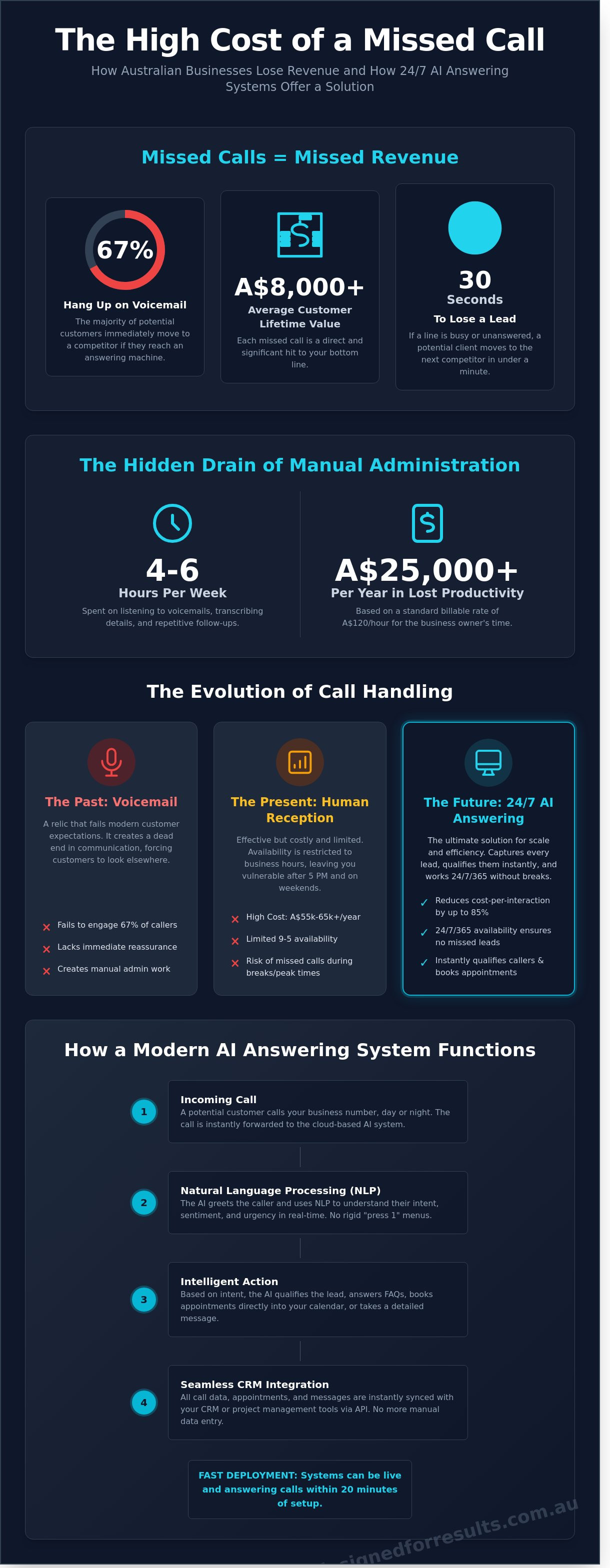
Recent industry data indicates that 67% of customers hang up immediately if they reach a voicemail, moving straight to the next Australian business in their search results. You likely recognise the frustration of losing potential revenue simply because you were on-site, in a meeting, or finished for the day. Managing a constant stream of enquiries often leads to a restrictive cycle where you spend your evenings trapped in repetitive administration rather than resting or planning your next move. Relying on a 24/7 automated phone answering service ensures your business remains responsive at every hour without requiring your personal intervention or additional headcount. You'll discover how to capture every lead and eliminate manual follow-ups through intelligent systems that qualify callers and book appointments automatically. This guide provides a clear path to improving your customer journey and removing yourself as the primary bottleneck in your company's operations. By the end of this article, you'll understand how to reclaim your time while maintaining a professional presence that prioritises immediate results.
The Impact of Missed Calls on Australian Business Revenue
A 24/7 automated phone answering service provides a robust system to manage inbound enquiries without human intervention. It acts as a digital receptionist that operates every hour of the year, ensuring every caller is greeted and processed professionally. In the 2026 Australian market, business success depends on immediate engagement. If a potential client calls a trade or professional service and hits a busy signal, they move to the next competitor within 30 seconds.
Research indicates the average lifetime value of a service-based customer in Australia often exceeds A$8,000. Missing a single lead isn't a minor inconvenience; it's a direct hit to the bottom line. Manual call handling creates a hard ceiling for business growth. You can only answer the phone while you're awake and available. This limitation forces many Australian business owners to trade their evenings for administrative catch-up, which eventually leads to burnout and stagnation.
Integrating automated attendant systems into your operations ensures every caller receives a response. This technology moves beyond simple recording and starts the qualification process immediately. Businesses looking to scale can explore bespoke ai automation to handle these workflows, allowing the owner to focus on high-value delivery rather than phone management.
The Hidden Costs of Manual Administration
Manual administration drains more than just time. Australian business owners often spend 4 to 6 hours per week listening to voicemails and transcribing details into their systems. At a standard billable rate of A$120 per hour, this administrative burden costs over A$25,000 annually in lost productivity. Managing enquiries while delivering services also increases the mental load. This divided attention leads to human error, such as misplacing contact numbers or failing to qualify leads properly, which further erodes profit margins.
Why Traditional Voicemail Fails Modern Customers
Traditional voicemail is a relic that no longer serves the 2026 consumer. Data shows that 67% of callers hang up without leaving a message when they reach a standard answering machine. Modern customers prefer interactive systems that offer immediate reassurance. A 24/7 automated phone answering service provide this by acknowledging the enquiry and outlining the next steps. This immediate interaction prevents the "search-and-call" cycle where a customer continues calling competitors until someone answers. It establishes professional authority from the first second of the call.
How 24/7 Automated Phone Answering Systems Function in 2026
Modern telecommunications have moved beyond the physical office. A 24/7 automated phone answering service now operates entirely within cloud-based environments, removing the need for expensive on-site hardware or complex wiring. These systems act as an intelligent layer between your Australian phone carrier and your business operations. They process incoming audio in real-time using Natural Language Processing (NLP) to interpret meaning, sentiment, and urgency. This allows for a level of interaction that mimics a human receptionist while maintaining the efficiency of a digital platform.
AI Voice Agents vs. Legacy Auto-Attendants
Legacy systems relied on rigid, menu-driven structures that required callers to navigate via keypad inputs. In 2026, AI voice agents focus on intent recognition. They understand the specific objective behind a customer's statement. If a caller asks to reschedule a plumbing quote for next Thursday, the agent identifies the intent and accesses the business calendar to find an open slot. This level of sophistication ensures that every call receives a professional response, regardless of volume. Service quality remains high during midnight enquiries or midday rushes, preventing the lead loss that occurs when calls go to voicemail. The system provides a consistent experience that builds trust with every interaction.
Integration with Existing Business Technology
Connection to the Australian telecommunications grid is seamless. Most systems integrate with local mobile and landline networks via simple call forwarding or SIP trunking. Deployment is straightforward. It doesn't require deep technical expertise or a dedicated IT department. You can often have a system live and answering calls within 20 minutes of setup.
Data flows through APIs to ensure your software ecosystem stays updated. When an agent takes a message or books an appointment, the information syncs immediately with your CRM or project management tool. This eliminates the need for manual data entry during your evenings. Understanding how digital tools can help your business is essential for any owner looking to reclaim their time. By implementing smart AI solutions, you replace unstructured administrative tasks with a disciplined, reliable communication channel. This approach ensures every lead is captured and every customer feels heard without increasing your personal workload.
Evaluating Automated Answering Against Human Reception Services
Choosing between a human receptionist and a 24/7 automated phone answering service requires a cold look at the numbers. An in-house receptionist in Australia typically earns between A$55,000 and A$65,000 annually, excluding superannuation, workers' compensation, and office overheads. Outsourced live-answering services often charge A$2.50 to A$4.50 per call, with additional surcharges for public holidays and after-hours support. Automation shifts this variable expense into a predictable, low-cost operational line item. It reduces the cost-per-interaction by up to 85% while removing the risk of missed calls during peak periods.
Availability is a significant differentiator for Australian business owners who struggle to switch off. A human team requires shift rotations to cover nights and weekends, which often leads to communication gaps during handovers. Automated systems provide 365-day coverage without penalty rates or overtime costs. When you launch a high-traffic marketing campaign, call volumes can spike by 400% instantly. A 24/7 automated phone answering service scales to handle hundreds of concurrent calls. This ensures every lead is captured even when your staff are at capacity or offline.
Accuracy remains the backbone of a professional customer journey. Human error in data entry, such as misspelt email addresses or incorrect phone numbers, affects approximately 3% of manual logs. Automated systems capture data directly and synchronise it with your CRM via API. This eliminates the need for manual transcription and ensures your follow-up process starts with clean, reliable data. It gives you back the hours spent deciphering handwritten notes or correcting database errors in the evening.
Operational Efficiency and Reliability
Automated systems don't experience fatigue or take sick leave. Reliability is constant regardless of the time of day or the volume of traffic. While a human receptionist can only manage one complex conversation at a time, automation handles multiple simultaneous enquiries with zero wait times. This efficiency prevents "caller bounce," where a potential client hangs up and calls a competitor because they were put on hold. Security is also improved through automation. Data handling is encrypted and processed through secure servers, reducing the privacy risks associated with physical call logs or verbal message passing.
Maintaining Quality in Customer Interactions
Quality is a product of intentional configuration. You can customise the voice, pace, and tone of your automated system to reflect your specific brand identity. This ensures a professional first impression that remains consistent for every caller. For complex or high-stakes enquiries, the system follows a logic-based path to escalate the call to a human team member immediately. This hybrid approach ensures urgent matters receive personal attention while routine tasks are handled by technology. For businesses with intricate workflows, bespoke AI automation provides the flexibility to manage nuanced customer journeys that basic systems cannot support. This level of customisation ensures the technology serves your business goals without compromising the user experience.
Implementing an Automated System to Reclaim Your Time
Establishing a 24/7 automated phone answering service requires a systematic approach to ensure it delivers measurable outcomes for an Australian business. Start by auditing your call logs to identify the 70% of enquiries that are repetitive or administrative. Tasks such as checking order statuses, confirming opening hours, or requesting basic quotes are the primary candidates for automation. Identifying these patterns allows you to offload the mental burden of routine interactions immediately.
Map the caller journey with precision. A logical flow should guide the caller from the initial greeting to a specific resolution, such as a booked appointment or a lodged service request. Every step must serve a purpose. Select a platform that integrates directly with your existing CRM to eliminate the need for manual data entry. This connection ensures that every interaction is logged without human intervention. Test the system using five common customer scenarios to verify accuracy before going live. Review performance data every Friday. This weekly analysis enables you to refine the interaction flow based on actual caller behaviour rather than assumptions.
Connecting Calls to CRM and Lead Follow-Up
Reliable lead follow up systems are the backbone of a high-performance sales process. When your 24/7 automated phone answering service handles a call, it should do more than just take a message. The system generates a text transcript and instantly syncs it with your central database. This trigger allows for an automated SMS or email response to be sent to the caller within 60 seconds. According to industry data, 78% of customers buy from the business that responds first. Maintaining a central database for all phone enquiries ensures no lead is lost in a cluttered inbox or a forgotten voicemail, providing a clear audit trail for every prospect.
Optimising the Customer Journey
Clear and concise scripts are essential for maintaining professional standards. Avoid lengthy introductions and get straight to the options that solve the caller's problem. Use the data gathered from the first 30 days of operation to identify where callers experience friction or hang up. If 40% of callers drop off at a specific prompt, shorten the script or clarify the instruction. The goal is a seamless transition from a phone enquiry to a confirmed booking in your calendar. This level of intentionality transforms your phone line from a source of interruption into a tool for consistent revenue generation. It's about ensuring your business remains accessible without requiring your constant presence.
Building a Results-Oriented Automation Strategy
Implementing a 24/7 automated phone answering service is a decisive move toward operational excellence. It replaces the manual burden of call handling with a reliable system for lead capture and enquiry management. Australian business owners frequently report losing up to 15 hours a week to basic administrative tasks. Automation recaptures this time immediately. It allows leadership to focus on high-value tasks like business development, service delivery, and team management. This transition is a foundational step for any business looking to scale without the overhead of additional headcount. Regular system monitoring ensures these automated workflows remain aligned with shifting customer expectations and operational requirements.
A 24/7 automated phone answering service functions as a consistent filter for incoming communication. It ensures every caller receives an immediate response, regardless of the time or day. This capability is vital in the Australian market where 60% of customers now expect instant engagement. When you automate these initial touchpoints, you eliminate the friction that often leads to lost leads. This shift creates the capacity for growth that manual processes cannot support. It moves the business away from reactive management and toward a model of high performance and measurable output.
Measuring Success Through Data
Data provides the clarity needed to evaluate system performance and return on investment. Focus on key performance indicators such as call resolution rates and speed-to-lead. Industry data from 2024 indicates that businesses responding to leads within five minutes are significantly more likely to convert the prospect. Automation makes this speed a standard part of your operations. Integrated sales dashboards offer real-time visibility into these interactions, allowing you to track how many enquiries the system handles without human intervention. This data-driven approach directly improves profitability by increasing conversion rates and reducing the cost per acquisition.
Partnering for Implementation
Effective automation requires technical precision to avoid friction in the customer journey. Professional guidance ensures that every automated workflow serves a specific business objective and integrates with existing software. Designed For Results supports Australian businesses in building these robust systems. We focus on creating environments where technology supports your specific goals. If your current administrative load prevents you from focusing on growth, let’s chat to identify where automation can deliver the most immediate impact. Partnering with experts ensures your communication infrastructure is reliable and ready to support long-term expansion.
Capture Every Opportunity and Scale Your Operations
Missed calls represent more than just a lost conversation; they're a direct drain on your bottom line. Industry research shows that 62% of calls to small businesses go unanswered, which often leads to potential customers moving immediately to a competitor. Implementing a 24/7 automated phone answering service ensures every inquiry is captured, qualified, and synced directly with your CRM. This transition removes the burden of manual lead follow-up and allows you to focus on high-value billable work rather than repetitive administrative tasks.
We specialise in Australian SME automation with a focus on measurable revenue outcomes. Our expertise in lead management ensures your system does more than just take messages; it builds a bridge between the initial contact and a signed quote. By prioritising a structured response system, you'll eliminate the inefficiency of evening admin and create a more professional customer journey. It's time to stop losing revenue to the sound of a ringing phone and start building a more efficient operation.
Book an automation strategy call to reclaim your time
Your path to a more scalable business starts with capturing every opportunity that comes your way.
Frequently Asked Questions
Is an automated phone answering service better than a human receptionist?
Automated services provide 100% coverage and immediate response times at a fraction of the cost of a full-time employee. A human receptionist in Australia typically earns a median salary of A$62,000 per year according to 2024 Talent.com data. An automated system eliminates human error, never takes sick leave, and manages multiple concurrent calls to ensure no lead is ever missed during peak periods.
How much does a 24/7 automated answering service cost in Australia?
Costs vary based on call volume and features, but professional entry-level systems often start between A$50 and A$150 per month. This price point is significantly lower than the A$35 to A$45 hourly rate for a casual Australian receptionist. Most providers offer tiered subscription models based on the number of minutes used or the complexity of the automation workflows required for your business operations.
Will my customers be frustrated by an automated system?
Modern systems reduce frustration by providing immediate solutions instead of forcing callers to wait on hold or leave a voicemail. A 2023 survey by Salesforce found that 74% of customers prefer using automated tools for simple enquiries if it results in a faster resolution. High-quality systems use natural language processing to ensure the interaction feels professional and efficient rather than repetitive or robotic.
Can an automated system book appointments directly into my calendar?
Yes, the system integrates with common scheduling software like Calendly, Acuity, or Google Calendar to manage bookings in real time. When a customer calls your 24/7 automated phone answering service, the system checks your live availability and secures the slot immediately. This removes the need for back-and-forth emails and ensures your diary is filled while you focus on billable work or on-site tasks.
Does the system work with my existing Australian phone number?
You can keep your current Australian landline or mobile number by using simple call forwarding. Most providers allow you to divert calls to the automated system after a certain number of rings or when the line is busy. This ensures a seamless transition for your existing clients who already have your contact details saved; it maintains brand consistency without requiring a complex number porting process.
What happens if the AI cannot answer a customer’s specific question?
The system follows a pre-defined escalation path to ensure the customer is never left without a solution. If the AI encounters a query outside its programmed knowledge base, it can automatically transfer the call to a designated staff member or record a detailed transcript for your review. This ensures complex technical enquiries receive the human attention they require while the system handles the 80% of routine traffic.
Is it difficult to set up an automated answering service for a small business?
Setup typically takes less than 48 hours and requires no technical coding knowledge. Most Australian service providers offer templates specifically designed for service-based businesses, such as plumbers, lawyers, or healthcare clinics. You simply provide your business details, operating hours, and common FAQs to create a customised response logic that aligns with your specific customer journey and operational requirements.
How does the system handle calls after business hours or on public holidays?
A 24/7 automated phone answering service operates with total consistency every day of the year, including Christmas and New Year's Day. The system applies specific rules for public holidays, such as informing callers of emergency contact procedures or scheduling follow-up calls for the next business day. This level of availability ensures you capture leads when competitors are closed, which directly increases your potential annual revenue.
