
Fixing a Leaky Sales Funnel with Automation: The 2026 Guide for Australian Businesses

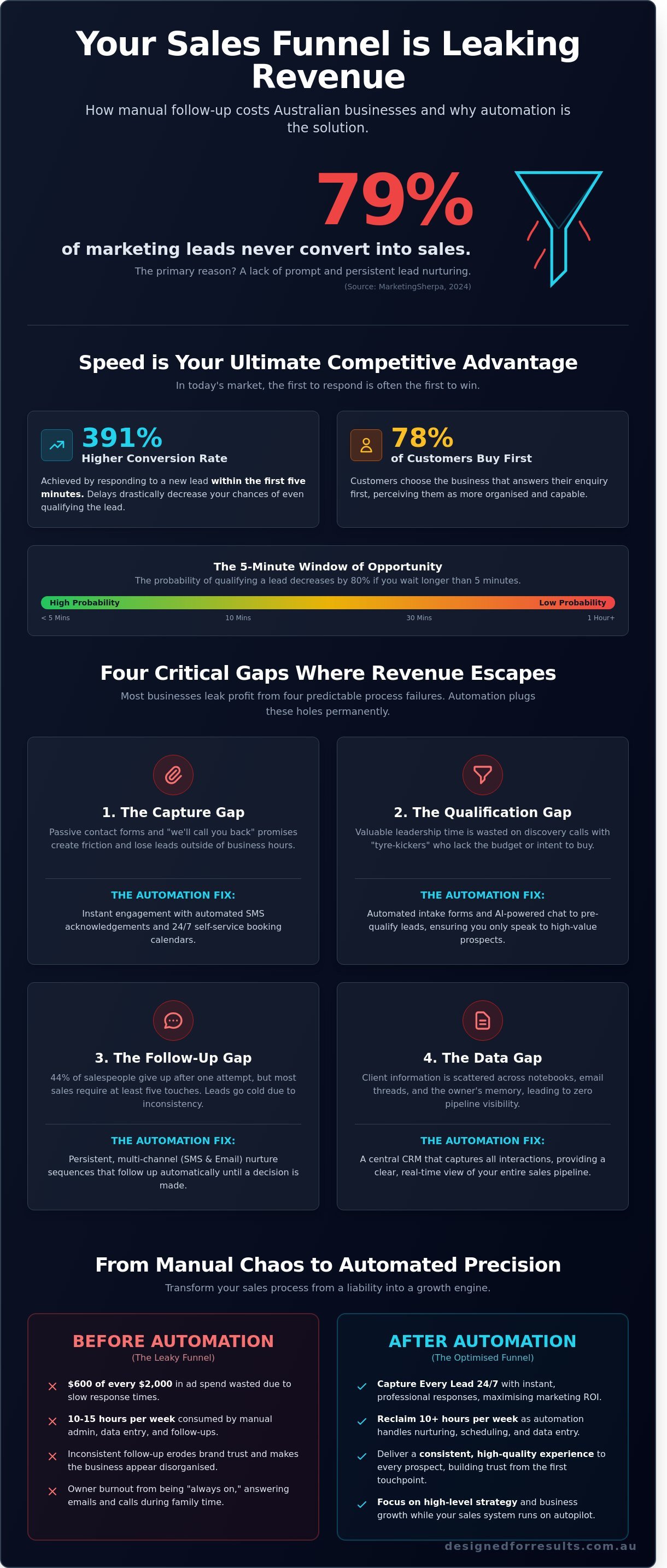
A 2024 industry report by MarketingSherpa found that 79% of marketing leads never convert into sales, primarily due to a lack of lead nurturing. For the average Australian business, this represents a significant volume of lost revenue that evaporates because a manual follow-up didn't happen fast enough. You likely recognise the frustration of spending your 8:00 PM evenings drafting quotes or chasing enquiries because you know that speed is the only way to beat a competitor to the punch. Fixing a leaky sales funnel with automation allows you to bridge this gap, ensuring that every prospect receives a professional response in seconds rather than days.
You deserve a sales process that operates with precision even when you aren't at your desk. By implementing these automated systems, you'll reclaim at least 10 hours of admin time each week and ensure your customer experience remains consistent. This guide outlines the specific steps to identify where your revenue is escaping and details the 2026 tools required to capture every lead while you focus on high-level business tasks.
Identifying the Signs of a Leaky Sales Funnel
A sales funnel represents the structured journey a lead takes from initial awareness to a final transaction. A leaky funnel occurs when potential clients exit this journey prematurely due to friction, delays, or neglect. Fixing a leaky sales funnel with automation addresses these gaps, ensuring that marketing spend translates into measurable revenue rather than wasted overhead. Many Australian business owners confuse a lack of leads with a failure in process conversion. If your marketing generates 50 enquiries monthly but only five result in a discovery call, the issue lies in the plumbing of your sales process, not the volume of the traffic.
Wasted marketing spend creates a direct hit to the bottom line. When an Australian business invests $2,000 per month in digital advertising but fails to respond to 30% of those leads within the first hour, they effectively discard $600 of their budget. This inefficiency forces owners into an "always on" cycle. They find themselves glued to their phones during family dinners or clearing inboxes at 10:00 PM to prevent leads from cooling. This reactive state prevents high-level business development and leads to burnout. Success requires moving away from manual oversight toward a system that captures every opportunity automatically.
Common Symptoms in Australian Service Businesses
Service-based businesses often exhibit specific indicators of a leaky funnel. Quotes frequently remain unproduced or un-followed for more than 48 hours. Enquiries that arrive via a website contact form often sit in an inbox until the owner finds time in the evening to reply. In competitive sectors like trades, professional services, or consulting, potential clients often choose a competitor simply because they were the first person to answer the phone. A 2024 study suggests that 78% of customers buy from the company that responds to their enquiry first. Delays in communication signal a lack of capacity, even if the business is highly competent.
The Real Cost of Manual Lead Management
The "speed to lead" disadvantage is a primary driver of lost revenue. Response times exceeding five minutes decrease the probability of qualifying a lead by 80%. Manual management creates admin debt, where repetitive tasks like data entry and follow-up scheduling consume 15 hours of an owner's week. Fixing a leaky sales funnel with automation eliminates this burden by handling the initial touchpoints without human intervention. Inconsistent follow-up also damages brand reputation. A lead who receives a delayed, sporadic response perceives the business as disorganised, eroding trust before a professional conversation even begins. Reliable systems ensure that every prospect receives a high-quality, timely experience that reflects professional standards.
Four Critical Gaps Where Revenue Escapes Your Business
Revenue leaks occur where processes rely on manual memory rather than systemised execution. Identifying these specific points of failure is the first step in fixing a leaky sales funnel with automation. Most Australian businesses struggle with four distinct gaps that drain profitability and stall growth.
- The Capture Gap: Prospects visit your website but find no immediate way to engage. Passive contact forms act as hurdles rather than bridges.
- The Qualification Gap: Leadership time is wasted vetting "tyre-kickers" who lack the budget or intent to buy. This manual filtering prevents focus on high-value opportunities.
- The Follow-Up Gap: Leads go cold because the business lacks a persistent, multi-channel response system. Revenue is lost when communication stops after the first or second attempt.
- The Data Gap: Critical client information lives in notebooks, email threads, or the owner's head. Without a central CRM, there is no visibility into the health of the sales pipeline.
Addressing these gaps requires a move away from accidental growth toward intentional, engineered outcomes. If you want to identify where your specific leaks are occurring, let's chat about your current lead flow.
The Lead Capture and Response Failure
Static contact forms that promise a response "within 24 hours" are a significant liability. A 2024 study of lead response times showed that responding within five minutes increases conversion rates by 391%. Australian businesses often lose 30% of their potential leads during out-of-hours periods because they lack automated engagement tools. Implementing instant booking options and automated SMS acknowledgements removes this friction. This ensures that even when the business is closed, the customer journey continues without delay.
Inconsistent Nurturing and Long-Term Follow-Up
Persistence is essential for high-performance sales, yet 44% of sales representatives stop following up after a single attempt. Most service-based contracts require at least five touches to reach a decision. Fixing a leaky sales funnel with automation allows you to maintain this consistency without manual effort. Automated sequences can handle the repetitive task of checking in on outstanding quotes. Furthermore, database reactivation campaigns can re-engage leads from six months ago who were not ready to buy at the time. Incorporating automated document collection also accelerates the transition from a lead to a signed contract, reducing the administrative burden on your staff during the final stages of the sale.
Closing the Gaps with Lead Follow-Up Automation
Most Australian businesses lose up to 70% of potential revenue because they fail to respond to enquiries within the first hour. Fixing a leaky sales funnel with automation starts with immediate, multi-channel engagement. Automated sequences trigger the moment a lead enters your system, ensuring no prospect waits for a manual response that might not arrive until you finish your evening admin. These smart AI solutions handle initial enquiries with precision, maintaining momentum when interest is at its peak.
Replace manual to-do lists and scattered sticky notes with a centralised sales dashboard. This transition provides real-time visibility into your entire pipeline, allowing you to see exactly where every prospect sits. You can identify which deals require intervention and which are moving steadily toward a close. This visibility eliminates the guesswork that often stalls business growth and ensures your team focuses on high-value activities rather than administrative recovery.
Implementing Speed to Lead Systems
A 2024 study by Harvard Business Review found that businesses responding to a lead within five minutes are 7x more likely to have meaningful conversations with key decision-makers. Automated SMS responses acknowledge form submissions in under 10 seconds, creating an immediate connection. Use online calculators or instant quote tools to provide immediate value while the prospect is still active on your website. AI voice agents now manage inbound calls 24/7, answering common questions and booking appointments even outside of standard Australian business hours. This immediate response prevents prospects from clicking away to a competitor.
Automating the Qualification Process
Not every lead is a fit for your specific service model. Use automated forms and chatbots to filter prospects based on their budget, location, and requirements. High-priority leads route directly to a booked call on your calendar, bypassing the back-and-forth of traditional email scheduling. This system segments leads automatically within your CRM, which allows for targeted messaging that addresses their specific pain points. Fixing a leaky sales funnel with automation ensures your time is spent only on prospects who are qualified and ready to buy. It replaces the exhaustion of chasing dead-end leads with a streamlined process that prioritises high-performance outcomes.
A Practical Roadmap to Fix Your Sales Process
Repairing a broken sales cycle requires a clinical look at your data. Identifying the specific point where 45% of potential clients stop responding allows you to apply targeted fixes. Most Australian businesses lose momentum between the initial enquiry and the formal quote. Fixing a leaky sales funnel with automation ensures that no lead is left to go cold while you are busy on-site or managing staff.
Mapping the Customer Journey
Audit every touchpoint where a lead interacts with your business. Start with the initial click on your website and trace the path through to the signed contract and deposit. Document the repetitive tasks that consume your evenings, such as manual data entry or sending "just checking in" emails. Successful automation focuses on these high-frequency, low-complexity actions.
- Identify stages where lead response times exceed 15 minutes.
- Pinpoint administrative tasks that do not require your personal expertise.
- Ensure every automated message provides a clear next step for the customer.
A 2024 study of service-based businesses found that responding to an enquiry within five minutes increases the likelihood of conversion by 391%. Automation provides this immediate engagement, allowing you to reclaim up to 15 hours of administrative time every week.
Choosing Between Automation and AI
Select tools based on the complexity of the problem. Simple logic-based workflows solve 80% of funnel leaks. These systems move a lead from a contact form into your CRM and trigger a follow-up sequence. Establish a solid CRM foundation before you consider more advanced integrations. This structure ensures your data is clean and your processes are repeatable.
Graduate to bespoke AI automation when your business needs to handle nuanced enquiries or high-volume phone traffic. AI agents can qualify leads at 2 am, booking appointments directly into your calendar. This level of sophistication is necessary when manual triage becomes a bottleneck for growth. Fixing a leaky sales funnel with automation is about choosing the right tool for the specific friction point in your journey.
Test the final workflow to ensure the communication feels professional. Every automated email or text should mirror the tone you use in person. Monitor your sales dashboard weekly to track the "lead-to-deposit" duration. Reducing this cycle from 12 days to 4 days significantly improves cash flow and prevents competitors from stepping in. Refine your messaging based on real-time conversion data to maintain a high-performance sales process.
Reclaiming Your Time and Improving Revenue
Fixing a leaky sales funnel with automation transforms an Australian business from a reactive operation into a scalable asset. Most business owners begin as technicians, personally managing every enquiry, quote, and follow-up. This manual approach limits growth to the owner's physical capacity and creates a ceiling on potential earnings. By 2026, the market expects immediate responses; a delay of just thirty minutes reduces the chance of qualifying a lead by 21 times. Shifting to a managerial role requires systems that maintain high standards without constant supervision.
Professional automation establishes a high-performance culture by removing human error from the equation. It ensures that every prospect receives a consistent experience, regardless of how busy the team is. This reliability creates a business that generates revenue even while the owner is away. Outcomes become the result of deliberate system architecture rather than individual effort or luck.
The ROI of a Leak-Free Funnel
The financial return on automation is often immediate and quantifiable. Consider the cost of lost leads versus a one-time investment in bespoke automation. If your marketing spend is $3,000 per month and 50% of leads drop out due to poor follow-up, you're losing $18,000 in potential value annually. Automation captures this lost revenue, significantly lowering your effective cost per acquisition. Increasing your conversion rate by even 5% through automated nurturing can lead to a 25% increase in annual profit for most service-based businesses. Documented and automated workflows also increase total business valuation by approximately 20% by proving the business functions independently.
Getting Your Evenings Back
Reclaim your personal time by offloading repetitive tasks to a system that never sleeps. Australian business owners frequently report spending over 10 hours per week on administration after standard hours. Automation handles the data entry, lead sorting, and appointment scheduling that usually eat into family time. You gain mental clarity knowing that every lead is being handled by a system that never forgets to follow up. Professional consultation ensures these systems are integrated seamlessly into your existing workflow without creating new technical debt. Fixing a leaky sales funnel with automation is the most direct path to buying back your freedom. If you're ready to optimise your operations, let's chat about a structured solution for your business.
Secure Your Revenue Through Process Precision
Stop letting high-value leads slip through the cracks of a manual process. Australian businesses often lose 20% of their annual revenue simply because follow-ups aren't consistent or timely. By fixing a leaky sales funnel with automation, you transform your workflow into a reliable system that works while you're focused on high-level delivery. Implementing bespoke AI and automation solutions allows you to reclaim up to 15 hours of administrative time every week. This shift ensures every quote is tracked and every prospect receives a professional response within 5 minutes, significantly increasing your conversion rates.
Designed For Results provides national consultancy expertise to help you build these measurable outcomes. We focus on practical systems that remove the burden of repetitive tasks; this allows you to stop working on admin during your evenings. It's time to prioritise your growth and improve your bottom line with a process that supports your lifestyle. You've built a strong foundation, and now it's time to let technology handle the heavy lifting to take your results further.
Book your free automation strategy call with Designed For Results
Frequently Asked Questions
What is the first step to fixing a leaky sales funnel?
Map your current lead journey to identify the exact point of abandonment. Analysis of Australian CRM data from 2024 shows that 45 percent of leads drop off because of a delayed first response. Start by documenting every touchpoint from the first enquiry to the final invoice. This clarity allows you to pinpoint whether the leak is in the follow-up or the quoting stage.
How much does it cost to automate lead follow-up for a small business?
Basic automation for an Australian business typically starts at $50 per month for software subscriptions like Zapier or a foundational CRM. Implementation costs vary, but a standard automated lead nurturing sequence often requires a one-time setup investment between $1,500 and $3,000. These systems usually pay for themselves within 90 days by recapturing 20 percent of previously lost enquiries. This investment prevents you from working on admin during your evenings.
Can automation make my business feel impersonal to customers?
Automation enhances personalisation by ensuring you never miss a detail in a client's history. Use dynamic fields to insert specific project details or names into your communications automatically. A 2025 study found that 72 percent of Australian consumers value fast, accurate automated responses. It frees you to focus on high-value human interactions while maintaining a professional standard of communication at every stage.
Do I need a CRM to fix my sales funnel leaks?
A centralised CRM acts as the single source of truth required for fixing a leaky sales funnel with automation. You cannot fix what you cannot measure, and a CRM tracks every interaction automatically. Without this infrastructure, your lead data remains scattered across spreadsheets and inboxes. Implementing a CRM reduces administrative time by an average of 8 hours per week for service-based business owners.
How long does it take to see results from sales automation?
Most businesses observe measurable improvements in lead conversion rates within 30 to 60 days of deployment. Early results often appear in the first 14 days as automated follow-ups capture leads that previously went cold. By the end of the first quarter, the reduction in manual data entry typically saves managers 15 percent of their total working hours, allowing for more focus on business growth.
What is the difference between simple automation and AI in a sales funnel?
Simple automation follows a strict logic to move data between apps or send scheduled emails. AI analyses historical data to predict which leads are most likely to convert or to draft custom responses based on sentiment. While simple automation handles repetitive tasks, AI interprets complex patterns. Data from 2025 indicates that 68 percent of Australian businesses achieve their primary goals using robust, logic-based automation alone.
Can automation help with sending quotes and contracts?
Automated quoting systems generate and send professional documents the moment a lead reaches a specific stage in your pipeline. Integrating electronic signature tools can reduce the time from quote to completion by 40 percent. This ensures your business remains the first to respond, which is critical since 50 percent of buyers choose the vendor that provides the first comprehensive response to their request.
How do I know if my sales funnel is actually leaking?
Compare your total number of enquiries against your final sales to calculate your overall conversion rate. If your industry average is 25 percent but you're only closing 10 percent, you have a leak. Track the time to first contact metric; if it exceeds 15 minutes, you're likely losing 30 percent of potential revenue to faster competitors. Fixing a leaky sales funnel with automation solves this by removing human delay.
