AI Voice Agents for Small Business: The 2026 Strategic Implementation Guide

Discover how to engineer high-performance AI conversational agents that capture leads via voice, web, or SMS, qualify prospects, and scale your Australian small business without increasing headcount.
What are AI Conversational Agents and Why is 2026 the Turning Point for Small Business?
An AI conversational agent is an autonomous system engineered to engage in human-like dialogue to achieve specific business outcomes. While this guide focuses on AI voice agents for small business—the most sophisticated application—the same underlying technology powers text-based interactions on your website or via SMS. These are not the "press 1 for sales" IVR systems of the past. We are talking about intelligent agents built on Large Language Models (LLMs) that can understand context, reason through complex queries, and respond with near-human fluency.
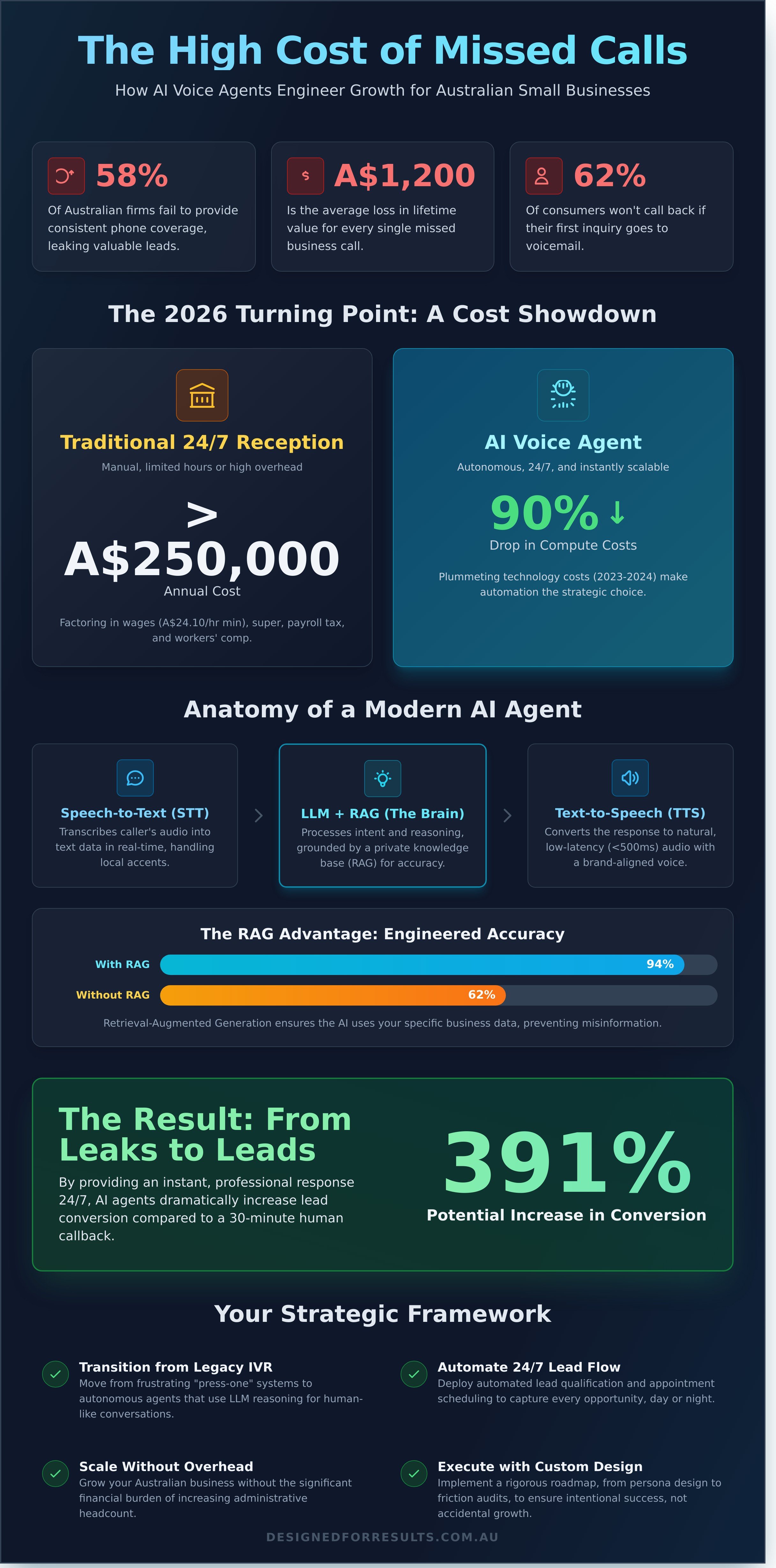
The year 2026 represents a critical inflection point. The convergence of plummeting AI compute costs and soaring local labour costs in Australia creates an undeniable economic imperative. Technology that was once the exclusive domain of enterprise-level corporations is now accessible, affordable, and powerful enough for small and medium-sized enterprises (SMEs) to deploy as a strategic asset.
The Anatomy of a Modern AI Agent
A high-performance AI agent is more than just a chatbot with a voice. It's a precisely engineered system of interconnected technologies designed for a single purpose: results.
Natural Language Processing (NLP): This allows the AI to understand intent and nuance, not just isolated keywords. It can discern frustration, urgency, or simple curiosity in a customer's query.
Ultra-low Latency: For a voice conversation to feel natural, response times must be sub-500ms. Anything slower creates awkward pauses that scream "robot." This speed is now achievable and is non-negotiable for a professional brand experience.
Emotive Synthesis and Voice Cloning: Modern Text-to-Speech (TTS) can create a unique, brand-aligned persona. You can design a voice that sounds warm, professional, efficient, or empathetic—and even clone a specific person's voice for ultimate brand consistency.
The "Leaky Funnel" Problem in Australian SMEs
Many successful Australian businesses grow accidentally, not intentionally. This rapid expansion often creates a critical bottleneck at the front line: customer communication. Every missed call after hours or every website visitor who can't get an instant answer is a potential leak in your revenue funnel.
Quantifying the Loss: Studies consistently show that over 60% of consumers will hang up if their call isn't answered within a minute. For a small business, this translates directly into lost leads and revenue handed to competitors.
The Service Bottleneck: As your business scales, the volume of simple, repetitive queries (e.g., "Are you open on public holidays?", "How do I book an appointment?") can overwhelm your team, pulling them away from high-value, revenue-generating tasks.
The Psychology of Immediacy: In today's market, speed wins. Providing an instant, intelligent response—at 10 PM on a Sunday—has a profound psychological impact on a prospect, positioning your business as responsive, professional, and ready to serve.
Engineering Authority: How AI Agents Work Under the Hood
To move beyond seeing an AI agent as a simple "tool" and start viewing it as a strategic asset, it's crucial to understand the core components. Whether for voice or text, the "brain" of the operation is what matters most.
The technology stack is a logical flow. For a voice agent, it looks like this: Speech-to-Text (STT) → Large Language Model (LLM) for Reasoning → Text-to-Speech (TTS)
For a text-based agent (website or SMS), the process is simpler, bypassing the voice components: Text Input → Large Language Model (LLM) for Reasoning → Text Output
The critical element in both is the LLM. This is where the magic of intentional design happens. Through sophisticated Prompt Engineering, we define the agent's personality, its boundaries, its objectives, and its tone of voice. We supplement this with a Knowledge Base using Retrieval-Augmented Generation (RAG), allowing the agent to pull accurate, business-specific answers from your own documentation, preventing it from making things up.
Large Language Models (LLMs) as the Reasoning Engine
The LLM is the agent's central processing unit. Advanced models like GPT-4o or Claude 3.5 Sonnet are capable of handling incredibly complex and nuanced customer queries that would derail any scripted bot.
Dynamic Conversation vs. Scripts: A well-engineered agent doesn't follow a rigid script. It listens, understands the user's goal, and dynamically navigates the conversation to reach a productive outcome, just as a well-trained human would.
Managing "Hallucinations": A primary concern with AI is its potential to provide incorrect information. This risk is mitigated through rigorous system design, grounding the LLM in your specific business data and setting strict rules to prevent it from speculating.
Integration: The Central Nervous System
An AI agent operating in a vacuum is useless. Its true power is unlocked when it's integrated directly into the central nervous system of your business: your Customer Relationship Management (CRM) platform and other core software.
The CRM Connection: Without a deep connection to your CRM, a voice or chat agent is just a fancy answering machine. True integration allows it to access customer history, log new interactions, and trigger follow-up sequences.
Real-time Data Fetching: A properly integrated agent can perform actions mid-conversation. It can check your team's real-time availability in Calendly, look up an order status in your e-commerce platform, or verify customer details in your database.
Webhooks and APIs: This is the technical plumbing that allows data to move seamlessly from the conversation into your business workflows. When an agent books an appointment, an API call instantly blocks out the time in your calendar and adds the new lead to your CRM, all without human intervention.
DownloadFeedback & RecreateDelete
Strategic Use Cases for the Australian Market
The goal is not to replace your entire team but to automate high-volume, low-complexity tasks, freeing up your human experts to focus on what they do best. The same core system can handle these tasks across multiple channels.
Inbound Lead Qualification: An AI agent can ask structured qualifying questions on a call or in a web chat, sorting the "just looking" prospects from the "ready to buy" leads before they ever reach your sales team.
24/7 Appointment Scheduling: Seamlessly book, reschedule, or cancel appointments directly into your existing scheduling software like Calendly or Acuity, whether the request comes via phone, SMS, or your website.
Outbound Follow-ups: Automate routine outbound calls or messages, such as confirming a service appointment for the next day or re-engaging a cold lead with a new offer.
Customer Support Tier 1: Handle the top 80% of frequently asked questions instantly, providing consistent and accurate answers around the clock and escalating only the most complex issues to your human team.
The Australian Context: Accents, Slang, and Compliance
Deploying an AI agent in Australia requires more than just flipping a switch. It requires localisation and a deep understanding of the local market.
Overcoming the "American Robot": Using a generic, American-accented AI is a fast way to alienate local customers. Modern systems can be configured with high-quality, natural-sounding Australian accents to build immediate rapport.
Compliance and Data Sovereignty: Any system handling customer data must comply with the Australian Privacy Act. This involves careful consideration of where data is stored and how it is processed, often favouring providers with local data centres.
Local Nuances: An effective agent must be programmed to understand local context, from recognising Australian public holidays for scheduling to interpreting common slang or location names correctly.
Industry-Specific Applications
Real Estate: Instantly qualify tenant enquiries and book property viewings 24/7, ensuring no lead is ever missed.
Professional Services: Handle the initial client intake for legal or accounting firms, gathering preliminary information before a formal consultation.
Trade Services: Manage emergency call-outs after hours, dispatching information to the on-call technician and scheduling non-urgent quotes for the following business day.
Implementing AI Agents: A Strategic Roadmap
A successful deployment is not a technical project; it's a business strategy project. It requires a structured, methodical approach that begins long before any code is written.
Audit: Identify the highest-friction, most repetitive touchpoints in your current communication flows. This involves analysing call logs, web chat transcripts, and email enquiries to find the patterns ripe for automation.
Persona Design: Deliberately craft the agent's identity. What is its name? What is its tone—is it purely efficient or warm and conversational? What level of authority does it have? This persona must be a perfect extension of your brand.
Workflow Engineering: Map the "if-this-then-that" logic of the conversation. This means defining the primary objective of every interaction and charting out both the "happy path" and the escape hatches for handling confused or frustrated customers.
Pilot Testing: Deploy the agent in a controlled, internal environment. Test it relentlessly with edge cases and unexpected queries to refine its logic, knowledge base, and conversational flow.
Full Deployment & Optimisation: Go live, but don't "set and forget." Continuously monitor key performance indicators—like lead capture rates, successful appointment bookings, and human escalation rates—to optimise the system for measurable results.
Step 1: The Automation Audit
This foundational step provides the business case for the entire project.
Analyse call and message logs to pinpoint the 5-10 most common, repetitive queries.
Calculate the potential ROI of automating 60% of this inbound traffic, factoring in saved labour hours and the value of captured after-hours leads.
Identify the "high-stakes" conversations—such as a major client complaint—that must always be routed directly to a human for resolution.
Step 2: Designing the Conversation Architecture
This is the blueprint for the agent's behaviour and capabilities.
Write a single, clear sentence defining the agent’s primary objective for every type of call or chat it will handle (e.g., "The agent's goal is to book a qualified sales consultation in an available calendar slot.").
Map the ideal conversational path while also designing graceful recovery loops for when a user goes off-topic or asks an unexpected question.
Engineer a seamless and reliable "Human Handoff" protocol for when the AI reaches its operational limits, ensuring the customer is never left in a frustrating loop.
Beyond the Bot: Why Custom Design Trumps Off-the-Shelf
The market is flooded with "plug-and-play" AI tools that promise instant results. However, true strategic advantage is not found in a generic product; it is engineered through a bespoke solution designed to meet your specific business goals.
The Danger of "Generic AI": An off-the-shelf bot that isn't deeply integrated with your workflows or aligned with your brand voice can do more harm than good, creating frustrating experiences for your customers.
Intentional Success: We believe in engineering success by design. This means building an agent that doesn't just answer questions but actively works to achieve your specific business objectives, whether that's increasing qualified leads by 20% or reducing administrative overhead by 15 hours per week.
The Value of Ongoing Optimisation: An AI agent is not a static asset. It is a dynamic system that requires ongoing monitoring and refinement to adapt to changing customer needs and business priorities.
The Pitfalls of DIY AI Implementation
Attempting a complex AI implementation without expert guidance can lead to significant challenges that damage both your brand and your bottom line.
The "Uncanny Valley": This is the uncomfortable space where a bot tries too hard to be human and fails, creating an unsettling and untrustworthy experience for the user.
Technical Debt: Building on fragile, poorly planned integrations can lead to a system that breaks every time a connected piece of software is updated, costing you time and money to fix.
Security Risks: Mismanaging API keys or failing to handle sensitive customer data correctly can create significant security vulnerabilities and expose your business to legal and reputational risk.
Designed For Results: Engineered Excellence
We are not a software vendor; we are a strategic consultancy that uses AI as a tool to engineer business growth.
Our Process: We move from high-level business analysis to meticulous technical deployment, ensuring every decision is aligned with your commercial objectives.
Focus on Measurable Outcomes: Our success is measured by your success. We focus on tangible metrics like lead capture rates, cost-per-acquisition, and administrative hours saved.
Frequently Asked Questions (FAQs)
Will an AI voice agent sound like a robot to my customers? No. Modern Text-to-Speech (TTS) technology allows for incredibly natural, human-sounding voices with customisable tones, pacing, and even Australian accents. The goal is to sound professional and efficient, not to trick someone into thinking they're human.
Can this technology also be used for a website chatbot or SMS? Absolutely. The core "brain" (the Large Language Model) is the same. Whether the agent communicates via voice, website chat, or SMS is simply a matter of changing the input/output channel. A single, well-designed system can often handle all three.
Is it legal to use AI voice agents for calls in Australia? Yes, it is legal, provided you comply with relevant legislation like the Privacy Act 1988 regarding data handling and consent. Transparency is key; it's best practice to ensure callers are aware they are speaking with an AI assistant.
How much does it cost to implement an AI agent for a small business? The cost varies significantly based on complexity. A simple appointment-booking agent will cost less than a sophisticated agent deeply integrated into multiple business systems. The investment should be framed against the ROI from captured leads and saved labour costs.
Can the AI agent book appointments directly into my calendar? Yes. Through API integrations with platforms like Google Calendar, Microsoft 365, Calendly, or Acuity, the agent can check real-time availability and book appointments directly into your team's schedule.
What happens if the AI agent doesn’t know the answer to a question? A well-designed agent is programmed with a "fallback" protocol. If it cannot answer a question or senses user frustration, it will gracefully offer to escalate the conversation to a human team member via a call transfer, email, or by scheduling a callback.
Do I need to be a tech expert to manage an AI agent? No. While the initial setup is a technical process, the ongoing management should be straightforward. A good implementation partner will provide you with a simple dashboard for monitoring performance and making minor updates to the knowledge base.
How long does it take to get an AI agent up and running? A pilot version for a common use case, like appointment booking, can often be designed and tested within 2-4 weeks. More complex, deeply integrated systems will have a longer implementation timeline based on the strategic requirements.
Can I use my own voice or a specific brand voice for the agent? Yes, modern voice cloning technology allows you to create a custom AI voice using a small sample of audio. This is a powerful way to ensure the agent is perfectly aligned with your brand's identity.
Book your AI Automation Audit and start engineering your growth today.