
Workflow Automation vs Custom Software: A Strategic Framework for 2026

Discover the definitive decision-making framework to choose between agile workflow automation and bespoke software development to maximise your business ROI.
For Australian business leaders, the 'complexity tax' of manual processes is no longer a sustainable cost. Rising labour costs and the relentless pace of market change demand a strategic response, not a technical one. The pivotal question is no longer just a line item in the IT budget; it's a fundamental choice about your business's agility and future growth: should you build a bespoke application or achieve a superior result faster with intelligent automation?
Many executives grapple with this decision, fearing that automation tools lack the power for their unique logic, while custom software looms as an expensive, long-term maintenance burden. This article cuts through the noise. We will prove that in 2026, the traditional 'Build vs. Buy' debate is obsolete. The clear winner is 'Designed Intentionality'—using high-agility automation platforms that deliver the power of custom software without the crippling technical debt.
The Strategic Fork: Defining Workflow Automation and Custom Software in 2026
Understanding the fundamental difference between these two paths is the first step toward strategic clarity. This is not a simple choice between tools; it is a choice between engineered agility and rigid architecture. In the current landscape, supercharged by AI, this distinction has never been more critical.
- Workflow Automation: This is the strategic orchestration of your existing best-in-class software platforms (like your CRM, finance software, and marketing tools) using powerful integration tools like Make or Zapier, often enhanced with intelligent AI Agents. It's about creating a seamless, modular system that works for your business, not forcing your business to work for a single piece of software.
- Custom Software: This involves building a proprietary codebase from the ground up. A development team writes unique code to create a specific application tailored exclusively to your processes.
The paradigm shift for 2026 is this: the rise of sophisticated AI and API-first platforms has given modern workflow automation the power and logical complexity that was once the exclusive domain of custom-built software.
Workflow Automation: The Agile Architecture
Modern workflow automation is built on a modular, API-first ecosystem. Think of it as constructing a high-performance engine using the best available components, rather than trying to forge every nut and bolt yourself. The primary competitive advantage is speed-to-market. A critical business process can be designed, built, and deployed in weeks, not months or years, delivering immediate efficiency gains. Furthermore, the integration of AI assistants and agents allows for the management of incredibly complex business logic and decision-making without writing a single line of code, directly addressing the objection that automation isn't 'powerful' enough.
Custom Software: The Bespoke Burden?
Building proprietary code is a true strategic asset in only a handful of scenarios—primarily when the software is the product you are selling to customers. For internal operations, it often becomes a strategic liability. Hiring external development teams introduces a 'black box' risk, where you have limited visibility or control over the codebase you are paying for. The long development cycles required for custom builds can stall business momentum, leaving you watching from the sidelines as more agile competitors capture market share.
Comparison Framework: Speed, Cost, and Scalability
A high-conviction analysis must go beyond surface-level quotes and examine the Total Cost of Ownership (TCO). The financial and operational demands of custom software versus workflow automation are fundamentally different, particularly for mid-sized Australian businesses.
| Feature | Workflow Automation | Custom Software Development |
|---|---|---|
| Initial Investment | Low (Agency implementation fees) | Very High (Developer salaries/shop fees) |
| Speed to ROI | High (Weeks to a few months) | Low (6-18+ months) |
| Ongoing Costs | Predictable (SaaS subscriptions & retainer) | High & Unpredictable (Maintenance, hosting, security) |
| Scalability | High (Modular & cloud-native) | Moderate (Often monolithic & costly to refactor) |
| Agility & Changes | High (Workflows modified in hours/days) | Very Low (Changes require development cycles) |
| Internal Team Needs | No dedicated IT team required | Requires ongoing developer/IT oversight |
The myth that automation cannot scale for larger enterprises is a relic of the past. Modern platforms are built on enterprise-grade cloud infrastructure, capable of handling immense volume. The more critical question is about human capital: who manages, maintains, and optimises the system after it goes live? With automation, this is handled by your agency partner; with custom software, that responsibility falls squarely on your shoulders.
Cost Realities for Australian SMEs
In the Australian economic context, the numbers speak for themselves. The cost of a single senior software developer's annual salary can often exceed the entire one-off implementation fee for a comprehensive, business-wide automation system from a specialised agency. When you contrast the predictable monthly costs of a 'Subscription Stack' (e.g., Make, OpenAI, your CRM) with the volatile and ever-increasing costs of server maintenance, security patching, and developer retainers for a custom application, the financial case becomes clear.
ROI in this context is best defined by a single metric: the total number of high-value team hours reclaimed per month.
Scalability and Performance Limits
While it's true that some low-code tools have a 'ceiling', a strategic automation partner knows how to engineer hybrid solutions—using small, targeted scripts or serverless functions—to break through these limits when necessary. This provides the best of both worlds. Conversely, custom software frequently becomes a bottleneck to growth. When the market shifts and your business needs to pivot, a rigid, monolithic codebase can be an anchor that slows you down, whereas a modular automated system can be reconfigured with surgical precision.
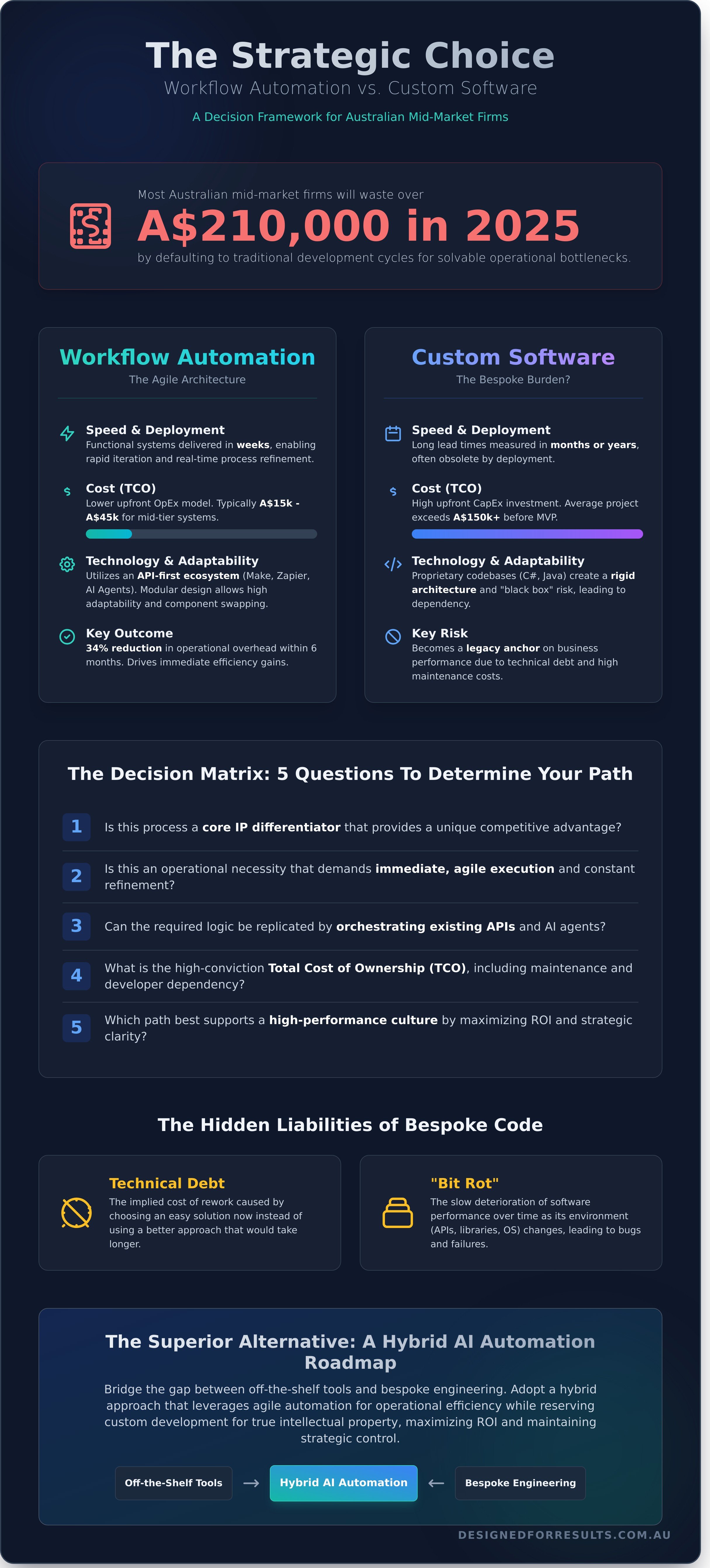
The Decision Matrix: 5 Questions to Determine Your Path
Move beyond technical specifications and ask these five strategic questions to find your answer.
- Is this process a core piece of my Intellectual Property (IP) or an operational necessity? If you are building a system to run your business more efficiently (e.g., lead management, client onboarding, financial reporting), you are solving an operational problem. Building custom software for this is like designing a new car just to get to the office. If the software itself is the unique product you will sell to thousands of customers, then it is your core IP.
- What is the 'Cost of Inaction' if a solution takes six to twelve months to develop? Calculate the lost revenue, wasted wages, and missed opportunities that will accumulate while you wait for a custom build. In most cases, this cost far outweighs the investment in a rapidly deployed automation solution.
- Does my internal team have the capability and capacity to maintain a proprietary codebase? Maintaining custom software is a permanent commitment. It requires specialised skills to fix bugs, patch security vulnerabilities, and make updates. If you don't have this team in-house, you become dependent on your original developer—a risky position.
- How often does my business logic need to change? If you operate in a dynamic market where processes, pricing, or service offerings change quarterly or even monthly, a rigid custom application will become a cage. An automated system is designed for iteration and continuous improvement.
- Can the desired outcome be achieved by connecting 3-4 existing best-in-class tools? The '80/20 Rule' of business functionality suggests that 80% of your needs can be met by the top 20% of features in market-leading software (like Xero for accounting or Pipedrive for sales). Don't reinvent the wheel. The strategic play is to orchestrate these powerful tools together.
The Agility Audit
Your ability to adapt is your greatest competitive advantage. This requires the freedom to 'hot-swap' tools as technology evolves. Imagine a new, superior AI model is released; integrating it into a modular automated workflow is a minor project. Integrating it into a hard-coded custom application could be a costly, complex overhaul. This agility protects you from the long-term danger of 'vendor lock-in' with a single development partner and allows for 'Intentional Engineering'—the process of testing, learning, and refining your systems based on real-world performance data.
The Hidden Liability: Technical Debt and Maintenance
The single greatest misconception about custom software is that once it's built, the spending stops. In reality, the build cost is just the down payment. You are also buying a lifetime of 'Technical Debt'—the implied cost of future rework caused by choosing an easy (limited) solution now instead of using a better approach that would take longer.
Custom code degrades. This 'Bit Rot' phenomenon occurs as underlying operating systems, security protocols, and connected services are updated, causing your static code to become unstable or insecure. The burden of maintaining security and compliance for a custom app is massive and rests entirely on you. This often leads to the 'Developer Hostage' scenario: the one person who understands the codebase leaves, and your business-critical system becomes an unmanageable black box.
Maintenance Costs: The Silent Profit Killer
Industry standards suggest that the annual maintenance cost for custom software is typically 15-20% of the original development cost. For a $150,000 application, that's a recurring $30,000 annual fee, just to keep it running. Contrast this with the 'Managed Service' model offered by automation agencies, where a predictable monthly retainer covers all monitoring, maintenance, and optimisation. The core platforms (like Make or Zapier) handle their own maintenance and updates, absorbing that complexity on your behalf.
Future-Proofing Your Infrastructure
A modular system built on workflow automation is inherently more future-proof than a monolithic codebase. It's designed to evolve. Integrating new technologies, like AI voice agents to handle inbound sales enquiries, is a simple case of adding a new module to an existing workflow. This approach also fosters a high-performance culture by empowering your team with best-in-class tools they can actually understand and use, rather than forcing them to conform to a clunky, proprietary system.
Designed For Results: The Hybrid Approach to Automation
The optimal path is not a choice between code and tools, but a synthesis of strategic rigor and agile technology. Our 'Strategic Alignment' process acts as the bridge, ensuring the solution is engineered specifically to achieve your most important business outcomes. We replace outdated, rigid software requirement documents with a dynamic 'AI Automation Roadmap'—a living plan that prioritises initiatives based on maximum ROI and speed-to-market.
This approach allows us to leverage the full power of the modern technology stack, integrating sophisticated tools like AI Voice Agents and Custom AI Assistants directly into your automated lead generation and client service workflows. It's about moving your business from accidental growth to intentional, engineered success.
Our Result-Oriented Methodology
We combine the speed and cost-efficiency of no-code automation with the strategic discipline of high-end consulting. Our 'Monthly Managed Service Retainers' provide you with a dedicated partner for ongoing optimisation, ensuring your systems evolve with your business and continue to deliver peak performance. We specialise in high-impact systems, like automated lead generation and follow-up sequences, that produce a direct and measurable impact on your bottom line.
Engineering Your Success
Our focus is on delivering 'Measurable Outcomes', not 'Lines of Code'. We anchor your operational ecosystem in a well-implemented CRM, creating a single source of truth that provides clarity and drives intelligent decision-making. Stop guessing about the right path forward. It's time to design the systems that will fuel your growth for 2026 and beyond.
Design your intentional growth with a Free AI Automation Audit
Frequently Asked Questions
Is workflow automation as secure as custom-built software? Yes, and in many cases, it is more secure. Leading automation platforms like Make and Zapier invest millions in enterprise-grade security, compliance (like SOC 2), and infrastructure. This level of security is often prohibitively expensive for a mid-sized business to replicate for a custom application, which would require constant, dedicated monitoring and patching.
How long does it typically take to see ROI from workflow automation vs custom builds? With workflow automation, Australian businesses typically see a positive ROI within 3-6 months, as critical processes are deployed quickly and efficiency gains are realised almost immediately. For custom software, the timeline for ROI is often 18-24 months or longer, factoring in the lengthy development, testing, and implementation cycle before any value is generated.
Can I migrate from automation tools to custom software later if I grow too large? Absolutely. One of the key benefits of a modular automation approach is that it doesn't lock you in. You can strategically replace individual components of your automated system with custom-built solutions if and when a specific process becomes a core IP differentiator that justifies the investment. This allows you to scale intelligently without massive upfront risk.
What are the most common tasks Australian SMEs should automate first? The highest-impact areas to automate first are typically repetitive, high-volume tasks that are prone to human error. This includes lead capture and follow-up sequences, client onboarding and welcome workflows, invoice generation and reminders, and the generation of internal reports.
Do I need a technical background to manage an automated workflow? No. While the initial design and build require specialist expertise, the systems are built for your team to use. With a managed service retainer, all the technical monitoring, maintenance, and complex updates are handled by your automation partner, freeing you to focus on running your business.
What happens if a tool like Zapier or Make goes down? Leading automation platforms have extremely high uptime (typically 99.9%+) and are built on resilient, redundant cloud infrastructure. In the rare event of an outage, they have dedicated status pages and support teams. A good automation partner also builds error-handling and notifications into your workflows to ensure any issues are identified and managed immediately.
How do AI voice agents fit into a standard workflow automation setup? AI voice agents act as a powerful module within a workflow. For example, a voice agent can answer an inbound call, qualify the lead by asking a series of questions, and then trigger an automation that creates a new deal in your CRM, assigns a sales representative, and sends the caller a confirmation SMS. They connect seamlessly via APIs just like any other application.
Why is custom software development so much more expensive in Australia? The high cost is driven primarily by competitive local salaries for skilled software developers, which are among the highest in the world. A custom project requires a team of these highly-paid specialists (developers, project managers, QA testers) for a prolonged period, leading to significant labour costs compared to the more efficient implementation model of an automation agency.
