
Automated Follow Up Sequences: A Guide for Australian Businesses

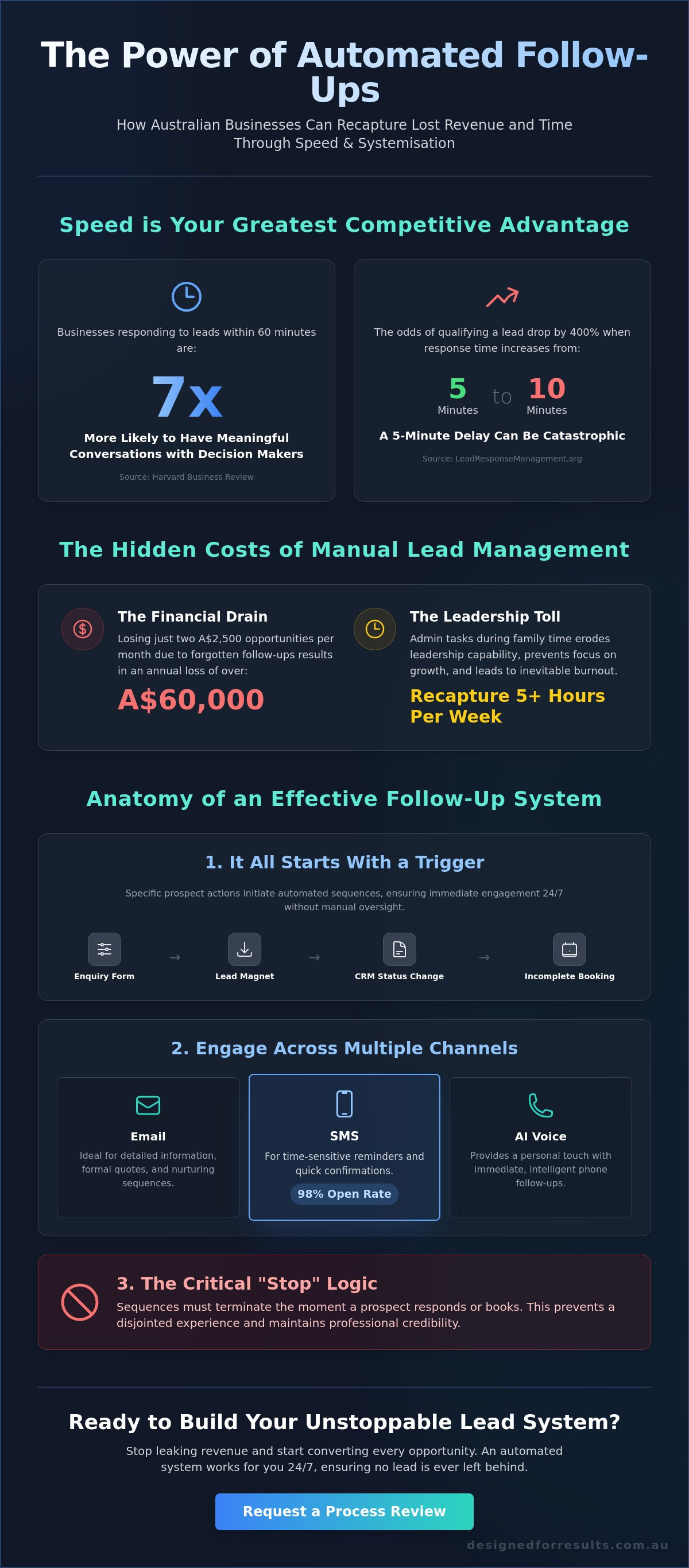
Research from the Harvard Business Review confirms that businesses responding to leads within sixty minutes are seven times more likely to have meaningful conversations with key decision makers. For most Australian business owners, it's nearly impossible to achieve this level of responsiveness manually while managing daily operations. You likely recognise the frustration of leads falling through the cracks or the exhaustion of handling administrative tasks during your family time. Implementing automated follow up sequences solves these inefficiencies. This technology ensures no prospect is ignored, regardless of your current workload.
This article demonstrates how to deploy intelligent systems that capture every lead and return at least five hours to your working week. We'll explore the practical steps to establish a culture of responsiveness that produces measurable outcomes, increases your lead-to-sale conversion, and secures a consistent brand voice for your business.
The Role of Automated Follow Up Sequences in Modern Business
Automated follow up sequences are a series of pre-scheduled communications triggered by a specific action, such as an enquiry form submission or a quote request. This technology allows Australian businesses to maintain consistent contact with prospects without requiring manual intervention for every touchpoint. Understanding what is marketing automation is essential for leaders who want to replace reactive administrative tasks with proactive sales management. By implementing these sequences, business owners eliminate the bottleneck of manual outreach and establish a high-performance culture where no lead is left to chance.
The transition from manual to automated systems represents a shift toward systematic reliability. Instead of relying on a business owner's memory or a cluttered inbox, these sequences ensure that every prospect receives the right information at the right time. This transition supports long-term leadership capability by freeing up mental bandwidth for high-level decision-making. Businesses that adopt these tools often see a measurable increase in conversion rates because their sales process remains active 24 hours a day.
Why Speed to Lead is Your Greatest Competitive Advantage
Responsiveness is the primary driver of conversion in the Australian service sector. Data from LeadResponseManagement.org indicates that the odds of qualifying a lead drop by 400% when the response time increases from five to ten minutes. Automated systems provide an instant acknowledgement to every enquiry, ensuring your business is the first to arrive in a prospect's inbox. This immediate professional communication builds instant trust and signals that your organisation is efficient and reliable. When a potential client receives a helpful response within seconds, it creates a psychological anchor that makes them less likely to continue searching for alternative providers.
The Hidden Costs of Manual Lead Management
Manual lead management carries a heavy mental load and significant financial risks. If an Australian business loses just two A$2,500 opportunities per month due to forgotten follow-ups, the annual cost exceeds A$60,000 in lost revenue. Beyond the financial impact, the habit of completing administrative tasks during evenings and weekends erodes long-term business leadership capability. It prevents owners from focusing on growth and leads to inevitable burnout. Transitioning to bespoke AI automation removes the burden of remembering to follow up with multiple prospects simultaneously. It replaces the chaos of manual tracking with a structured system that delivers measurable outcomes and gives the owner their time back.
Mechanics of an Effective Follow-Up System
Building a reliable communication system requires more than just sending occasional emails. It involves engineering a series of logic-based steps that react to prospect behaviour in real time. Automated follow up sequences ensure that no lead is ignored, regardless of how busy the office becomes during peak hours. High-performing Australian businesses use these systems to maintain a professional presence while the owner focuses on high-level operations. Success in this area is a result of precision rather than luck.
Common Triggers for Automation
Every sequence begins with a specific trigger. Website enquiry forms and lead magnet downloads are standard entry points that demand an immediate response. Data indicates that businesses contacting prospects within five minutes are 21 times more likely to qualify them compared to those waiting 30 minutes. Beyond initial contact, status changes within a CRM can initiate specific workflows. For instance, moving a prospect to a "Quote Sent" stage can trigger a follow-up if the document isn't signed within 48 hours. Incomplete booking requests also serve as critical triggers; a simple nudge can often recover a lead who was distracted mid-process. Integrating marketing automation workflows allows these triggers to function 24/7 without manual oversight.
Multi-Channel Engagement Strategies
Effective engagement requires a mix of communication methods to reach the prospect where they are most active. Email provides the space for detailed information and formal quotes, but it often lacks urgency. SMS fills this gap with an average open rate of 98%, making it the superior choice for time-sensitive reminders or quick confirmations. For businesses that require a more personal touch, integrating AI voice agents enables immediate phone follow-up. This multi-channel approach ensures your brand stays top-of-mind across different platforms while maintaining a consistent professional tone. Every message must be concise and focused on the next logical step in the customer journey.
Timing and frequency must be tailored to the specific industry. A service business like a plumber might send three messages within 24 hours, whereas a consultancy might space communications over two weeks. The most critical component of the mechanics is the "stop" logic. The sequence must terminate the moment a prospect responds or books a meeting. Continuing to send automated prompts after a human interaction has occurred creates a disjointed experience and damages credibility. If you need to streamline your current lead management, you can request a process review to identify where your system is leaking potential revenue.
Designing Sequences That Maintain Personal Connection
Automation succeeds when it remains invisible to the recipient. Effective automated follow up sequences do not rely on generic templates that broadcast to a broad audience. Instead, they utilise precise data to mirror the nuances of a manual, one-to-one conversation. High-performing sequences leverage segmentation to ensure every message aligns with the recipient's specific stage in the buying journey. By categorising leads based on their initial enquiry or service interest, an Australian business can deliver content that addresses exact pain points rather than broad industry generalisations.
Dynamic variables are essential for maintaining this level of relevance. Beyond inserting a first name, sophisticated systems pull in data points such as the specific service discussed, the date of a site visit, or a particular quote reference number. This level of detail demonstrates that the business is attentive and professional. It replaces the need for an owner to manually type out reminders at 9 PM, ensuring lead momentum continues without sacrificing the personal touch that builds trust.
Personalisation at Scale
True personalisation requires looking deeper than a contact's name. Use industry-specific data or previous engagement history to tailor the narrative of each email. If a prospect downloaded a guide on commercial solar incentives, the follow-up should focus on tax depreciation and long-term ROI rather than residential installation basics. This targeted approach ensures the communication provides immediate value.
Write in a conversational style that reflects your natural professional voice. Avoid overly formal language that creates a barrier between you and the prospect. Use short, punchy sentences to convey authority and clarity. Every message must set a clear expectation for the next step, whether that is a discovery call or a formal proposal review. This transparency helps move the prospect through the funnel with minimal friction. For those requiring a more tailored approach, bespoke AI automation can help integrate these complex data points seamlessly into your workflow.
The Art of the Nudge
Persistence is a requirement for conversion in the Australian service sector. Research indicates that 80% of sales require at least five follow-up contacts after the initial meeting, yet many businesses stop after two. An automated sequence ensures you reach this threshold every time. Space these touchpoints logically to remain helpful without becoming a nuisance. A typical cadence might involve follow-ups at day one, three, seven, and fourteen.
- Vary the Call to Action: Don't ask for a meeting in every email. Offer a case study in one, a helpful checklist in another, and a direct calendar link in the third.
- Respect Preferences: Include a clear, easy-to-find opt-out mechanism. This is a legal requirement under the Australian SPAM Act 2003 and maintains your brand's reputation for professionalism.
- Know When to Stop: Define a clear "break-up" point. If a lead hasn't engaged after six or seven attempts, move them to a long-term nurture list to protect your sender authority.
Maintaining professional boundaries while being persistent demonstrates reliability. When a prospect is ready to buy, they will choose the business that stayed top-of-mind through consistent, respectful communication.
Integrating Automation into Your Business Workflow
Effective automated follow up sequences require a unified tech stack. Fragmented data leads to missed opportunities and administrative bottlenecks that drain your time. By connecting your follow-up system directly to your CRM, you establish a single source of truth for every prospect interaction. This integration ensures that your sales team operates with clarity, knowing exactly where each lead sits in the pipeline without manual updates.
Success relies on workflow automation to move data between your marketing tools and financial software. For many Australian businesses, connecting follow-up sequences to Xero is a priority. When a quote remains outstanding for 48 hours, the system triggers a personalised reminder. This direct link between your sales activity and financial tools reduces the time spent on manual reconciliations and ensures no revenue is left on the table.
CRM as the Central Intelligence Hub
Your CRM must do more than store contact details. It should actively manage lead flow through automated segmentation. When a new enquiry arrives, the system categorises the lead based on their specific needs and value. This allows for:
- Automated lead scoring: Assign values to leads based on their engagement levels to prioritise high-value opportunities.
- Dynamic task reminders: Generate notifications for your team only when a lead requires a personal phone call or a bespoke response.
- Database hygiene: Remove inactive contacts automatically to maintain a high-performance mailing list.
Beyond the Initial Enquiry
Automation extends far beyond the first "thank you" email. It manages the entire lifecycle of the customer journey. Australian businesses often lose momentum after sending a proposal. Automated follow up sequences bridge this gap by sending strategic nudges that keep your business top-of-mind until a decision is made.
Once a client signs on, use automated welcome sequences to handle onboarding. This delivers necessary documents and sets expectations without you lifting a finger. Additionally, you can reactivate past clients through targeted campaigns. Reaching out to a customer who hasn't purchased in six months with a relevant offer can increase repeat business by up to 25% based on current retail benchmarks. Monitor your open rates and booking conversions weekly to refine these touchpoints and ensure maximum ROI.
Implementing Your Follow-Up System for Long-Term Efficiency
Transitioning to automated follow up sequences requires a disciplined approach to your current operations. Begin with a thorough audit of your manual sales process to identify exactly where leads stall or drop off. Data from industry studies suggests that 78% of customers buy from the business that responds first. If your current method involves manual replies sent during your evening downtime, you're likely losing revenue to faster competitors. Map every touchpoint to see where human intervention is essential and where automation can take the lead.
Select a technology stack that integrates seamlessly with your existing tools. Your CRM, email platform, and SMS gateway must communicate without friction to prevent data silos. Choosing the right software depends on your specific volume and the complexity of your sales cycle. Once the system is live, use real-world feedback to refine the messaging. A 5% increase in lead retention can significantly impact your bottom line without increasing your marketing spend. Focus on measurable outcomes to ensure the technology serves your business goals.
The Implementation Roadmap
Map the customer journey from the first enquiry to the final invoice. Build your initial sequence to address the most frequent questions your Australian business receives daily. This focus ensures your automation handles the bulk of repetitive administrative tasks immediately. Review your sequence performance every 30 days to identify friction points. If a specific follow-up email has a low engagement rate, adjust the timing or the call to action based on the data provided by your analytics dashboard. Consistent refinement leads to a high-performance culture within your sales process.
Partnering for Success
Deciding between a self-managed system and professional implementation depends on your available time and technical capability. Many business owners find that managing complex automations becomes another administrative burden they cannot afford. Bespoke AI solutions offer customisation that aligns directly with your unique operational requirements; this ensures the technology supports your goals rather than complicating them.
Managed services provide the security of knowing your systems remain functional as software updates occur. This professional oversight allows you to focus on high-level management while your leads are nurtured automatically. Success in modern business is a product of intentional engineering. Book a consultation to discuss your business automation needs and discover how to reclaim your time while improving your customer journey.
Maximise Your Business Capacity
Australian businesses frequently lose potential revenue because manual follow-up tasks are neglected during peak periods. Implementing automated follow up sequences ensures every enquiry and quote receives a prompt response, removing the burden of repetitive admin from your daily schedule. This approach maintains a professional connection with your leads while you focus on delivering your core services.
Efficiency relies on reliable systems that produce measurable outcomes. You don't need to spend your evenings caught up in paperwork to maintain a high-performance culture. Our team specialises in helping Australian SMEs transition to automated workflows that increase lead conversion rates and provide business owners with the freedom to scale. We focus on practical solutions that deliver a clear return on investment for your specific market conditions.
Book your free automation strategy call with our Australian team to start reclaiming your time and securing your revenue. It's the most effective way to ensure your business grows without exhausting your personal resources.
Frequently Asked Questions
What is an automated follow up sequence?
An automated follow up sequence is a series of pre-scheduled communications sent to a prospect after they take a specific action, such as submitting a lead form. These systems ensure no potential client is forgotten by delivering consistent touchpoints without manual intervention. By using automated follow up sequences, Australian businesses maintain a professional presence and keep their services top-of-mind during the decision-making process.
Will automated emails make my business seem impersonal?
Automated emails enhance personalization by using merge tags to include the recipient's name, industry, or specific service interest. Modern software allows you to tailor content based on a prospect's behavior, ensuring the message remains relevant. According to a 2023 Epsilon study, personalized automated communications can trigger a 122% higher opening rate than generic broadcasts, making your business feel more attentive and responsive to individual needs.
How many emails should be in a follow-up sequence?
Most effective sequences for service-based businesses consist of 5 to 7 emails sent over a 14 to 21-day period. The first 3 messages should arrive within the first 72 hours to capitalize on high intent. Data from Woodpecker indicates that sequences with 4 to 7 emails see a 27% response rate, which is triple the engagement of a single follow-up attempt.
Can I use SMS in my automated follow-up?
Integrating SMS into your sequence is a highly effective way to reach Australian customers who might overlook a crowded email inbox. Text messages boast a 98% open rate, with 90% of those read within 3 minutes of delivery. Use SMS for urgent updates, such as appointment reminders or quote expiry alerts, while ensuring you comply with the Australian Spam Act 2003 by providing a clear opt-out mechanism.
What happens if a prospect replies to an automated email?
The automated sequence stops immediately once a prospect replies, allowing you to step in and provide a manual response. Most automation platforms use reply detection to pause further scheduled messages, preventing the awkwardness of sending a follow-up after the conversation has started. This transition ensures you only spend time on leads that have demonstrated genuine interest and are ready for a direct consultation.
How much time can I actually save with these systems?
Australian business owners often reclaim 5 to 10 hours per week by automating their lead nurturing and administrative follow-ups. Instead of spending your evenings manually typing emails or chasing unpaid quotes, these systems handle the repetitive tasks in the background. This shift allows you to focus on high-value billable work or business development rather than getting bogged down in basic administration.
Do I need expensive software to start automating my follow-ups?
You don't need a massive budget to implement automation, as many entry-level platforms cost less than A$50 per month. Tools like MailerLite offer free tiers for small databases, while more robust systems like ActiveCampaign provide advanced features for approximately A$70 monthly. The investment typically pays for itself by preventing lost leads that would otherwise go uncontacted due to a lack of time.
Is it possible to automate the follow-up of quotes and proposals?
Automating the follow-up of quotes and proposals is a standard practice that significantly increases conversion rates. You can set triggers to send a reminder 2 days after a quote is sent, followed by a final check-in 5 days later. This structured approach ensures that you aren't leaving money on the table simply because a client got busy and forgot to approve the work.
