
Automated Lead Nurturing: A Guide for Australian Businesses in 2026

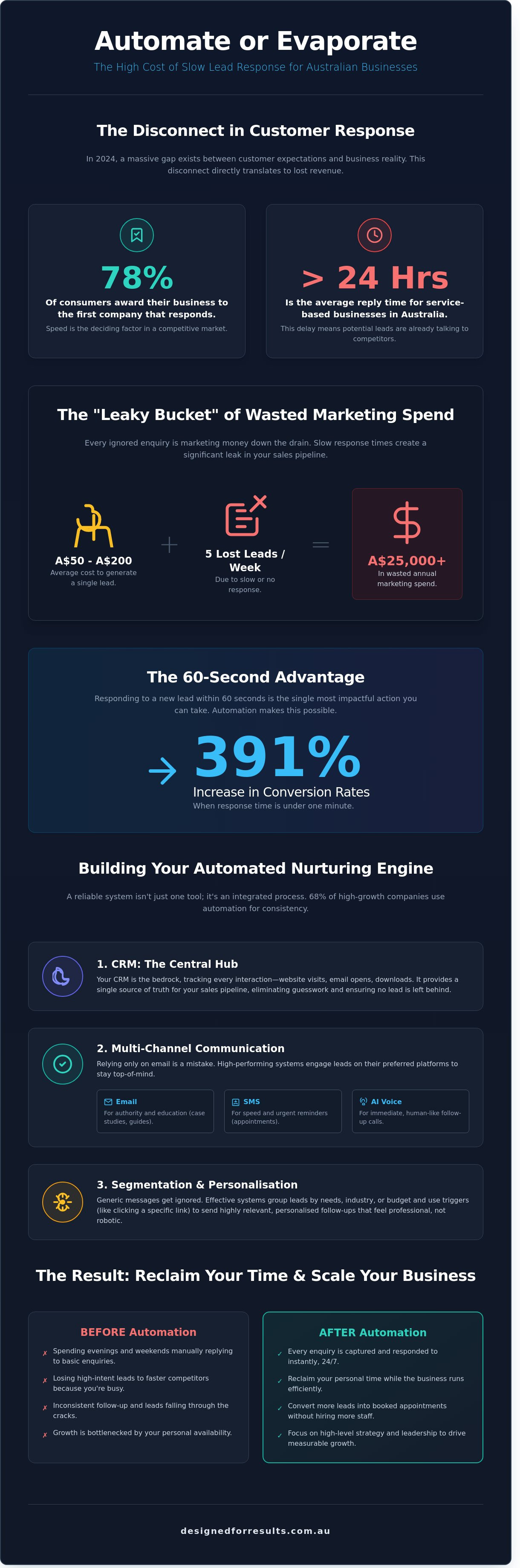
According to 2024 industry benchmarks, 78% of Australian consumers award their business to the first respondent, yet the average service-based business still takes over 24 hours to reply. This delay results in lost revenue and wasted marketing spend. Spending Sunday afternoons manually responding to basic pricing enquiries prevents you from focusing on your leadership capability. It's exhausting to watch potential leads go to faster competitors because you're physically unable to be in two places at once. Implementing **automated lead nurturing** ensures your business maintains a high-performance sales process without requiring your constant presence.
Manual follow-up is a bottleneck that limits your ability to scale. You'll learn how to implement a system that captures every enquiry immediately, reclaims your evenings, and converts more leads into booked appointments without hiring expensive staff. This article outlines the exact steps to build a reliable enquiry handling system that drives measurable revenue growth throughout 2026.
What is Automated Lead Nurturing and Why Your Business Needs It
Automated lead nurturing is a system of pre-scheduled communications triggered by specific lead actions. Instead of waiting for a staff member to manually send an email, the system responds instantly when a prospect downloads a guide or submits an enquiry. This process forms a critical part of modern lead management, ensuring every potential client receives a consistent experience. The primary goal is moving a prospect from an initial enquiry to a booked call or sale without requiring manual effort from the business owner.
Speed to lead is the single most important metric for Australian businesses. Research indicates that responding to a lead within 60 seconds can increase conversion rates by 391%. Most manual systems fail this test. Transitioning from inconsistent, manual follow-up to a reliable, automated process eliminates the risk of human error. It ensures that your business remains at the top of a prospect's mind while their intent is at its highest. Automated lead nurturing provides the professional persistence required to close deals in a competitive market.
The Financial Impact of Delayed Follow-Up
Ignored enquiries represent a significant "leaky bucket" in most sales pipelines. When a lead goes cold, the cost of acquisition is wasted. In many service-based sectors, the average lead costs between A$50 and A$200 to generate. Losing just five leads a week due to slow response times can cost a business over A$25,000 in annual marketing spend alone. Automated systems capture leads instantly, even at 2 AM on a Sunday. This consistency builds trust and directly increases lifetime customer value by establishing a professional standard from the first interaction.
Reclaiming Your Evenings from Administrative Tasks
Many Australian business owners spend their evenings caught in a cycle of administrative tasks. They find themselves sending "just checking in" emails at 9 PM because they were too busy on-site or in meetings during the day. Automation handles these repetitive follow-ups. By deploying bespoke automation, you remove the burden of manual data entry and follow-up. This shift allows you to focus on high-level delivery and results. A well-designed system ensures the business operates efficiently while you're offline, providing the freedom to step away from the screen without sacrificing growth.
Core Components of a High-Performing Nurture System
Building a reliable automated lead nurturing system requires a structured technical foundation. It's not about sending random messages. It's about creating a logical flow of information that moves a prospect toward a sale. Australian businesses often lose revenue because leads fall through the gaps of a disjointed process. Statistics from 2024 indicate that 68% of high-growth companies use automation to maintain consistency. This starts with clean data capture. Your website forms and landing pages must feed directly into your database. If you're manually entering lead details from emails into a spreadsheet during your evenings, you're already losing the battle for efficiency.
Effective communication relies on multi-channel touchpoints. Relying solely on email is a mistake in 2026. High-performing systems integrate SMS for urgent reminders and AI voice agents for immediate follow-up. These channels ensure your business stays top-of-mind without requiring a staff member to pick up the phone every five minutes. Every interaction must be tracked to ensure no lead is left behind.
The Role of the CRM in Automation
Your CRM is the central repository for every interaction a lead has with your brand. It tracks website visits, email opens, and resource downloads to trigger specific sequences. A professional CRM implementation serves as the bedrock for all automation. It provides clear visibility into deal stages, allowing managers to see the health of the sales pipeline at a glance. When a lead moves from "Inquiry" to "Quote Sent," the system automatically updates and adjusts the messaging. This level of visibility eliminates the guesswork that plagues many small businesses.
Segmentation and Personalisation
Generic messages are ignored. Segmentation involves grouping leads by their specific needs, industry, or budget. This ensures you aren't sending a commercial service offer to a residential client. Using personalisation tags like a first name or specific industry terms makes automated messages feel relevant and professional. It respects the reader's time by only providing what they asked for.
Modern systems use lead behaviour to drive the lead nurturing process forward. If a lead clicks a link about a specific service, the system tags them and triggers a follow-up focused on that topic. This precision saves hours of manual sorting and ensures every prospect receives the right information at the right time. To see how these components fit your specific workflow, you can chat with our team about your current setup.
Selecting the Right Channels: Email, SMS, and AI Voice
Effective automated lead nurturing requires a multi-channel approach that matches the communication style to the prospect's stage in the buying journey. Australian businesses often lose potential revenue by relying on a single method, such as manual follow-up calls that rarely happen on time. By diversifying channels, you ensure your message reaches the lead where they are most likely to engage. Email provides the depth needed for complex service explanations, while SMS and AI voice agents provide the speed required to capture interest before it cools.
Email Marketing for Authority and Education
Email serves as the backbone of long-term engagement. Use automated sequences to deliver case studies and detailed answers to common client questions. This approach positions your business as a knowledgeable leader in your field. A cadence of one email every four to seven days keeps your brand visible without overwhelming the recipient's inbox.
To maintain high quality without spending hours writing, smart AI solutions can generate relevant content based on your specific service offerings and historical client data. This ensures every message feels personal and addresses the specific pain points of an Australian business owner. Consistent, high-value emails build the trust necessary to move a lead toward a high-value purchase or contract.
SMS and AI Voice for Immediate Engagement
SMS delivers a 98% open rate, making it the most effective tool for time-sensitive communication. Australian service businesses use SMS automation to send appointment reminders, which can reduce no-show rates by up to 40%. A simple text confirmation sent 24 hours before a scheduled quote or consultation protects your schedule and ensures your time is spent on active prospects.
AI voice agents represent the next step in automated lead nurturing by providing instant phone interaction. When a lead submits a form at 9:00 PM, an AI agent can call them immediately to qualify their needs and book a meeting. This 24/7 availability is crucial, as 50% of leads choose the vendor that responds first. These agents handle repetitive initial enquiries, allowing you to focus on closing deals rather than playing phone tag. Implementing these tools transforms a slow, manual process into a responsive system that operates around the clock.
How to Build Your First Automated Nurture Sequence
Define a single, uncompromising objective to begin your automated lead nurturing. You must decide whether you want the lead to book a discovery call, download a detailed quote, or register for a specific demonstration. Vague goals lead to fragmented results. Research from 2024 indicates that Australian businesses lose up to 60% of potential revenue due to inconsistent follow-up. Building a sequence for automated lead nurturing removes this human error and ensures every prospect receives the attention required to move them toward a decision.
Mapping the Lead Journey
Organise the flow of information by anticipating the specific questions a prospect asks at different stages of their journey. Initial touchpoints should provide immediate value, such as a case study showing how a similar Australian business saved A$12,000 in annual overheads through better systems. Identify conversion points where the lead is most likely to commit to the next step. Provide clear, singular instructions at every stage to eliminate friction and guide the lead toward your desired outcome.
Setting Triggers and Time Delays
Utilise precise triggers to initiate contact based on lead behaviour. An immediate trigger occurs when a prospect submits a form on your website, while scheduled delays ensure you stay top-of-mind without overwhelming their inbox. For example, set a delay to wait 2 days before sending a follow-up that addresses common industry objections. A stop trigger is a mechanism that prevents redundant communication once a goal is met. This ensures a lead doesn't receive introductory nurture emails after they've already booked a consultation with your team.
Write concise, high-impact messages that respect the recipient's limited time. Avoid long-winded introductions and focus on the specific outcomes your business delivers. Once the content is loaded into your chosen platform, test the entire workflow twice. Verify that every link functions and the timing settings align with your plan. Faulty automation reflects poorly on your professional standards and can alienate high-value leads before you've even spoken to them. By engineering these sequences correctly, you reclaim your evenings and ensure no lead is left to cool off.
To start reclaiming your time and improving your conversion rates, view our bespoke automation solutions today.
Optimising Your System for Long-Term Growth
Implementation is only the beginning. A high-performance nurture system requires consistent refinement to maintain its effectiveness as market conditions shift. Australian businesses often find that a sequence performing well in early 2025 needs adjustment by mid-2026 to stay relevant. High-level automated lead nurturing functions as a living asset. It builds equity in your brand and increases the valuation of your business by providing predictable, scalable revenue. Designed For Results specialises in building these systems, removing the technical burden from the business owner and ensuring the logic remains sound. This transition from basic sequences to sophisticated AI-driven workflows allows you to focus on high-level decision making while the software handles the repetitive heavy lifting.
Reviewing Key Performance Indicators (KPIs)
Data provides the clarity needed to move beyond guesswork. Focus on three primary metrics: open rates, click-through rates, and appointment booking rates. A healthy email open rate for service providers in Australia currently sits between 25% and 35%. If your rates drop below 20%, your subject lines or sender reputation require immediate attention. Use a quarterly review cycle to audit these numbers. This frequency allows for enough data collection to identify genuine patterns rather than reacting to weekly fluctuations. Refining the timing of a message by even two hours can improve engagement by 15% in certain service sectors. Use these insights to tighten your messaging and ensure your content addresses the current pain points of your target audience.
The Path to Full Business Automation
Effective automated lead nurturing acts as the foundation for broader operational efficiency. Once the lead capture and nurture phases are stable, the next logical step involves automating sales hand-offs, client onboarding, and feedback loops. This creates a cohesive journey where the customer feels supported at every touchpoint without the owner needing to intervene manually. Integrating these workflows reduces administrative overhead by up to 40% for many Australian service businesses. It shifts the focus from survival to performance. To identify which parts of your current process are ready for this transition, chat with an expert to map out your specific opportunities. Moving toward full automation ensures your business remains competitive and profitable while you reclaim your evenings and weekends.
Modernise Your Lead Management Today
Australian businesses frequently lose up to 25% of potential revenue simply because they lack the time to follow up on quotes promptly. Implementing automated lead nurturing ensures that every inquiry receives a response within 5 minutes, even when you're busy on-site or managing your team. By integrating your CRM with SMS and AI voice channels, you can reclaim approximately 10 hours of administrative time each week. This transition eliminates the need to process paperwork during your evenings and provides a more professional experience for your customers. We are specialists in Australian SME automation with deep expertise in CRM and AI integration. Our focus remains entirely on delivering measurable business outcomes that help you grow without increasing your workload.
Ready to stop chasing leads and start closing more deals? Book an Automation Strategy Call with Designed For Results to see how we can streamline your operations. You've built a solid foundation; now it's time to let technology handle the heavy lifting so you can enjoy the rewards of your hard work.
Frequently Asked Questions
What is the difference between marketing automation and lead nurturing?
Marketing automation refers to the broad technology stack used to streamline repetitive tasks across different digital channels. Automated lead nurturing is a specific subset of this technology focused on building relationships with prospects who aren't ready to buy immediately. While automation handles the mechanical delivery of messages, nurturing focuses on the content and timing required to move a lead through your sales funnel.
How much does it cost to set up automated lead nurturing?
Implementing a basic system typically requires a software investment between A$150 and A$500 per month for most Australian businesses. Professional implementation or data migration services generally cost between A$2,500 and A$8,000 depending on the complexity of your existing customer records. These costs are often offset by the 20% increase in sales opportunities typically seen when follow-ups are handled systematically rather than sporadically.
Is automated lead nurturing too impersonal for a small service business?
Automated systems actually increase the perceived personal touch by ensuring every enquiry receives a response within 5 minutes. Small service businesses often lose prospects because they're too busy on-site to reply to emails or quotes quickly. By using merge tags to include specific details about an enquiry, you maintain a professional standard that 65% of Australian consumers now expect from local service providers.
What software is best for automated lead nurturing in Australia?
ActiveCampaign and HubSpot remain the primary choices for Australian service businesses due to their local support teams and robust integration capabilities. Pipedrive is an excellent alternative for those who prioritise a visual sales pipeline over complex marketing features. These platforms comply with the Australian Privacy Act 1988, ensuring your lead data remains secure and legally compliant. Choosing a platform with local data centres helps maintain high performance.
How many emails should be in a lead nurturing sequence?
A standard sequence should consist of 5 to 7 touchpoints delivered over a 21-day period. This frequency keeps your business at the front of the prospect's mind without becoming intrusive or overwhelming their inbox. Statistics from 2024 show that 80% of sales require at least five follow-up contacts, yet most business owners stop after only two attempts. Consistent communication builds the trust necessary for a lead to commit.
Can I automate lead nurturing for phone enquiries as well as website leads?
You can bridge the gap between offline and online interactions by using call tracking software integrated with your CRM. When a prospect calls your office, the system logs the interaction and triggers an immediate SMS or email thank-you message. This ensures that phone enquiries receive the same high-level automated lead nurturing as those who fill out a website form, capturing every potential opportunity without manual data entry.
How long does it take to see results from automated nurturing?
Most businesses observe measurable improvements in conversion rates within 60 to 90 days of activation. This timeframe allows enough leads to move through the entire sequence so you can identify which messages resonate best with your audience. Initial wins, such as a 15% reduction in administrative time spent on manual follow-ups, are often visible within the first 30 days of the system going live.
Do I need a technical background to manage these systems?
Managing modern automation platforms doesn't require a degree in computer science or a deep technical background. Most leading software providers use drag-and-drop interfaces that allow you to build workflows visually without writing any code. If you can navigate a standard online banking portal or a basic spreadsheet, you have the skills necessary to oversee these systems. Professional setup services can handle the initial configuration to ensure everything runs correctly.
