
Chatbot Questions Examples: How to Qualify Australian Leads on Autopilot

How much revenue is slipping through your fingers while you sleep or handle repetitive admin during your evenings? According to 2023 industry benchmarks, Australian businesses lose up to 35% of potential leads simply by failing to respond within the first five minutes. You likely recognise that manual lead qualification is a bottleneck that keeps you chained to your desk long after the working day ends. It's exhausting to spend your limited energy on enquiries that never convert or manually entering data into your CRM at 9:00 PM. This article provides specific chatbot questions examples that transform your website into a 24/7 sales assistant, ensuring you only speak with high-value prospects who are ready to buy.
You'll discover how to structure an automated sequence that captures essential details, qualifies intent, and books appointments directly into your calendar without a single manual phone call. We'll examine the exact logic needed to filter out low-quality enquiries so you can focus on growing your business while reclaiming your personal time. Businesses implementing these automated flows often report a 40% reduction in time spent on manual admin within the first 30 days. By the end of this guide, you'll have a clear roadmap to automate your lead intake and deliver a consistent customer experience every hour of the day.
The Role of Chatbot Questions in Modern Lead Capture
Chatbot questions are the digital gatekeepers of your sales funnel. These pre-defined prompts serve a specific function: they gather critical data and guide website visitors toward a conversion without requiring manual intervention. For an Australian business, implementing effective chatbot questions examples turns a static website into an active sales tool that operates 24 hours a day.
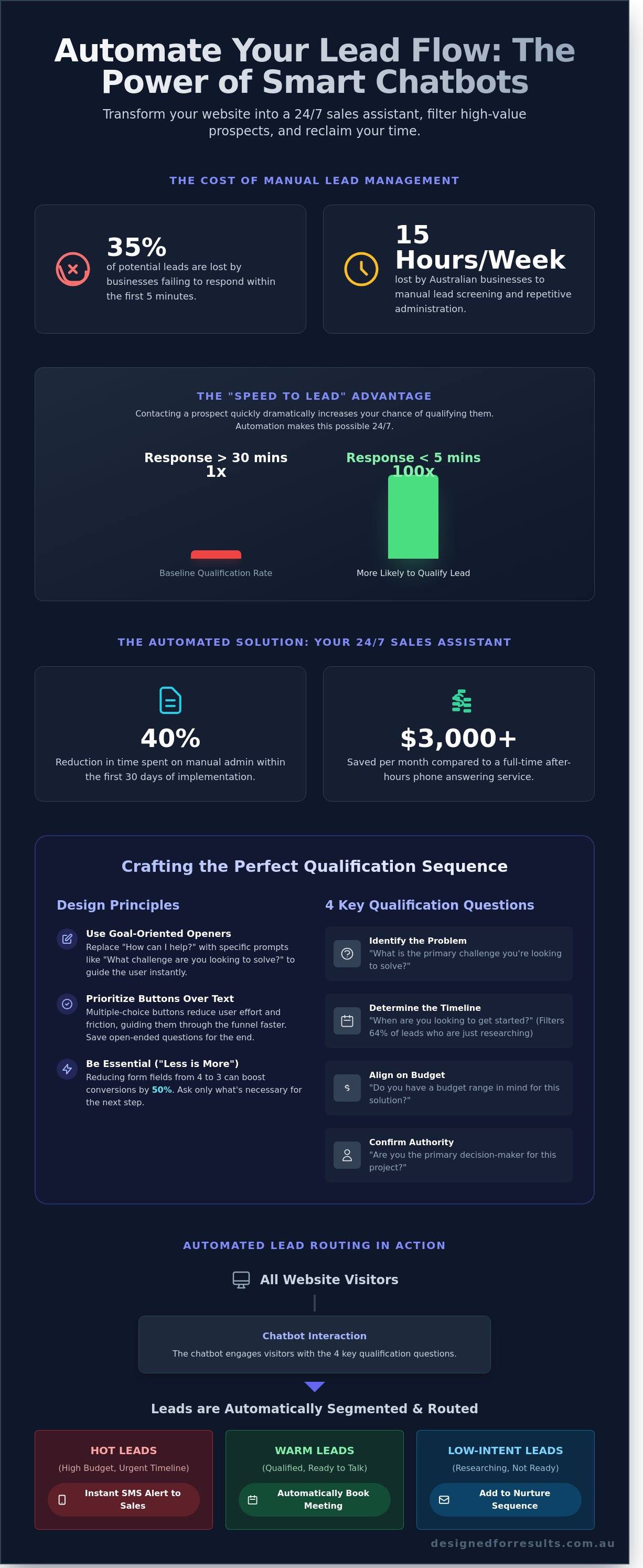
Speed is the primary differentiator in a competitive service market. Research from the Harvard Business Review indicates that businesses contacting prospects within five minutes are 100 times more likely to qualify them than those waiting 30 minutes. Automation ensures your business achieves this "speed to lead" every time. When a potential client visits your site at 9:00 PM while you are finishing admin or spending time with family, the chatbot initiates the conversation immediately. It qualifies the lead while the intent is highest.
Replacing a 24/7 human receptionist is a significant cost-saving measure. A full-time after-hours phone service can cost upwards of $3,000 per month, yet often fails to integrate data directly into your workflow. Automated questions provide a consistent, professional interface that never sleeps. They handle repetitive enquiries about service areas, pricing, or availability, allowing you to focus on high-value tasks that actually generate revenue.
Structured button choices typically outperform open-ended prompts during the initial interaction. Buttons reduce the cognitive load on the user, making it easy for them to click through a series of options. Open-ended questions are better suited for the final stages of a conversation, such as asking for a brief description of a specific problem. This hybrid approach ensures you capture the necessary nuance without creating unnecessary friction for the visitor.
Why Intentional Design Matters
Every question must have a clear objective. You are either qualifying a lead based on budget, segmenting them by service type, or booking a consultation. Formstack reports that reducing the number of fields in a lead form from four to three can increase conversions by 50%. Apply this logic to your chatbot. Ask only what is essential to move the lead to the next step. Clear, purposeful questions demonstrate professionalism and build immediate trust with your visitors.
Moving Beyond Basic Greetings
Generic openers like "How can I help?" often lead to dead-end conversations. Replace these with goal-oriented prompts that align with your specific services. If you offer bespoke AI automation, your first question should help the user identify their primary pain point. This approach sets clear expectations from the first click. It tells the user exactly what your business does and how you can solve their problem, moving them closer to a quote or a booking.
Lead Qualification Questions to Filter High-Value Enquiries
Australian businesses lose an average of 15 hours every week to manual lead screening and repetitive administration. This inefficiency prevents growth and forces owners to handle paperwork during their evenings. Implementing specific chatbot questions examples allows you to automate the initial gatekeeping process. By the time a lead reaches your inbox, they've already been vetted for fit and intent.
- Identify the problem: "What is the primary challenge you're looking to solve today?" This question forces the prospect to articulate their pain point, allowing the system to determine if your services align with their needs.
- Determine the timeline: "When are you looking to get started with this project?" Use this to separate "tyre-kickers" from urgent requirements. A 2023 survey of Australian service providers found that 64% of leads are just researching for the following year.
- Budget alignment: "Do you have a specific budget range in mind for this solution?" This ensures your pricing matches their expectations before you spend time on a custom quote.
- Decision-making authority: "Are you the primary person responsible for this project?" Knowing this helps you tailor your follow-up approach.
Categorising Leads Automatically
Automation tools use multiple-choice buttons to segment users by service type instantly. You can set rules to identify "hot" leads that require immediate human intervention. If a prospect indicates a high-value project and an immediate timeline, the bot can alert your team via SMS. Low-intent enquiries are routed to educational resources or email nurturing lists. This ensures you're only speaking with people ready to buy.
Examples for Service-Based Businesses
Trade businesses should ask about the specific type of repair or installation needed to filter out jobs that fall outside their service area. Professional services benefit from enquiring about the size of the organisation or current software used. Real estate agents can capture location and property type preferences in seconds. These smart AI solutions provide the data needed to prioritise high-margin work. Using these chatbot questions examples correctly can reduce your administrative workload by 40% while improving the customer journey.
Customer Support Questions that Reduce Manual Admin
Australian business owners often lose up to 14 hours every week to manual administration. This time drain prevents growth and forces managers to handle paperwork during evenings. Deploying specific chatbot questions examples allows you to automate these low-value tasks and keep your team focused on revenue-generating activities.
Effective automation starts with self-service prompts. A simple question like "Would you like to track an existing order or start a new one?" directs the user without human intervention. If the user requires specific account details, the bot should ask: "Please provide your reference number so I can look up your details." This ensures that when a human does step in, they have the context needed to resolve the issue in under three minutes.
At the end of every session, use a feedback prompt: "On a scale of 1 to 5, how helpful was this interaction?" High scores validate your automation; low scores trigger an escalation path. The bot can then ask: "Would you like me to notify a team member to call you back?" This ensures no customer feels ignored while protecting your staff from unnecessary phone calls.
Handling Repetitive Enquiries
Identify the five questions your business receives most frequently each week. These usually involve pricing, availability, or basic service inclusions. Creating automated paths for these queries removes the need for manual replies. For instance, an automated path for invoice requests can deliver a PDF link instantly, which typically reduces administrative emails by 40%. Providing instant answers to availability questions keeps leads warm while you are off the clock.
Gathering Necessary Documentation
Administrative bottlenecks often occur when waiting for client information. Use your chatbot to ask users to upload files or photos directly through the chat interface. This is particularly effective for service businesses requiring site photos or previous billing statements to generate a quote. Automating this collection process shortens the sales cycle significantly. Ensure you link these responses to your bespoke AI automation and CRM for seamless record-keeping. This structure ensures your data remains organised and accessible without manual data entry. Using these chatbot questions examples creates a professional customer journey that respects the user's time and your bottom line.
Conversion and Booking Questions to Drive Revenue
Conversion occurs when you eliminate the gap between curiosity and commitment. Using high-impact chatbot questions examples at the end of a conversation ensures the lead doesn't go cold while waiting for a manual response. Australian businesses often lose 30% of potential bookings because the follow-up takes longer than 24 hours. Chatbots remove this friction by facilitating an immediate transition from an enquiry to a scheduled appointment.
Start the closing sequence with a direct prompt: "Ready to see how this works for your business?" This confirms the lead's intent before moving to logistics. Once they agree, present your calendar integration immediately. Ask, "Which of these times works best for a 15-minute discovery call?" This simple shift moves the prospect into your sales funnel without a single email back and forth. It respects the time of a busy business owner and provides the instant gratification modern customers expect.
Closing the Loop on Enquiries
Speed is the primary factor in modern lead conversion. A lead's interest drops by 10x if they aren't contacted within five minutes of their initial enquiry. By deploying specific chatbot questions examples focused on scheduling, you move a lead from a website visit to a booked appointment in under two minutes. This level of responsiveness is a competitive advantage for Australian business owners who are often tied up on-site or in meetings during the day.
Reducing no-show rates is equally vital for maintaining a high-performance culture. High no-show rates, which can exceed 20% in service industries, are often the result of poor communication. Secure the booking by asking, "What is the best mobile number to send your booking reminder to?" This question serves a dual purpose; it confirms the appointment and secures a direct line for SMS reminders. Follow this with, "Is there anything specific we should review during our session?" to ensure the lead is prepared and the meeting is productive.
Integrating with Your Sales Pipeline
Efficiency relies on how data moves from the chat interface into your management systems. Chatbot answers should automatically populate custom fields in your CRM, removing the need for repetitive administrative tasks in the evening. This automation allows you to trigger specific follow-ups based on the data collected during the chat. For instance, a lead who selects a high-value service can be prioritised for a faster call-back.
Automated systems can also initiate email or SMS sequences based on specific answers provided during the qualification process. You can learn more about smart AI solutions that connect chat to sales to see how this works in practice. This structured approach ensures every enquiry has a clear next step, allowing you to grow your revenue without increasing your personal workload.
Stop losing leads to slow follow-ups. Book a call today to see how automation can reclaim your evenings and grow your business.
Implementing Your Automated Question Flow
Map your current customer journey to pinpoint exactly where leads stall. Start by identifying the specific moment a prospect first interacts with your brand. Research from the Harvard Business Review indicates that businesses contacting prospects within an hour are seven times more likely to have meaningful conversations. Automating this initial contact ensures you capture interest while it's fresh. Focus on the most frequent administrative bottlenecks, such as quote requests or basic service enquiries. These represent the highest-impact areas for immediate automation.
Begin with a narrow scope. Select two or three high-value chatbot questions examples that filter out unqualified leads from serious prospects. Test these questions against real user interactions for a period of thirty days. Review the data to see where users drop off and adjust the phrasing accordingly. Your chatbot must mirror the professional, direct tone your clients expect from an established Australian business. Consistency in voice builds trust during the automated qualification stage.
Technical Considerations
Decide between simple logic-based bots and AI-driven assistants. Logic bots follow a set path; they're ideal for booking appointments or providing standard pricing. AI assistants handle more complex, open-ended enquiries. Integrate your flow with existing tools like Xero for automated invoicing or Slack for instant team notifications. Secure your data immediately. Ensure your system complies with Australian privacy principles to protect the personal information your leads provide during the conversation. Use chatbot questions examples that only ask for data you actually need to process the lead.
Next Steps for Business Owners
- Identify one repetitive administrative task, such as qualifying a new lead or answering FAQs, to automate this week.
- Review your current website contact form. A static form often feels like a barrier to time-strapped customers. A conversational flow reduces friction and can increase completion rates by up to 40%.
- If you're ready to reclaim your evenings and focus on high-level outcomes, let’s chat about a custom solution.
Transform Your Lead Capture Into a Revenue Driver
Implementing a structured sequence of chatbot questions examples allows your business to filter high-value enquiries while you focus on service delivery. This automation handles the initial contact; it qualifies prospects and books appointments directly into your calendar. Most Australian businesses reclaim over 10 hours of admin time every week by removing manual data entry from their workflow. You don't need to spend your evenings on repetitive paperwork when technology can manage the heavy lifting.
We are Australian-based experts who specialise in connecting AI chatbots to your existing CRM systems. Our team has a proven track record of helping service businesses reduce manual admin by 40% since 2018. We focus on practical outcomes that drive revenue and improve the customer journey from the very first interaction. By automating these touchpoints, you ensure no lead is ignored and every high-value prospect receives an immediate response.
It's time to take control of your growth and stop letting manual tasks limit your capacity. You can build a more responsive business and finally get your time back. We look forward to helping you move your business forward.
Book an Automation Strategy Call
Frequently Asked Questions
What are some effective chatbot questions for lead generation?
Effective chatbot questions examples include "Which specific service does your business require?" and "What is your desired start date for this project?". These queries immediately categorise leads based on urgency and service type. Australian businesses using targeted qualification questions see a 25% increase in lead quality according to 2023 industry benchmarks. Specificity allows your team to prioritise high-value quotes without manual screening.
How many questions should a chatbot ask before a conversion?
Limit your chatbot sequence to 3 or 5 questions to maintain high engagement levels. Data from 2024 user experience studies indicates that completion rates drop by 40% when a bot asks more than 6 questions. Focus on the essential data points needed to provide an accurate quote or book a discovery call. Brief interactions respect the customer's time and increase the likelihood of a successful conversion.
Can a chatbot ask for sensitive information like budgets or phone numbers?
Chatbots can request budgets and phone numbers once they establish clear value for the user. Ask for a budget range using predefined buttons to reduce friction and encourage a response. 68% of B2B customers share contact details if the bot promises a specific outcome, such as an instant PDF guide or a scheduled callback. Secure data handling ensures these details move directly into your internal workflow.
How do I make my chatbot questions sound more human and less robotic?
Use natural contractions like "we're" or "you'll" to make interactions feel more approachable and less formal. Incorporate clear, direct language that reflects how your team speaks to clients in person. A 2023 study by Drift found that bots using conversational language achieve 15% higher engagement than those using rigid scripts. Keep sentences short to mirror the rhythm of actual text message conversations.
Should I use open-ended questions or multiple-choice buttons in my chatbot?
Use multiple-choice buttons for 80% of your chatbot interactions to streamline the user journey. Buttons eliminate typing effort and ensure the data captured fits your CRM's predefined fields. Reserve open-ended questions for the final stage where a user might need to describe a specific problem in their own words. This structure reduces the time a lead spends in the chat window by approximately 30 seconds.
How do chatbot questions help with CRM data entry?
Chatbots automate CRM data entry by mapping specific answers directly to lead profiles. This integration eliminates the 5 to 10 minutes staff usually spend manually inputting contact details from emails. When a lead selects a service, the automation tags the contact in your system, triggering a relevant follow-up sequence. This ensures your data remains accurate and your sales pipeline stays current without manual intervention.
What happens if a user asks a question the chatbot cannot answer?
Implement a fallback response that offers a direct contact method or creates a support ticket when the bot encounters an unrecognised query. 74% of users prefer a bot that admits it doesn't have the answer and provides a path to a human representative. Ensure the bot collects the user's email before the hand-off so your team can respond within 24 hours. This prevents lead leakage and maintains a professional impression.
Is it better to ask for an email address at the start or the end of the chat?
Request the email address after the chatbot has provided initial value or answered a preliminary qualification question. Asking for contact details too early can result in a 20% bounce rate as users haven't yet built trust with the interface. Position the email capture as a necessary step for sending a formal quote or booking a meeting time. This timing ensures you collect data from leads who are genuinely interested in your services.
