
Automated Proposals: How Australian Businesses Can Reclaim Time and Close More Deals

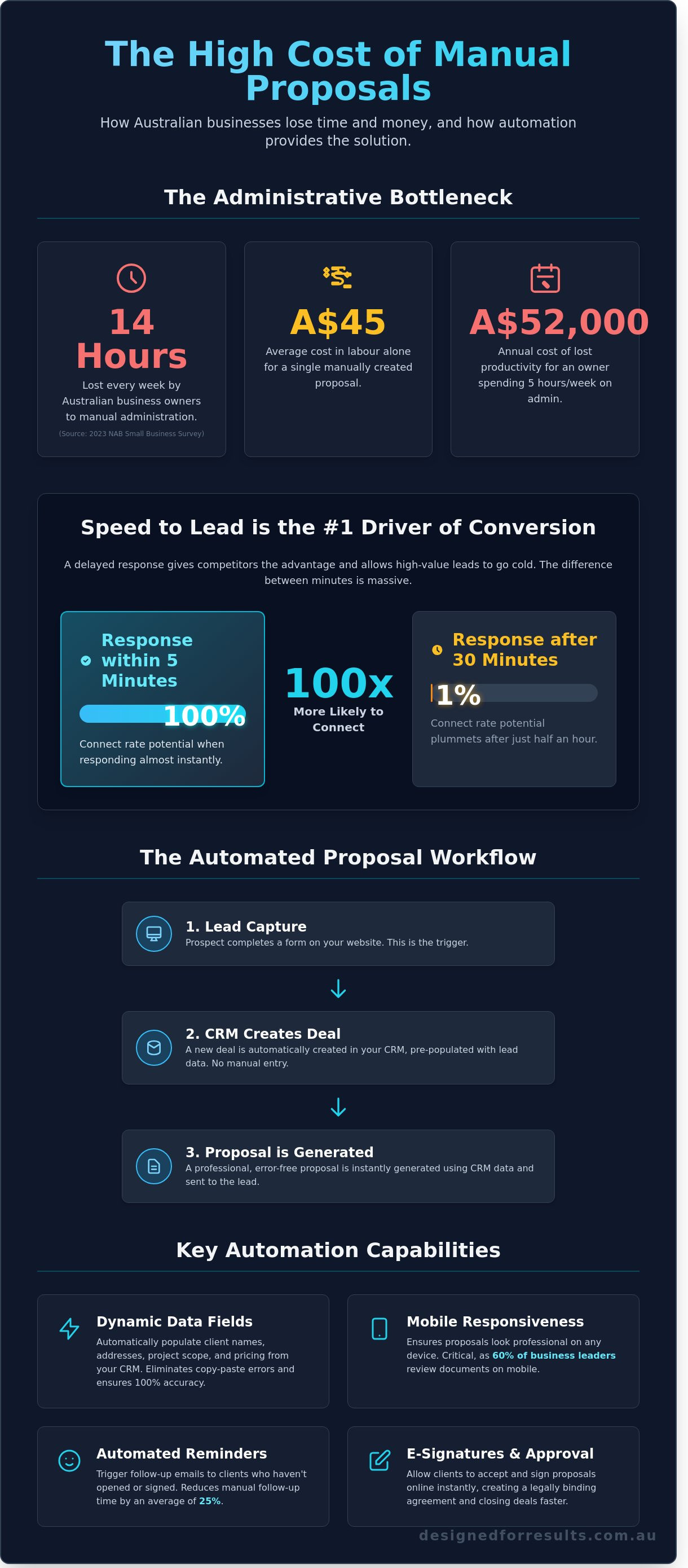
The 2023 NAB Small Business Survey revealed that Australian business owners lose an average of 14 hours every week to manual administration. This time is usually stolen from evening family commitments or high-level planning. Implementing automated proposals isn't merely a technical convenience; it's a vital tool to ensure high-value leads don't go cold while you're trapped in a cycle of repetitive data entry. Research indicates that businesses responding to inquiries within five minutes are 100 times more likely to connect with a lead than those waiting just 30 minutes.
It's exhausting to watch your evenings disappear into a mountain of paperwork that should've been finished by 5:00 PM. You've likely felt the frustration of losing a deal simply because a competitor was faster to the inbox. This article demonstrates how to eliminate manual document creation and transform your sales process into a high-speed conversion system. We'll explore how to reclaim your time, maintain professional consistency, and achieve a faster lead-to-deal timeline through effective automation. By removing the friction from your workflow, you can finally focus on closing deals rather than managing administrative chores.
The Impact of Manual Proposal Delays on Sales Growth
Australian businesses lose significant revenue through inefficient sales cycles. Manual document creation costs an average of A$45 per proposal in labour alone. When an owner spends four hours drafting a single quote, they aren't just losing time; they're losing momentum. High-performance sales teams know that speed to lead is the primary driver of conversion. Research indicates that businesses responding to a lead within five minutes are 100 times more likely to connect than those waiting 30 minutes. Manual entry delays this response by hours or days, causing professional friction and making the transition to automated proposals a commercial necessity.
The Problem of the Proposal Bottleneck
Leads go cold when they wait for a price. This bottleneck creates a heavy mental load for owners who must recall specific project details while juggling other tasks. Repetitive administrative work limits the ability of a business to scale because output is capped by the owner's personal capacity. Implementing Proposal software eliminates this ceiling. It ensures that automated proposals are sent while the prospect is still engaged, removing the friction of manual data entry and reducing avoidable errors that damage credibility.
Quantifying the Value of Your Time
Calculate the actual cost of your evening admin sessions. If a business owner values their time at A$200 per hour, spending five hours a week on basic data entry costs the business A$52,000 annually in lost productivity. This is a high price for tasks that don't generate revenue. Fast follow-ups build immediate customer trust and demonstrate professional reliability. Shifting away from manual processes allows for a direct focus on business development and high-level decision-making. Every hour reclaimed from a spreadsheet is an hour invested in measurable outcomes. Results depend on execution; waiting until 10:00 PM to send a quote is an execution failure that costs Australian business owners their growth potential and their personal time.
How Automated Proposals Integrate with Your CRM
Integration transforms your CRM from a passive database into an active sales tool. Automated proposals function as a direct bridge, mapping your existing lead data into professional templates without manual entry. This system ensures every piece of information, from the client's name to specific project requirements, flows directly from your CRM into the final document.
Leveraging Smart AI Solutions enhances this data mapping by identifying the most relevant case studies or service descriptions based on the prospect's industry. Using a centralised data source eliminates the risk of using outdated pricing or incorrect contact details. Accuracy becomes a byproduct of your system rather than a result of tedious double-checking.
The Lead Capture to Document Workflow
Efficiency begins the moment a prospect completes a website form. This submission acts as a trigger, automatically creating a new "deal" within your CRM and prepopulating the necessary fields. You move from lead capture to a generated document in seconds, skipping the administrative bottleneck that usually stalls momentum.
Eliminate the repetitive cycle of copying and pasting data from emails into Word documents. Australian business owners often spend five hours or more each week on these administrative tasks during their evenings. Automation reclaims this time. You focus on the strategy of the deal while the system handles the clerical heavy lifting. Achieving a high return on investment with document automation is possible when you remove human error from the initial workflow.
Maintaining Data Integrity
Consistency across your documentation builds professional trust. Automated systems use dynamic fields to insert personalised details across multiple pages instantly. If a project scope changes from A$5,000 to A$7,500 in your CRM, the proposal updates automatically. This synchronisation prevents embarrassing pricing discrepancies that can damage your reputation.
- Dynamic fields ensure client names and addresses are 100% accurate.
- Product selections map directly to inventory or service lists.
- Standardised terms and conditions remain protected from accidental edits.
Centralising your data ensures every team member produces documents that meet your high-performance standards. If you want to see how these systems can give you your evenings back, let's chat about your specific workflow needs.
Key Capabilities of Modern Document Automation Systems
Modern automated proposals function as more than static documents; they are dynamic tools that eliminate manual entry errors. A professional system must integrate with your existing CRM to pull client data directly into the document. This ensures accuracy and saves approximately 40 minutes per document according to 2023 workflow efficiency benchmarks. High-performance systems also offer automated reminders. These triggers send prompts to clients who haven't opened or signed a document within a set timeframe, such as 48 hours. This feature reduces the time spent on manual follow-up by 25% for the average Australian business owner.
- Dynamic Data Fields: Automatically populate client names, addresses, and ABNs to prevent repetitive typing.
- Mobile Responsiveness: Ensure proposals look professional on smartphones, as 60% of Australian business leaders review documents on mobile devices.
- CRM Integration: Sync data between your proposal software and platforms like HubSpot or Salesforce to maintain a single source of truth.
E-Signatures and Legally Binding Approvals
Removing friction from the final stage of a sale is critical for maintaining momentum. Integrated e-signatures allow clients to approve quotes instantly on any device. Under the Australian Electronic Transactions Act 1999, these digital signatures are as legally binding as ink on paper. Digital document management provides superior security through encrypted audit trails. These trails record the IP address and timestamp of every interaction, providing a level of verification that physical documents cannot match. This level of security protects the interests of the business while providing a seamless experience for the customer.
Tracking and Engagement Analytics
Real-time tracking provides a clear advantage for sales follow-ups. When a notification confirms a client has opened a proposal, a follow-up call within 10 minutes can increase the likelihood of closing a deal. Data from the 2024 Lead Response Management Study suggests immediate responses are significantly more effective than delayed ones. Analytics also reveal which sections, such as the pricing table or project timeline, the client viewed most frequently. If a client spends three minutes on the implementation section, the next conversation should focus on delivery logistics.
This data allows an Australian business to refine their automated proposals by removing low-engagement sections and expanding on areas that drive conversions. Using these insights ensures that every template is optimised based on actual client behaviour. For more information on implementing these tools, visit bespoke AI automation. Effective tracking moves the sales process from guesswork to a structured, data-driven operation that respects the time of both the owner and the client.
A Practical Roadmap for Automating Your Sales Documents
Transitioning to automated proposals requires a systematic approach to ensure your sales pipeline remains efficient and error-free. Start by auditing your current document workflow. Identify every repetitive task, such as manually typing client addresses or copying service descriptions from a spreadsheet. Research from 2023 indicates that many Australian business owners lose up to 10 hours a week on these administrative burdens, often working late into the evening to catch up. Select a toolset that integrates directly with your existing stack, such as Xero for invoicing or a local CRM. This integration ensures that data flows without manual intervention, removing the risk of double-entry errors.
- Audit your current process to isolate sections that never change, such as your ABN, bank details, and standard terms.
- Select software that offers native integrations with Australian accounting and CRM platforms.
- Map your data fields to ensure the system pulls the correct client information every time.
- Establish clear triggers, such as moving a deal to the "Quote Requested" stage, to initiate document creation.
- Train your team on the new workflow to ensure everyone follows the same high-performance standards.
Designing for Consistency and Speed
Create a master template that addresses 90% of your standard client needs. Identify static elements like your company profile, insurance certificates, and case studies. These remain constant. Then, map your CRM fields to the dynamic sections of the template. When a lead moves forward, the system pulls the client's name, project scope, and specific A$ pricing into the document. This precision accelerates delivery time from hours to minutes, allowing you to reach prospects while their interest is at its peak.
Testing and Optimisation
Run five test deals through the system before a full rollout. This identifies broken triggers or formatting issues that could alienate a prospect. Gather direct feedback from your team on the internal workflow to ensure it actually saves them time. Data from 2023 shows that businesses that refine their automation triggers every quarter see a 22% higher conversion rate. Regular maintenance ensures your templates reflect current Australian consumer law and updated service pricing. Ongoing adjustments prevent your automated systems from becoming stagnant or irrelevant as your business scales.
Ready to reclaim your evenings and streamline your sales process? Explore our bespoke automation solutions to get started.
Reclaiming Your Time with Bespoke Automation
Transitioning from manual administration to a structured sales system changes the trajectory of an Australian business. Most owners spend between 45 and 90 minutes drafting a single quote. This manual approach creates a ceiling on your capacity. Replacing repetitive tasks with automated proposals reduces this time to less than five minutes per lead. You move from being a technician trapped in paperwork to a leader focused on high-level growth and measurable outcomes.
The Shift from Admin to Leadership
Australian business owners often sacrifice 10 to 15 hours each week to evening administrative work. Eliminating this burden returns that time to your personal life while ensuring the business continues to function at a high level. A fast, automated response improves your professional image, as customers perceive speed as a marker of competence. This efficiency supports a high-performance culture where accuracy is the standard rather than a goal. You gain the freedom to lead your team instead of chasing signatures.
Next Steps for Your Business
Data from LeadConnect indicates that 78% of customers buy from the business that responds to their enquiry first. If your current lead follow-up time exceeds 24 hours, you're losing revenue to faster competitors. Review your current response times this week to identify where the delays occur. Identifying these bottlenecks is the first step toward reclaiming your schedule.
For businesses with complex requirements that standard software can't solve, Bespoke AI and Automation provides a tailored solution to streamline your operations. We focus on removing friction from your sales process so you can focus on the bottom line. Let’s Chat about your specific business bottlenecks and how to build a more efficient roadmap for your growth.
Scale Your Revenue Through Sales Efficiency
Manual paperwork often acts as a bottleneck that prevents Australian businesses from reaching their full potential. Implementing automated proposals reduces the time spent on administrative tasks by up to 80%, allowing your team to focus on high-value client interactions. Data from LeadSimple indicates that responding to a lead within five minutes increases the likelihood of conversion by nine times compared to delayed responses. Integrating these systems with your existing CRM ensures data accuracy and eliminates the repetitive data entry that keeps business owners working late into the evening.
Designed For Results specialises in creating revenue-generating workflows for Australian SMEs. We provide a no-nonsense implementation process that avoids technical jargon and focuses on measurable outcomes. By removing the friction from your sales process, you reclaim your time and establish a professional standard that builds trust with every prospect. It's time to replace manual effort with a system that works as hard as you do. You've built a great business; now let's make it run more efficiently.
Book a free automation strategy call with Designed For Results
Frequently Asked Questions
What are automated proposals and how do they work?
Automated proposals are digital documents generated by software that pulls client information directly from your CRM or enquiry forms into pre-set templates. These systems use logic-based triggers to populate pricing, project scopes, and company details instantly. By removing manual data entry, you ensure every prospect receives a professional quote in seconds, eliminating the delays that often lead to lost leads.
Can I still personalise my proposals if they are automated?
You can maintain high levels of personalisation by using dynamic content blocks and custom fields within your templates. Automation handles the repetitive 80% of the document, such as your terms and company bio, while leaving specific sections open for you to tailor the project scope. This balance allows you to address the client's specific pain points without rebuilding the entire document from scratch.
Do I need expensive software to automate my quotes?
Professional proposal automation is highly affordable for small Australian businesses, with entry-level platforms starting at approximately A$25 to A$45 per month. You don't need a complex enterprise suite to see a return on investment. Most owners find the software pays for itself within the first month by reclaiming roughly 6 hours of administrative time previously spent on manual formatting and follow-ups.
Is it difficult to integrate automated proposals with my CRM?
Integrating automated proposals with your existing CRM is typically a 15-minute task using native connectors or tools like Zapier. Most modern platforms are designed to sync seamlessly with Xero, HubSpot, or Pipedrive. This connection ensures that when a deal moves to a specific stage, the system automatically triggers the proposal generation process using the stored contact details and project requirements.
How much time can an Australian business save with proposal automation?
The average Australian business saves between 5 and 12 hours per week by automating their quoting and contract processes. For a manager whose time is valued at A$120 per hour, this represents a monthly productivity gain of over A$2,400. This reclaimed time allows you to focus on billable work or business development instead of spending your evenings stuck in front of a computer doing admin.
Are e-signatures on automated proposals legally binding in Australia?
E-signatures used in these systems are fully legal and enforceable under the Australian Electronic Transactions Act 1999. These digital signatures provide a secure audit trail, capturing IP addresses and timestamps for every interaction. This legal framework provides the same protection as a physical signature while significantly reducing the time it takes to get a commercial contract finalised and returned.
What happens if I need to change a detail in a generated proposal?
You can update any detail in a generated proposal by editing the draft within your software dashboard before it is sent. If a client requests a change after they have received the document, you simply update the live version. The link the client holds refreshes automatically, ensuring they always see the most recent A$ figures and project details without the confusion of multiple PDF versions.
Will my customers find automated proposals too impersonal?
Customers typically view automated proposals as more professional and efficient than manual emails. Speed is a major factor in modern purchasing; data shows that 50% of buyers choose the vendor that responds first. A polished, interactive proposal delivered immediately after a consultation demonstrates that your business is organised and respects the client's time, which builds significant trust from the outset.
