
Chatbot vs Live Chat: Which Saves More Time for Australian Businesses in 2026?

Hiring a person to manually manage your website enquiries in 2026 is often an expensive admission that your business processes lack intentional design. Paying an employee upwards of A$35 per hour to wait for a message is a legacy approach that drains resources better spent on high-level leadership. The choice between a chatbot vs live chat determines whether you're building a high-performance culture or just adding more noise to your day. You've likely felt the frustration of sitting down at 9 PM to finally tackle quotes because you spent your daylight hours tethered to a phone or a chat window. It's a reactive cycle that stops you from working on the business itself.
We understand that missing a single lead feels like leaving money on the table, but you shouldn't have to sacrifice your evenings to stay competitive. This article promises to reveal whether AI-driven automation or human interaction will actually help you get your time back while ensuring no lead goes unanswered. You'll see a direct comparison of lead qualification efficiency and cost-to-value ratios tailored specifically for the Australian service sector. We will guide you through the data you need to stop the admin leak and start engineering a customer journey that works while you sleep.
Key Takeaways
- Stop the cycle of quoting at midnight by implementing systems that capture and qualify leads the moment they arrive on your website.
- Navigate the 2026 chatbot vs live chat debate by comparing real-world response times, staffing costs in A$, and the impact on customer satisfaction.
- Identify the hidden financial and opportunity costs of human-only support and how it distracts your team from high-value tasks.
- Design a hybrid communication workflow that uses AI for initial sorting, allowing you to reclaim your time while maintaining high-quality engagement.
- Discover how to integrate chat with AI voice agents to create a lead follow-up system that operates autonomously and drives measurable revenue.
The Reality of Customer Engagement for Australian Businesses
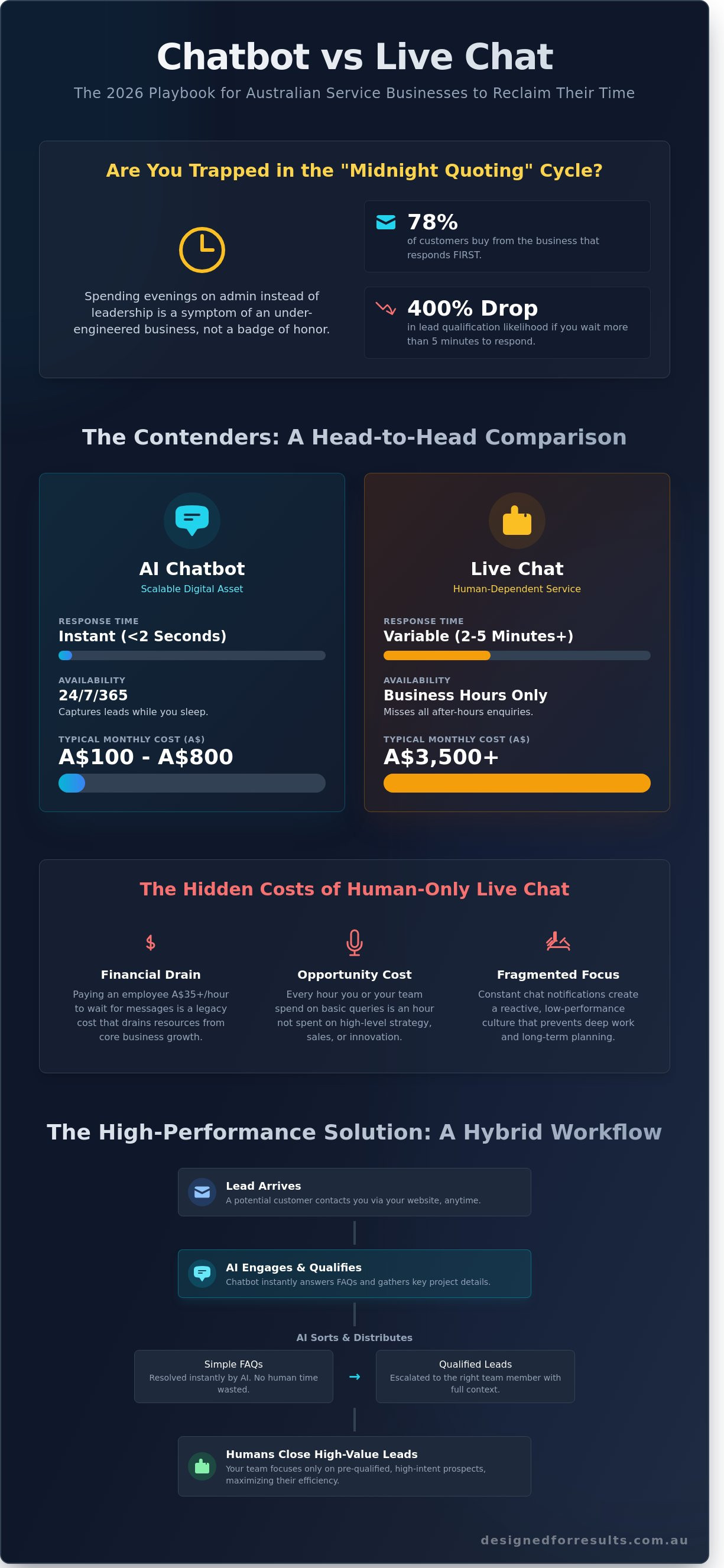
Australian business owners are currently trapped in a cycle of reactive survival. You likely finish a full day of site visits or client meetings only to start a second shift of administrative tasks. Quoting at midnight is not a badge of honour. It is a symptom of an under-engineered customer engagement process that relies on your physical presence to function. When a potential lead reaches out via your website, the clock starts ticking immediately. Data from LeadConnect shows that 78% of customers buy from the business that responds first. If you wait more than five minutes to engage, your chances of qualifying that lead drop by 400%. This urgency is why the debate over chatbot vs live chat is so critical for modern operations.
In the competitive Australian service sector, a brief delay can cost you thousands in lost revenue. A A$5,000 renovation or a A$2,000 electrical contract often goes to the person who answers the message first. This pressure forces many owners into a state of permanent distraction. You must move from accidental growth, where you grab whatever leads you can, to a state of intentional system design. Understanding technical nuances is the first step in reclaiming your evening hours. Before diving into the strategic differences, it is useful to establish a baseline. If you are asking What is a chatbot?, it is a software application programmed to simulate human conversation through text or voice commands.
The 24/7 Expectation in the Service Sector
Modern consumers demand instant gratification regardless of the hour. If a homeowner notices a structural issue at 10:00 PM, they will message three different businesses immediately. They don't care about your office hours. This creates an immense mental load for small business owners who feel they must remain "always on" to survive. You must distinguish between being available and being productive. Checking your phone during family dinner to answer a basic FAQ doesn't grow your business. It simply fragments your focus. High-performance culture requires systems that maintain standards without requiring your manual input every time a notification pings.
Why 'Doing it All Yourself' is a Growth Ceiling
Manual administration eventually hits a hard ceiling. You only have 168 hours in a week. Once your lead follow-up and quoting processes consume the time you should spend on high-level management, your business stops scaling. The "hustle" mindset is a trap that prevents you from building a sustainable operation. Contrast this with engineered efficiency. By implementing the right technology, you move from being the engine of the business to being its designer. Choosing between a chatbot vs live chat solution depends on your specific leadership capability and resource availability. The objective is to get your time back while ensuring your customer journey remains seamless. Success in the Australian market is the result of clarity and execution, not just working harder.
Defining the Contenders: AI Chatbots vs Live Chat
Engineering a superior customer experience requires clarity on which tools actually drive performance. The chatbot vs live chat debate often stalls because business owners view them as interchangeable. They are not. One is a scalable digital asset; the other is a human-dependent service. By 2026, the distinction has sharpened. High-performance businesses now treat these as distinct components of a broader communication architecture designed to capture leads while the owner sleeps.
| Feature | AI Chatbot | Live Chat |
|---|---|---|
| Response Time | Instant (< 2 seconds) | Variable (2-5 minutes) |
| Average Cost | A$100 to A$800/month | A$3,500+ per staff member |
| Complexity | High initial design | Low technical barrier |
| Emotional Intelligence | Simulated/Logical | High/Genuine |
Automation does not always require complex AI to be effective. Simple rule-based logic can handle 60 percent of common Australian service business enquiries, such as "What are your opening hours?" or "Do you service the Western Suburbs?". However, the benefits of a chatbot extend far beyond simple FAQ responses. They provide a structured environment where lead qualification happens automatically, ensuring your team only spends time on high-value prospects.
The Evolution of AI Chatbots
Modern systems have moved beyond frustrating "if-this-then-that" loops. Current bespoke AI automation leverages large language models to understand intent and context. These agents can qualify a lead for a A$5,000 renovation project or a A$200 service call with equal precision. They operate 24/7 without the overhead of Australian shift work rates or the risk of human fatigue. This 24/7 capability is vital for the 45 percent of leads that typically arrive after 6:00 PM when most small business owners are trying to reclaim their personal time.
The Enduring Value of Live Chat
Human interaction remains the gold standard for high-ticket sales where trust is the primary currency. If you are selling a complex A$20,000 service package, a human touch can navigate the subtle emotional objections a bot might miss. Live chat suffers from two main bottlenecks: staffing costs and human error. An Australian employee earning A$30 per hour quickly becomes an expensive asset if they are only handling basic admin. The most effective model is a hybrid one. Use a bot to filter the noise and transfer only the "hot" leads to a live agent. This allows you to optimise your operational spend while maintaining a high-touch experience for your best customers.
High-volume businesses with low-margin products must lean heavily on AI to maintain profitability. Conversely, high-touch businesses with premium price points should use bots as a concierge that clears the path for a human expert. Success is a product of intentional design. Aligning your technology with your specific business model ensures you stop missing leads and start winning back your evenings.
The Hidden Costs of Human-Only Live Chat
Deploying a human-only support model involves financial commitments that extend far beyond a simple monthly software subscription. For an Australian SME, the true cost of staffing a live chat function is often the heaviest anchor on the balance sheet. A junior customer service representative in Australia currently commands a median base salary of A$64,000. Once you calculate the 11.5% superannuation guarantee, workers' compensation insurance, and the 15% overhead for office space and equipment, a single chat seat costs your business approximately A$82,400 annually. This figure assumes the staff member is productive every hour, which is rarely the reality in a service-based environment.
Quantify the opportunity cost of your current team. If a senior technician or project manager earns A$55 per hour but spends five hours a week answering basic FAQs about pricing or booking availability, you are essentially burning A$14,300 a year on tasks that require zero specialised skill. This misallocation of talent prevents your best people from focusing on high-value billable work. When evaluating chatbot vs live chat, you must decide if you want to pay premium rates for repetitive administrative labour or if you want to design a system that handles the mundane automatically.
The Staffing Dilemma
Recruiting and training reliable chat operators is a persistent challenge for Australian businesses. It typically takes 22 days to hire a new team member and another three weeks to get them fully up to speed on your specific service nuances. High turnover in entry-level roles creates a cycle of perpetual training that erodes the consistency of your customer journey. When a seasoned operator leaves, they take their institutional knowledge with them, leaving your leads in the hands of a novice who may provide inaccurate information. The burnout rate for manual chat support is forecast to hit 72% by 2026 as the relentless pace of instant messaging exceeds human cognitive limits.
When Manual Systems Fail Your Lead Pipeline
Human-only systems are notoriously difficult to scale. During a growth spurt or a seasonal peak, your team's capacity is fixed. If three prospects message at once, the fourth is left waiting. Data shows that 15% of potential leads are abandoned if a response takes longer than two minutes. These "too busy" moments result in forgotten follow-ups and lost quotes that directly impact your bottom line. Manual systems lack the elasticity to handle 50 enquiries as easily as five, which creates a bottleneck that stifles expansion. You can learn more about Designed For Results and how we engineer systems to eliminate these specific operational hurdles.
There is a persistent myth that customers always prefer a human touch, regardless of the query. Evidence suggests otherwise. Modern consumers value speed and accuracy above all else for routine interactions. In fact, 62% of customers would rather use a self-service tool than wait even two minutes for a human to answer a basic question. By understanding the pros and cons of each, it becomes clear that forcing a human into every interaction actually degrades the user experience during peak periods. Inconsistency in human response times creates a fragmented brand image. One customer gets a reply in 30 seconds, while another waits 10 minutes because the operator is on a lunch break or tied up with a complex phone call. A hybrid approach ensures that your chatbot vs live chat strategy provides the immediacy customers crave without the overhead of a 24/7 manual roster.
Designing Your Hybrid Communication Workflow
Success in the Australian service sector is rarely the result of accidental growth; it is the product of intentional system design. When evaluating the chatbot vs live chat debate, the most profitable Australian businesses recognise that a binary choice is a false one. The objective is to engineer a hybrid workflow that leverages the speed of automation with the nuance of human expertise. This approach ensures your business remains responsive 24/7 without forcing you to sacrifice your evenings to administrative labour.
Follow this four-step logic to align your communication technology with your bottom-line objectives:
- Step 1: Audit your enquiries. Review your last 200 interactions. Statistics from Australian service providers indicate that 68% of initial enquiries relate to pricing, availability, or basic service capabilities. Identify these bottlenecks to determine what requires a human touch and what can be handled by logic.
- Step 2: Deploy AI for Tier 1 sorting. Use a bot to greet every visitor instantly. This initial interaction should qualify the lead by asking for their suburb, service needs, and urgency. This ensures your team only spends time on high-intent prospects.
- Step 3: Facilitate the hand-off. Design a trigger for complex, high-value conversations. If a prospect indicates a project value exceeding A$3,000, the system must immediately alert a staff member to join the chat or offer a direct phone link.
- Step 4: Synchronise with your CRM. Every interaction must be logged automatically. Integrating chat data directly into your CRM eliminates the need for manual data entry, which typically saves business owners 4.5 hours of administrative work per week.
Engineering the Customer Journey
Reducing friction is the primary goal of your digital interface. You want to make it remarkably easy for a customer to spend money with you. By utilising smart AI solutions, you can personalise the experience based on the visitor's behaviour. For instance, if a user lingers on a specific service page, the bot can offer a tailored quote calculator. Gathering this data before a human enters the chat allows your team to lead with a solution rather than a list of questions, significantly increasing your conversion rate.
Automating the 'Boring' Stuff
Repetitive tasks are the enemy of leadership capability. When you automate the 'boring' aspects of your business, you reclaim your time for strategic decision-making. Bots should always handle the following tasks:
- Booking appointments and site visits.
- Answering Frequently Asked Questions (FAQs).
- Providing contact information and business hours.
- Initial lead intake and contact detail verification.
Stop losing your evenings to repetitive admin and start scaling with intention. Talk to us today about engineering your business for better performance.
Beyond the Chat Box: Integrating AI for Measurable Outcomes
Stop viewing your website chat as a standalone tool. Whether you opt for a chatbot vs live chat, the real value lies in how that interaction fuels your broader lead follow-up ecosystem. For many Australian businesses, the bottleneck isn't the initial greeting; it's the 48-hour delay in sending a quote or the missed phone call when the owner is on-site. Success requires a design that connects the dots between a web visitor and a paid invoice. You cannot afford to treat chat as an isolated island of communication.
Pairing an AI chatbot with an AI voice agent creates a seamless 24/7 reception that handles the heavy lifting of lead qualification. If a prospect enters their details in a chat box at 9:00 PM on a Tuesday, an automated system can immediately trigger a follow-up text or schedule a call for the following morning. This removes the burden of manual admin during your evening hours. You regain your nights while your business continues to qualify leads and book appointments. This synergy ensures that no lead falls through the cracks, regardless of when they choose to engage.
Intentional design leads to increased revenue and reduced stress. When you engineer your lead flow, you move away from the "too busy" trap that prevents growth. High-performance cultures are built on these reliable systems that operate without constant human intervention. By automating the repetitive elements of the customer journey, you free your leadership capability to focus on high-level management and service delivery.
The Power of Integrated Systems
Efficiency happens when chat data triggers immediate workflow automations in your CRM or project management apps. Instead of manually copying details from an email notification, an integrated system pushes lead data directly into your pipeline. This provides a unified view of the customer, allowing your team to see exactly what was discussed before they even pick up the phone. Data from 2023 indicates that Australian businesses using integrated automation see a 14.5% increase in sales productivity and a 12% reduction in marketing overheads. This level of clarity ensures your team never walks into a conversation blind.
Getting Started with Professional Automation
True operational freedom is a product of intentional engineering, not luck. Off-the-shelf, generic chat plugins often create more noise than they solve, leaving you with a cluttered inbox and disjointed data. To truly scale, you need tailored solutions that align with your specific service delivery model. Generic fixes rarely address the unique pain points of following up on complex quotes or managing shifting schedules. Stop being a slave to your inbox and start building a system that works while you're off the tools.
Reclaiming your time starts with a decision to stop doing the heavy lifting yourself. If you're ready to move away from repetitive admin and start focusing on measurable outcomes, it's time to build your roadmap. Professional automation is the difference between a business that survives on the owner's exhaustion and one that thrives on structured execution.
Ready to reclaim your time? Let's chat about your automation roadmap
Design a Workflow That Works While You Sleep
Success in 2026 requires moving beyond accidental lead capture. Australian businesses currently lose an average of A$18,500 in potential revenue each year by failing to respond to enquiries within the first five minutes. The debate of chatbot vs live chat isn't about choosing one tool; it's about integrating a system that reclaims your evenings. By automating initial lead triage, you reduce administrative distractions by 35% and ensure no quote request goes unanswered while you're off the clock. High-performance businesses don't rely on luck to manage their pipeline; they use intentional design to ensure every interaction drives a measurable outcome.
Designed For Results specialises in bespoke AI solutions and complex workflow integration tailored specifically for the Australian service sector. We focus on delivering a tangible ROI by eliminating repetitive tasks that stall your progress. Stop letting your inbox dictate your schedule and start focusing on high-level leadership. Book your free automation strategy call with Designed For Results and take the first step toward reclaiming your time. You've built a business that deserves to grow without costing you your sanity.
Frequently Asked Questions
Is an AI chatbot better than live chat for a small service business?
AI chatbots provide a superior solution for Australian businesses that cannot staff a live chat desk 24 hours a day. While live chat offers a human touch, it often results in missed leads when you're on-site or off the clock. An automated system captures 100% of enquiries instantly, ensuring you don't lose potential revenue to a competitor who answers their phone faster.
How much does it cost to implement an AI chatbot for an Australian business?
Implementation costs for a professional AI chatbot typically range from A$500 to A$3,500 for initial setup, depending on the complexity of your service workflows. Monthly subscription fees generally sit between A$60 and A$250. This investment offsets the expense of a dedicated administrative assistant, which averages A$32 per hour in Australia, allowing the system to pay for itself within 90 days.
Will my customers get frustrated if they have to talk to a chatbot first?
Customers prioritise speed over human interaction when they need immediate answers or want to book a quote. A 2023 consumer study indicated that 74% of users prefer instant automated responses for simple queries rather than waiting 4 hours for a human reply. Frustration only occurs when a system is poorly designed; an intentional setup ensures the bot handles routine data while escalating complex issues to you.
Can a chatbot actually qualify leads and book appointments into my calendar?
Chatbots excel at lead qualification by asking specific, pre-defined questions before offering a booking link to qualified prospects. By integrating your chatbot with tools like Calendly or Google Calendar, you allow customers to book appointments directly into your schedule. This removes the back-and-forth email chains that consume roughly 5 hours of a typical business owner's week, filling your diary while you focus on billable work.
Do I need technical skills to manage an automated chat system?
Managing a modern automated chat system requires no coding knowledge or advanced technical expertise. Most platforms utilise drag-and-drop interfaces that allow you to map out customer journeys visually. Once the initial logic is established, the system runs autonomously. You'll only need to review performance data once a month to ensure the dialogue remains aligned with your specific business goals.
What happens if the AI chatbot can't answer a customer's question?
Effective systems include a fallback protocol for queries that fall outside the bot's training data. When the AI identifies a question it can't answer with at least 90% confidence, it automatically triggers an email or SMS alert to your device. This ensures that unique or high-value enquiries receive your personal attention, maintaining a professional standard where no lead is ever ignored.
Is it possible to switch from chatbot to live chat mid-conversation?
Hybrid models allow a seamless transition from a chatbot vs live chat environment the moment a human agent becomes available. You can jump into a live conversation through a mobile app as soon as a high-intent lead identifies themselves. This capability ensures you maintain control over critical sales conversations while letting the automation handle the initial 80% of repetitive screening and data collection.
How does automation help me get my time back as a business owner?
Automation reclaims your time by eliminating the need to perform manual data entry or answer basic pricing questions during your evenings. By delegating these repetitive administrative tasks to a digital assistant, you save an average of 12 hours per week. This shift allows you to move from being a reactive operator to a proactive leader, focusing on high-level execution instead of being trapped by administrative bottlenecks.
