
Mastering Lead Response Time: The Australian Business Guide to 2026 Sales

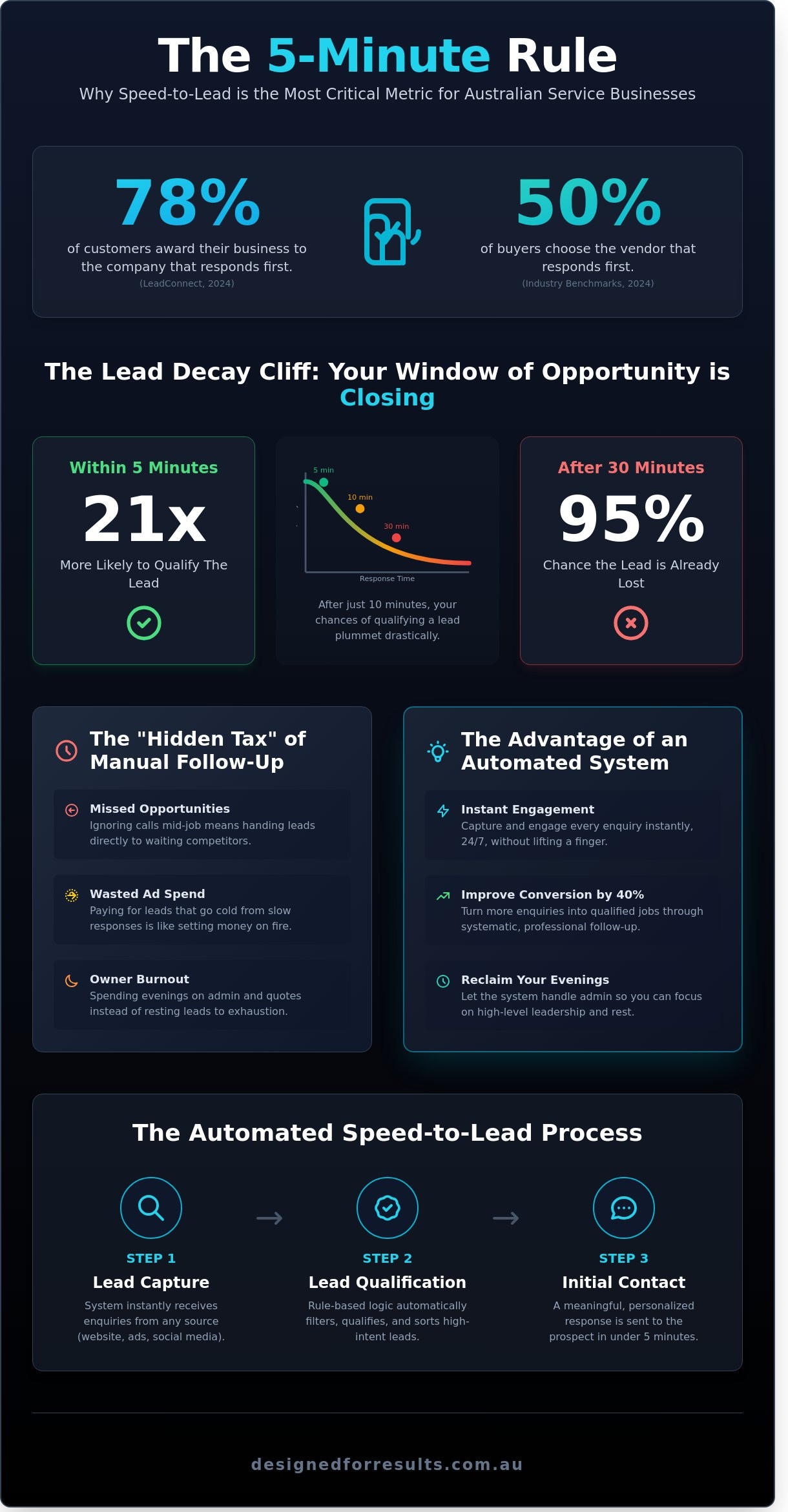
A 2024 report by LeadConnect found that 78% of customers award their business to the company that responds to their enquiry first. If you're taking more than five minutes to reply, you're likely handing your competitors a win. In the Australian service sector, your lead response time is the most critical factor in determining whether you scale or stagnate. You understand the stress of hearing your phone ring while you're mid-job, knowing that ignoring it means losing a lead while answering it disrupts your current client. It's an exhausting cycle that usually ends with you performing admin at 9:00 PM when you should be resting.
You deserve a business that operates with precision rather than luck. This guide will show you how to automate your follow-up processes to secure more leads without increasing your workload. We'll outline the exact steps to improve your conversion rates by 40% and provide a clear path to reclaiming your evenings. We will examine the transition from manual follow-ups to an automated system that captures every opportunity. It's time to stop chasing your tail and start winning back your time.
Key Takeaways
- Understand why lead response time is the primary metric that dictates revenue outcomes and learn to distinguish between generic auto-replies and meaningful engagement.
- Leverage the 5-minute rule to increase lead qualification rates by 21 times, securing prospects before their interest evaporates in the competitive Australian market.
- Stop paying the "hidden tax" of manual follow-up that consumes your evenings and weekends with repetitive administrative burdens and missed opportunities.
- Transition from manual effort to automated lead management to ensure your business captures every enquiry instantly without requiring your constant personal intervention.
- Reclaim your time by replacing accidental growth with intentional systems designed to drive measurable results while you focus on high-level leadership.
Understanding Lead Response Time for Australian Businesses
Lead response time measures the exact duration between a prospect’s initial enquiry and a business’s meaningful reply. In the Australian service sector, this interval dictates whether you secure a high-value contract or lose it to a competitor. A generic auto-reply stating "we've received your message" does not qualify as a response. Genuine engagement requires a human or an intelligently automated interaction that addresses the prospect’s specific needs and moves them closer to a transaction. It's the difference between a placeholder and a professional commitment.
Australian consumers in 2026 operate with a zero-friction mindset. They no longer respect the traditional 9-to-5 boundary. If a homeowner discovers a leaking pipe or a business owner seeks a commercial quote at 8:00 PM on a Tuesday, they expect an acknowledgement before they move to the next Google search result. Waiting until the following morning signals a lack of operational maturity. It tells the prospect that your business lacks the leadership capability to handle their requirements efficiently. This shift from business hours to an always-on expectation is now a baseline requirement for any organisation seeking strategic alignment with modern market demands.
The Definition of Speed-to-Lead
Speed-to-lead involves three distinct stages: lead capture, lead qualification, and initial contact. Successful Australian businesses treat this as a designed process rather than a series of fortunate events. Most local businesses rely on accidental response times, where a notification sits in an inbox until someone finds a spare moment between jobs. This lack of intentionality creates bottlenecks that stifle revenue and lead to missed opportunities.
Integrating robust lead management systems allows owners to automate the qualification phase. This ensures that only high-intent prospects reach your desk, saving you from the burden of manual sorting. Measuring your lead response time provides the baseline for all future business growth. You cannot optimise what you do not measure. By engineering speed into your workflow, you transition from reactive fire-fighting to proactive leadership.
Why Local Businesses Must Prioritise This Metric
Data from recent 2024 industry benchmarks indicates that 50% of buyers choose the business that responds first. Speed acts as a proxy for professional reliability. When you answer a query within five minutes, you demonstrate that your internal systems are healthy and that you have the capacity to take on new work. It builds immediate trust before a single word of the quote is even discussed.
Slow responses do the opposite. They suggest your business is overwhelmed or disorganised. For a time-strapped business owner, falling behind on lead follow-ups creates a compounding debt of administrative tasks. This burden often forces owners to spend their evenings quoting and chasing leads instead of resting. Prioritising lead response time through automation allows you to reclaim these hours. You stop being a slave to your inbox and start operating as a professional focused on measurable outcomes. Rapid response is not just about sales; it's about demonstrating that your business is built for results.
The 5-Minute Rule: Why Every Second Costs You Revenue
Speed isn't just a convenience; it's a competitive moat. When a prospect submits an enquiry to an Australian business, the clock starts a countdown to zero interest. According to landmark research from Harvard Business Review, you are 21 times more likely to qualify a lead if you respond within five minutes compared to waiting 30 minutes. This isn't accidental. It's the result of capturing a prospect while they're still in a window of intent, before their attention shifts elsewhere.
After 10 minutes, the lead decay curve turns into a cliff. By the time 30 minutes pass, your chances of qualifying that prospect drop by 400 percent. Most Australian business owners spend thousands of dollars on Google Ads or SEO to drive traffic. They essentially set that money on fire by allowing leads to sit in an inbox while they finish a job or eat dinner. If you don't answer, the consumer simply clicks the next result on their smartphone. Their loyalty lasts exactly as long as it takes to hit the back button.
Investing in faster lead response time offers a significantly higher ROI than increasing your marketing budget. If you spend A$1,000 to generate 20 leads but only reach 5 of them because of a two-hour delay, your cost per qualified lead is A$200. By designing a system that ensures a sub-five-minute response, you could reach 15 of those same 20 leads. This effectively triples your marketing efficiency without spending an extra cent on advertising. Success in the service sector is a product of intentional engineering rather than luck.
The Science of Conversion Decay
Prospects operate within a fleeting window of intent where their problem is top-of-mind and they're ready to commit. Every minute of silence allows doubt, distraction, or a competitor to intervene. Waiting 30 minutes to call back decreases your qualification chances by 400 percent because the emotional urgency of the prospect has dissipated. The 5-minute rule is the non-negotiable operational standard where every digital enquiry receives a response within 300 seconds to secure the customer's attention before they move on.
Calculating Your Current Response Performance
You cannot optimise what you don't measure. To find your actual lead response time, use this simple formula: Total time taken to respond to the last 10 leads divided by 10. Don't rely on a best guess. Audit your last 10 enquiries from your website or social media to find the real average. Distinction is key here. Time to call is just the start; time to value is how quickly you provide the solution or quote they need. If you're struggling to find the time for this, you might consider how to automate your lead engagement to reclaim your evenings and stop the revenue leak.
The High Cost of Manual Follow-Up: Escaping the Too Busy Trap
"I'm too busy" is a frequent refrain among Australian business owners. While it sounds like a sign of success, it usually signals a lack of operational design. When you rely on manual follow-up, you're essentially placing a ceiling on your own revenue. Every minute spent manually typing an SMS or an email is a minute stolen from high-value work or family time. This "Hidden Tax" is expensive. Statistics show that businesses responding within five minutes are 100 times more likely to connect with a lead than those waiting thirty minutes. For a local service provider, failing to optimise your lead response time means handing a potential A$2,000 or A$5,000 contract directly to a competitor who was faster to the phone.
Relying on memory is a recipe for missed revenue. Human-led follow-up is naturally inconsistent, especially during peak work periods when your focus is on current clients. You can't expect to maintain a high-performance culture when your lead management depends on whether you remembered to check your voicemail between jobs. Success is a product of intentional engineering, not luck. If your process requires you to be "on" 24/7 just to keep the lights on, you haven't built a business; you've built a cage.
The Myth of the Evening Admin Session
Quoting at 9 PM is a defensive move, not a strategic one. If a lead arrives at 10 AM, they're in "buying mode" at that exact moment. By the time you sit down with your laptop at night, that lead has cooled significantly. A Harvard Business Review study highlights that the odds of qualifying a lead drop by 10 times after just the first hour. Beyond the lost revenue, the mental load of carrying unreturned calls throughout the day creates a persistent state of low-level anxiety. This "always on" mentality leads to burnout because you're never truly present at work or at home. You're physically there, but your mind is stuck in an unorganised inbox.
Why Manual Systems Scale Poorly
Manual processes are inherently fragile. They rely on your memory, your energy levels, and your physical presence. When your business grows from five leads a week to twenty, a manual system hits a breaking point. You'll start to experience "leaky buckets" where enquiries simply vanish into the void. Relying on "getting to it later" is an accidental strategy that guarantees missed revenue. Implementing bespoke AI automation removes this human bottleneck entirely. It ensures that every enquiry receives an immediate, professional response, regardless of whether you're on a job site or asleep. Intentional design allows your business to scale without requiring you to work more hours. You get your time back while your lead response time remains flawless, ensuring no prospect is left waiting for a response that comes too late to matter.
- Immediate Engagement: Automated systems don't get distracted or tired.
- Consistent Experience: Every lead receives the same high standard of communication.
- Reduced Mental Load: Clear your plate of repetitive tasks to focus on leadership.
Stop treating your sales pipeline like a secondary chore. If you don't design a system to handle the load, the load will eventually break the business. Transitioning from manual chaos to automated precision is the only way to secure long-term growth and personal freedom.
Building an Automated Response System for 2026
Stop relying on manual reflexes to grow your business. Relying on a staff member to check emails or return calls between jobs creates a bottleneck that kills conversion rates. By 2026, the standard for Australian businesses will shift entirely toward automated systems that operate without human intervention. Transitioning from manual effort to an automated system isn't just about speed; it's about intentional design. A 2024 study by LeadConnect revealed that 78% of customers buy from the business that responds first. If you're busy on a job site, you've already lost the race. You need a system that acts while you're working.
The Foundation: CRM and Auto-Responders
Centralising lead data is the first step toward professional efficiency. A CRM acts as the brain of your operation, capturing every enquiry from your website, Facebook, or Google Business Profile instantly. The moment a prospect fills out a form, the system triggers an immediate SMS or email. This isn't a generic, robotic message. It's a personalised acknowledgement that addresses their specific needs and confirms you've received their data. Integrating smart AI solutions allows you to qualify these leads automatically. This ensures your lead response time is measured in seconds, not hours, and filters out tyre-kickers before they reach your desk.
The Future: AI Voice Agents and 24/7 Reception
Service based business owners often miss the most valuable leads because they're literally on the tools or driving between sites. AI voice agents solve this by acting as a 24/7 digital reception. These agents answer calls in a natural, professional tone, qualify the caller's needs, and book appointments directly into your calendar. They eliminate the voicemail death spiral where a potential customer hangs up and calls your competitor. By removing the need for a human to answer every initial enquiry, you reclaim your day. You focus on high-level execution while the system secures the next contract. This technology ensures that no prospect ever hears a busy signal or a generic recorded greeting again.
Implementing a Multi-Attempt Cadence
One touchpoint is rarely enough to close a deal in the Australian market. Data indicates that 70% of leads require at least five follow-ups before a booking occurs, yet most businesses stop after one failed call. An automated 3-day cadence keeps the lead warm without you lifting a finger. This sequence should be low-friction and value-heavy.
- Day 1: Send an immediate SMS with a link to a helpful project guide or a rough pricing estimate.
- Day 2: Deliver a brief email featuring a case study or a testimonial from a similar project completed in their local area.
- Day 3: Send a final automated check-in via SMS offering a specific time slot for a 10-minute discovery call.
Reclaiming Your Time: The Designed For Results Approach
Automation serves as the bridge between a business that consumes your life and one that funds it. Most Australian business owners view technology as an added layer of complexity or an unnecessary overhead. We view it as an architected solution for liberation. When you reduce your lead response time from several hours to a few seconds, you aren't just winning a new contract; you're reclaiming your evening. This shift marks the transition from being a slave to the phone to becoming an intentional business leader who directs a high-performance system.
The Designed For Results approach focuses on intentionality rather than accidental growth. We engineer systems that work while you sleep, ensuring that an enquiry received at 2 AM is handled with the same precision as one received at 10 AM. This consistency builds immediate trust with potential clients and protects your margins by eliminating the need for expensive, manual follow-ups. By removing the friction from your sales process, you create a seamless customer journey that reflects the professional standards of your brand.
Bespoke Systems for Australian Service Businesses
We don't believe in "off-the-shelf" software that forces you to change your natural workflow. Our process begins with mapping your specific sales journey to identify exactly where leads fall through the cracks. For many Australian businesses in the service sector, a single missed lead can represent anywhere from A$1,500 to A$15,000 in lost revenue. We don't just plug in tools; we design results based on your specific operational goals. This ensures your technology stack supports your staff rather than complicating their day. You can learn more about Designed For Results and how we prioritise measurable outcomes over hollow efficiency.
Taking the First Step Toward Automation
Complexity often leads to paralysis. To avoid this, we encourage business owners to start small by automating the most painful, repetitive task in their current workflow. For 70% of the managers we consult, this is the initial response to a website enquiry or the scheduling of a discovery call. Automating this single touchpoint can return up to five hours of productive time to your week. Over a year, that equates to 260 hours, or six full working weeks, returned to your life or your family.
Every minute you spend manually typing the same introductory email is a minute stolen from high-level leadership or personal rest. By architecting a system that handles these baseline interactions, you ensure your lead response time remains elite without requiring your constant presence. This is the path to a business that operates with discipline and clarity. If you are ready to stop reacting to your inbox and start leading with intent, book a strategy chat to get your time back. We will help you identify the specific bottlenecks holding your business back and design a structured path toward better performance and increased revenue.
Secure Your Competitive Edge Through Intentional Design
Speed is no longer a luxury for Australian businesses; it's a fundamental requirement for survival. Industry data indicates that responding within five minutes increases your chances of qualifying a lead by 21 times compared to a 30-minute delay. Relying on manual follow-up during your evening hours isn't a sustainable strategy. It's a recipe for burnout that leaves revenue on the table. By implementing an automated system, you replace accidental outcomes with measurable performance.
Mastering your lead response time allows you to reclaim your calendar while your competitors are still playing phone tag. As specialists in Australian SME automation, we deploy custom AI voice agents and boardroom-grade advice to ensure no enquiry goes cold. You don't need to be tethered to your phone to provide a high-performance customer journey. It's time to stop the administrative drain and focus on the high-level leadership your business requires.
Book your free automation strategy call to get your time back
You've built your business through hard work; now it's time to scale it through precision.
Frequently Asked Questions
What is the ideal lead response time for a service business?
The ideal lead response time for an Australian service business is five minutes or less. Data shows that responding within this window increases your conversion probability by 391 percent compared to later attempts. Businesses that engineer their systems for this speed capture interest while the prospect is still actively seeking a solution. Waiting even 30 minutes results in a 21x decrease in lead qualification, turning a hot prospect into a cold trail.
How much does lead response time actually affect conversion rates?
Your lead response time is the single greatest predictor of sales success in a competitive market. A study of 2,241 Australian businesses found that those attempting contact within an hour were seven times more likely to have meaningful conversations than those waiting longer. Speed creates a competitive moat. If you allow leads to sit until the evening, you effectively hand revenue to more responsive competitors who prioritise immediate engagement over accidental growth.
Can I use automation without making my business feel impersonal?
You can maintain a personal touch by using automation to handle the initial handshake rather than the entire conversation. Smart workflows use data points like the prospect's name and specific service interest to trigger immediate, relevant acknowledgments. This isn't about replacing human connection; it's about using technology to bridge the gap until you can step in. Properly designed automation ensures no lead feels ignored while you're busy on a job site or managing operations.
What happens if I respond to a lead after 30 minutes?
Responding after 30 minutes reduces your chances of qualifying a lead by 80 percent compared to a five-minute response. By this point, the average Australian consumer has likely contacted two other businesses or moved on to a different task. Delayed replies signal a lack of operational discipline. This lag forces you into a chase dynamic, where you spend more time and A$100s in hidden labour costs trying to reach someone who has already cooled off.
Do I need a large team to achieve a 5-minute response time?
You don't need a large team to achieve elite response speeds; you need intentional system design. Small Australian businesses often use automated SMS triggers and AI-driven scheduling to manage the first contact instantly. This removes the administrative burden from the owner, allowing you to focus on high-value work without missing opportunities. Automation acts as a digital receptionist that works 24/7 for a fraction of the cost of a full-time hire, helping you get your time back.
What tools are best for automating lead follow-up in Australia?
Leading tools for Australian businesses include platforms like GoHighLevel or HubSpot, which integrate directly with local SMS gateways. These systems allow you to automate follow-ups for as little as A$150 per month, which is far less than the cost of a missed A$5,000 contract. By implementing these tools, you eliminate the need to spend your evenings manually replying to enquiries. You gain back roughly 10 hours of personal time every week while increasing lead engagement.
Is an auto-reply email enough to count as a response?
A generic auto-reply email is a placeholder, not a true response. While it confirms receipt, it doesn't move the lead through your sales process or answer specific questions. To be effective, your initial contact must provide value, such as an instant booking link or a specific timeframe for a callback. High-performance businesses use multi-channel automation, combining email with an immediate SMS to ensure the prospect feels heard and prioritised across all communication platforms.
How can AI voice agents help with my lead response speed?
AI voice agents provide an immediate, human-like phone response the moment a lead submits a form. These agents can qualify the prospect, answer basic pricing questions, and book an appointment directly into your calendar. This technology ensures your lead response time remains under 60 seconds, even if you're on a ladder or in a meeting. It's a scalable way to ensure every enquiry receives a professional, high-conviction first impression without increasing your overhead or administrative workload.
