
CRM Data Hygiene Best Practices: A Guide for Australian Businesses in 2026

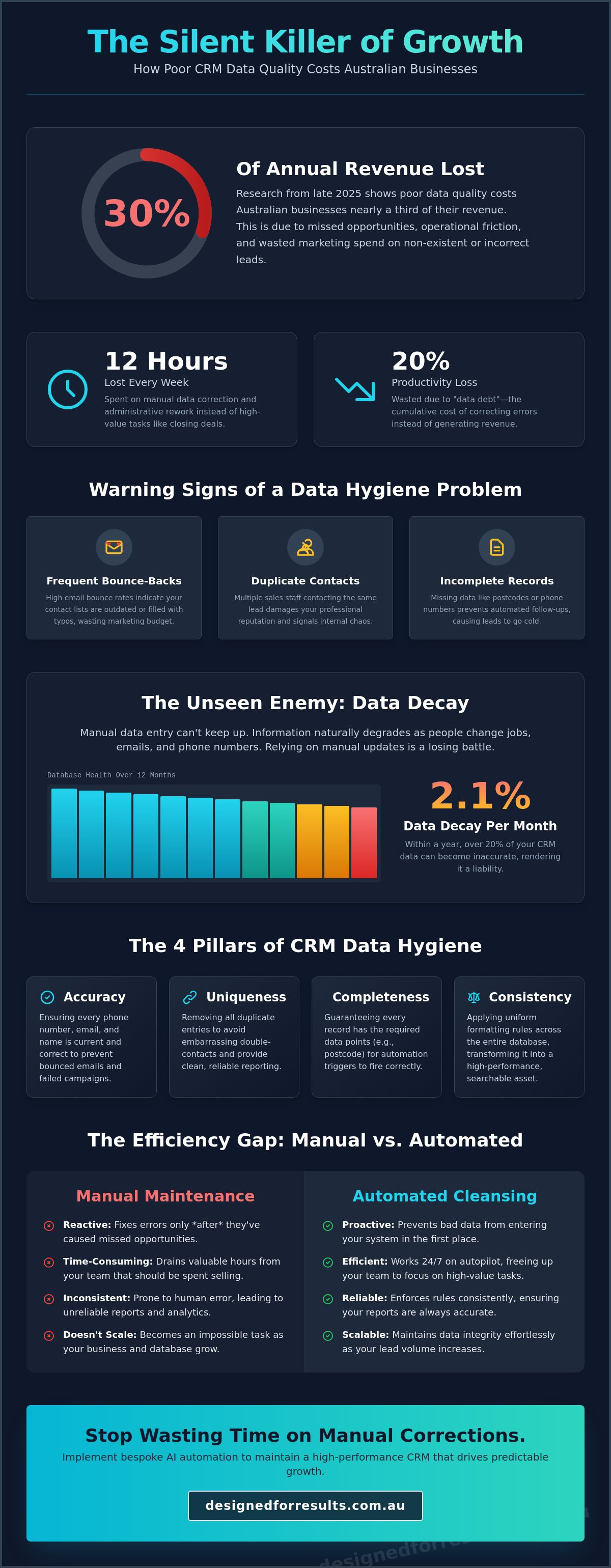
A CRM that requires manual corrections throughout the evening is a liability to your operations. Research from late 2025 indicates that poor data quality costs Australian businesses up to 30% of their annual revenue through missed opportunities and operational friction. Implementing crm data hygiene best practices is the only way to stop losing leads to mistyped digits or sending duplicate marketing emails to the same client. It's an exhausting cycle that prevents you from trusting your own reports for growth decisions.
This guide explains how to eliminate duplicate records, repair incomplete leads, and automate your maintenance routines to reclaim your time. By following these steps, you'll ensure your lead tracking is consistently accurate for 2026. We will demonstrate how to transition your system to a state of high-performance automation that works on autopilot; this allows you to focus on high-value tasks while providing a superior customer experience for every Australian business you serve. Reliable data provides the necessary foundation for predictable growth.
The Impact of CRM Data Quality on Australian Business Performance
CRM data hygiene is the ongoing process of ensuring customer information remains accurate, unique, and complete. It's the technical foundation of a high-performance sales operation. Without high-quality data, your CRM becomes a graveyard of missed opportunities rather than a tool for growth. Implementing data cleansing protocols ensures that your database remains a reliable asset that supports your team instead of slowing them down.
Poor data quality leads to failed lead follow-ups and wasted marketing spend. When contact details are incorrect, your team spends valuable hours chasing leads that don't exist or have already moved on. Research indicates that an Australian business can lose up to 12 hours every week to manual data correction and administrative rework. This is time that should be spent on high-value tasks like closing deals or refining service delivery. Clean data allows for accurate reporting and better financial decision-making, ensuring every A$ spent on marketing delivers a measurable return. Adopting crm data hygiene best practices is essential for any owner looking to reclaim their time and optimise their bottom line.
Signs Your Business Has a Data Hygiene Problem
- Frequent bounce-backs: High email bounce rates indicate that your contact lists are outdated or contain significant errors.
- Duplicate contacts: Sales staff contacting the same lead multiple times suggests your CRM lacks unique identifiers, which damages your professional reputation.
- Incomplete records: Missing phone numbers or industry tags prevent automated follow-up sequences from triggering, causing leads to stall in your pipeline.
Why Manual Data Entry Fails the Modern Business
Human error is inevitable when staff are rushed or tired. Inconsistent formatting, such as mixing international and local phone number formats, makes searching and segmenting your database nearly impossible. Data decay is the natural degradation of information as people change jobs and phone numbers, occurring at an average rate of 2% per month. Relying on manual updates to combat this decay is a losing battle that drains resources. You need bespoke AI automation to maintain accuracy without increasing your administrative workload. Establishing crm data hygiene best practices through automation ensures your records stay current as your business scales.
Core Pillars of CRM Data Hygiene Best Practices
Effective CRM management relies on four operational pillars: accuracy, uniqueness, completeness, and consistency. These pillars represent the fundamental crm data hygiene best practices that allow an Australian business to automate workflows without the risk of system errors. Accuracy involves verifying that every phone number, email address, and name is current and correct. Inaccurate records result in bounced emails and failed SMS campaigns, which directly impact your bottom line. Data decay happens at a rate of roughly 2.1 percent per month, meaning a database left unmanaged quickly becomes a liability.
Completeness ensures that every record contains the specific data points required for your automation triggers to fire. If a lead record lacks a postcode, your regional routing rules will fail. Uniqueness focuses on the removal of duplicate entries that cloud your reporting and lead to embarrassing double-contacts. Finally, consistency dictates that data follows a uniform format across the entire organisation. This logical structure transforms a cluttered database into a high-performance asset. The consequences of poor data quality often manifest as missed revenue and administrative bottlenecks. When your data is clean, your team spends less time fixing errors and more time engaging with high-value prospects.
Standardising Data Entry Protocols
Administrative errors usually occur because of a lack of clear rules. Eliminate "ghost" records by making essential fields mandatory for every new entry. If a staff member cannot save a lead without an email address, your database remains functional. Replace free-text fields with dropdown menus for categories like lead source, industry, or service type. This prevents variations like "Real Estate" and "Property" from splitting your data into two separate categories. Enforce strict rules for capitalisation and phone number formatting. Standardisation ensures your bespoke automation functions reliably every time a new lead enters the system.
Managing Duplicate Records and Information Silos
Data silos cost an Australian business time and money. When customer information is trapped in individual email inboxes or private spreadsheets, the rest of the team operates with a blind spot. Centralise every interaction within the primary CRM to maintain a single source of truth. Use unique identifiers, such as an Australian Business Number (ABN) or a primary email address, to automatically detect and merge duplicate records. This prevents the frustration of multiple staff members chasing the same lead. Eliminating these redundancies allows you to reclaim your evenings and focus on growth rather than manual data entry.
The Efficiency Gap: Manual Maintenance vs Automated Cleansing
Manual data maintenance is a losing battle against entropy. By the time a manual audit is finished, the records are already decaying. Australian businesses frequently lose 20% of their total productivity to data debt, which is the time spent correcting errors rather than generating revenue. Adopting crm data hygiene best practices requires a shift from human-led correction to system-led prevention.
The Limitations of Periodic Manual Audits
Manual cleaning is a reactive process. It addresses inaccuracies after they've caused missed opportunities or failed deliveries. Staff often view data entry as a low-priority task, which leads to neglect and inconsistent records. The financial burden is also high. When an Australian business pays a team member A$40 per hour to cross-reference 1,000 records, the labour cost outweighs the benefit of a clean list. Data decays at roughly 2% every month, meaning a manual audit is functionally obsolete within weeks.
Real-time Validation and Data Enrichment
Automation solves the problem at the point of entry. Software validates email addresses and phone numbers as they are typed into forms, blocking invalid data before it reaches the database. Advanced tools enrich leads by pulling company size and industry data based on a domain name. This reduces friction for the customer and improves lead scoring for the business. Ensuring your bespoke AI automation includes data validation steps is essential for long-term accuracy.
Australian businesses save dozens of admin hours per month by automating these hygiene tasks. This consistency ensures that sales, marketing, and operations teams always view the same accurate record. Integration between tools ensures data remains consistent across the business. When a customer updates their address in an accounting platform, automation should push that change to the CRM immediately to eliminate double entry.
- Validate contact details instantly to maintain high deliverability and reduce bounce rates.
- Enrich records with third-party data to provide sales teams with context without manual research.
- Connect CRM and accounting tools to ensure a single source of truth for every customer interaction.
Effective crm data hygiene best practices remove the need for evening admin sessions. They allow owners to focus on high-level strategy while the system maintains the integrity of the database automatically.
Implementing an Effective Data Hygiene Routine
Success in lead management requires a disciplined approach to system maintenance. Australian businesses often lose hours every week chasing incorrect contact details or filtering through duplicate entries. You can stop this waste by following a structured routine that turns your CRM into a high-performance asset. Clean data is not a luxury; it is a fundamental requirement for any business looking to scale without increasing administrative overhead.
Start with a five-step process to reclaim your database. First, conduct a comprehensive audit to identify the current state of your data. Second, define your Golden Record. This is the mandatory information every lead must contain to be useful for your sales team. Third, clean the existing database using deduplication tools to remove redundant entries. Fourth, establish automated workflows that validate data at the point of entry. Finally, schedule regular review intervals to monitor system health and prevent future decay.
Conducting a Comprehensive CRM Data Audit
Begin your audit by measuring the depth of the problem. Research from 2023 indicates that B2B data decays at a rate of roughly 30 percent annually. Identify the percentage of records with missing phone numbers or emails. Often, you will find that 20 to 25 percent of your database is functionally useless because of these gaps. Locate the sources of this dirty data. It usually stems from legacy spreadsheets or web forms that lack validation rules. Evaluate every field in your system. Remove the fluff fields that don't drive business decisions. If your team hasn't used a specific data point in the last six months, it's likely cluttering your workflow.
Establishing Ongoing Maintenance Schedules
Consistency is the only way to maintain crm data hygiene best practices over the long term. Set a recurring monthly calendar invitation to review system-generated error reports. This prevents small errors from compounding into systemic failures. Assign clear ownership of the CRM to a specific team member. When one person is accountable for data integrity, standards remain high. This oversight ensures that your database remains a reliable source of truth for your sales activities. A clean CRM is a prerequisite for smart AI solutions to function correctly. Without accurate inputs, even the most advanced automation will produce flawed results.
Adopting these crm data hygiene best practices ensures you spend less time on administration and more time on high-value revenue generation. It removes the friction that prevents Australian business owners from scaling effectively. Every minute you spend fixing a broken record is a minute you aren't closing a deal.
Leveraging Automation to Maintain Long-term Data Integrity
Manual data entry is a significant drain on resources for Australian businesses. It's often the primary cause of duplicate records and incorrect contact details. High-performing organisations treat data as a valuable asset that requires constant protection. Implementing crm data hygiene best practices through automation ensures your database remains a reliable tool for revenue generation rather than a cluttered archive of missed opportunities.
Connecting website forms directly to your CRM removes the friction of manual input. This integration allows lead data to flow instantly into your pipeline. When you link your CRM with financial tools like Xero, you ensure that billing addresses and ABN details remain synchronised across your entire operation. This connectivity prevents the common frustration of chasing payments due to outdated contact information.
Workflow automation also handles the tedious task of standardising data formats. You can set rules to automatically correct phone numbers to the +61 format or capitalise names and addresses. Automated lead follow-ups should only trigger for records that meet your specific hygiene standards. This protects your sender reputation and ensures your sales team focuses only on verified, high-quality prospects.
Connecting Lead Capture to CRM with Validation
Data integrity begins at the point of entry. Smart forms act as a first line of defence by blocking invalid email formats or obviously fake phone numbers. This gatekeeping ensures your database isn't poisoned by low-quality submissions. Configuring these forms to segment leads automatically based on the services they select allows you to deliver a tailored customer journey from the very first touchpoint, increasing the likelihood of conversion.
Workflow Automation for Continuous Accuracy
Data decays at a rate of approximately 2.1% per month as people change jobs or move house. To combat this, set up triggers that alert your team when a record hasn't been updated in six months. Automation can also handle document collection, such as requesting updated insurance certificates or trade licences from clients without manual intervention. This proactive approach keeps your records current and your business compliant. To reclaim your time and fix your data, let’s chat about your automation needs.
Secure Your Business Performance Through Data Integrity
Poor data quality costs Australian businesses thousands in missed opportunities and wasted labour every year. Transitioning from manual maintenance to automated cleansing recovers approximately 15 hours of management time every month. Adopting crm data hygiene best practices ensures your database remains a reliable asset for rapid lead conversion and accurate quoting. A functional system supports growth and removes the burden of repetitive manual entry during your evenings.
Designed For Results specialises in workflow automation for Australian SMEs, focusing on measurable outcomes and significant time savings. Our no-code solutions provide technical efficiency and don't require specialised expertise from your team. This approach allows you to focus on high-level leadership while your systems handle the routine processing. Book an automation strategy call to clean up your CRM systems and establish a clean data environment for your business. Taking control of your data today builds a foundation for sustained performance throughout 2026 and beyond.
Frequently Asked Questions
What are the main causes of poor CRM data hygiene?
Human error during manual entry and a lack of system integration cause 60% of data decay according to industry benchmarks. Duplicate entries often occur when web forms lack validation rules or when multiple staff members enter the same lead details. Outdated information is another factor; roughly 25% of B2B contact data becomes inaccurate every year as people change roles or Australian businesses relocate.
How often should an Australian business clean its CRM data?
Conduct a deep clean every 90 days to maintain system integrity. Australian businesses typically experience data decay rates of 2% to 3% per month. Setting a quarterly schedule ensures your marketing lists remain compliant with the Australian Spam Act 2003 and prevents wasted spend on undeliverable communications. Regular maintenance gives you back the hours usually spent fixing errors during high-pressure sales periods.
Can I automate the process of deduplicating CRM records?
Yes, you can deploy automation tools that merge duplicate records based on unique identifiers like email addresses or Australian Business Numbers (ABNs). Modern CRM platforms allow you to set background rules that flag or merge identical entries automatically. This removes the need for manual auditing and ensures your team works from a single source of truth, allowing for faster follow-ups on quotes.
What is the fastest way to fix incomplete lead data?
Use data enrichment services to automatically populate missing fields such as industry, company size, or professional profiles. These tools scan public records and databases to fill gaps in seconds. Integrating an enrichment API into your CRM is the most efficient method to ensure your sales team has the context they need without performing manual research during their evenings.
How does poor data hygiene affect my automated marketing campaigns?
Inaccurate data leads to high bounce rates and poor engagement, which can damage your sender reputation. If 10% of your email list is invalid, your messages might be flagged as spam by Australian ISPs. Maintaining crm data hygiene best practices ensures your automated workflows trigger correctly and deliver personalised content that improves the customer journey and drives revenue.
Is it better to clean data manually or use a professional automation service?
Automation is the superior choice for any business managing more than 500 records. Manual cleaning is prone to human error and consumes hours of administrative time that owners should spend on leadership and high-level management. Automation services provide consistent application of data standards and scale as your database grows, ensuring your records remain professional and useful.
What are the most important data fields to keep clean for an SME?
Focus on email addresses, mobile numbers, and lead sources to ensure reliable communication and accurate ROI tracking. Accurate contact names and company details are also vital for professional personalisation. Keeping these five core fields clean allows for effective follow-ups and prevents the embarrassment of sending incorrect information to a prospect, which protects your brand reputation.
How do I stop my staff from entering "dirty" data into the system?
Implement mandatory fields and dropdown menus to restrict data entry options and ensure consistency. Use validation rules to ensure phone numbers follow the Australian 10-digit format and email addresses contain the correct syntax. Training your team on the importance of data quality helps them understand how clean records reduce their own repetitive administrative tasks and improve their sales outcomes.
