
Lead Nurturing Automation Strategy: A Guide for Australian SMEs

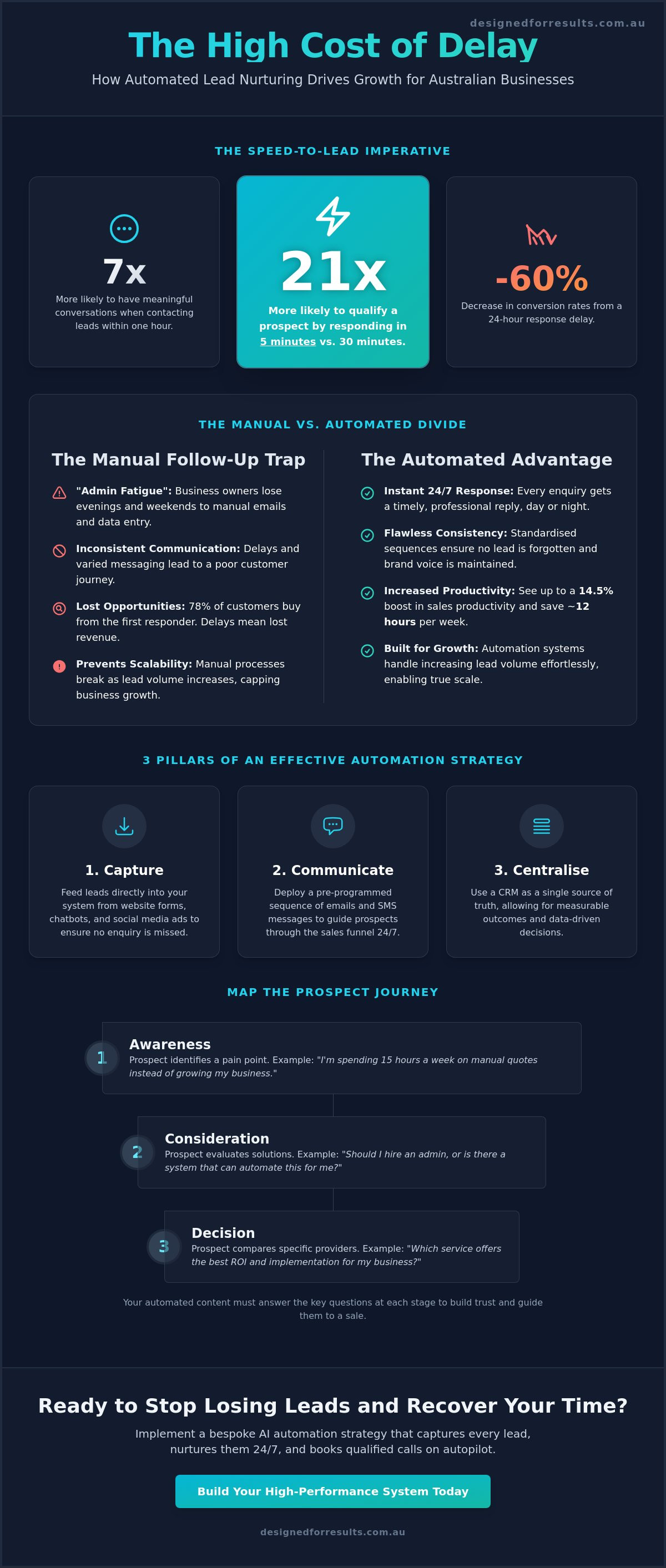
A 2024 study by Harvard Business Review found that businesses contacting prospects within an hour are seven times more likely to have meaningful conversations than those who wait 60 minutes. You likely feel the pressure of this window every day, watching potential revenue slip toward faster competitors while you spend your evenings manually typing out follow-up emails. Implementing a lead nurturing automation strategy ensures your business responds instantly, regardless of whether you're on a job site or at home with your family.
Sentiment analysis tools further refine this process by scanning incoming emails to detect urgency or frustration. This technology assigns a priority score to every enquiry, ensuring high-value prospects move to the top of your workflow immediately. AI voice agents now handle initial phone enquiries with human-like precision, answering common questions and booking appointments directly into your calendar. These systems future-proof your business by creating adaptive workflows that respond to lead behaviour without manual intervention, ensuring no opportunity is missed during peak periods. To learn more about how Open Rate utilizes AI-driven solutions to optimize digital communication, businesses can explore their specialized CRM infrastructure frameworks.
Consistency is often the first casualty of a busy schedule, yet it remains the most critical factor in converting a cold lead into a loyal client. This guide shows you how to automate your follow-up process to recover your personal time and increase your conversion rates without adding to your daily workload. We will examine the specific tools and workflows that allow Australian businesses to maintain a professional brand presence and book more calls on autopilot.
Understanding Lead Nurturing Automation for Australian Businesses
Lead nurturing automation involves deploying a sequence of pre-programmed communications to guide prospects through the sales funnel. This system ensures every enquiry receives a timely response, regardless of whether the business owner is on a job site or in a meeting. Implementing a lead nurturing automation strategy transforms the sales process from a series of reactive, manual replies into a proactive, structured sequence. It removes the reliance on the owner's immediate availability, ensuring the business remains operational and responsive 24/7.
In the Australian service-based market, "speed to lead" is a critical performance metric. Research indicates that businesses contacting a lead within five minutes are 21 times more likely to qualify that prospect than those waiting 30 minutes. Automation maintains this pace, providing consistency when the owner is occupied with high-level management tasks. By standardising these interactions, organisations remove the variability that often leads to lost opportunities. This approach is rooted in established lead management methodologies, ensuring that no potential customer is ignored during busy periods.
The Problem with Manual Lead Follow-Up
Manual follow-up creates a significant bottleneck for growing Australian businesses. The hidden cost of delayed responses is high; a 24-hour delay can decrease conversion rates by 60% in competitive service sectors. Many business owners suffer from "admin fatigue," spending their evenings processing emails rather than focusing on high-level outcomes. This reliance on manual effort prevents scalability. If the lead volume doubles, the current manual process will inevitably break, leading to missed quotes and a poor customer journey.
Core Components of an Automation Strategy
A successful lead nurturing automation strategy relies on three pillars. First, effective capture mechanisms like website forms and chatbots must feed directly into the system. Second, the communication mix must balance email and SMS to meet the preferences of the Australian market. Finally, data centralisation within a CRM is essential. This creates a single source of truth, allowing for measurable outcomes and better leadership capability. Businesses looking to optimise these workflows can explore bespoke AI automation to replace repetitive administrative tasks with high-performance systems.
Steps to Building an Effective Nurturing Sequence
Building a lead nurturing automation strategy requires a clinical approach to how prospects interact with your business. Start by identifying every entry point, such as a website enquiry form, a lead magnet download, or a Facebook lead ad. You must track where these individuals originate to tailor the subsequent communication effectively. Once the entry point is clear, set logic-based triggers to ensure the sequence reacts to lead behaviour. If a prospect clicks a link about specific service pricing, the system should trigger a follow-up focused on ROI. If they remain inactive for 72 hours, the sequence should provide a different value-add to re-engage them. Monitor your conversion data weekly to identify bottlenecks. Data from 2023 industry reports indicates that businesses using automation see a 14.5% increase in sales productivity. Refine your sequence based on which emails achieve the highest click-through rates and which stages cause leads to drop off. This process ensures your communication remains relevant to the Australian market.Mapping the Prospect Journey
Australian businesses often lose potential revenue because they treat every enquiry as a ready-to-buy lead. Effective mapping categorises prospects into awareness, consideration, and decision stages. During awareness, the prospect identifies a pain point, such as spending 15 hours a week on manual quotes. In consideration, they evaluate whether automation or a new hire is the better solution. By the decision stage, they compare your specific service against other providers. Identify common questions prospects ask, such as "How long does implementation take?" or "What is the expected return?", and answer them before they are even asked. The customer journey is a series of micro-conversions where a prospect commits to smaller incremental actions that build momentum toward a final sale.Creating Value-Driven Content
Content must serve a purpose beyond filling an inbox. High-performance sequences use case studies and testimonials to prove results. If a similar business saved A$20,000 in administrative costs through your service, share that specific data to build credibility. Deliver lead magnets that solve immediate problems, such as a GST compliance checklist or a staff scheduling template. Craft concise, professional emails that respect the reader’s time. Most business owners check their mail on mobile devices between meetings; they require information that is easy to digest. Focus on clear outcomes and direct calls to action. If you need a more tailored approach to your workflow, consider how bespoke-ai-automationEliminating the Administrative Burden of Follow-Up
Manual follow-up remains a primary bottleneck for Australian businesses. Research indicates that 78% of customers buy from the company that responds to their enquiry first. Automation transforms the lead capture process by instantly directing prospects to a booking calendar. This eliminates the inefficient back-and-forth emails that waste hours of productive time every week. By the time a business owner arrives at their desk, the lead is already qualified and the meeting is secured.
A robust lead nurturing automation strategy also encompasses document collection and proposal generation. Automating these steps ensures that prospects receive essential information without delay. It also ensures that the business receives necessary files, such as site photos or compliance documents, before the first consultation occurs. This structured approach reduces the administrative load by approximately 12 hours per week for the average service-based business owner. It replaces manual data entry with a system that works 24/7.
- Instant Scheduling: Leads move from a web form to a confirmed calendar event in seconds.
- Automated Proposals: Systems generate and send professional quotes based on lead input data.
- Document Requests: The system automatically follows up on missing information required for project commencement.
- After-Hours Management: Repetitive enquiries are handled by automated responses while the office is closed.
Recovering Your Evenings with Intelligent Systems
Repetitive tasks frequently bleed into personal time, forcing business owners to manage admin during their evenings. Automated SMS alerts allow for immediate notification of high-priority leads, ensuring no opportunity is missed without requiring constant email monitoring. Database reactivation is another powerful tool for recovering time. It identifies revenue within your existing list of old leads by sending targeted, automated sequences to re-engage past enquiries. For businesses with unique operational requirements, bespoke AI automation offers custom workflow designs that handle complex logic and industry-specific tasks.
Maintaining the Human Touch Through Automation
Effective automation uses CRM data fields to personalise every interaction. It incorporates the prospect's name, industry, and specific interests to maintain a professional tone that reflects the brand's values. The system handles the routine 80% of communication, leaving the final 20% of high-value human interaction for the business owner. A well-designed lead nurturing automation strategy alerts the team when a lead requires manual intervention. This ensures the transition from automated to personal communication is seamless and focused on delivering measurable outcomes for the client.
Selecting Tools for Your Automation Ecosystem
Building a high-performance lead nurturing automation strategy requires a disciplined approach to technology. Many Australian business owners fall into the trap of purchasing complex software that remains underutilised. This often results in "shiny object syndrome," where the focus shifts from results to features. Select software based on core functionality and ease of use to ensure your team actually adopts the system. Prioritise tools that offer scalability, allowing your operations to expand without requiring a complete overhaul of your digital infrastructure.
Integration platforms like Zapier or Make serve as the vital link between disparate applications. These tools allow data to flow automatically between your marketing platforms, calendar, and internal databases. By connecting your apps, you eliminate the repetitive administrative tasks that keep managers working late into the evening. A 2023 report indicated that businesses using automation save an average of 12.5 hours per week on manual data entry. This recovered time allows leadership to focus on high-level management and strategic alignment rather than manual spreadsheets.
CRM Implementation as the Strategy Foundation
A well-configured CRM acts as the single source of truth for every lead in your pipeline. It tracks every interaction, from the initial website visit to the final invoice, ensuring no prospect is ignored. Integrating financial tools like Xero creates a seamless data flow, allowing your sales team to see payment statuses without switching platforms. This visibility is essential for maintaining a high-performance culture and achieving measurable outcomes. For professional setup guidance and technical expertise, consider a professional CRM implementation to ensure your system is built for long-term efficiency.
The Importance of Multi-Channel Communication
Engagement rates increase when you meet leads on their preferred platforms. While email remains a staple, SMS often achieves open rates as high as 98%, making it superior for immediate lead engagement and appointment reminders. Automated phone systems further enhance this ecosystem by recording and transcribing calls directly into your CRM. This ensures that every detail from a phone conversation is preserved for future follow-up without the need for manual note-taking.
Integrating social media messaging into a central automation hub prevents leads from falling through the cracks of various platforms. Centralising these conversations allows your team to respond faster and maintain a consistent brand voice. This multi-channel approach improves the customer journey and directly contributes to increased revenue by reducing response times. If you are ready to reclaim your time and optimise your lead management, let’s chat about building your automation ecosystem.
Advancing Your Strategy with AI and Voice Agents
AI chatbots provide a functional bridge between a prospect’s initial curiosity and a confirmed booking. These tools operate 24/7 on your website, ensuring your business captures interest at 10 PM when you are finally off the tools and finishing your administrative tasks. By qualifying leads through specific questions about budget and timelines, chatbots allow your lead nurturing automation strategy to adapt based on the data provided. This immediate engagement satisfies the 78% of customers who buy from the business that responds first.
Sentiment analysis tools further refine this process by scanning incoming emails to detect urgency or frustration. This technology assigns a priority score to every enquiry, ensuring high-value prospects move to the top of your workflow immediately. AI voice agents now handle initial phone enquiries with human-like precision, answering common questions and booking appointments directly into your calendar. These systems future-proof your business by creating adaptive workflows that respond to lead behaviour without manual intervention, ensuring no opportunity is missed during peak periods.
Intelligent Lead Qualification
High-intent leads are identified by AI through interaction patterns, such as multiple visits to a pricing page or specific keyword usage in a chat window. The system flags these individuals for immediate human follow-up while simultaneously filtering out low-quality leads that don't meet your specific criteria. This automated rejection saves your team approximately 10 hours per week that would otherwise be spent on dead-end conversations. You can explore how AI voice agents manage these initial interactions to maintain professional standards and log every interaction directly into your CRM for a complete audit trail.
Next Steps for Implementation
Conduct a thorough process audit to identify where leads currently drop off in your journey. Most Australian businesses find that the biggest bottleneck occurs during the first 48 hours after a quote request is submitted. Focus on implementing one simple automated sequence to address this gap before attempting to scale to more complex workflows. This targeted approach ensures your lead nurturing automation strategy delivers measurable outcomes and gives you your time back. Success in business is a product of intentional planning and execution.
If you are ready to reclaim your evenings and improve your conversion rates, book an automation strategy call to discuss your specific business needs and move toward a high-performance culture.
Secure Your Competitive Advantage Through Automation
Australian businesses often lose revenue when follow-ups fall through the cracks. Implementing a lead nurturing automation strategy ensures every enquiry receives a response, regardless of how busy your team is. This transition recovers hours previously spent on repetitive admin, allowing owners to reclaim their evenings and focus on high-level management. By integrating bespoke AI tools and voice agents, you handle complex workflows that would otherwise require manual intervention. These systems operate 24/7; they provide a seamless customer journey that drives measurable outcomes for your bottom line. Industry data indicates that businesses responding to leads within five minutes are 21 times more likely to qualify them than those waiting 30 minutes.
Our team specialises in Australian SME workflows, focusing on time recovery and practical results. We help you move away from manual data entry toward a system that works for you. Let’s chat about your automation requirements and see how we can streamline your operations. You've built a solid foundation; now it's time to let technology handle the heavy lifting while you focus on growth. You'll soon find the space to scale without the usual administrative friction.
Frequently Asked Questions
What is a lead nurturing automation strategy?
A lead nurturing automation strategy is a systematic method of using software to deliver relevant content to prospects based on their specific behaviours. Use this system to remove the burden of manual follow-up from your daily schedule. It ensures every enquiry receives a timely response, allowing you to reclaim your evenings from administrative tasks while maintaining a professional presence for your Australian business.
How much does it cost to automate lead nurturing for a small business?
Budget between A$30 and A$75 per month for entry-level automation platforms suited for Australian businesses. Professional-tier CRM systems with advanced features typically range from A$150 to A$450 per month. Investing in these tools reduces the 10 to 15 hours per week many owners spend on manual lead management, providing a clear return on investment through recovered time.
Will automation make my business feel impersonal to my customers?
Automation improves the customer experience by providing immediate responses at the exact moment a lead expresses interest in your services. Use personalisation tokens to insert names, specific services, or quote details into emails automatically. This ensures your communication remains relevant and professional without requiring manual intervention for every message sent to a prospect during the buying journey.
Can I integrate my existing CRM with lead nurturing automation?
Connect your existing CRM directly to automation tools using native integrations or third-party connectors like Zapier. Linking these systems allows data to flow between your sales pipeline and marketing sequences without manual entry. This setup maintains accurate records across your business and ensures your team always works with the most current lead information to drive measurable outcomes.
How long does it take to see results from an automated nurturing system?
Observe immediate time savings in your administrative workload within the first 30 days of implementing a new system. Measurable increases in conversion rates typically manifest between three and six months as leads progress through your automated sequences. This duration provides enough data to identify which touchpoints successfully drive revenue and which parts of the journey require further refinement.
What is the best way to start automating my lead follow-up?
Map your most frequent lead path and automate the initial response to new enquiries to start the process. Identify the repetitive questions you answer daily and incorporate those answers into an automated email sequence. This initial step secures your time and ensures every prospect receives a professional introduction to your services immediately after they submit an enquiry on your website.
Do I need AI to have an effective lead nurturing strategy?
Use simple rule-based logic to build an effective lead nurturing automation strategy without requiring complex artificial intelligence. Most businesses achieve their goals by triggering specific emails based on lead actions, such as sending a quote reminder after three days of silence. While AI can offer further optimisation, basic automation provides the structure needed to prevent leads from being ignored during busy periods.
Is lead nurturing automation suitable for all service-based industries?
Adopt automated nurturing systems across all service-based industries, particularly those with sales cycles exceeding 14 days. Any business requiring multiple touchpoints to secure a contract can use these tools to maintain consistent contact with prospects. Automation allows your team to focus on high-value delivery tasks and reduces the time spent chasing prospects who are not yet ready to buy.
