
How to Avoid Automation Project Failure: A Guide for Australian Businesses

Eighty per cent of automation projects fail to deliver their intended outcomes; a reality that often leaves Australian business owners with expensive software that fails to solve the problem of manual data entry. Whether you've experienced a failed rollout or you're watching local examples like Booktopia's operational disruptions, the risk of wasted investment is high. Understanding how to avoid automation project failure requires moving beyond the hollow enthusiasm of tech trends and focusing on a grounded, results-oriented strategy.
Just as digital systems require a systematic approach to scale, physical infrastructure also needs careful planning; A1 Precision Solutions provides turnkey solutions for commercial and industrial facilities to ensure your workspace supports your evolving operational needs.
You've likely spent your evenings chasing lead follow-ups or quoting manually because you don't trust a system to do it for you. It's frustrating to lose business to a faster competitor while you're buried in administrative tasks. This guide outlines a systematic approach to implementing automation that secures a clear ROI and returns time to business owners for high-level tasks. We will explore how to map your workflows effectively and ensure your next project results in a reliable system that captures leads on autopilot.
The Real Cost of Automation Project Failure in Australian Business
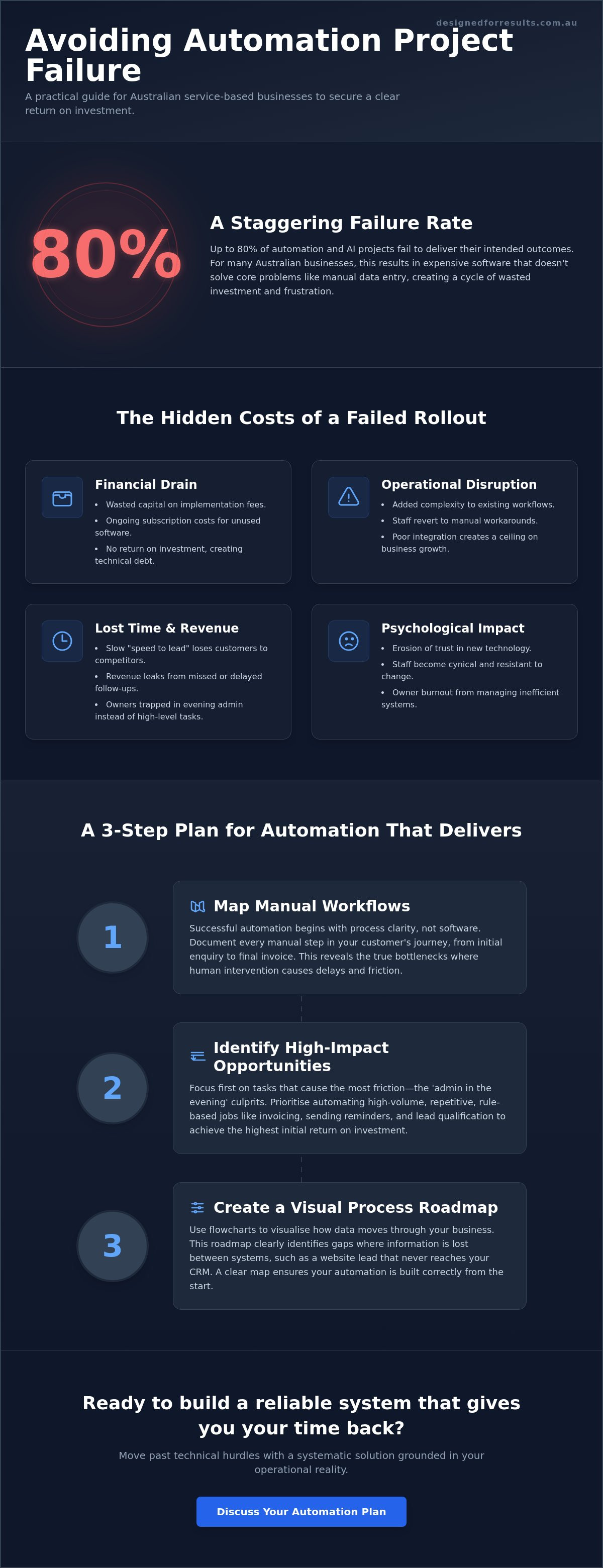
Automation project failure occurs when a technical implementation fails to deliver the promised operational efficiency or fiscal return. For many an Australian business, this manifests as software that remains underutilised or adds unnecessary complexity to an already strained workflow. Research indicates that up to 80% of AI projects fail to deliver their intended outcomes. This is a staggering figure for an owner who has invested capital in implementation fees and ongoing subscription costs, only to find themselves still performing manual data entry late into the night. Understanding how to avoid automation project failure starts with acknowledging that technology requires a clear operational plan to be effective.
The financial impact extends beyond the initial setup costs. When a system is poorly integrated, the business continues to pay for monthly software licences while staff revert to manual workarounds. This technical debt creates a ceiling on growth. The Australian online retailer Booktopia provides a stark example of how poorly managed automation transitions can lead to significant operational disruptions and financial instability. To protect your investment, you must adopt a systematic approach to Business process automation that prioritises your specific business goals over generic technical features.
Quantifying Lost Time and Revenue
Manual processes are expensive and difficult to scale. Every hour an employee spends copying data between spreadsheets is an hour diverted from revenue-generating activities. Slow "speed to lead" is particularly damaging for service-based businesses. If an enquiry is not addressed immediately, the prospect often moves to a competitor who responds faster. Reliable lead follow up systems ensure that enquiries are captured and nurtured without human intervention, preventing the revenue leaks caused by oversight or fatigue. High-performing businesses use these systems to maintain a consistent customer journey that does not rely on the owner's constant availability.
The Psychological Impact of Technical Setbacks
Failed rollouts create a deep erosion of trust within an organisation. When a new system increases the workload rather than decreasing it, staff become cynical and resistant to future improvements. This frustration keeps owners trapped in a cycle of evening admin, unable to focus on high-level growth because they are too busy managing the very tools meant to save them. The mental load of managing inefficient legacy processes prevents clear decision-making. Transitioning to a reliable system allows you to step away from the daily grind and focus on the strategic direction of your business. If you are ready to move past these technical hurdles, you can book a call to discuss a systematic solution that fits your operations.
Mapping Manual Workflows to Identify High-Impact Opportunities
Successful automation is rooted in process clarity rather than software features. Learning how to avoid automation project failure requires you to document every manual step before looking at a single line of code or a software subscription. Industry analysis on Why Process Automation Initiatives Fail highlights that a lack of clear goals is a primary driver of technical setbacks. For an Australian business, this means tracing the path of a customer enquiry from the initial website form to the final invoice to pinpoint exactly where delays occur. Focus on tasks that are repetitive, high-volume, and follow logical rules. Simple automation often provides a higher return on investment than complex AI solutions for these foundational workflows.
Effective documentation reveals the bottlenecks where human intervention causes friction in the customer journey. You should prioritise the digitisation of workflows that currently rely on manual data entry or physical paperwork. In 2025, 27% of businesses admitted to not having a clear plan for their digital initiatives. By identifying these high-impact opportunities early, you ensure that technology serves your operational goals rather than creating new complications. This systematic approach transforms uncoordinated growth into a structured, scalable operation.
Identifying the 'Admin in the Evening' Culprits
Owner burnout is often driven by a specific set of repetitive tasks that accumulate throughout the day. Common culprits include manual invoicing, contract generation, and sending appointment reminders. Evaluate the time required for manual lead qualification and segmentation. If you are spending hours sorting through enquiries to find viable prospects, you are losing valuable time that should be spent on high-level business tasks. These tasks contribute most to operational friction and are the primary candidates for bespoke AI automation. Removing these burdens allows you to reclaim your evenings and focus on revenue-generating activities.
Creating a Visual Process Roadmap
Visualising your operations through flowcharts helps track the movement of data across the business. These roadmaps identify where information falls through the cracks between systems, such as when a lead is captured on a website but fails to reach the CRM. Mapping these gaps is essential for building a reliable system that operates on autopilot. The team at Designed For Results specialises in identifying these structural opportunities to ensure every technical implementation is grounded in operational reality. A clear roadmap provides the necessary clarity to execute automation with precision, ensuring your investment delivers a quantifiable return.
Selecting the Right Technology and Ensuring Data Integrity
Selecting the right technology stack ensures your systems communicate without friction. Most Australian business owners already rely on tools like Xero for accounting or specific CRMs for client management. Your automation should integrate with these platforms natively to prevent the need for manual data transfers. Technical compatibility is a non-negotiable requirement. Choosing a platform that lacks native integration creates a fragmented ecosystem that requires constant manual oversight. This is a critical factor in how to avoid automation project failure.
Data integrity acts as the foundation of your technical infrastructure. If your underlying data is messy or incomplete, you will simply automate the production of errors. This "garbage in, garbage out" result leads to incorrect invoices, missed leads, and customer frustration. You must clean and categorise your existing data before attempting to sync it with new systems. For complex operational needs that require a high degree of customisation, bespoke AI automation ensures the technology fits the specific nuances of your service delivery. Prioritising data quality ensures that your automated workflows produce accurate, reliable results every time.
Research indicates that 57% of businesses deploy AI because of competitive pressure rather than a clear strategy. This reactive approach often leads to selecting tools that do not align with operational needs. You should evaluate the scalability of any chosen platform to ensure it can handle future business growth without requiring a complete system overhaul. Systems that offer flexible API connections and robust security standards, such as the AS IEC 62443 series, provide a more stable long-term investment for your operations.
Automation vs Artificial Intelligence
Simple automation handles predictable, rule-based triggers. When a website form is submitted, a confirmation email is sent immediately. This type of automation is highly reliable and cost-effective for managing standard administrative tasks like appointment reminders or internal notifications. Artificial Intelligence is necessary when interactions become variable and require intent recognition. AI chatbots interpret customer enquiries and provide relevant responses without human input. These tools are effective for qualifying leads or handling reception tasks where the conversation does not follow a linear path. Matching the technology to the complexity of the task prevents over-engineering and keeps implementation costs manageable. You should select the simplest tool that effectively solves the problem to ensure long-term system stability.
The Critical Role of CRM Implementation
A central CRM provides the single source of truth for your entire business. Fragmented data stored across spreadsheets and disparate applications is a primary cause of project stalls. Effective CRM implementation allows you to track the entire customer journey in one place, from the first click to the final payment. Layering smart AI solutions over a clean CRM database provides real-time pipeline visibility and allows for automated follow-up sequences. This setup ensures that your data remains organised and actionable as your business scales. A well-structured CRM reduces the mental load on managers by providing clear insights into operational performance. Without this central hub, your automation efforts will remain disconnected and difficult to manage.
Implementing Systematic Change and Managing Adoption
Successful adoption requires a disciplined approach to change management. Introducing new systems in stages prevents overwhelming your team and allows for the correction of minor technical issues before they become operational crises. This methodology is a core pillar of how to avoid automation project failure. Assign clear responsibility for monitoring the performance of each new workflow. Regular reviews ensure that the software delivers the intended time-savings without creating new administrative burdens.
Gather feedback from your staff during the first few weeks of implementation. They are often the first to identify friction points that can be refined to improve the customer journey. Under the Work Health and Safety Amendment (Digital Work Systems) Bill 2026 in New South Wales, businesses have a primary duty of care to ensure that digital systems do not pose risks such as excessive workloads. Managing adoption systematically ensures compliance while improving efficiency.
Training should focus on the personal benefits for your team members. When staff understand that a new lead follow up system removes the need for manual data entry, they are more likely to embrace the change. Frame the transition as a way to eliminate repetitive tasks rather than a way to monitor performance. This supportive approach balances strategic rigor with accessibility, ensuring the human element of your business remains aligned with your technical goals.
Phased Deployment Strategies
Start with low-risk, high-reward automations to build internal confidence. Automated appointment reminders or simple lead capture notifications provide immediate value with minimal technical risk. Once these foundational systems are stable, you can move toward more complex ai chatbots for websites to handle variable customer enquiries. Each phase must deliver a measurable win before you proceed to the next stage of the rollout. This step-by-step progression allows you to manage costs while securing a consistent return on investment.
Ensuring Long-Term Adoption
Document the new automated procedures to ensure consistency during future staff onboarding. Clear documentation prevents a return to inefficient legacy processes when team members change. Review system logs monthly to verify that automations are firing correctly and that data is moving seamlessly between your CRM and other tools. Celebrating the hours saved each week reinforces the value of the automation programme and keeps the team focused on high-level business tasks. If you need assistance structuring your implementation, book a call to discuss a systematic transition for your operations.
Sustaining Efficiency Through Ongoing Monitoring and Managed Services
Automation systems are dynamic operational assets that require regular performance tuning to remain effective. Treat technology as a living component of the organisation to ensure long-term stability. Cloud-based platforms such as Xero or HubSpot update their interfaces and API connections frequently. These changes can disrupt established workflows without warning, leading to broken sequences or data silos. Sustaining a high ROI requires the ongoing monitoring of these connections to ensure your systems remain synchronised.
A central part of how to avoid automation project failure involves planning for the post-implementation phase. Monitoring real-time business data allows you to optimise workflows based on actual performance metrics. If a lead follow-up sequence shows a drop in engagement, the logic or timing requires immediate adjustment. Managed service retainers provide a viable path for an Australian business to outsource these technical maintenance tasks. This approach ensures the infrastructure remains robust while the owner focuses on high-level business tasks.
The Myth of 'Set and Forget'
Third-party software updates are a primary cause of system instability. When a CRM updates its data structure, your automated documents or lead capture forms may stop functioning correctly. Unmonitored systems often produce incorrect data, which erodes the customer journey and leads to operational friction. Perform periodic reviews of your AI prompts and automation logic to ensure they align with your current business goals. Proactive maintenance prevents small technical glitches from escalating into significant project setbacks. Regular audits of system logs help identify these issues before they impact the bottom line.
Professional Support for Continuous Improvement
A strategic partner identifies new efficiency gaps that emerge as your business scales. Recurring maintenance ensures that your automated lead generation system remains effective in a changing market. Outsourcing the technical management of your infrastructure allows you to focus on revenue-generating activities without the distraction of software updates or API troubleshooting. Consistent system reviews keep your operations lean and your customer interactions professional. This disciplined oversight transforms a one-off project into a permanent operational advantage. If you are ready to secure your technical future, book a chat to discuss your automation roadmap and ensure your systems continue to deliver results.
Securing Your Operational Future through Structured Automation
Success in digital transformation is a product of deliberate planning and operational clarity. By mapping your manual workflows and prioritising data integrity, you establish a stable foundation for technical growth. Understanding how to avoid automation project failure requires a shift from chasing software trends to executing a structured plan that delivers measurable time and revenue outcomes. This systematic approach ensures that every implementation serves a specific fiscal purpose rather than adding unnecessary complexity to your daily workload.
Designed For Results specialises in providing no-code and AI integration expertise for the Australian business. As specialists in SME service organisations, we focus on removing the administrative burden that keeps you working late into the evening. Transitioning to a reliable, automated system allows you to reclaim your time and focus on high-level leadership. Book your free automation strategy call today to discuss your roadmap. You can build a business that operates with precision and scales without the friction of manual processes.
Frequently Asked Questions
What is the most common reason automation projects fail in small businesses?
The primary reason is a failure to map existing manual workflows before applying technology. Many businesses rush into software implementation without documenting the logical steps of their current processes. This misalignment leads to systems that don't solve the core problem, which is why understanding how to avoid automation project failure requires a focus on process clarity before tool selection.
How much should an Australian business expect to invest in automation?
Investment levels depend entirely on the complexity of your workflows and the specific outcomes you require. A simple lead follow up system requires less capital than a bespoke AI integration across multiple departments. You should evaluate the potential time savings and revenue increases to determine a justifiable budget for your specific operations. Every project should be grounded in a clear ROI calculation.
Can I automate my business without using Artificial Intelligence?
You can certainly automate many business functions using simple, rule-based triggers without incorporating Artificial Intelligence. Standard automation handles predictable tasks like sending appointment reminders or updating a CRM when a form is submitted. AI is only necessary for interactions requiring intent recognition, such as handling variable customer enquiries via a chatbot or interpreting voice calls. Match the tool to the complexity of the task.
How do I know if a process is ready for automation?
A process is ready for automation if it is repetitive, high-volume, and follows a consistent set of logical rules. Tasks that involve manual data entry between two systems or standard email responses are ideal candidates. If a task causes a bottleneck in your customer journey or consumes your evenings with admin, it should be prioritised for digitisation to return time to your leadership team.
What is the difference between a one-time setup and managed automation services?
A one-time setup involves building the initial system and handing it over to your team for internal management. Managed automation services provide ongoing performance tuning, API monitoring, and workflow optimisation to ensure the system evolves with your business. Managed services prevent technical debt by addressing software updates and connection breaks before they impact your daily operations.
Will automation replace the need for my current staff?
Automation reallocates human effort from repetitive administrative tasks to higher-value, revenue-generating activities. It removes the burden of manual data entry rather than the need for skilled staff. By automating lead qualification and follow-up, your team can focus on closing sales and improving the customer experience. This shift allows your business to scale without a linear increase in headcount.
How long does it typically take to see ROI from an automation project?
Time-savings are often immediate, while measurable revenue increases typically manifest within three to six months. The speed of return depends on how quickly your team adopts the new system and the volume of leads processed. High-impact automations, such as automated quote systems or lead capture sequences, often show a faster fiscal return by increasing conversion rates and reducing lead response times.
What happens if the software I use for automation updates its system?
Third-party software updates can disrupt automated sequences by changing API connections or data structures. Regular monitoring is essential to ensure that your workflows continue to fire correctly after a platform like Xero or HubSpot makes a system change. Managed services provide a proactive way to handle these updates, ensuring your technical infrastructure remains stable without requiring your constant attention.
