
Integrating CRM With Other Systems: A Guide for Australian Businesses

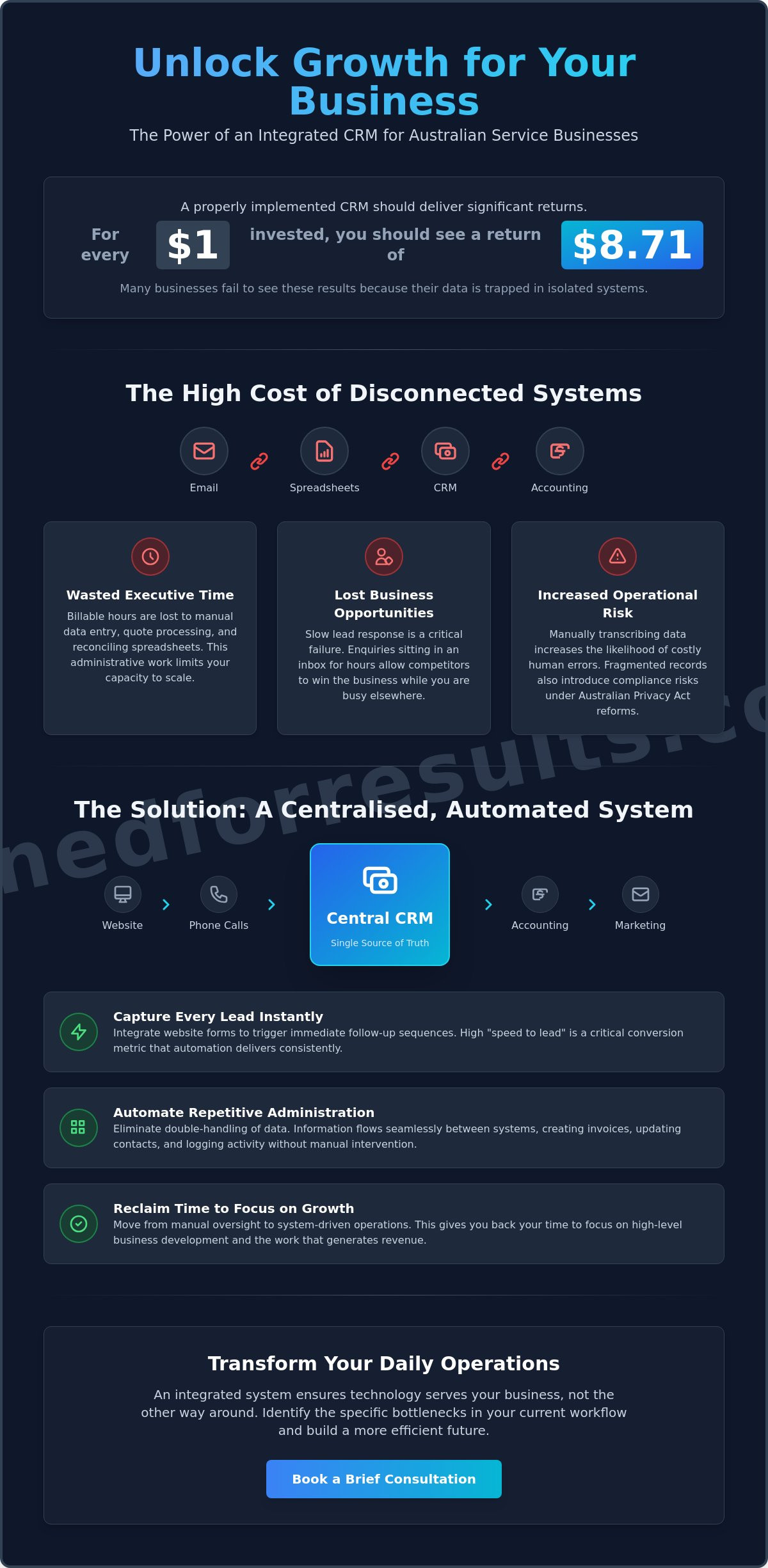
Every dollar you invest in a CRM should return $8.71 to your bottom line; however, many Australian businesses fail to see these results because their data remains siloed. You likely purchased a CRM to streamline operations, but without integrating crm with other systems, you've simply created another digital filing cabinet that requires constant manual intervention. Eliminate the need for double-handling data between Xero and your lead tracking sheets to ensure your technology facilitates growth.
Address the compliance risks introduced by the Australian Privacy Act reforms scheduled for 10 December 2026 by consolidating fragmented records. Focus on high-level business tasks and automate repetitive administrative data entry or manual consent logs. This article explains how to connect your CRM with your essential tools to eliminate manual administration and capture every incoming lead automatically. We'll examine the structural methodology required to create a centralised system that updates in real time, ensuring a seamless customer journey while giving you back your weekends.
The Operational Impact of Disconnected Business Systems
CRM integration is the automated synchronisation of data between your central database and external applications. For many Australian businesses, software stacks grow organically over time. This often results in a collection of tools that do not communicate, leaving the owner to act as the manual bridge between systems. This approach is expensive. It consumes billable hours and limits your ability to respond to new opportunities. Every hour you spend rekeying data into Xero or updating lead statuses is an hour stolen from high-level business development. Establishing a unified system ensures that technology serves the business rather than creating more work for the team.
Manual administration creates a ceiling on your growth. If you are spending your evenings processing quotes or reconciling spreadsheets, you lack the capacity to scale operations. A centralised system allows you to capture every lead the moment it arrives. Many Australian businesses lose revenue simply because an enquiry sat in an inbox for 48 hours while the owner was busy on-site. Speed to lead is a critical metric for conversion. Integrating crm with other systems ensures that every website form or phone call triggers an immediate response without manual intervention.
The Hidden Costs of Software Silos
Isolated data creates friction within your sales process. When information is trapped in one application, it creates a bottleneck that prevents your team from acting decisively. Manually transcribing contact details or lead notes between platforms increases the likelihood of human error. These mistakes are costly; a typo in an email address or a missed follow-up date can end a customer relationship before it begins. Effective Customer relationship management (CRM) requires data to move at the speed of your customers. Disconnected systems ensure your response times remain slow, allowing competitors to win the business while you are still searching for data.
Reclaiming Executive Time Through Automation
Automated workflows allow you to exit the cycle of repetitive administrative tasks. By implementing bespoke automation, you move from manual oversight to system-driven operations. This shift gives you back your time and allows you to focus on the work that actually generates revenue. Real-time visibility into your sales pipeline ensures you make decisions based on facts rather than intuition. Integrating crm with other systems transforms your database into an active asset that manages the heavy lifting of lead management and client onboarding while you focus on leadership.
Core Systems to Integrate for Australian Service Businesses
Building a unified business architecture requires identifying which applications handle your most critical data. For most Australian businesses, the journey begins by connecting the CRM to the tools that manage cash flow, customer communication, and new enquiries. By establishing a single source of truth within your CRM, you eliminate the confusion of mismatched records and ensure your team always operates from the most current information. Integrating crm with other systems isn't just a technical upgrade; it's a strategic move to secure your business's operational integrity.
Financial Automation with Xero
Manual invoicing is a major time drain that often leads to reconciliation errors. Syncing your CRM with Xero allows for the automatic creation of contacts and invoices based on specific deal stages. When a prospect signs a contract, the data flows directly into your accounting software without a single keystroke from your admin team. This Financial Automation ensures that invoice statuses are reflected in your CRM, giving your sales team visibility into payment history without needing full access to your financial records. It removes the need for double-handling and ensures your books stay accurate in real time.
Lead Capture and Marketing Synchronisation
Capture every opportunity without the delay of manual entry. Your website forms should feed directly into your database to trigger immediate follow-up sequences. This ensures you maintain a high speed to lead, which is often the deciding factor for customers comparing multiple service providers. Utilising Lead Generation Systems allows you to segment enquiries automatically and send behaviour-triggered emails that nurture prospects until they are ready to book. This level of responsiveness creates a professional first impression that manual systems cannot replicate, especially during busy periods or after hours.
Consistency defines the modern customer journey. Integrating your CRM with communication tools and calendar systems ensures that appointment booking is frictionless for both your team and your clients. Automated reminders and reschedules reduce no-show rates and save hours of back-and-forth coordination every week. If you want to see how these connections can transform your daily operations, booking a brief consultation can help identify the specific bottlenecks in your current workflow.
Implementation Methodologies: From Native Connectors to Custom Automation
Selecting the correct methodology for integrating crm with other systems depends on your tech stack and the complexity of your workflows. Native integrations represent the most straightforward option. These built-in connections allow two applications to share data with minimal setup. For instance, connecting a CRM to Microsoft Outlook or Google Workspace usually requires only a few clicks. These are efficient for basic data transfer. They often lack the flexibility required for complex business logic or unique operational requirements.
When standard connections are insufficient, no-code middleware like Zapier or Make provides a flexible bridge. These tools allow you to create multi-step automations that move data across several platforms. You might trigger a sequence where a website form entry creates a lead in the CRM, adds a row to a tracking spreadsheet, and sends a notification to a team channel. This approach handles the Common Integration Challenges associated with rigid software by allowing for custom filters and logic that native connectors cannot provide.
Choosing the Right Connection Method
Native connectors serve standard business tools well. Growth often demands more sophisticated logic. Middleware bridges the gap for most multi-step automations. However, if your business relies on legacy software or requires highly specific data processing, standard tools may fall short. In these instances, professional Bespoke AI Automation provides the necessary custom API integration. This ensures that your systems communicate exactly how your operations require, rather than forcing your business to adapt to the limitations of the software.
Ensuring Data Integrity and Security
Success in any integration project relies on the quality of your source data. Clean your database before commencing to prevent the automated spread of errors. Accurate data mapping is essential; you must define exactly which information lands in which field to maintain a clear record. Security remains a priority. Use secure authentication protocols to protect sensitive client information and establish ongoing monitoring to ensure system performance remains stable. This disciplined approach prevents technical debt and ensures your automated systems remain reliable assets for your Australian business.
Overcoming Common Integration Challenges
Successful execution requires more than just technical connectivity. It demands a rigorous assessment of how data flows through your organisation. Mismatched data formats often disrupt synchronisation, causing errors where lead records fail to update correctly because of inconsistent field requirements. For example, a website form might capture dates in a format that your CRM cannot interpret without a transformation layer. Adopting a phased approach to implementation allows you to troubleshoot these issues in a controlled environment, ensuring your core operations remain stable while you refine the system logic. This deliberate pace ensures that small errors do not compound into significant data integrity issues across your entire business.
Addressing Technical Debt and Legacy Software
Legacy systems frequently lack the modern connection capabilities required for seamless data exchange. Evaluate your current infrastructure to determine if an old system can support an API or if it serves as a permanent bottleneck to growth. Legacy systems often fail to meet the transparency requirements for automated decision-making mandated by the Australian Privacy Act reforms commencing on 10 December 2026. Transitioning to a cloud-based CRM involves a meticulous data migration process to ensure no historical client information is lost during the move. Clean your data before the transfer to prevent importing years of accumulated errors into your new environment. Engaging in Strategic Consulting provides a structured audit of your existing technology, identifying which tools are assets and which are liabilities. This clarity prevents you from wasting resources on systems that cannot scale with your business requirements.
Managing Organisational Change
Technology only delivers results when your team adopts it fully. Clear internal communication helps staff understand how integrating crm with other systems simplifies their daily roles and eliminates the need for after-hours administration. Document every new automated workflow to provide a permanent reference point for the team, ensuring that processes are followed correctly even as you hire new staff. This reduces the confusion often associated with system changes and ensures consistency across the business. Removing repetitive administrative tasks directly improves employee morale. It allows your staff to focus on high-value client interactions rather than manual data entry. When your team sees the time-saving benefits, resistance to new technology disappears, replaced by a focus on productive, revenue-generating activities.
Overcoming these challenges requires a disciplined approach to both technology and people. If you are ready to audit your current systems and eliminate manual bottlenecks, book a consultation to discuss your integration requirements.
Achieving Scalability Through a Unified Tech Stack
Integrating crm with other systems provides the structural foundation for scaling without a linear increase in administrative headcount. When your systems communicate, growth becomes a matter of increasing lead volume rather than increasing manual labour. The return on investment manifests in reduced overhead and the elimination of the repetitive work that prevents executives from focusing on high-level strategy. A unified tech stack ensures that every department operates from the same data, creating a seamless experience for the customer that naturally drives higher retention and referral rates.
Systematic integration is no longer optional for businesses operating in the competitive Australian market. As the CRM market in Australia is projected to reach over $1.67 billion in 2026, the businesses that thrive will be those that have moved away from uncoordinated growth toward a disciplined, automated model. This unified view allows you to anticipate customer needs and respond with a level of precision that manual systems cannot match. Most importantly, it gives you back your evenings and weekends by removing the administrative burden that typically follows a successful day of trade.
The Future of Business Automation and AI
Integrated data sets the stage for advanced AI Solutions that can predict customer behaviour and automate complex decision-making processes. Once your CRM is the central hub for all business data, you can deploy AI Voice Agents to interact directly with your database, handling enquiries and updating records in real time. Staying current with these technological advancements is essential to maintain a competitive edge. Automation handles the repetitive tasks, while AI provides the insights necessary for strategic expansion.
Next Steps for Your Integration Journey
Begin with a professional audit of your existing workflows and software tools to identify the most significant time-leaks in your current operation. Prioritise integrations that offer the most immediate relief from manual administration, such as connecting your lead capture forms to your sales pipeline. This targeted approach ensures you see a rapid return on your investment while building the capacity for more complex automations later. If you are ready to stop managing data and start leading your business, Let’s Chat to develop a tailored automation roadmap that gives you your time back.
Transform Your Business Through Systematic Connectivity
Transitioning from fragmented tools to a unified tech stack is the most direct path to reclaiming your evenings and securing operational growth. Integrating crm with other systems ensures your data flows without manual oversight; this allows you to focus on high-level revenue generation rather than administrative maintenance. By centralising your database, you remove the bottlenecks of double-handling data and ensure every customer journey is consistent and professional.
Scalability is the result of deliberate planning rather than chance. As specialists in Australian SME automation, we provide the expertise in no-code and bespoke AI solutions required to modernise your operations. Our approach is focused on reclaiming owner time and increasing revenue through disciplined, structural methodology. You have the opportunity to exit the cycle of manual follow-ups and quote generation by implementing systems that work as hard as you do.
Book your free automation strategy call today to identify your specific time-leaks and develop a clear roadmap for your business. Your transition to a more efficient, automated future starts with a single strategic decision.
Frequently Asked Questions
What is the purpose of integrating a CRM with other tools?
The primary purpose is to create a unified data flow that eliminates manual administrative tasks. It ensures that information captured in one system, such as a website form, is immediately available in others, like your accounting or project management software. This connectivity removes the need for double-handling and ensures your team always works from accurate, real-time data.
How do I choose the right CRM integrations for my Australian business?
Prioritise the tools that manage your most critical workflows, such as Xero for finances or your lead capture forms. Focus on the connections that solve your biggest time-leaks first. Evaluate whether a native connector exists or if you require a middleware solution to achieve the specific logic your operations demand for long-term scalability.
Can CRM integration help reduce manual administration for my team?
Integrating crm with other systems directly replaces manual data entry with automated synchronisation. It allows your staff to stop rekeying information between platforms and focus on high-value client interactions. This shift improves speed to lead and ensures your business maintains a professional standard without requiring after-hours administrative work from you or your team.
Is it expensive to integrate my CRM with Xero or my website?
Costs vary based on the complexity of the workflow and the tools used, though many native connectors are included in your software subscriptions. While custom solutions require an initial investment, the long-term ROI is found in reduced hourly wages spent on admin and the prevention of lost revenue from missed leads or delayed quotes.
Do I need a developer to connect my CRM to other systems?
Many standard connections utilise no-code middleware or native connectors that don't require deep technical knowledge. However, complex logic or legacy software often requires professional implementation to ensure the data remains secure and accurate. Professional guidance ensures the system is built correctly from the start to prevent technical debt and data errors.
Will integrating my systems help me follow up on leads faster?
Automation ensures that new enquiries trigger immediate responses and task assignments within your CRM. This eliminates the delay caused by manual monitoring of inboxes or spreadsheets. By accelerating your speed to lead, you increase your conversion rates and provide a better experience for your prospective clients compared to manual follow-up methods.
What happens if my existing software does not have a native integration?
Use middleware like Zapier or Make to create a bridge between applications that don't talk to each other directly. If these tools are insufficient for your requirements, custom API connections can be established to handle bespoke requirements. This ensures that even niche or legacy software can participate in your automated workflows and share data seamlessly.
How long does a typical CRM integration project take to complete?
Simple native connections can be established in a few hours, while comprehensive system-wide automations typically take several weeks to plan, build, and test. A phased approach allows you to implement critical connections first to see immediate time-savings. This disciplined methodology ensures that complex logic is refined without disrupting your daily business operations.
