
Sales Pipeline with Automated Deal Progression: 2026 Guide for Australian Businesses

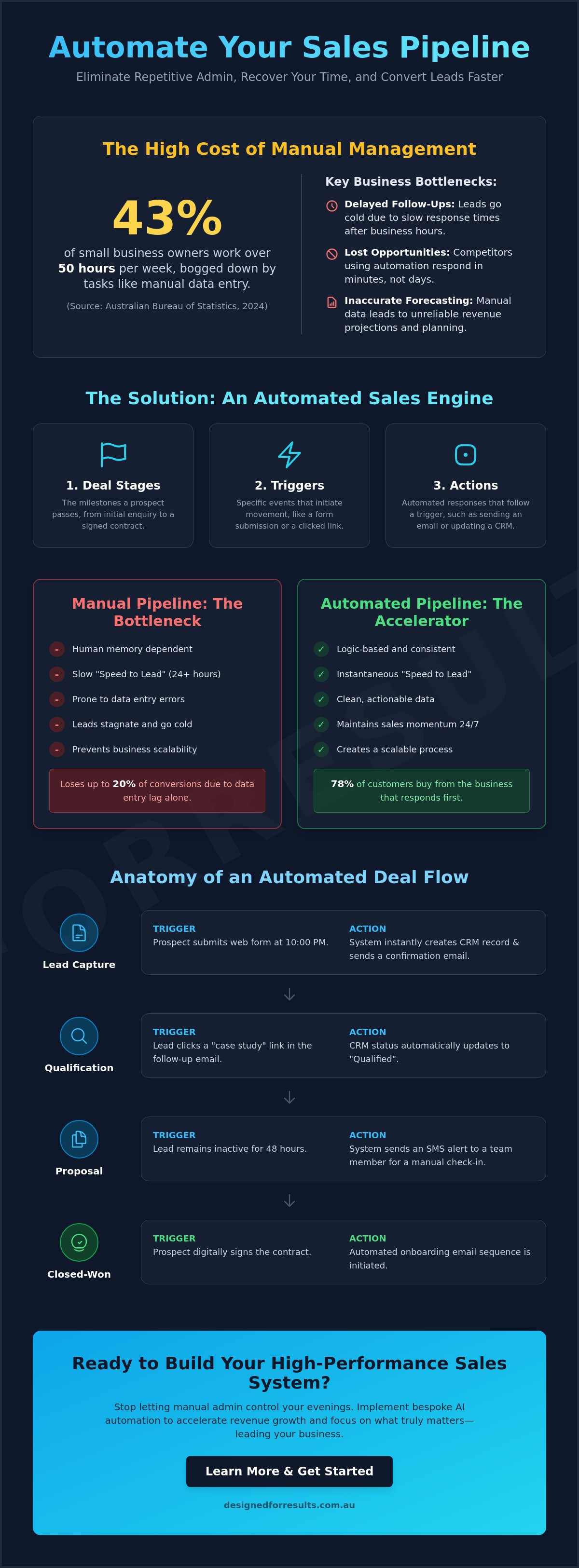
A 2024 study by the Australian Bureau of Statistics indicates that 43% of small business owners consistently work over 50 hours per week, often sacrificing their evenings to handle manual data entry. You likely recognise the frustration of watching a potential lead go cold simply because you lacked the time to send a timely follow-up after a long day of operations. It's a common bottleneck that limits your leadership capability and prevents you from achieving the high-performance culture your business requires to scale. This guide demonstrates how to implement a sales pipeline with automated deal progression to eliminate these repetitive administrative tasks and recover your personal time.
By establishing clear triggers and status updates, you can ensure every prospect receives a consistent experience without needing your constant intervention. You'll learn how to transform your current workflow into a self-managing system that prioritises strategic alignment and measurable outcomes. We will examine the specific automation tools and logic required to accelerate your revenue growth and return your focus to high-level decision-making.
What is a Sales Pipeline with Automated Deal Progression?
A sales pipeline with automated deal progression is a digital system that shifts a prospect through the buying journey based on specific actions or data points. It removes the requirement for a business owner to manually update spreadsheets or move cards on a digital board. This systematic approach is rooted in Sales process engineering; it ensures every lead follows a consistent path toward a conversion. For Australian businesses, this technology reduces the administrative burden that often consumes evenings and weekends.
Automation maintains sales momentum regardless of whether the business owner is on-site or managing a team. It ensures that a lead who downloads a pricing guide at 10:00 PM receives a follow-up immediately. This promptness satisfies the modern customer's expectation for instant communication. The direct link between rapid, automated movement and conversion rates is clear. Research indicates that 78% of customers buy from the business that responds to their enquiry first. By removing human delay, businesses capture interest while it is at its peak.
The Core Components of Automated Progression
Building a reliable system requires three fundamental elements to work in unison.
- Deal Stages: These are the milestones a prospect must pass, such as the initial enquiry, the discovery call, the quote sent, and the final contract.
- Triggers: These are specific events that initiate movement. Examples include a prospect clicking a link in an email, submitting a web form, or digitally signing a proposal.
- Actions: These are the automated responses that follow a trigger. The system might send a confirmation email, update the lead status in a CRM, or alert a team member via SMS to take action.
Implementing bespoke AI automation allows these components to operate without constant oversight, ensuring no prospect is left waiting.
Why Manual Pipeline Management Fails Growing Businesses
Manual management relies on human memory and consistent data entry, both of which are prone to failure during busy periods. When follow-up depends on an owner finding time between jobs, leads inevitably stagnate. Transitioning to a sales pipeline with automated deal progression removes the risk of lead stagnation and creates a scalable process. Manual data entry creates a bottleneck that prevents growth because the owner becomes a single point of failure in the sales cycle.
Slow "speed to lead" is a significant risk in the current Australian market. A manual system that takes 24 hours to process a quote often loses the deal to a competitor who uses automation to respond in minutes. Relying on manual updates also leads to inaccurate forecasting. This makes it difficult to project revenue or plan for future expansion with confidence. Automation provides the clarity needed to manage a high-performance sales environment.
Mechanics of an Effective Automated Sales System
A sales pipeline with automated deal progression functions as a digital architect for your revenue. It replaces manual oversight with logic-based triggers. Every deal requires a defined entry point and a clear exit threshold to maintain momentum. Integrating lead capture forms directly into your CRM eliminates the data entry lag that often costs an Australian business up to 20% of its potential conversion rate. This direct link ensures that no enquiry falls through the cracks because a staff member was too busy to check an inbox.
Stagnation is the primary enemy of conversion. You must implement time-based triggers that alert a consultant or trigger an automated nudge if a lead remains inactive for more than 48 hours. Using proven sales automation strategies ensures that secondary tasks, such as document collection and meeting reminders, occur without human intervention. This frees up your team to focus on high-value closing activities rather than chasing signatures or sending "just checking in" emails during their evenings.
Defining Your Sales Stages
Australian service businesses often struggle with vague pipeline definitions. You need to map the natural progression from the initial enquiry to the final sign-off. Moving a deal from "Qualified" to "Proposal Sent" shouldn't be a matter of opinion. It requires specific data points. Use forced data fields in your CRM to ensure your team captures the project scope and budget before the system allows the deal to progress. This level of standardisation ensures that every proposal is backed by accurate information and that your sales data remains clean and actionable.
Automating the Follow-Up Sequence
Speed to lead is a critical metric in the Australian market. An immediate response to a new enquiry captures interest while it's at its peak. You can schedule a series of nurture emails that provide value, such as case studies or industry insights, while the lead is in the evaluation phase. Linking AI chatbots to your pipeline allows for 24/7 qualification. This ensures that even enquiries received on a Sunday evening are processed and ready for a follow-up by Monday morning. If you want to eliminate the administrative burden of manual tracking, exploring bespoke AI automation can provide the structure your business needs to scale effectively.
Comparing Standard Automation and AI-Enhanced Progression
Distinguishing between linear workflows and intelligent decision-making is essential for any Australian business building a sales pipeline with automated deal progression. Standard automation operates on fixed logic. If a prospect downloads a brochure, the system sends an email. This structure provides a reliable foundation for administrative efficiency. AI-enhanced progression introduces a layer of interpretation. It evaluates the context of an interaction, such as the sentiment in an email reply or the specific questions asked during a call, to determine the next best action.
Prioritise basic automation when your primary goal is consistency. Small to medium-sized businesses often lose revenue because follow-ups fall through the cracks during busy periods. Implementing a structured workflow ensures every lead receives a timely response without requiring the owner to work into the evening. AI becomes necessary when the volume of leads exceeds the capacity for manual qualification, allowing the system to rank prospects based on their likelihood to convert.
Standard Workflow Automation
Standard systems excel at managing predictable, repetitive tasks. Moving a deal to the "Quote Sent" stage when a PDF is opened reduces manual CRM updates and maintains data integrity. These cost-effective solutions provide 24/7 monitoring of lead activity. They ensure no prospect is forgotten, which is critical for service-based businesses where response time often dictates the winner of a contract. Reliable automation frees up approximately 10 to 15 hours of administrative time per week for the average business owner. This level of automation handles the heavy lifting of lead management, ensuring the customer journey remains fluid even when the team is off-site.
AI-Driven Deal Intelligence
Deploying bespoke AI automation allows for the analysis of lead sentiment across multiple touchpoints. AI identifies subtle buying signals that standard triggers miss. You can implement AI voice agents to qualify leads over the phone, ensuring that only high-value opportunities reach your calendar. This technology handles nuanced communication, answering complex questions and booking appointments based on real-time availability. AI-driven deal intelligence transforms a sales pipeline with automated deal progression into a proactive revenue generator. Predictive analytics then use historical pipeline velocity to forecast revenue outcomes, giving leadership clear visibility into future cash flow based on current lead quality. Businesses using these intelligent layers often see a 30% increase in conversion rates by focusing effort on the leads most likely to close.
Steps to Implement Automated Progression in Your Business
Audit your current sales process to identify where leads typically stall. Implementing a sales pipeline with automated deal progression requires a clear understanding of your existing bottlenecks. Research from 2023 indicates that 50% of sales go to the vendor that responds first. If your team is stuck doing admin during the evenings, you are losing revenue to faster competitors who have already automated their initial touchpoints.
Select a CRM that supports robust workflow automation and API integrations. This infrastructure ensures your software communicates directly with your existing tools without manual data entry. Build the initial automation for your most time-consuming stage first. For many Australian service-based businesses, this is the transition from Lead Captured to Quote Sent. Automating this single step can save a manager up to five hours of repetitive work every week.
Test the system with real lead data to ensure triggers fire correctly. A single broken link in the automation can alienate a high-value prospect. Once the technical foundation is solid, train the team on how to interact with the automated system. They need to understand how to move deals through the pipeline to trigger the correct sequences. This alignment ensures the technology supports their work rather than creating additional confusion.
Mapping the Customer Journey
Visualise every touchpoint from the first website visit to the final invoice. This exercise highlights repetitive administrative tasks that drain your energy and stall your growth. Identifying these gaps allows you to implement smart AI solutions that handle the heavy lifting of lead qualification. Simplify the process to ensure it remains manageable for your staff. A complex system that your team finds frustrating is a wasted investment that won't deliver the ROI you expect.
Technical Setup and Testing
Connect lead sources like Google Business profiles or website forms directly to your CRM. Configure specific notifications so the team knows exactly when a manual intervention is required. This prevents leads from falling through the cracks during busy periods. Verify that data flows correctly between the CRM and other tools like Xero. Accurate data synchronisation ensures your financial reporting remains precise and gives you back the hours usually spent on manual reconciliation.
Ready to stop losing leads to manual follow-up delays? Book a consultation to streamline your sales workflow.
Recover Your Time with Custom Sales Automation
Transitioning to a sales pipeline with automated deal progression shifts your role from an administrator to a high-level strategist. Current data suggests that many Australian business owners spend up to 30% of their working week on repetitive manual tasks. This includes updating lead statuses, sending follow-up emails, and checking if quotes have been viewed. Automating these workflows removes the need for constant supervision. The system handles the logistics while you focus on closing high-value contracts and strengthening client relationships.
A structured sales environment ensures that growth is a result of consistent execution. When your pipeline moves leads through stages automatically, you eliminate the cognitive load of remembering who to call and when. This proactive approach allows for a high-performance culture where every lead receives a premium experience without increasing your head count. You move away from reactive firefighting and toward a model where every action is a deliberate step toward a measurable outcome.
Eliminating the Admin Burden
Manual data entry is a significant drain on resources. Industry reports from 2024 indicate that small business managers spend an average of 12 hours per week on sales-related admin. Implementing a sales pipeline with automated deal progression reclaims this time. You stop the "second shift" of administrative work that typically happens after 6 PM, which directly improves work-life balance. This creates a scalable foundation for your business. You can handle a 50% increase in lead volume without hiring additional support staff because the infrastructure manages the volume for you.
- Automated lead follow-ups ensure no prospect is ignored during busy periods.
- Instant deal updates provide real-time visibility for the entire team without manual reports.
- System-driven reminders replace manual to-do lists, ensuring 100% follow-up consistency.
Partnering for Professional Implementation
Success with automation depends on the quality of the initial setup. A poorly configured system creates more problems than it solves, often leading to missed notifications or incorrect data. Professional configuration ensures the pipeline is reliable from the first day of operation. This technical precision prevents the frustration of broken workflows and ensures your team trusts the data they see. Ongoing maintenance allows the system to evolve as your business needs change, ensuring you remain efficient as you scale toward your 2026 targets. To start building a tailored automation roadmap that returns your time and increases your revenue, contact Designed For Results to discuss your requirements.
Modernise Your Sales Process for 2026
Implementing a sales pipeline with automated deal progression shifts the burden of administrative follow-ups from the business owner to a reliable, logic-based system. Australian businesses that adopt these workflows reclaim significant hours previously lost to manual data entry and evening admin. By 2026, the distinction between high-performing service providers and those struggling to scale will depend on their ability to manage leads without constant human intervention.
Designed for Results operates as an Australian-based specialist team focusing on measurable ROI for SMEs. We combine expertise in AI with robust no-code workflow automation to ensure your systems perform predictably. Transitioning to an automated model allows you to focus on high-value client interactions while the software handles the repetitive tasks that typically stall momentum. It's time to stop sacrificing your personal time to manage spreadsheets and chase quotes.
Book an automation strategy call to reclaim your evenings
Building a more efficient business starts with a single step toward better systems. You have the capability to transform your workflow today.
Frequently Asked Questions
Will automated deal progression make my sales process feel impersonal?
Automation increases the quality of your personal interactions by handling repetitive follow-ups that often slip through the cracks. A 2023 study by Harvard Business Review indicated that businesses responding to leads within 60 minutes are seven times more likely to have productive conversations. Use automation for the initial speed and save your personal energy for complex negotiations. This approach ensures your clients receive immediate attention without sacrificing the human touch.
Do I need a specific CRM to automate my sales pipeline?
Most modern CRMs like HubSpot, Pipedrive, or Zoho support a sales pipeline with automated deal progression. You need a platform that offers workflow triggers based on stage changes or specific data entry. If your current software lacks these features, third-party tools can connect your systems to provide the necessary functionality. Choose a tool that fits your current volume and technical capability to ensure strategic alignment with your goals.
How much time does it take to set up automated progression?
Initial setup for a standard five-stage pipeline usually takes four to six hours. This time is spent mapping your workflow, drafting templates, and testing the logic of each trigger. Once the system is live, it can save an Australian business owner upwards of 10 hours of manual administration every week. The return on this time investment is visible within the first 30 days of operation.
Can I automate deal movement based on an email reply?
You can configure your CRM to advance a deal automatically when a prospect sends a reply. Systems detect inbound email activity and move the lead from 'Sent' to 'Engaged' without any manual input. This ensures your view of the sales process remains accurate in real-time. It allows you to prioritise active conversations over stagnant leads, improving your overall leadership capability in managing the sales team.
What happens if a lead needs a manual follow-up in an automated system?
You retain the ability to step in and manage any deal manually when the situation requires it. Automated systems can be designed to pause sequences or generate a high-priority task for you when a lead asks a specific question. These notifications ensure you provide bespoke advice when it's most valuable. Automation manages the routine so you can manage the exceptions and maintain a high-performance culture.
Is automated deal progression suitable for small Australian businesses with only a few employees?
Small businesses with fewer than five staff members often see the greatest impact from a sales pipeline with automated deal progression. These organisations typically lack dedicated admin support, meaning the owner often handles quotes during the evening. Automation allows a small team to manage a lead volume that would otherwise require additional hiring. It provides the infrastructure needed to scale without increasing your personal workload.
Can I integrate my existing website forms with an automated pipeline?
Direct integration between your website forms and your pipeline is a standard feature for most automation platforms. When a visitor submits an enquiry, the system creates a deal and sends an immediate confirmation email. Research shows that 78% of customers purchase from the business that responds first. Connecting your forms ensures you never miss an opportunity due to a delayed manual response, leading to measurable outcomes for your bottom line.
