
Signs Your Business Has Outgrown Spreadsheets: A 2026 Guide to Automation

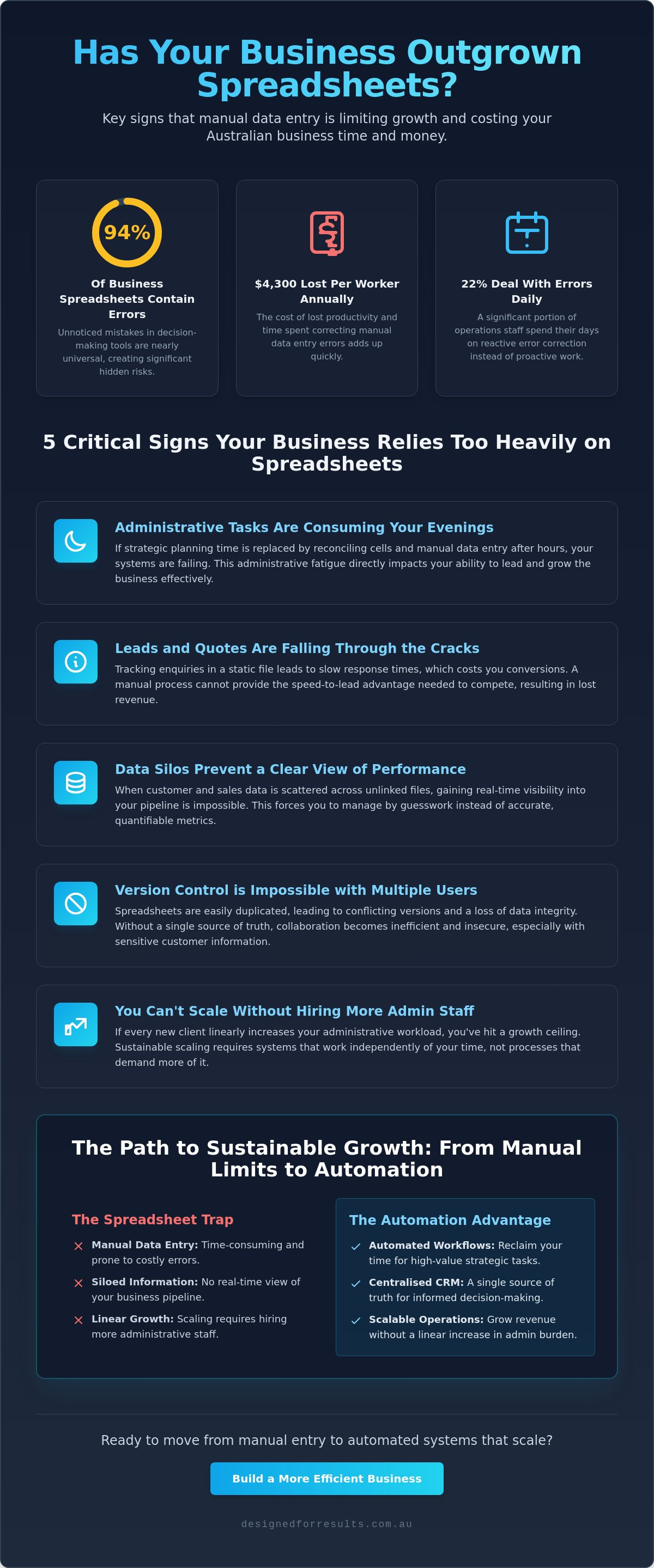
Ninety-four per cent of business spreadsheets used in decision-making contain errors that go unnoticed. For an Australian business, these manual mistakes cost an average of $4,300 per worker every year in lost productivity and rectification time. Relying on static cells and complex formulas to manage your operations is no longer a viable strategy for sustainable growth. Identifying the signs your business has outgrown spreadsheets is the first step toward reclaiming your evenings and ensuring your data actually supports your bottom line.
You probably started using spreadsheets because they were accessible and cost-effective, but now they feel like a bottleneck that prevents you from following up on leads or seeing your true sales pipeline. This guide identifies the critical operational triggers that signal it's time to move from manual entry to automated business systems. We will examine how shifting to workflow automation and centralised CRMs allows you to scale without hiring more admin staff; giving you back the personal time you currently spend on repetitive data tasks.
The Limitations of Spreadsheet-Based Business Management
Spreadsheets are inherently static environments. While they excel at isolated calculations, they lack the structural integrity required to manage complex, multi-user business processes. These are calculation tools. Scalable operations require more robust foundations. Recognising the signs your business has outgrown spreadsheets is essential for any Australian business owner who finds themselves trapped in administrative loops. Relying on manual input creates a hard ceiling for growth because every new lead or customer adds a linear increase to your administrative burden.
Scaling a service-based business requires systems that work independently of the owner's time. Manual spreadsheets require constant oversight to keep quotes and lead follow-ups current. Manual processes result in a demanding job that requires more of your time as the business succeeds. For many Australian business owners, this burden translates into hours of unpaid admin during evenings. This shift from proactive management to reactive error-correction indicates that your current tools are failing to support your scale. These are the clear signs your business has outgrown spreadsheets.
The lack of data integrity becomes critical when your business expands beyond a single operator. Information becomes siloed in individual files, making it impossible to gain real-time visibility into your sales pipeline or customer history. Without a centralised data source, you lose the ability to make informed decisions based on accurate, live metrics. Transitioning to a dynamic CRM Implementation ensures that data flows automatically between departments, reducing the need for manual oversight and allowing you to focus on high-value strategic tasks.
The Fragility of Manual Data Entry
Manual data entry is a high-risk activity. A 2024 study by Prof. Pak-Lok Poon found that 94 per cent of business spreadsheets used in decision-making contain errors. These mistakes are often hidden within broken formulas or accidental cell deletions. The financial impact is measurable; research from May 2026 indicates that fixing these errors costs organisations approximately $4,300 per worker each year. Without a centralised system, your team spends more time on reactive correction, leaving little room for proactive business development.
Why Spreadsheets Stifle Team Collaboration
Collaboration requires a single source of truth. Spreadsheets are portable files that are easily duplicated, leading to version control conflicts. When multiple staff members access unlinked files, data integrity vanishes. The Limitations of Spreadsheets are most apparent when sensitive customer information is stored in insecure formats. Spreadsheets lack the robust audit trails or simultaneous editing capabilities found in professional business automation systems. This lack of transparency makes it difficult to track changes or maintain data security across a growing team.
5 Critical Signs Your Business Has Outgrown Spreadsheets
Recognising when a tool has shifted from a helpful asset to a growth inhibitor is a fundamental leadership requirement. Many Australian business owners operate in a state of uncoordinated growth, where they are simply too busy to scale effectively. This friction is one of the primary Signs Your Business Has Outgrown Spreadsheets. When your operations rely on manual data entry, you are trading your most valuable asset—strategic time—for low-value administrative maintenance. Identifying these triggers allows you to move toward a more disciplined, systematic approach to operations.
Administrative Tasks Are Consuming Your Evenings
Administrative fatigue is a silent killer of strategic momentum. If you spend your evenings updating cells or reconciling data rather than planning your next move, your current system is failing you. Manual reporting often delays decision-making by weeks because the data is never current. You cannot lead an organisation effectively when you are exhausted by repetitive tasks that should be handled by automation. Successful Australian business owners prioritise high-level management over manual entry to ensure their leadership quality remains high.
Lead Follow-Up and Quotes Are Falling Through the Cracks
Slow response times kill conversions and drain revenue. If you are tracking new enquiries in a file that requires manual updates, you are likely losing money to faster competitors. A dedicated lead follow up system ensures no quote is forgotten and every prospect receives a timely response. Speed to lead is a measurable competitive advantage that manual systems cannot provide. Transitioning to bespoke AI automation allows you to capture and nurture leads with zero manual intervention.
Data Silos Prevent a Clear View of Performance
Data silos create a fragmented and unreliable view of your business. Opening multiple files to understand a single customer journey is inefficient and prone to error. Real-time pipeline visibility is impossible when data is scattered across personal drives or unlinked worksheets. Centralised systems provide the accountability and clarity needed for consistent performance across your team. Without this visibility, you are managing by guesswork rather than quantifiable metrics.
Beyond these visibility issues, two other critical signs include a constant confrontation with errors—which 22 per cent of operations professionals deal with daily—and the inability to take on new clients without immediately needing to hire more administrative staff. When your business reaches this ceiling, the only path to sustainable revenue growth is through structural methodology and automation.
The Operational Cost of Sticking to Manual Processes
Maintaining outdated systems is a direct drain on your bottom line. Every hour a manager spends manipulating data in a spreadsheet is an hour lost to business development or high-level strategy. This opportunity cost is one of the most significant Warning Signs Your Small Business Has Outgrown Its Spreadsheet. When your executive team becomes a collection of high-paid data entry clerks, your growth has stalled. You are paying for strategic expertise but receiving administrative maintenance.
Spreadsheet reliance also creates a dangerous vulnerability regarding intellectual property. Many Australian businesses rely on a single "spreadsheet expert" who built and maintains the complex web of linked files. If this individual leaves the organisation, they take the operational logic with them. This lack of structural methodology leaves you exposed. Standardised, automated systems ensure that your business logic remains an institutional asset rather than a personal secret. These vulnerabilities are compounding signs your business has outgrown spreadsheets and requires a more resilient foundation.
The Staffing Trap of Manual Admin
Hiring more staff to manage an inefficient system is a reactive fix that increases your overhead without improving your margins. Manual processes require linear hiring; as your volume grows, your wage bill grows at the same rate. This prevents you from achieving true economies of scale. Non-standardised files also create a massive training burden for new hires, leading to higher error rates during onboarding. Implementing workflow automation allows you to handle increased volume without expanding your administrative headcount. It's a shift from uncoordinated growth to a disciplined operational model that prioritises fiscal outcomes.
Customer Experience and Speed to Lead
Modern consumers expect immediate responses. Manual quote generation creates friction in the sales cycle, giving your competitors a window to step in. If a lead has to wait 48 hours for a quote because you're busy cross-referencing three different sheets, you've already lost the professional image of a market leader. These delays are clear signs your business has outgrown spreadsheets and is now failing to meet market expectations. Modern service-based businesses require speed to lead as a core metric. Automated onboarding and instant quote calculators ensure a seamless customer journey that reflects the quality of your services and secures the deal before interest wanes.
Mapping Your Path Beyond the Grid
Moving beyond the grid requires more than just a software purchase. It demands a systematic audit of your current operations. By the time you recognise the signs your business has outgrown spreadsheets, you are likely already losing revenue to hidden inefficiencies. Transitioning to a centralised system starts with process mapping. This involves documenting every step of your customer journey from the first enquiry to final delivery. Clarity in your workflow is the prerequisite for effective automation.
Identify the high-impact targets for automation by looking at where manual data entry occurs most frequently. Any process that requires copying data from one sheet to another is a prime candidate for systemisation. A disciplined approach to this transition prevents uncoordinated growth and ensures your new infrastructure supports long-term fiscal outcomes. Centralising your data ensures that every team member operates from a single source of truth, eliminating the confusion of version control errors.
Auditing Your Current Workflows
Audit every active spreadsheet to determine its true utility. Ask which files are essential for daily operations and which are merely legacy habits. Identify repetitive tasks that occur on a weekly or monthly basis; these are often the primary sources of administrative fatigue. Pinpoint any "single points of failure" where only one staff member understands the logic behind a complex file. If the loss of a specific spreadsheet would halt your operations, that process must be moved to a more resilient, automated platform immediately.
Selecting a Scalable Alternative
Modern business management requires a centralised CRM that provides real-time visibility into your sales pipeline. Modern platforms allow for simultaneous editing and robust data security, providing a level of reliability that static files cannot match. Integrating smart AI solutions into your workflow can handle complex data tasks that previously required hours of manual oversight. These systems work tirelessly to maintain data integrity, allowing your team to focus on high-value client interactions.
Prioritise integration capabilities when choosing your software ecosystem. Your CRM should communicate seamlessly with your email marketing, accounting, and lead generation tools. This connectivity ensures data flows automatically, eliminating the need for manual reconciliation. Moving your data to a centralised automation platform allows you to scale without increasing your administrative headcount. If you are ready to reclaim your time and stop the manual data grind, chat with us about your automation needs.
Implementing a Sustainable Automation Strategy
Adopting a phased approach to systemisation ensures your team adapts to new workflows without operational disruption. Implementing a sustainable strategy is the final step in addressing the signs your business has outgrown spreadsheets. Success in this transition is a product of deliberate planning rather than chance. Professional CRM Implementation provides the structural methodology needed to move away from uncoordinated growth and toward a model of planned progress. Professional oversight during this phase prevents common configuration errors that often plague DIY attempts.
Clean data migration is the foundation of your new system. Moving redundant or incorrect information from old files only replicates inefficiency in a more expensive environment. Standardise your data formats and remove obsolete records before the migration process begins. This disciplined preparation ensures your new automation platform provides accurate metrics from day one. A centralised system allows your Australian business to operate with a level of precision that manual spreadsheets simply cannot support.
The Transition Process
Moving data from Excel or Google Sheets to a structured CRM requires a logical sequence of actions. Map your existing data fields to your new system to ensure every piece of customer information has a designated home. Staff training is essential during this change; your team must understand the new processes to maintain data integrity. Setting up internal approval workflows within the system provides necessary oversight without requiring your constant presence. This structure replaces the "single point of failure" risk associated with individual spreadsheet experts and creates a more resilient organisational foundation.
Achieving Operational Freedom
Operational freedom is the ultimate outcome of effective automation. Your "new normal" includes a sales dashboard with real-time pipeline visibility and automated alerts for lead follow-ups. These tools provide the clarity needed for executive decision-making without the need for manual data manipulation. Automation handles the repetitive tasks of lead capture and document collection, allowing you to focus on high-level management and revenue growth.
Regaining your personal time is a measurable metric of success. When your business processes run independently of manual oversight, you no longer need to spend your evenings on administrative maintenance. This shift allows you to scale your Australian business without the immediate need to hire more admin staff. If your current systems are creating a bottleneck in your growth, book a chat to review your operations and identify your most effective path to automation.
Reclaiming Your Operational Command
Transitioning from manual spreadsheets to automated systems is a strategic necessity for any Australian business aiming for sustainable growth. We have identified that the primary signs your business has outgrown spreadsheets manifest as administrative fatigue, missed lead follow-ups, and a lack of real-time visibility into your sales pipeline. Moving your operations to a centralised CRM eliminates the hidden costs of manual data entry; ensuring your intellectual property remains a secure institutional asset rather than a personal secret.
Establishing a disciplined operational foundation allows you to scale without the linear increase in administrative headcount. Our specialists focus on Australian SME automation and possess the expertise in CRM and AI integration required to transform your workflow. We are dedicated to giving business owners their time back so they can focus on high-level management and revenue outcomes. Book your free automation strategy call with our Australian team to evaluate your current systems and map a path toward operational freedom. Your business is ready for its next phase of planned progress.
Frequently Asked Questions
How do I know if my business is ready for automation?
Your business is ready for automation when manual administrative tasks prevent you from focusing on high-value strategic growth. If you find yourself working late into the evening to update records or reconcile data; these are clear signs your business has outgrown spreadsheets. You should consider systemisation when the cost of manual oversight and human error begins to impact your bottom line.
Is it expensive to move away from spreadsheets to a CRM?
The cost of transitioning to a CRM is an investment in your operational efficiency that often pays for itself through reclaimed time and improved lead conversion. While software and implementation require an initial outlay; the ongoing cost of manual errors and lost productivity is significantly higher. Australian businesses should evaluate the long-term fiscal benefits of a system that allows for scale without linear hiring.
Can automation work for a small business with only a few employees?
Automation is particularly effective for small teams because it provides the operational capacity of a much larger organisation. Implementing lead capture and automated follow-up sequences allows a small team to handle a high volume of enquiries with zero manual intervention. This ensures every customer journey is professional and consistent; regardless of your current headcount.
What happens to my old spreadsheet data during a transition?
Your existing data undergoes a process of auditing and cleaning before being migrated into a structured CRM or database. This ensures that historical customer information is preserved while removing redundant or incorrect records that currently hinder your performance. Professional migration provides a clean foundation for your new automated workflows; ensuring your data remains a valuable institutional asset.
Do I need to be a tech expert to manage an automated system?
Modern automation platforms are designed for intuitive use by business owners and managers rather than IT specialists. Once the initial workflow mapping and system configuration are complete; the day-to-day management requires minimal technical knowledge. Training is a core part of the implementation process to ensure your team can navigate the new system with confidence.
How long does it typically take to implement business automation?
The timeline for implementation depends on the complexity of your current processes and the volume of data to be migrated. Critical systems like lead follow-up and automated quoting can often be active within a few weeks. A phased approach ensures that each new automation is fully adopted by your team before moving to the next operational area.
Will automation replace my current staff members?
Automation is designed to replace repetitive and low-value tasks rather than the people who perform them. By removing the burden of manual data entry; your team can focus on high-value activities that directly increase revenue and improve client relationships. This shift improves organisational productivity and allows your staff to contribute to strategic outcomes rather than administrative maintenance.
What are the first steps to take when outgrowing spreadsheets?
Begin by documenting your current customer journey and identifying the specific points where manual data entry causes delays. Audit your active files to see which ones are prone to errors or version control issues. Seeking professional advice on CRM implementation and workflow automation is the most effective way to ensure your new systems support your long-term growth objectives.
