
How to Keep Your CRM Data Clean and Accurate: An Automated Approach for Australian Businesses

Research indicates that 44% of businesses lose more than 10% of their annual revenue due to poor-quality CRM data. For an Australian business, this isn't just a technical oversight; it is a direct drain on your capacity that often results in spending your evenings correcting administrative errors. You likely recognise that manual data entry is inherently flawed, leading to duplicate leads and inaccurate reporting that hampers your decision making. Knowing how to keep your crm data clean and accurate is the only way to move from uncoordinated data entry to a structured system that supports your bottom line.
You deserve a database that maintains itself while you focus on high-level leadership. This article will show you how to eliminate duplicates and automate data hygiene to reclaim your time and improve your sales accuracy. We will examine the automated workflows that can help you recover the 546 hours of sales time lost annually to poor data, providing you with a reliable sales dashboard and a significant reduction in administrative overhead.
The Operational Cost of Poor CRM Data Quality
Poor CRM data quality creates a silent tax on your operations. When contact details are fragmented or outdated, your sales pipeline becomes a series of missed opportunities. Research shows that 44% of businesses lose over 10% of their annual revenue due to poor-quality data. For an Australian business, this loss often stems from failed follow-ups or leads that slip through the cracks because their records were incomplete. Adhering to fundamental data quality principles is essential because information is only valuable when it is accurate, timely, and complete.
The time lost to manual corrections is staggering. Inaccurate B2B contact data accounts for a 27.3% waste of a sales representative's time. This equates to 546 hours per year for every full-time staff member. Your team frequently spends time hunting for correct phone numbers or reformatting spreadsheets, which limits their capacity to close deals. This manual effort creates admin debt, a state where the volume of cleanup tasks prevents you from scaling your operations. When your staff must manually verify every email before clicking send, your growth is capped by their physical speed.
Inaccurate data also cripples your marketing automation. Behaviour-triggered campaigns rely on precise triggers; if a lead is tagged incorrectly, they receive a welcome email months after they have already purchased. This misalignment wastes your marketing budget and makes your outreach feel impersonal. Understanding how to keep your crm data clean and accurate ensures that your automated systems work for you to drive revenue.
Administrative Burden on Australian Business Owners
Small business owners frequently find themselves trapped in a cycle of evening administrative work. You spend your weekends reconciling lead information because your systems are uncoordinated. This creates a heavy mental load and prevents you from performing high-level business analysis. Learning how to keep your crm data clean and accurate is the only way to stop the bleed of personal time and focus on strategic outcomes.
The Impact on Customer Experience
Messy databases directly damage your brand reputation. Sending duplicate emails to the same prospect makes your business look disorganised. A seamless customer journey requires precision from the first point of contact. High-quality initial data is the foundation of automated client onboarding. Without clean data, your automated sequences trigger the wrong messages, which leads to frustrated potential clients choosing your competitors.
CRM De-duplication: Eliminating Redundancy at the Source
CRM de-duplication is the systematic process of identifying and merging identical or near-identical records within your database. It is the most effective method for maintaining a single source of truth for every customer interaction. Primary identifiers like email addresses, mobile numbers, and Australian Business Numbers (ABNs) serve as the anchors for this process. Without these anchors, your database quickly becomes a fragmented collection of partial profiles that confuse your sales team and delay follow-ups. Given the direct impact of data quality on revenue, ensuring your records are unique is a fiscal necessity for any growing Australian business.
Manual merging carries significant operational risks. It often leads to permanent data loss or broken activity histories, where notes from one record fail to transfer to the merged profile correctly. To avoid this, you must establish a master record hierarchy. This logic dictates which record takes precedence based on specific criteria, such as the most recent activity or the completeness of the profile. This structural approach ensures that the most accurate information is preserved while redundant entries are purged. It removes the guesswork from data management and prevents the loss of vital historical context.
Automated Matching Logic
Modern automation tools utilise fuzzy logic to identify variations in business names or addresses that a human might overlook. For example, "Designed For Results Pty Ltd" and "Designed For Results" are recognised as the same entity. Unique identifiers prevent the creation of new duplicates by checking existing data before a new entry is saved. Crucially, these systems merge the entire deal history alongside contact information. This preserves the context of every previous conversation and quote, allowing your team to understand exactly how to keep your crm data clean and accurate without manual intervention. A well-configured CRM implementation provides the visibility needed to trust your data again.
Integrating Entry Points
Preventing duplicates starts at the point of capture. Using website form to CRM segmentation ensures that new enquiries are automatically checked against your current database before a new record is created. API integrations maintain this consistency across all your software, from accounting to project management. Automated document collection further reduces risk by removing the need for manual uploads that often result in duplicate files and fragmented records. This systematic methodology ensures that your data remains lean and actionable from the moment a lead enters your ecosystem, effectively stopping admin debt before it begins.
Implementing Automated Validation and Data Hygiene
Data hygiene is a continuous automated workflow. Automated validation rules prevent incorrect phone formats or invalid email addresses from entering your system. These rules act as a filter to ensure your team only deals with actionable information. Using third-party verification tools allows you to enrich data in real-time during lead capture. Verifying an ABN or an email deliverability status happens instantly. This ensures your sales team focuses on leads with valid contact details and ready-to-buy profiles.
Data decay is a persistent threat to your operational efficiency. Research indicates that 70% of CRM data degrades annually as individuals change jobs or businesses update their contact information. Automation identifies these stale records based on lack of engagement or bounce rates. It flags them for archiving or triggers a database reactivation campaign. This keeps your active pipeline relevant. Internal approval workflows add another layer of protection. They ensure a lead meets your specific data standards before it progresses to the next stage of your sales cycle, maintaining the integrity of your reporting.
Proactive Data Management
Validating data at the entry point maintains peak operational efficiency. Rules in website forms ensure every lead is qualified before hitting the CRM. This structural approach supports lead follow up systems by providing accurate contact details for immediate outreach. You reclaim your time by automating the maintenance of your database. This proactive stance ensures that your database remains a high-performance asset for your business.
Standardisation through Automation
Workflows automatically format text to maintain professional standards. They convert names to Proper Case and apply international dialling codes without human intervention. Automated tagging and segmentation remove the need for manual categorisation, ensuring your marketing reaches the right audience. Using picklists is a fundamental tactic in how to keep your crm data clean and accurate. It forces uniformity across all records. This makes your sales dashboard a reliable tool for high-level management decisions and long-term business analysis.
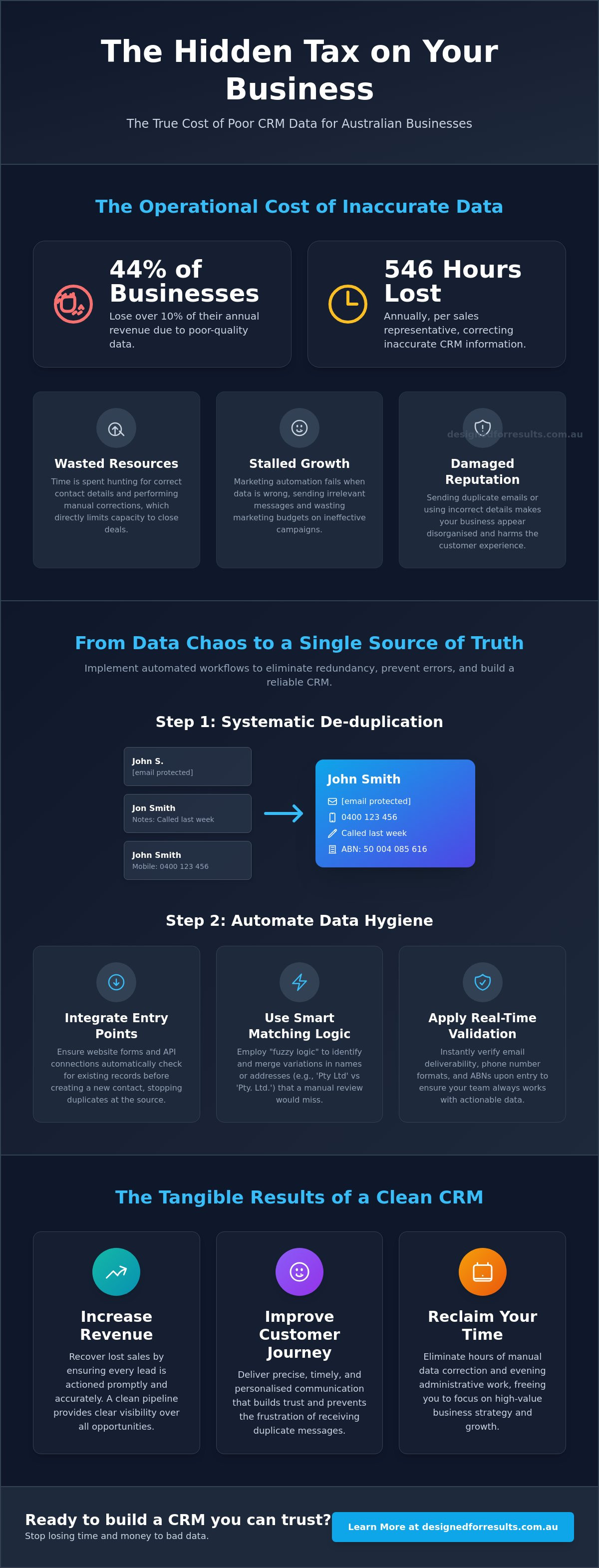
A Framework for Maintaining CRM Data Accuracy
Maintaining a high-performance database requires a structured methodology. Conduct a comprehensive audit to identify existing inconsistencies and gaps that hinder your sales team's ability to follow up on quotes. Establish clear data entry standards for both team members and automated systems to ensure long-term reliability. Deploy automated de-duplication and validation workflows to handle the heavy lifting. This allows your staff to focus on revenue-generating activities. Regular, automated performance reporting monitors data health metrics to keep you informed without manual effort. Review and refine your system logic as your business grows to ensure your database remains a reliable asset for high-level management decisions. Understanding how to keep your crm data clean and accurate is the first step toward reclaiming your time and securing your operational outcomes.
Step 1: The Initial Database Audit
Start with a baseline by identifying dead weight records. These are contacts with no engagement or activity in the last 12 months that should be archived to keep your pipeline lean. Use this audit to spot patterns in entry errors and address the root cause. This process highlights where your current data collection needs adjustment. Use this checklist to assess your current health:
- Archive records with no activity for 12 months.
- Identify fields with under 80% completion rates.
- Spot duplicate patterns originating from specific lead sources.
- Verify the accuracy of your current sales pipeline visibility.
Step 2: Locking Entry Points
Restrict manual entry to ensure all information follows your established standards. Every website form field must map directly to a corresponding CRM property to eliminate data fragmentation. This ensures that information flows seamlessly from lead capture to your sales dashboard. A professional CRM implementation sets the foundation for this methodology, moving your business toward systematic efficiency. By locking these entry points, you ensure that every new lead is categorised correctly from the moment of first contact. Secure your database and your time by speaking with an automation specialist today to discuss how to keep your crm data clean and accurate.
Transforming Clean Data into Revenue
High-quality data is the precursor to high-velocity sales. When you master how to keep your crm data clean and accurate, you unlock the ability to respond to leads in seconds rather than hours. Speed to lead is a critical metric for any Australian business. A lead responded to within five minutes is significantly more likely to qualify than one contacted after thirty minutes. Automation removes the hesitation of manual verification. It allows your system to trigger follow-ups immediately, ensuring you are the first to reach a prospect.
Accurate data provides real-time pipeline visibility. You stop guessing your monthly revenue and start forecasting it with precision. This clarity allows for highly targeted behaviour-triggered email campaigns. If a client interacts with a specific service page, your CRM triggers a relevant nurture sequence because the segmentation tags are correct. This precision is vital for database reactivation campaigns. Sending the right offer to a dormant contact can recover thousands in lost revenue that would otherwise remain hidden in a messy database.
Enabling Intelligent Automation
AI assistants and voice agents are only as effective as the data they access. "Clean data in" is the mandatory prerequisite for "revenue out" in any automated system. If your database is cluttered with duplicate records or incorrect phone numbers, an AI agent cannot function. It requires structural integrity to identify the correct contact and provide relevant information. Review our AI voice agents guide to understand how these systems rely on accurate data to close deals without human involvement. Success in 2026 is a product of this deliberate planning.
Reclaiming the Business Owner’s Time
The ultimate outcome of knowing how to keep your crm data clean and accurate is freedom. You stop spending your evenings on administrative cleanup. Your CRM becomes a self-maintaining asset that operates in the background without constant supervision. This shift allows you to focus on strategic growth and high-level leadership. You move from being a data entry clerk in your own business to a disciplined executive focused on operational outcomes. If you are ready to eliminate admin debt and build a database that drives revenue, book a strategy call to discuss your specific CRM challenges.
Reclaim Your Time Through Systematic Data Integrity
Operating an Australian business with a fragmented database is a choice to accept lower margins and higher stress. You've seen how automated de-duplication and real-time validation remove the administrative burden that currently keeps you working late into the evening. By replacing manual entry with structured workflows, you ensure that every lead is actionable and every report is reliable. Understanding how to keep your crm data clean and accurate is the foundational step toward deploying advanced tools like AI voice agents or automated lead follow up systems.
We specialise in bespoke CRM implementation and no-code workflow automation for Australian businesses. Our focus remains on quantifiable business metrics and delivering a clear ROI by returning your time to you. If you're ready to move from uncoordinated data management to a system that drives revenue, Book a Free Automation Strategy Call today. Your database should be your most valuable asset. Start building the structural methodology your business needs to scale with confidence.
Frequently Asked Questions
How often should an Australian business clean its CRM data?
Australian businesses should treat data maintenance as a continuous automated process rather than a periodic chore. While manual audits are often conducted quarterly, automated hygiene workflows ensure your database remains reliable every day. This approach prevents the accumulation of admin debt that typically leads to missed sales opportunities and inaccurate reporting.
Can CRM de-duplication tools accidentally delete important client notes?
Automated de-duplication tools preserve client notes by following a master record hierarchy. This logic ensures that when two profiles merge, all historical activities, notes, and deal data are consolidated into the primary record. Correct system configuration prevents data loss and maintains the full context of every customer relationship during the merging process.
What is the difference between CRM data cleansing and CRM hygiene?
CRM data cleansing is a reactive process of fixing existing errors, while CRM hygiene is the proactive maintenance of data standards. Hygiene focuses on how to keep your crm data clean and accurate at the point of entry through validation rules. Cleansing usually involves one-off projects to repair a database that has already become uncoordinated.
Is it better to use built-in CRM tools or third-party automation for cleaning?
Third-party automation tools often provide superior cross-platform consistency compared to built-in CRM features. While native tools handle basic de-duplication, third-party integrations allow you to validate ABNs or email deliverability in real-time across multiple software entry points. This creates a unified source of truth for your entire operation without manual intervention.
How does poor data quality affect my lead follow-up speed?
Poor data quality forces your sales team to manually verify contact details before every call, which kills your speed to lead. When your database is accurate, automated follow-up sequences trigger instantly. This removes the friction that prevents your team from reaching a prospect within the critical first five minutes of a new enquiry.
What are the first signs that my CRM data is becoming inaccurate?
High bounce rates and duplicate communications are the primary indicators that your CRM data is degrading. You might also notice that your sales dashboard provides conflicting figures or that staff are spending their evenings on repetitive manual cleanup. These signs suggest that your current entry points lack the necessary validation rules to maintain integrity.
Will automating data hygiene help me save money on my CRM subscription?
Automating data hygiene reduces your CRM costs by archiving "dead weight" records that would otherwise push you into higher subscription tiers. Most CRM providers charge based on the number of active contacts in your database. Archiving inactive or duplicate records ensures you only pay for the leads that contribute to your revenue.
Do I need a custom AI solution just to keep my database clean?
Most Australian businesses only require standard workflow automation to maintain a high-performance database. Custom AI solutions are valuable for transcribing calls or managing complex lead generation, but basic hygiene is a matter of logical validation rules. You can achieve a self-maintaining system by focusing on how to keep your crm data clean and accurate through simple, structured automation.
