
The Hidden Costs of DIY Automation for Australian Businesses in 2026

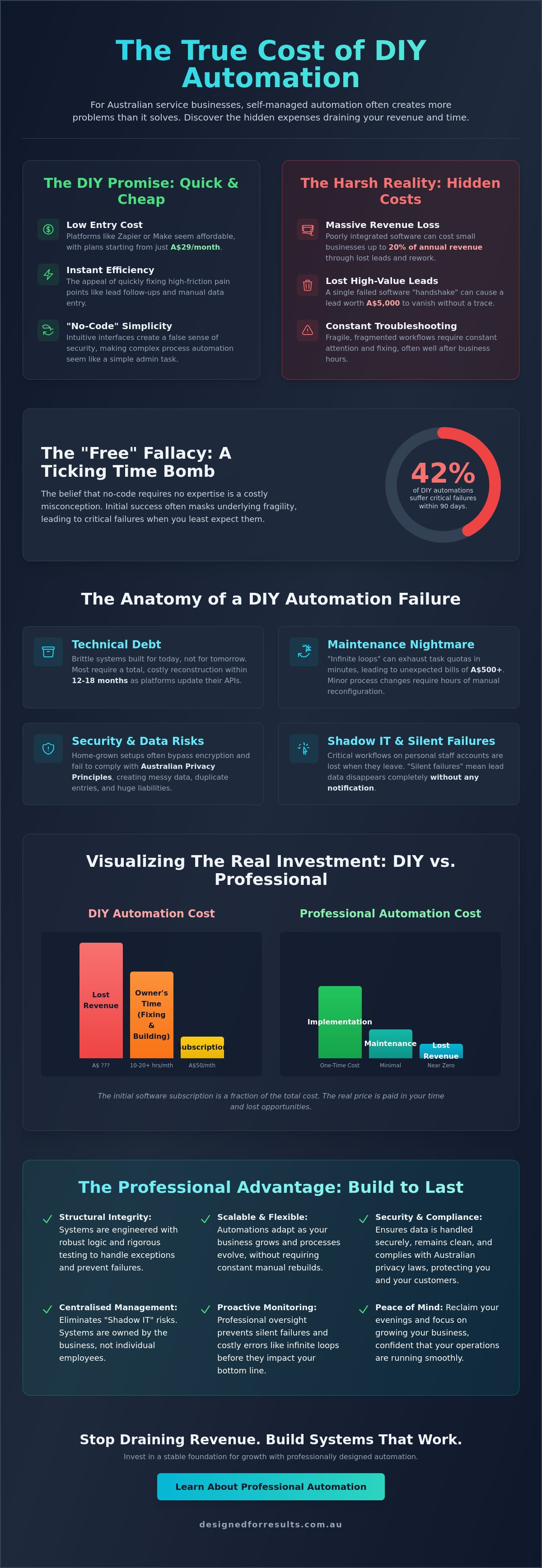
Building your own automation systems to save money often results in a net loss for Australian service businesses. You likely started using tools like Zapier or Make to reclaim your evenings and stop leads from falling through the cracks. It's a logical step to manage these tools yourself when you're focused on the bottom line. However, the hidden costs of diy automation frequently manifest as fragmented workflows that require constant troubleshooting well after business hours. Industry data from 2024 indicates that poorly integrated software can cost small businesses up to 20% of their annual revenue through lost leads and manual rework. These unreliable setups often mean a lead worth A$5,000 disappears because a simple software handshake failed unnoticed.
This article identifies the specific financial and operational risks you face when managing complex integrations without professional oversight. You'll discover how to stop software silos from draining your revenue and learn the steps to implement systems that work every time. We'll examine the measurable impact of professional implementation on your personal freedom and business growth.
What is DIY Business Automation and Why is it Tempting?
DIY business automation is the self-directed assembly of no-code platforms like Zapier or Make to manage repetitive operational tasks. By 2026, the barrier to entry for Australian businesses has effectively vanished. Owners can now access powerful integration tools for as little as A$29 per month. This accessibility creates an immediate appeal. It promises instant efficiency and the elimination of manual data entry without the need for expensive software developers. Owners typically turn to these solutions to solve high-friction pain points, such as failing to follow up on leads or spending hours on quotes after the work day ends. These tools offer a quick fix for the exhaustion that comes from constant administrative overhead.
The Rise of No-Code Tools in Australian Business
The proliferation of tools like ChatGPT and Zapier has made automation feel like a standard administrative task rather than a technical discipline. This shift leads many to underestimate the complexity involved. There is a vast difference between simple task automation and sophisticated Business Process Automation. A single task might move a name from a website form to a spreadsheet. A professional workflow manages the entire customer journey from the initial enquiry to the final invoice. While modern interfaces are intuitive, the business logic required to handle exceptions and data integrity remains complex. Australian businesses often find that software ease of use does not translate to operational stability.
The "Free" Fallacy of Self-Implementation
The belief that no-code tools require no technical expertise is a common misconception. A typical starting point involves a business owner linking a website contact form to a database to save time on evening admin. This initial success is often misleading. It creates a false sense of achievement while masking the hidden costs of diy automation. These costs manifest when the setup fails to account for API updates or data formatting errors. Industry data from 2025 indicates that 42% of self-managed automations in small Australian businesses experience critical failures within the first ninety days. These failures often occur during peak periods, resulting in lost data or missed customer opportunities. Professional bespoke AI automation provides the structural integrity that DIY attempts often lack. Reliable systems are built on logic and rigorous testing, ensuring that growth is supported by stable infrastructure rather than fragile workarounds.
The Technical Debt of Unprofessional Workflows
Technical debt is the cumulative interest a business pays when choosing a quick, convenient solution over a well-engineered one. In the context of Australian business operations, this debt manifests as brittle automation flows that require total reconstruction within 12 to 18 months. While a DIY setup might function today, it often lacks the structural integrity to survive software updates. When platforms like Xero or HubSpot update their API schemas, unmonitored DIY connections fail. A 2023 report by MuleSoft highlighted that 80% of organisations struggle with these integration challenges, leading to disconnected data silos that hinder decision-making.
Shadow IT presents a significant risk to continuity. Many managers build critical workflows using personal accounts rather than centralised business profiles. This leaves sensitive company data living in unmanaged environments. If a staff member leaves the business, their personal automation account often goes with them. The resulting disruption is one of the most significant hidden costs of diy automation, as it forces an immediate, high-pressure rebuild of essential systems. Without professional error handling, these builds also suffer from silent failures. If a lead sync fails, the data is frequently lost without any notification to the owner, directly impacting the bottom line.
Maintenance: The Silent Profit Killer
Automation is a living asset, not a static tool. It requires consistent monitoring to remain effective as business processes evolve. DIY builds often lack the flexibility to adapt, meaning every minor change in a workflow requires hours of manual reconfiguration. A common technical failure is the infinite loop. This occurs when two automations trigger each other recursively. On platforms like Zapier, an undetected loop can exhaust monthly task quotas in minutes, resulting in unexpected invoices exceeding A$500 in a single afternoon. Professional oversight prevents these inefficiencies through rigorous logic testing.
Data Integrity and Security Risks
Security is often an afterthought in DIY setups. Many home-grown automations bypass essential encryption or fail to comply with the Australian Privacy Principles (APP). This creates a liability for businesses handling sensitive customer information. Poorly designed logic also creates duplicate entries within a CRM, causing friction for the customer service team. When data is messy, the customer journey suffers. Implementing bespoke automation solutions ensures that data remains clean and secure. Centralised account management also simplifies staff offboarding, protecting business intelligence and maintaining security protocols without disrupting daily operations.
Calculating the True Cost: DIY vs. Professional Implementation
Software subscriptions represent only a small fraction of your total investment. The hidden costs of diy automation often manifest in the hours diverted from revenue-generating activities. Australian business owners frequently underestimate the technical debt accrued when building systems without a professional foundation. While a A$50 monthly subscription seems economical, the actual price includes the time you spend building, testing, and inevitably fixing the system when it breaks.
The Opportunity Cost of Your Time
Every hour you spend troubleshooting a software integration is an hour stolen from business development. You can calculate the immediate impact using this formula: (Hours spent troubleshooting) x (Owner’s hourly billable rate) = Actual Cost. If your billable rate is A$250 and you spend four hours fixing a broken workflow, that "free" automation just cost you A$1,000.
Contrast spending an afternoon on a complex Zap with spending those same hours closing a high-value contract. The mental load of managing technical issues during your evenings leads to admin fatigue and burnout. Professional systems remove this burden, allowing you to focus on high-level leadership and measurable outcomes. Your time is better spent on strategic growth than on debugging API errors at 9:00 PM.
The Cost of Lost Opportunities
A single failure in an automated lead follow-up system can be devastating. Research shows that responding to a lead within five minutes increases conversion rates by 900%. If a DIY system lags or fails to trigger, you lose that "speed to lead" advantage to a more responsive competitor. Quantify the value of a lost lead. If your average project value is A$5,000, one broken automation trigger costs you exactly that much in potential revenue.
- Brand Reputation: Sending incorrect automated messages or duplicate emails makes an Australian business look unorganised.
- System Reliability: Professional builds include error handling and redundancy that DIY setups lack.
- Lead Retention: Reliable systems ensure no prospect falls through the cracks during the customer journey.
Scalability is another critical factor. DIY setups often reach a breaking point once volume increases, requiring a total rebuild that disrupts operations. Investing in bespoke AI automation provides a robust architecture that grows with your business. This professional approach delivers a higher long-term ROI by preventing the need for constant patches and expensive emergency repairs. It creates a high-performance culture where technology supports growth rather than hindering it.
When to Build and When to Hire an Expert
Deciding whether to build an automation in-house or partner with a specialist requires a clear assessment of risk and complexity. Low-stakes automations, such as setting a personal reminder for a weekly meeting or auto-filing a specific email, are suitable for DIY experimentation. These tasks carry minimal consequences if they fail. However, the hidden costs of diy automation become apparent when Australian businesses attempt to build core operational systems without professional oversight. Success in automation depends on aligning technical execution with measurable outcomes.
The Complexity Threshold
Audit your proposed workflow for technical depth. Any system involving more than three steps or connecting more than two different applications represents a high-risk DIY project. These multi-app workflows often require sophisticated conditional logic and error-handling paths that standard DIY templates ignore. Without these safeguards, a single API update can break the entire chain, leaving you to troubleshoot complex code during business hours. Seek AI consulting services before committing internal resources to a major project. Professional design ensures your systems remain stable as your business scales, preventing the technical debt that accumulates from amateur builds.
The Criticality Test
Evaluate the impact of system failure on your bottom line. Ask: if this automation stops working for 48 hours, what is the impact on revenue? Any process that touches a customer or a payment requires a professional build. This applies directly to lead follow up systems where a missed notification can result in losing a A$15,000 contract to a competitor. Professional builds provide the documentation and support structures necessary for long-term reliability. Managed service retainers offer ongoing system health checks, ensuring that your customer journey remains seamless even as software environments evolve. Ignoring the hidden costs of diy automation in revenue-generating workflows often leads to expensive emergency repairs.
Professional automation partners deliver more than just a working script; they provide the architecture for high-performance culture. They document every logic gate and provide a clear recovery plan for when external software updates disrupt the flow. This level of rigour allows business owners to reclaim their evenings and focus on leadership capability rather than fixing broken zaps. Professional engineering secures your business infrastructure more effectively than trial and error.
Ready to move beyond basic tools? Let's chat about building a reliable system for your business.
Achieving Scalable Efficiency with Professional Automation
Moving from a collection of best-guess tools to a professionally built architecture is the most significant step an Australian business can take toward sustainable expansion. Professional implementation ensures your systems work for you, rather than the other way around. You stop losing hours to technical debt and start operating with a system that supports growth without requiring more headcount. This shift directly addresses the hidden costs of diy automation, which often manifest as lost leads and wasted executive time.
Treat professional automation as a capital investment. It is an asset that appreciates in value as it handles more of your business logic. Unlike DIY setups that require constant tinkering, professional systems include proactive monitoring. This means your lead follow-up or quoting process remains active 24/7, even while you sleep. Recent industry data from 2024 indicates that businesses with integrated automation see a 30% reduction in operational costs within the first twelve months of deployment. The peace of mind gained from knowing your systems won't break during a peak period is invaluable for any serious business leader.
A professional approach provides several distinct advantages over a DIY setup:
- Predictable Performance: Systems are built to handle high volumes without slowing down or failing.
- Reduced Risk: Expert monitoring identifies potential API issues before they disrupt your customer journey.
- Operational Clarity: Data flows cleanly between departments, providing a single source of truth for your finances and sales.
- Human Resource Savings: Your team focuses on high-value client interactions instead of manual data entry.
Building for the Future of Your Business
Professional systems integrate natively with core tools like Xero or your CRM to ensure data flows without manual intervention. Whether you use HubSpot, Salesforce, or a industry-specific platform, the connection must be seamless. Once this foundation is stable, you can layer in advanced capabilities like AI voice agents to manage inbound enquiries or appointment setting. The objective is simple: remove the owner from repetitive admin tasks. By automating the 15 to 20 hours of weekly paperwork, you return to the high-value work that actually drives revenue and improves your bottom line.
Taking the Next Step
Audit your current systems to identify where the hidden costs of diy automation are draining your resources. The Designed For Results approach focuses on removing complexity to deliver clear, measurable outcomes. We help you move past the busy work that stalls your progress and prevents you from scaling. To discuss how to streamline your specific operations and reclaim your evenings, book a chat with our team today. We'll help you build a system that works as hard as you do.
Secure Your Competitive Advantage
Building your own systems often results in technical debt that stalls your growth. The hidden costs of diy automation appear when workflows break or fail to capture leads, forcing you to handle repetitive admin tasks late into the night. Professional implementation ensures your technology remains an asset. By integrating no-code solutions and AI with expert oversight, you secure measurable time-back and a professional customer experience. According to the 2024 ACS Australia’s Digital Pulse report, businesses that lead in digital adoption see significantly higher revenue growth than those struggling with poorly integrated systems. It's time to stop patching holes and start building a foundation that supports your long-term goals. Every hour you save on administration is an hour you can spend growing your revenue or enjoying your personal life. You deserve a business that operates efficiently without your constant intervention.
Stop wasting time on broken workflows. Let’s chat about a professional solution.
Your business has incredible potential, and the right systems will help you reach it.
Frequently Asked Questions
Is DIY automation always a bad idea for Australian businesses?
DIY automation works well for basic, single-step tasks such as sending a standard internal notification. The hidden costs of diy automation usually appear when businesses try to scale complex, multi-step workflows without technical expertise. A 2024 report by Gartner indicates that 80% of citizen-developed automations require significant rework within 12 months. Start with low-risk tasks but recognise when a process requires professional engineering to remain stable.
How much does it cost to fix a broken DIY automation system?
Repair costs often exceed the original setup price because specialists must audit and untangle undocumented logic. Australian automation consultants typically charge between A$150 and A$350 per hour for emergency troubleshooting. If a critical lead capture system fails for 48 hours, a business generating A$1 million annually could lose approximately A$5,400 in potential revenue based on average industry conversion rates.
What are the most common signs that my DIY automation is failing?
Frequent data discrepancies between your CRM and accounting software are the first indicators of logic failure. You might also notice an increase in "failed run" notifications or find yourself manually verifying if tasks were actually completed. When your team spends more than five hours a week troubleshooting tools meant to save time, the system is a liability. Reliable systems operate in the background without requiring constant human intervention.
Can I start with DIY and upgrade to a professional system later?
You can transition to professional systems, but you should expect to rebuild most workflows from the ground up to ensure high-performance outcomes. Professional systems utilise robust error handling and direct API integrations that basic DIY tools often lack. A 2023 study by Forrester found that migrating from fragmented DIY tools to a unified, professionally managed platform reduces operational overhead by 30% over two years.
Do I really need AI, or is simple automation enough for my business?
Simple automation handles repetitive, rules-based tasks while AI is necessary for interpreting unstructured data or making complex predictions. Most Australian service businesses achieve significant results by first perfecting workflow automation for lead follow-ups and invoicing. Focus on automating core administrative bottlenecks that keep you working late. If your primary struggle is manual data entry, standard automation provides the most immediate ROI.
What is the average ROI for professional workflow automation in Australia?
Professional automation delivers a full return on investment within six to nine months for most Australian businesses. Data from Nucleus Research indicates that for every dollar spent on advanced automation, businesses see an average return of A$8.00. This profit stems from reduced labour costs, the elimination of human error, and the capacity to process 25% more leads without increasing your total headcount.
How do I know if my business is ready for a managed automation service?
Your business is ready for managed services when the cost of system downtime outweighs the monthly service fee. If you process more than 500 automated transactions monthly, a single failure can disrupt your entire customer journey and damage your brand reputation. Managed services provide proactive monitoring and updates, ensuring your revenue-generating processes remain functional while you focus on high-level leadership and strategic growth.
What happens to my DIY automations if the software provider updates their API?
Your automation will likely stop functioning immediately because DIY setups rarely include the sophisticated error handling required for software updates. Major platforms like Xero or Salesforce update their APIs multiple times per year. These hidden costs of diy automation manifest as broken workflows that require immediate manual intervention. Professional systems include version control to prevent these updates from crashing your business operations.
