
Workflow Automation vs Custom Software: A Strategic Framework for 2026

Discover the definitive decision-making framework to choose between agile workflow automation and bespoke software development to maximise your business ROI.
For Australian business leaders, the 'complexity tax' is no longer a footnote; it's a strategic anchor. Rising labour costs and the relentless pace of market change demand systems that are both powerful and pliable. You feel the pressure, and you're facing a critical question: Should you invest in a bespoke application built from the ground up, or can you achieve superior results faster with modern automation tools?
The old 'Build vs. Buy' debate is obsolete. In 2026, the winning strategy is 'Designed Intentionality'—leveraging high-agility automation platforms that mimic the power of custom software without the crippling technical debt. This framework will guide you to the right decision for your business.
The Strategic Fork: Defining Workflow Automation and Custom Software in 2026
The choice before you isn't merely technical; it's a fundamental decision between engineered agility and rigid architecture. Understanding this distinction is the first step toward making a strategically sound investment.
Workflow Automation in 2026 is the intelligent orchestration of existing, best-in-class software platforms. Think of it as conducting a symphony of specialised tools (like your CRM, email marketing, and accounting software) using conductors like Make, Zapier, and sophisticated AI Agents to perform complex, cross-functional tasks.
Custom Software, by contrast, is the process of building a proprietary codebase from the ground up. It involves hiring developers to write unique code, creating a completely bespoke digital asset that your business owns, but must also exclusively maintain. The game has changed. The rise of powerful AI has elevated low-code automation, giving it the logical muscle that was once the sole domain of custom-built applications.
Workflow Automation: The Agile Architecture
The power of modern workflow automation lies in its modular nature, built upon an ecosystem of API-first platforms. Instead of a single, monolithic system, you have a flexible architecture of interconnected components.
- Unmatched Speed-to-Market: The primary competitive advantage is speed. Where custom development can take six to twelve months, a core automated workflow can be designed, built, and deployed in weeks, delivering immediate efficiency gains.
- Modular and Adaptable: Your business isn't static, and your systems shouldn't be either. Automation allows you to swap out tools, integrate new technologies like AI voice agents, and adapt processes on the fly without a costly and time-consuming rewrite.
- AI-Driven Logic: Previously, complex, multi-step logic required a developer. Today, AI assistants and agents can manage intricate conditional pathways, data transformations, and decision-making within an automated workflow, bridging the gap between simple 'if-this-then-that' recipes and true operational intelligence.
Custom Software: The Bespoke Burden?
Building a proprietary application still has its place, but its strategic application has narrowed significantly. It should be reserved for scenarios where the software itself is the core, sellable intellectual property of the business.
- The Black Box Risk: When you hire an external development team, you are often entrusting a critical business function to a process you cannot see. Delays, cost overruns, and a final product that doesn't quite match the vision are common risks.
- Momentum-Killing Development Cycles: Long development timelines don't just delay ROI; they drain business momentum. While you wait for the 'perfect' system to be built, your competitors are deploying agile solutions and capturing market share.
- When is it Necessary? Custom software is a true asset only when it creates a feature or function that is utterly unique in the market and provides a defensible competitive moat. For 95% of internal operational processes, it's an expensive and rigid way to reinvent the wheel.
Comparison Framework: Speed, Cost, and Scalability
A high-conviction decision requires a clear-eyed analysis of the Total Cost of Ownership (TCO), not just the upfront price tag. The true cost of a system reveals itself over its entire lifecycle.
| Feature | Workflow Automation | Custom Software |
|---|---|---|
| Initial Investment | Low (Agency fees, subscriptions) | High (Developer salaries, project fees) |
| Speed to ROI | High (Weeks to months) | Low (Months to years) |
| Maintenance | Low (Managed by platforms & agency) | High (Requires dedicated developers) |
| Agility & Adaptability | High (Modular and easily changed) | Low (Rigid, requires code changes) |
| Human Capital | Managed by an automation partner | Requires an in-house or contracted IT team |
The enduring myth that automation can't scale for larger enterprises is a relic of the past. Modern platforms are built to handle enterprise-level volume, and a well-designed architecture can outperform a poorly built custom application. The real question is not about technical limits, but about human capital: who owns, manages, and optimises the system after it goes live?
Cost Realities for Australian SMEs
In the specific economic context of Australia, the financial divergence between these two paths is stark.
- Talent Costs: The high cost of local developer salaries is a significant factor. A custom build requires a substantial investment in technical wages, whereas automation implementation fees paid to a specialised agency are a one-off project cost.
- Ongoing Expenses: A custom application's costs never end. You are responsible for server hosting, security patching, database management, and ongoing bug fixes. This contrasts sharply with the predictable, tiered costs of a 'Subscription Stack' (e.g., Make, OpenAI, CRM licences), where maintenance and security are handled by the platform provider.
- Defining ROI: In this context, ROI is most powerfully defined in a single metric: the total number of team hours reclaimed per month, multiplied by your average loaded labour cost.
Scalability and Performance Limits
Concerns about the 'ceiling' of automation tools are valid but often misplaced.
- Breaking Through the Ceiling: While basic tools have limits, a strategic approach uses hybrid logic. This involves connecting low-code platforms with serverless functions (like AWS Lambda) for intensive data processing tasks, giving you the best of both worlds: speed and power.
- The Custom Bottleneck: A custom application, designed for yesterday's business reality, often becomes a strategic bottleneck. When a market shift demands a rapid pivot, the monolithic codebase can be slow and expensive to change, hindering your ability to respond.
- Reliability: Cloud-based automation platforms boast enterprise-grade uptime and reliability, often exceeding what a small or medium-sized business can afford to build and maintain in a self-hosted environment.
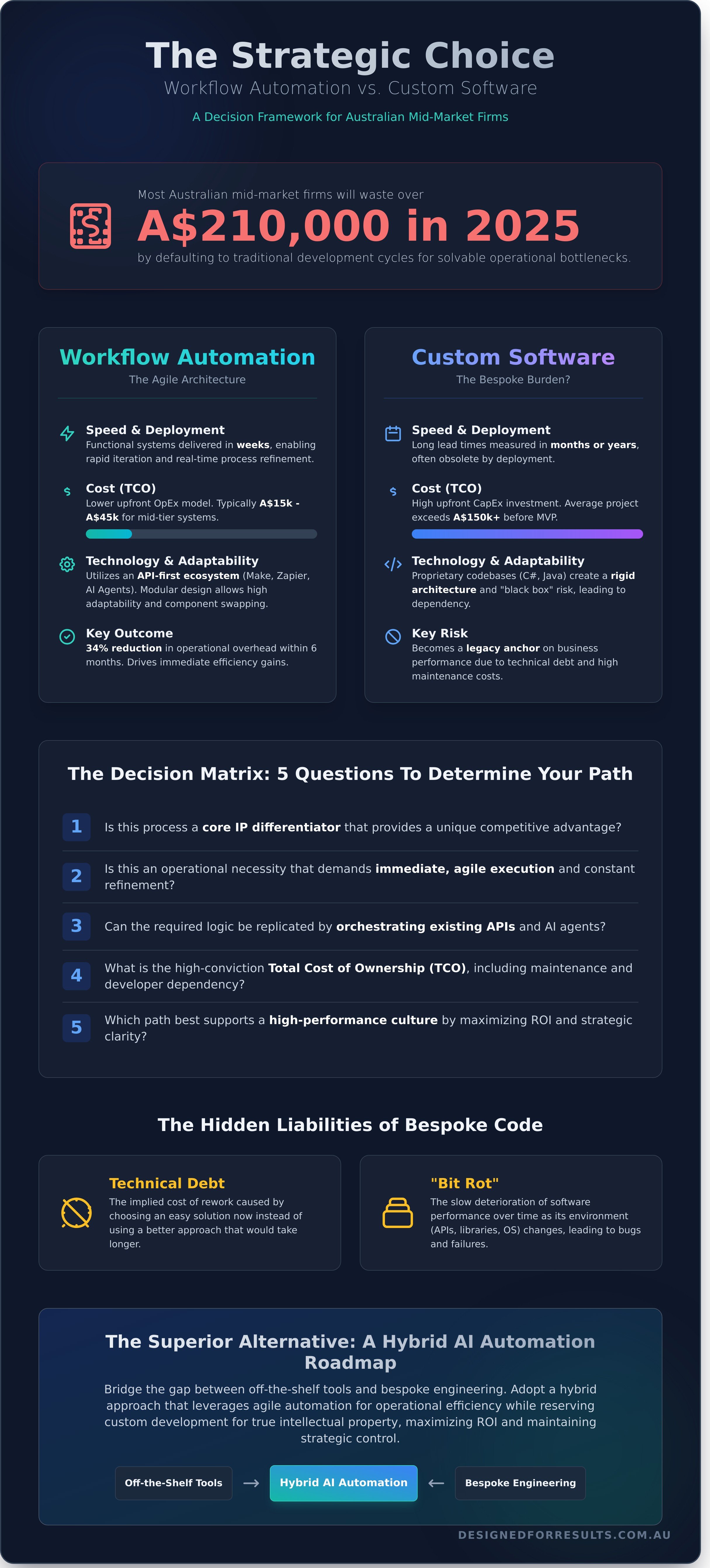
The Decision Matrix: 5 Questions to Determine Your Path
Move beyond technical specifications and ask these five strategic questions. Your answers will illuminate the correct path for your business.
- Is the process a core IP differentiator or an operational necessity?
- What is the 'Cost of Inaction' if a solution takes six months to deploy?
- Does your internal team have the capability and desire to maintain a proprietary codebase?
- How often does your core business logic change in response to market shifts?
- Can the desired outcome be achieved by intelligently connecting 3-4 existing best-in-class tools?
Identifying Your Core IP
The most critical distinction is whether you are building a product to sell or a system to run your business.
- Product vs. Process: If you are a SaaS company, your code is the product. If you are a service business, your operational systems are processes that enable the product. Don't confuse the two.
- Stop Reinventing the Wheel: Building a custom CRM or a bespoke lead generation tool in 2026 is a strategic error. Specialised platforms have invested millions in perfecting that functionality. Your advantage comes from how you orchestrate them, not from rebuilding them.
- The 80/20 Rule: Focus your resources on the 20% of your business that delivers 80% of your unique value. For everything else, leverage the efficiency of best-in-class automated solutions.
The Agility Audit
Your ability to adapt is your greatest competitive weapon. Your systems must support, not hinder, this agility.
- 'Hot-Swapping' Technology: The AI landscape changes monthly. A modular, automated system allows you to 'hot-swap' components—for example, upgrading from one AI model to a more powerful one—with minimal disruption. This is nearly impossible in a hard-coded custom application.
- The Danger of Vendor Lock-in: A long-term relationship with a custom software development shop can lead to 'vendor lock-in', where you become dangerously dependent on a single team's knowledge of your proprietary system.
- Intentional Engineering: Automation enables true 'Intentional Engineering'. You can rapidly test, measure, and iterate on your processes in a live environment, using real-time data to optimise for performance. This iterative cycle of improvement is the hallmark of a high-performance culture.
The Hidden Liability: Technical Debt and Maintenance
The single greatest misconception about custom software is that once it's built, the expense is over. In reality, the work has just begun.
This is the concept of Technical Debt: the implied cost of rework caused by choosing an easy (limited) solution now instead of using a better approach that would take longer. With custom software, this debt compounds silently until it becomes a crisis.
- The 'Bit Rot' Phenomenon: Code is not a static asset; it degrades. Without constant attention, custom code becomes incompatible with new operating systems, security standards, and third-party APIs, a phenomenon known as 'bit rot'. Automated workflows, managed by the platform providers, are continuously updated for you.
- Security and Compliance: The burden of maintaining custom security patches to protect against new threats is massive and never-ending. A single vulnerability in your bespoke code can have catastrophic consequences.
- The 'Developer Hostage' Scenario: What happens when the one developer who understands your complex, undocumented codebase leaves? The business is left in a state of paralysis, effectively held hostage by a critical knowledge gap.
Maintenance Costs: The Silent Profit Killer
These ongoing costs are not trivial; they are a silent drain on profitability that must be factored into your TCO calculation.
- The 20% Rule: Industry analysis consistently shows that businesses spend, on average, 15-20% of the initial development cost annually just to maintain a piece of custom software.
- The Managed Service Alternative: Contrast this with the 'Managed Service' model offered by automation agencies. For a predictable monthly retainer, your systems are monitored, maintained, and optimised, transforming a volatile capital expense into a manageable operational one.
- Effortless Updates: When a platform like Zapier or Make updates its infrastructure, your workflows are automatically brought up to the latest standard. This background maintenance is a powerful, hidden benefit of the automation model.
Future-Proofing Your Infrastructure
Choosing a systems architecture is a long-term bet on the future. A modular approach is inherently more resilient and future-proof than a monolithic one.
- Designed for Change: Because workflow automation connects specialised tools, it's designed for change. Integrating a new AI voice agent or a revolutionary data analysis tool becomes a simple matter of adding a new module, not rewriting a core application.
- Empowering Your Team: The goal of any system is to enhance human capability. Giving your team an agile, high-performance system they can understand and leverage builds a culture of ownership and efficiency. Complex, black-box custom software often does the opposite, creating friction and frustration.
Designed For Results: The Hybrid Approach to Automation
The optimal solution is not about choosing tools over code. It's about applying the strategic rigour of custom software engineering to the agile world of automation.
Our 'Strategic Alignment' process serves as the bridge. We don't just connect apps; we engineer outcomes. We begin by developing a comprehensive AI Automation Roadmap, a strategic blueprint that functions as a superior alternative to a traditional Product Requirements Document (PRD). This roadmap ensures every automation, every AI Agent, and every workflow is directly aligned with a measurable business objective.
This is where the true power of the hybrid approach is realised—deploying sophisticated AI Voice Agents and custom AI Assistants within automated flows to handle complex tasks like lead qualification and customer service, all without writing a single line of proprietary code. The goal is to move your business from accidental growth to intentional, engineered success.
Our Result-Oriented Methodology
We combine the speed of no-code development with the strategic depth of bespoke consulting.
- Strategic Rigour: Our process starts with your business goals, not with technology. We design systems to solve your most pressing commercial challenges.
- Ongoing Optimisation: Through our Monthly Managed Service Retainers, we become your long-term strategic partner, continuously monitoring and refining your systems to ensure they deliver peak performance as your business evolves.
- High-Impact Systems: We specialise in high-value areas like Lead Generation Systems, engineering automated funnels that capture, qualify, and nurture leads to drive measurable revenue growth.
Engineering Your Success
We believe that success should be designed, not stumbled upon.
- Outcomes Over Code: Our key performance indicator is not 'Lines of Code' but 'Measurable Outcomes'. We focus on metrics that matter: hours saved, leads generated, and revenue increased.
- A Single Source of Truth: A core part of our methodology is expert CRM implementation. We establish your CRM as the central nervous system of your business, ensuring all data flows into a single source of truth that provides clarity and drives intelligent decision-making.
Stop letting operational drag dictate your potential. It's time to engineer the systems that will drive your growth for 2026 and beyond.
Design your intentional growth with a Free AI Automation Audit
Frequently Asked Questions
Is workflow automation as secure as custom-built software? Yes, and in many cases, it's more secure. Leading automation platforms like Make and Zapier invest millions in enterprise-grade security, compliance, and infrastructure—a level most small and medium-sized businesses cannot afford for a custom application. The security burden is managed by dedicated expert teams, rather than your own.
How long does it typically take to see ROI from workflow automation vs custom builds? Workflow automation typically delivers a positive ROI within 2-4 months, as implementation is fast and efficiency gains are immediate. Custom software projects often take 12-18 months or more to show a return, due to long development cycles and high upfront costs.
Can I migrate from automation tools to custom software later if I grow too large? Absolutely. A key benefit of a modular automation strategy is that it's not an all-or-nothing decision. You can systematically replace individual automated processes with custom-coded solutions if and when a specific function becomes a core piece of your sellable IP and requires unique, proprietary logic.
What are the most common tasks Australian SMEs should automate first? We recommend starting with high-volume, low-value tasks that create the most administrative drag. The top candidates are typically: lead capture and qualification, client onboarding, invoice and payment reminders, and internal reporting processes.
Do I need a technical background to manage an automated workflow? No. While the initial design and build require expertise, the systems are designed to be managed by non-technical staff. Through our Managed Service retainers, we handle all the ongoing monitoring, maintenance, and optimisation, so you can focus on running your business.
What happens if a tool like Zapier or Make goes down? Leading automation platforms have extremely high uptime (typically 99.9% or higher). In the rare event of an outage, they have built-in error handling and automatic retries, ensuring that once the service is restored, your tasks will resume without data loss. This is often more reliable than a single-server custom application.
How do AI voice agents fit into a standard workflow automation setup? AI voice agents act as a powerful module within a larger workflow. For example, an agent can handle inbound calls, qualify a lead by asking a series of questions, and then pass that structured data into your CRM via an automated workflow, which then triggers follow-up tasks—all without any human intervention.
Why is custom software development so much more expensive in Australia? The primary driver is high local labour costs. Australia has some of the highest salaries for skilled software developers in the world. This makes the 'human capital' component of a custom software project significantly more expensive than in many other regions, amplifying the financial benefits of a lean, automation-first approach.