
Automating Accounts Receivable Follow Up: A Guide for Australian Businesses in 2026

Australian businesses lose approximately 12 days every year just chasing overdue invoices according to recent SME productivity reports; a figure that represents a direct drain on your operational capacity. Managing inconsistent cash flow is exhausting when administrative tasks consume your personal time and disrupt your focus. These manual processes often delay your ability to scale and create unnecessary friction in client relationships that should otherwise remain professional and positive.
Implementing a system for automating accounts receivable follow up allows you to secure your revenue while removing the emotional burden of manual debt collection. This guide demonstrates how to deploy intelligent workflows that ensure you get paid faster and maintain professional client standards without constant intervention. We'll examine the specific automation tools that eliminate manual follow ups; allowing you to focus on high-value work and reclaim your evenings. Results come from a deliberate approach to financial operations where every invoice is tracked through a reliable, automated sequence that protects your bottom line.
The Impact of Manual Accounts Receivable on Australian Business Growth
Manual accounts receivable management is a primary barrier to scaling for service-based Australian businesses. This process involves the repetitive, manual tracking of invoices and the subsequent chasing of debtors through phone calls and emails. By understanding accounts receivable as a core liquidity metric, it becomes clear that manual intervention is a bottleneck. Automating accounts receivable follow up digitises this workflow, ensuring that every invoice is tracked and every reminder is sent without human intervention.
Consistent follow-up is the most effective lever for reducing Days Sales Outstanding (DSO). When a business relies on manual chasing, the follow-up schedule is often the first casualty of a busy week. This inconsistency signals to clients that payment deadlines are flexible, which delays cash arrival. Transitioning to an automated system removes this ambiguity and establishes a professional standard for payment expectations.
The Real Cost of Delayed Payments
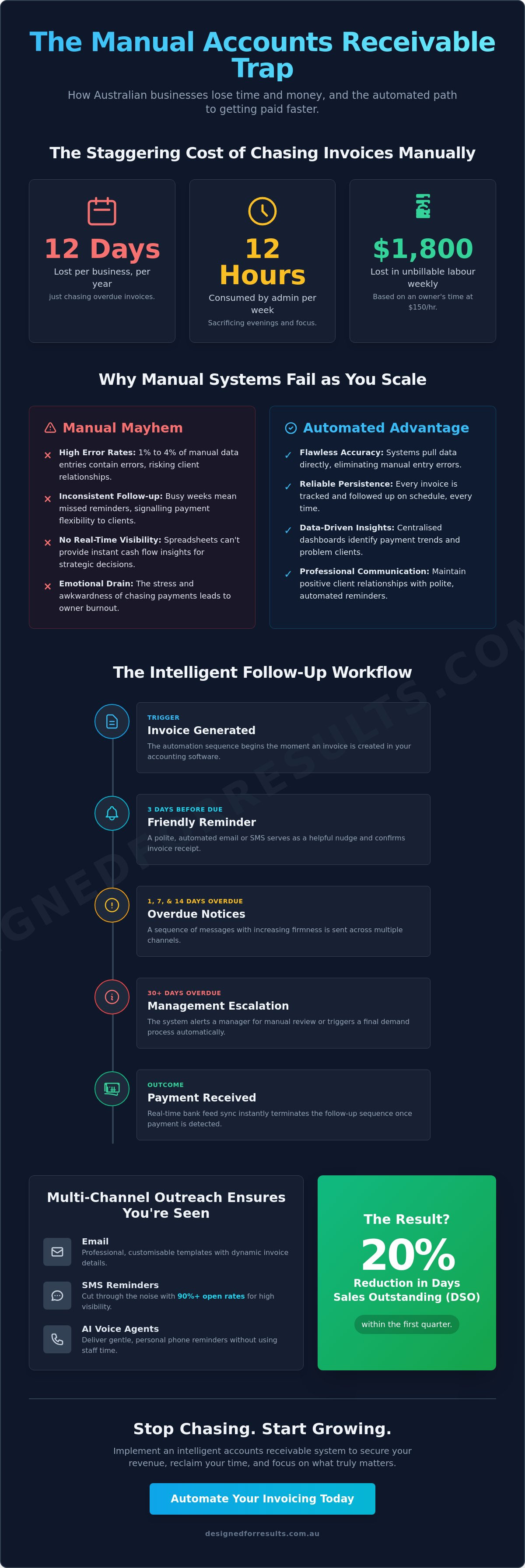
The financial impact of manual chasing extends far beyond the face value of an unpaid invoice. Data from the Australian Small Business and Family Enterprise Ombudsman (ASBFEO) in 2023 indicates that late payments affect 25% of small businesses, directly impacting their ability to meet operational costs. Administrative time spent on manual follow-ups costs the average Australian business owner approximately 12 hours per week. If an owner values their time at A$150 per hour, they're effectively losing A$1,800 weekly in unbillable labour.
This stagnant cash flow prevents reinvestment in lead generation and team expansion. Beyond the balance sheet, manual debt collection takes a significant emotional toll. Most owners find themselves stuck in "admin evenings," sacrificing personal time to reconcile bank statements and draft awkward payment reminders. This cycle leads to burnout and reduces the executive's capacity to focus on high-level decision-making.
Why Manual Systems Fail as You Scale
Manual systems are inherently fragile and cannot support high-performance growth. As client volume increases, the complexity of tracking multiple payment terms across various spreadsheets leads to critical errors. Research into manual data entry shows error rates between 1% and 4% in complex environments. These mistakes result in missed invoices or, worse, chasing a client who has already paid, which damages the customer relationship. For businesses looking to scale, bespoke AI and automation solutions provide the necessary visibility that spreadsheets lack.
Spreadsheets offer no real-time data visibility, making it difficult to forecast cash flow accurately. Without a centralised, automated dashboard, managers cannot identify which clients are habitual late payers or which services are most prone to payment delays. Automating accounts receivable follow up provides the data clarity required to make informed decisions about client retention and credit terms, moving the business away from reactive management toward a model of intentional performance.
The Mechanics of an Automated Follow-Up Workflow
Effective systems for automating accounts receivable follow up rely on precise engineering rather than manual guesswork. Every action stems from a specific data point within your accounting software. When an invoice is generated, the sequence begins. Real-time synchronisation between your bank feeds and your automation platform is non-negotiable. Without this, you risk the professional embarrassment of chasing a client who has already paid. Data must flow bi-directionally to ensure that once a payment hits your account, the follow-up sequence terminates instantly.
Customisable templates maintain your professional standards while removing the burden of drafting individual messages. These templates use dynamic fields to pull specific invoice numbers, amounts, and due dates directly into the communication. This ensures accuracy and saves hours of administrative work every week. Australian businesses using these structured systems often see a 20% reduction in Days Sales Outstanding (DSO) within the first quarter of implementation.
Trigger-Based Communication Sequences
Triggers act as the logic gates of your cash flow. The first trigger is the "Friendly Reminder," typically scheduled for 3 days before the due date. This serves as a helpful nudge and confirms the client has received the invoice. If the due date passes without payment, the system initiates the "Overdue Notice" sequence at 1, 7, and 14 days. Each message increases in firmness. For accounts reaching 30 days past due, an escalation trigger alerts management or initiates a final demand process to protect the bottom line.
Multi-Channel Outreach Strategies
Email alone is often insufficient. Combining email with SMS ensures higher visibility, as SMS open rates in Australia remain consistently above 90%. For a more personal touch, AI voice agents can deliver gentle phone reminders. These agents handle the initial follow-up calls, answering basic questions about payment methods without requiring your staff to pick up the phone. If these digital touches fail, the system can automatically generate a formal letter of demand, formatted to meet Australian regulatory requirements. This multi-layered approach ensures no invoice is overlooked.
Building these workflows allows you to reclaim your evenings and focus on high-level delivery. If you want to see how these systems fit into your current operations, you can book a brief consultation to discuss your specific requirements.
Designing Effective Communication for Late Payments
Effective communication is the cornerstone of a healthy ledger. When automating accounts receivable follow up, the primary goal is to secure payment without alienating the client. Success depends on the quality of the messaging and the ease with which a client can settle their debt. High-conviction communication ensures that your expectations are clear and your professional boundaries remain intact.
Segment your client base to ensure the intensity of the follow-up matches the risk profile. Assign clients to specific tiers based on their historical payment reliability. A long-term client with a 100% payment record requires a different touchpoint than a new account that has missed three consecutive deadlines. This segmentation allows the automation software to apply the correct tone and frequency for each group, ensuring that your most valuable relationships receive the appropriate level of care.
Maintaining the Client Relationship
Draft concise copy that prioritises clarity over emotion. Avoid aggressive language that creates defensiveness. Start the cycle with a courtesy reminder five days before the invoice is due. This initial message serves as a helpful prompt for busy Australian business owners who may have simply overlooked the email. As the invoice ages, increase the firmness of the language. A 30-day overdue notice should state the outstanding amount and the required action clearly. This structured escalation protects your cash flow while preserving the professional relationship.
Reducing Friction in the Payment Journey
Remove every possible barrier to payment. Embed instant payment links in every email and SMS reminder to allow for immediate settlement via credit card or digital wallet. Using gateways compatible with the Australian market ensures the transaction is familiar and secure for the client. By implementing bespoke automation, you can ensure these links are dynamic and lead directly to the specific invoice in question.
Offer a dedicated customer portal. This allows clients to download invoices and view their statement history without contacting your office, saving hours of administrative time. Automate the receipting process to ensure the system records the payment instantly. This prevents the embarrassment of sending a late notice for an invoice that has already been settled.
Handle disputes through automated feedback loops. Include a specific option for the client to flag an issue directly from the reminder email. When a client identifies a problem, the system should pause automated reminders and alert your team to resolve the matter. By automating accounts receivable follow up with these feedback loops, you eliminate the administrative bottleneck of manual query management and demonstrate a commitment to professional service.
Integrating Automation with Existing Financial Systems
Success in automating accounts receivable follow up depends on how well your software ecosystems communicate. Australian businesses often manage fragmented systems where data sits in silos, leading to missed payments and administrative friction. Bridging the gap between your accounting platform and your communication tools ensures that every follow-up is based on live payment data. This integration eliminates the need for manual data entry and reduces the risk of chasing a client who has already settled their account.
The Role of Xero and MYOB in Automation
Most Australian businesses rely on Xero or MYOB as their financial core. These platforms provide the essential raw data for invoice statuses, yet their native reminder features are often too rigid for complex service-based operations. They lack the ability to handle nuanced payment terms or highly personalised messaging. Implementing bespoke AI automation allows for a more robust approach. It pulls real-time data from your ledger and triggers specific actions based on client behaviour. This ensures your communication is always accurate and timely.
Integrating your CRM adds a vital layer of intelligence to the process. When financial data flows into your CRM, your team gains immediate visibility into payment histories. This prevents the professional embarrassment of pitching new services to a client with a significant overdue balance. Maintaining data integrity is the priority here. Automated synchronisation every 15 minutes eliminates the risk of human error that occurs during manual data transfers between platforms.
Workflow Mapping for Finance Processes
Effective automation requires a clear map of your current manual steps. Start by documenting every touchpoint from the moment an invoice is issued until the funds clear in your bank account. Identify the specific bottlenecks where your team is currently forced to intervene. You might find that staff spend five hours every week manually cross-referencing bank statements against open invoices. These repetitive tasks are the primary candidates for digital flows.
Design an exception-based system to maximise efficiency. This model allows the automation to handle 95% of standard follow-ups without human oversight. Your team only intervenes when a specific trigger occurs, such as a disputed invoice or a high-value account exceeding a 60-day limit. This shift gives the business owner back their time and ensures that human effort is focused solely on high-stakes problem-solving and relationship management.
Achieving Operational Efficiency through Professional Workflow Design
Transitioning to a structured automation system converts a fragmented administrative process into a reliable profit driver. Australian businesses frequently find themselves trapped in a cycle of manual follow-ups that consume up to 15 hours of management time every month. By automating accounts receivable follow up, you replace inconsistent manual effort with a precise, scheduled sequence. This shift allows you to reclaim the capacity to lead and focus on high-level service delivery. Professional implementation ensures that every touchpoint reflects your brand values while maintaining the pressure necessary to secure payment. Ongoing monitoring of these workflows allows for the fine-tuning of message timing and tone, ensuring the system remains effective as the business scales. A professional approach to workflow design provides the stability needed to grow without the constant fear of cash flow bottlenecks.
Measuring the ROI of AR Automation
Tracking the success of your automation efforts involves monitoring tangible financial shifts within the organisation. Data from 2024 industry benchmarks indicates that businesses using automated reminders see a 15% to 25% improvement in on-time payments within the first six months of implementation. These results translate directly into measurable outcomes for the bottom line.
- Cash Flow Velocity: Shifting your average collection period from 45 days to 38 days significantly improves your working capital position, providing the liquidity needed for immediate reinvestment.
- Write-off Reduction: Early intervention through automated triggers reduces the volume of debt reaching the 90-day overdue mark. This decreases the need for external collection agencies that typically charge 10% to 20% commission on recovered funds.
- Time Recovery: Quantifying the hours saved is essential. For most Australian business owners, eliminating 10 hours of monthly admin at a management rate of A$100 per hour represents a direct A$12,000 annual productivity gain.
- Forecasting Accuracy: Automated systems provide real-time data on payment trends, allowing for more precise financial forecasting and better-informed procurement decisions.
Next Steps for Australian Business Owners
Examine your current aged receivables report to identify the exact point where your cash flow stalls. Most businesses find that the majority of delays occur in the first 14 days after an invoice falls due. Start your journey by automating accounts receivable follow up for this specific window. This targeted implementation provides a proof of concept that builds confidence for further operational improvements across the business. Professional guidance helps avoid common technical errors that lead to double-billing or damaged client relationships. To see how these solutions fit your specific model and to reclaim your time, book an automation strategy call to discuss your specific needs.
Maximise Cash Flow Through Automated Systems
Manual debt collection drains resources and delays essential capital. Australian businesses lose significant hours every week chasing invoices, a task that shifts focus away from service delivery and leadership. Implementing a system for automating accounts receivable follow up removes the friction from your financial operations. It ensures every late payment is addressed with consistent, professional communication without requiring your direct intervention. Data from the Australian Small Business and Family Enterprise Ombudsman highlights that late payments impact the liquidity of over 50% of small businesses. By integrating these workflows into your existing financial software, you establish measurable outcomes that protect your bottom line.
We specialise in helping Australian SMEs transition from manual administration to high-performance systems. Our expertise as an AI automation agency allows us to build solutions that prioritise your time and operational efficiency. Book an automation strategy call to reclaim your time. You have the capacity to transform your accounts process into a reliable asset that supports your long-term objectives.
Frequently Asked Questions
Is automating accounts receivable follow-up too aggressive for my clients?
Automation maintains professional boundaries and ensures consistency rather than aggression. You control the tone, timing, and frequency of every message sent to your customers. A 2024 study by Dun & Bradstreet found that consistent communication reduces payment delays by 25%. By setting clear expectations through scheduled reminders, you remove the emotional friction often associated with debt collection. This approach treats all clients with the same level of professional respect.
How much time can an Australian business save by automating its AR?
Australian businesses typically reclaim 10 to 15 hours of administrative time per month by automating accounts receivable follow up. This eliminates the need for manual spreadsheet tracking and individual email drafting. Research from Xero indicates that automated reminders help businesses get paid up to 14 days faster. You can redirect these recovered hours toward high-value activities like service delivery or business development. It stops the cycle of working on admin during evenings.
Do I need a specific type of accounting software to automate my follow-ups?
You need a cloud-based accounting platform like Xero, QuickBooks Online, or MYOB that supports API integrations or built-in reminder features. Most modern Australian businesses use these platforms to sync their bank feeds and invoice data in real-time. If your current system lacks advanced automation, third-party tools connect directly to your ledger. These integrations ensure your data remains accurate without manual entry and provide the technical infrastructure required for reliable scaling.
Can I still manually intervene if a specific client needs more time to pay?
You retain full control to pause or customise automation for any specific invoice or client. If a long-term partner requests an extension, you simply toggle off the automated sequence for that specific record. This flexibility allows you to handle unique circumstances with empathy while the system manages the standard 90% of your ledger. It ensures your high-touch relationships receive personal attention without slowing down your overall cash flow or operational efficiency.
What happens if a client disputes an invoice in an automated system?
Most automation platforms include a dispute button or link that immediately halts the reminder sequence once clicked. This action notifies your accounts team to resolve the issue manually. Industry data shows that 15% of payment delays stem from billing errors or disputes. Resolving these quickly through a structured system prevents the frustration of receiving reminders for an incorrect invoice. It protects your professional reputation while ensuring errors are addressed promptly.
How does automation improve my business cash flow in the long term?
Automation improves cash flow by reducing your Days Sales Outstanding (DSO) and ensuring a predictable capital influx. Constant follow-up reduces the likelihood of debts becoming uncollectable, which happens to 5% of invoices older than 90 days. By automating accounts receivable follow up, you create a disciplined financial environment where capital is available for reinvestment. This stability allows you to plan for growth with certainty rather than reacting to bank balance fluctuations.
