
Best Review Generation Tools for Australian Small Businesses 2026

Different business models require different technical foundations. Trade services often prioritise SMS capability and mobile ease of use, whereas professional consultancies might value deep CRM integration and long-form feedback options. The value of AI-generated responses also varies; high-volume businesses benefit most from AI's ability to maintain engagement without manual typing, often utilizing specialized software from providers like Reasons Reviews. The table below outlines how these tools compare across core functional areas.
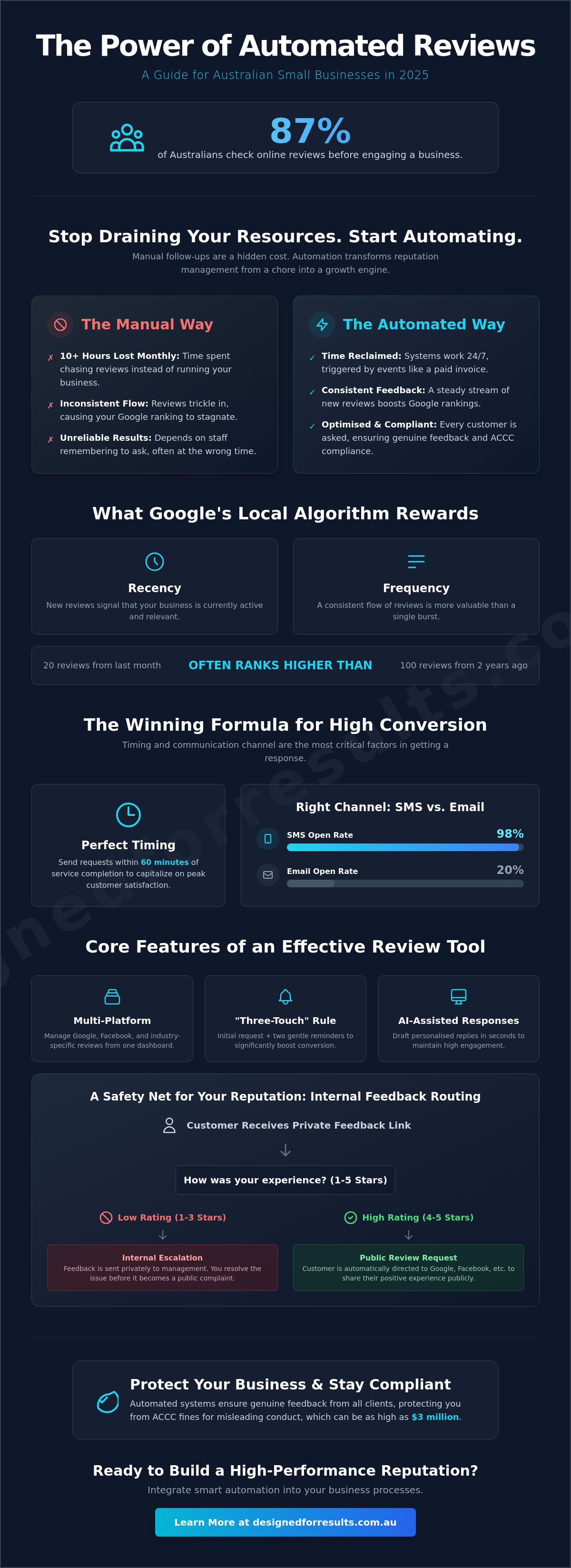
87% of Australians check online reviews before they ever pick up the phone or visit a shopfront. If your business isn't consistently capturing positive feedback, you're likely losing leads to competitors who have simply automated their reputation management. You know that manual follow-ups are essential, but spending your evenings chasing customers for a Google rating isn't a sustainable way to grow. It's frustrating to watch your search ranking stall because your review flow is inconsistent.
This guide identifies the best review generation tools for small businesses 2025, focusing on systems that integrate directly with your workflow to capture feedback automatically. You'll learn how to build a high-performance reputation that increases your visibility on Google Maps without adding a single hour to your administrative workload. We will compare the top-rated Australian platforms and break down the ACCC regulations you must follow to ensure your feedback collection remains genuine and compliant.
Beyond Manual Requests: Why Automated Review Systems are Essential in 2026
Manual follow-up is a hidden drain on your profitability. If you spend just 12 minutes per client on personalised review requests, a business with 50 clients a month loses 10 full hours to basic administration. This is time better spent on high-level leadership or with your family. Relying on staff to ask for reviews in person is equally unreliable. People forget, and customers get distracted. The result is a stagnant Google Business Profile that fails to attract new leads. Finding the best review generation tools for small businesses 2025 is about securing a consistent, hands-free flow of feedback that keeps your profile active.
Google prioritises recency and frequency in its local search algorithm. A business with 100 reviews from two years ago will often rank lower than a competitor with 20 reviews from the last month. Effective reputation management requires a system that operates without your constant intervention. Beyond visibility, the Australian Competition and Consumer Commission (ACCC) has issued fines as high as $3 million for businesses that manipulate their online presence. Automated systems help you stay compliant by ensuring you collect genuine feedback from every client rather than selectively picking positive ones. This transparency builds long-term trust and protects your business from the legal risks associated with misleading conduct.
The Psychology of the Review Request
Timing is the most critical factor in feedback conversion. Sending a request exactly when a service is completed ensures the experience is fresh in the customer's mind. SMS is the most effective channel for gathering feedback in Australia, providing a 98% open rate that ensures your message is seen. Email open rates often struggle to reach 20%, making them a secondary choice for urgent engagement. Immediate review requests sent within 60 minutes of service completion capitalise on peak customer satisfaction to drive higher conversion rates.
Removing the Administrative Burden
Automation eliminates the need for you to manage review requests during your evenings. By linking your CRM to an automated system, you can trigger requests based on specific milestones like a signed contract or a paid invoice. This ensures every customer receives a professional request in your brand voice every time. Transitioning to a structured system moves your business away from relying on luck to build a reliable reputation. You can explore how bespoke AI automation can integrate these triggers directly into your existing business processes. These systems create a high-performance culture of feedback that works in the background while you focus on scaling your operations.
Evaluating Review Software: Core Features for Service-Based Businesses
Selecting the best review generation tools for small businesses 2025 requires a focus on features that drive measurable outcomes rather than just adding more software to your stack. A professional system must support multi-platform aggregation, allowing you to manage feedback from Google, Facebook, and industry-specific sites like ProductReview.com.au from a single dashboard. This centralised approach ensures you maintain a high-performance culture across all digital touchpoints. High-level importance of online reviews dictates that your presence must be broad and active to capture the 87% of Australians who research services online before booking.
Effective automation relies on the "three-touch" rule. Most customers intend to leave a review but get distracted by daily life. A system that sends an initial request followed by two gentle reminders over seven days significantly increases conversion rates. Modern tools now include AI-assisted response generation, which allows you to draft personalised replies to every review in seconds. This maintains high engagement levels without requiring you to type every word manually. You can see how these smart AI solutions integrate into your daily operations to save hours of administrative work.
Internal Feedback Routing and Escalation
A sophisticated review system acts as a safety net for your reputation. By implementing internal routing, you can invite customers to provide feedback privately before they reach a public forum. If a customer submits a low rating through your internal link, the system triggers an immediate alert to management. This allow you to resolve issues and improve internal business processes before a negative experience becomes a public 1-star review. This proactive escalation ensures your public profile remains a reflection of your best work while providing a structured path for customer recovery.
SMS vs Email: Choosing the Right Channel
Australian businesses see the highest engagement through SMS. With open rates sitting at 98%, text messages ensure your request is seen almost instantly. This is vital for high-volume service businesses where speed-to-lead and immediate feedback are essential. Email remains a valuable tool for longer-form feedback in professional services where a client might want to provide more detailed insights. A comprehensive system combines both channels; it starts with an SMS for immediate impact and follows up via email to ensure no customer is missed. This multi-channel design guarantees a steady flow of fresh feedback to your profile.
The Top 5 Review Generation Platforms for Small Businesses in 2025
Selecting the right platform requires a balance between technical capability and ease of use. While many options exist, only a few provide the strategic rigor needed to transform your reputation into a lead-generation asset. The following platforms represent the best review generation tools for small businesses 2025, each serving specific operational needs within the Australian market.
- Podium: This is the heavy-hitter for businesses requiring deep AI communication. It consolidates customer interactions into a single inbox, ensuring that review requests are part of a broader, automated conversation.
- NiceJob: This platform is best for visual-heavy businesses like landscaping or construction. It excels at turning customer feedback into "stories" that can be shared across social media to build trust through visual proof.
- Birdeye: Designed for multi-location businesses, Birdeye offers comprehensive reputation management. As our research indicates, pricing is available upon request, reflecting its focus on larger-scale operations needing detailed sentiment analysis across several sites.
- Broadly: This tool is streamlined for small teams focused on simplicity and local SEO. It removes the friction from the customer journey, making it easy for clients to leave feedback with minimal clicks.
- GoHighLevel: This is the preferred choice for businesses wanting total workflow integration. It allows you to replace multiple subscriptions by housing your CRM, lead follow-up, and review requests in one centralised system.
- Designed For Results: For businesses that require more than a standard subscription, Bespoke AI Automation provides a tailored approach. We design systems that integrate directly with your specific service milestones, ensuring feedback collection is a natural byproduct of your existing operations.
Direct Comparison of Top Platforms
Different business models require different technical foundations. Trade services often prioritise SMS capability and mobile ease of use, whereas professional consultancies might value deep CRM integration and long-form feedback options. The value of AI-generated responses also varies; high-volume businesses benefit most from AI's ability to maintain engagement without manual typing. The table below outlines how these tools compare across core functional areas.
| Platform | Ease of Use | SMS Capability | CRM Integration |
|---|---|---|---|
| Podium | High | Advanced | Deep |
| NiceJob | Very High | Standard | Moderate |
| Broadly | High | Advanced | Standard |
Pricing Models and Hidden Costs
Subscription costs are only one part of the financial equation. You must distinguish between flat-rate plans and those that charge per message, as high-volume SMS campaigns can quickly inflate your monthly bill. Verified data shows a wide range of entry points in the Australian market; QuickOrder offers plans starting at $59 per month, while TrustTide begins at $199 per month when billed annually. High-end, done-for-you services like Revuva's Starter plan sit at $5,999.99 per year. The cheapest option often costs more in manual oversight because it lacks the deep automation required to truly "set and forget" your reputation management. Investing in a system that aligns with your high-performance culture ensures a higher ROI by giving you your time back. For a system engineered to your specific requirements, consider Bespoke AI Automation as a way to eliminate repetitive admin and focus on growth.
Implementation Strategy: Integrating Review Requests into Your Existing Workflow
Deploying the best review generation tools for small businesses 2025 is only the first step toward a high-performance reputation. Without a logical implementation strategy, software becomes another disconnected administrative island that adds to your workload. You must embed review collection into your existing operational architecture to ensure consistency. Follow these five steps to build a system that runs without your daily intervention.
- Map the journey: Identify the specific moment of peak satisfaction. For most Australian businesses, this occurs immediately after a service is completed or an invoice is settled.
- Connect your CRM: Link your review tool to platforms like Xero or HubSpot to automate the trigger. This removes the need for manual data entry or evening admin.
- Customise templates: Professionalism matters. Ensure your message templates reflect your brand voice and speak directly to an Australian audience.
- Set up internal alerts: Create a feedback loop where management receives an instant notification for every new review. This allows for immediate engagement or escalation.
- Refine based on data: Monitor your conversion rates. If requests sent at 4:00 PM on a Friday perform better than those sent on Monday morning, adjust your automation schedule accordingly.
CRM Integration: The Secret to "Set and Forget"
Connecting your review software to your CRM is the only way to achieve a truly automated workflow. You can configure triggers based on "Invoice Paid" or "Job Completed" status in your accounting or project management software. Tools like Zapier or Make act as the bridge between these systems, allowing data to flow seamlessly without manual oversight. This design ensures every client is reached without exception. You must also ensure your data handling complies with the Australian Privacy Principles (APP) to maintain professional standards and client trust. A well-constructed integration eliminates the risk of human error and ensures your reputation grows while you focus on high-level leadership.
Crafting the Perfect Review Request
High conversion rates depend on the quality of your request. Use personalisation tokens to include the client's name and the specific service they received; this increases trust and makes the request feel like a genuine interaction rather than a generic broadcast. Your call to action must be singular and direct. Provide one link that leads straight to your Google Business Profile to minimise friction. If you require assistance with the technical setup of these systems, you can consult an AI Automation Agency Australia to ensure your workflow is engineered for maximum ROI. To explore how these systems can be tailored to your specific business needs, book a consultation with our team today.
Bespoke Automation vs. Subscription Software: Choosing Your Path
Standard subscription software provides a functional entry point for reputation management. For a new Australian business with simple service delivery, a basic tool often suffices to establish a digital presence. However, "boxed" software frequently fails to accommodate complex service workflows or unique customer journeys. These generic platforms often force your business to adapt to their technical limitations rather than supporting your established operational strengths. Selecting the best review generation tools for small businesses 2025 involves deciding whether you want to manage another software subscription or build a permanent, integrated asset.
Custom-built automation yields a higher long-term ROI by removing the friction between your CRM and your feedback loops. We build review systems into your core business DNA. This ensures that every request is a natural extension of your service rather than a disjointed administrative task. By aligning feedback collection with your leadership capability, you create a high-performance culture that values consistent customer insights. This intentional approach to reputation management ensures that your growth is a product of design rather than luck.
Evaluating the Total Cost of Ownership
Managing multiple software subscriptions creates a fragmented data environment. You lose time toggling between dashboards and reconciling customer information across different platforms. A single, custom-designed system consolidates your data and provides real-time pipeline visibility. Bespoke automation is a long-term business asset that increases in value as your database grows. This approach eliminates the hidden costs of manual oversight and ensures your reputation management is engineered for scalability. You can explore how bespoke AI automation replaces disjointed tools with a unified workflow.
Taking the Next Step Toward Reputation Management
Start by auditing your current review process to identify efficiency gaps. Look for points where customer feedback is requested manually or where follow-ups are missed entirely. Preparing your business for an automated reputation overhaul requires a clear understanding of your service milestones. Once these triggers are identified, you can transition from accidental feedback to a reliable, automated system. This shift allows you to reclaim your evenings and focus on high-level outcomes. To begin this transition, you can book an automation strategy call to discuss your review system and how to reclaim your time.
Secure Your Competitive Advantage Through Automation
Building a dominant online reputation requires more than just high-quality service; it requires a system that captures customer sentiment at the moment of peak satisfaction. We have explored how the best review generation tools for small businesses 2025 can transform your Google Business Profile from a static listing into a high-performance lead generation asset. By integrating these tools directly into your CRM, you eliminate the 10 hours of monthly admin typically lost to manual follow-ups, allowing you to focus on high-level leadership instead of evening paperwork.
Every Australian business deserves a workflow that operates with strategic rigor. As specialists in Australian SME automation, we focus on measurable time-saving outcomes through expert CRM and AI integration. Transitioning from accidental feedback to a designed reputation system ensures your business remains visible, trusted, and compliant with ACCC standards. Book your free automation strategy call with Designed For Results to discuss how we can engineer a custom solution that gives you your time back while driving consistent revenue growth. Your business is ready for the next level of operational efficiency.
Frequently Asked Questions
How many Google reviews does my Australian business actually need to rank higher?
Google prioritises review velocity and recency over a high static total. A business with 15 reviews from the last 30 days often outranks a competitor with 200 reviews that are over a year old. Aim for a consistent flow of at least 3 to 5 new reviews every month to signal to Google's algorithm that your business is active and reliable. This steady input is a core outcome when using the best review generation tools for small businesses 2025.
Can I automate reviews for industry-specific sites like ProductReview.com.au?
Most advanced automation platforms support multi-channel requests across Google, Facebook, and niche Australian sites like ProductReview.com.au or TrueLocal. You can configure your system to rotate request links or prioritise specific platforms where your profile needs more visibility. This ensures your reputation remains balanced across the entire digital landscape rather than being limited to a single platform.
Is it against Google’s terms of service to automate review requests?
Google permits automated requests as long as you don't engage in "review gating," which involves using a system to filter out negative feedback before it reaches the public profile. You must invite every customer to leave a review regardless of their experience. Automated systems are the most efficient way to maintain compliance because they remove the temptation to selectively pick which clients receive a request.
What happens if a customer leaves a negative review through an automated system?
Negative reviews are a natural part of business and provide an opportunity for public resolution. The ACCC has issued penalties, such as a $3 million fine to Meriton, for businesses that selectively remove or manipulate genuine negative feedback. Your system should alert management immediately so you can respond professionally within 24 hours. Addressing concerns publicly demonstrates your commitment to customer service and builds trust with future leads.
How do I integrate my review tool with Xero or MYOB?
Integration is typically achieved through webhooks or automation platforms like Zapier. You can set a trigger so that when an invoice is marked as "Paid" in Xero or MYOB, the review tool automatically sends a request to the client. This connection ensures your feedback loop is tied directly to your financial milestones, making the process entirely hands-free for your administrative team.
Can I use AI voice agents to gather feedback over the phone?
AI voice agents can conduct brief follow-up calls to record and transcribe customer feedback. These systems are particularly effective for professional services where a personal touch is valued but manual calling is too time-consuming. The transcribed data can then be used to generate internal reports or prompted as a drafted review for the client to approve and post online.
What is the best time of day to send a review request to an Australian customer?
Data suggests that mid-week afternoons, specifically between 2:00 PM and 4:00 PM, yield the highest response rates from Australian consumers. Sending requests during these windows avoids the morning rush and the evening family period. For service-based businesses, sending the request within 60 minutes of job completion is also highly effective as the "moment of delight" is still fresh in the customer's mind.
How much should a small business expect to pay for review generation software in 2025?
Pricing for the best review generation tools for small businesses 2025 varies based on the level of automation and support required. QuickOrder offers entry-level plans starting at $59 per month, while TrustTide's monthly plans begin at $199 when billed annually. For businesses seeking a comprehensive "done-for-you" reputation manager, Revuva offers annual plans such as their Starter package for $5,999.99 per year.
