
How to Build a Business That Runs Without You: An Automation Guide for 2026

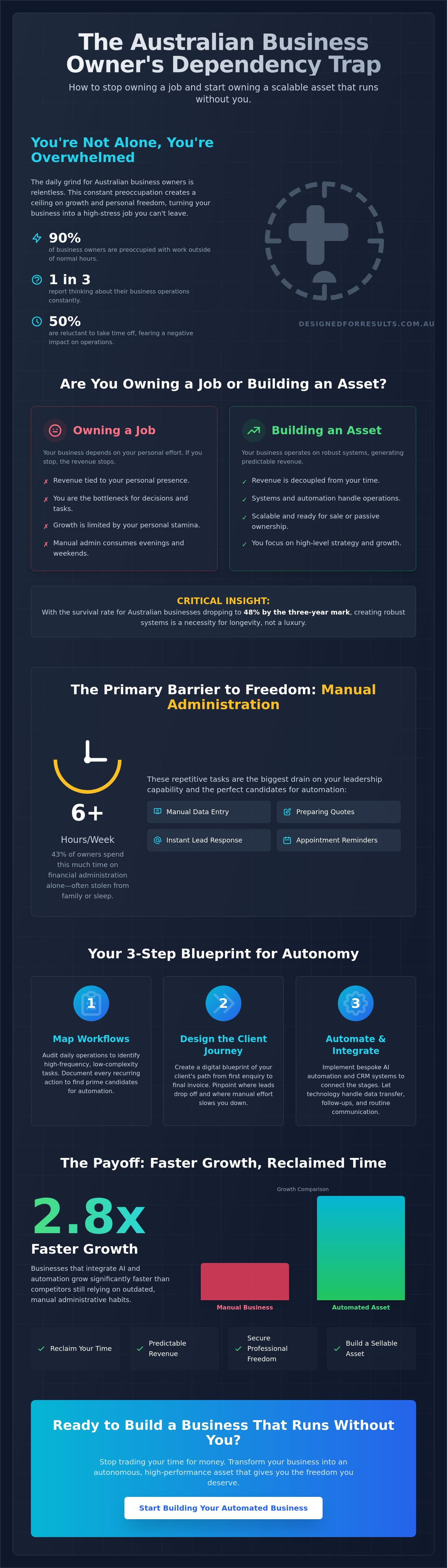
90% of Australian business owners remain preoccupied with work outside of typical hours, and one in three report thinking about their operations constantly. This persistent mental load often stems from a reliance on direct intervention, yet learning how to build a business that runs without you is the essential step to securing professional freedom. When revenue depends entirely on your personal presence, the business becomes a constraint that prevents you from taking holidays or pursuing new ventures.
Centralising business data is the pivot point for achieving operational autonomy. When information is scattered across spreadsheets and email threads, the owner must remain the central hub for every query. This manual oversight is the primary obstacle for anyone learning how to build a business that runs without you. By 2026, the most resilient Australian businesses have moved beyond fragmented tools to a single, automated platform. This centralisation, which can be achieved through digital growth systems like those offered by Iwobotics, ensures that every team member has real-time pipeline visibility. It replaces individual memory with a reliable digital record, allowing the business to maintain a high-performance culture independently of the founder's daily presence.
You likely recognise the exhaustion of manual data entry and the frustration of losing leads due to slow follow-up. This guide provides a clear path to decoupling your time from your income by implementing autonomous systems and intelligent workflow automation. We will explore how to transform your operations into a scalable asset that generates predictable revenue, allowing you to reclaim your time while growing 2.8 times faster than competitors who still rely on outdated administrative habits.
Recognising the dependency trap in Australian small businesses
A business that runs without you functions as a self-sustaining system of workflows. It operates independently of your daily presence and thrives through engineered processes rather than your personal stamina. Many Australian business owners find themselves trapped in a model where they are the sole decision-maker for every operational detail. This dependency creates a ceiling on growth. If you are working late nights on manual data entry or spending your weekends preparing quotes, you have built a business that relies on your exhaustion to survive. Data from 2025 indicates that 50% of small business owners are reluctant to take time off due to concerns about the impact on their operations. This reality highlights the risk of a founder-dependent model; without the owner, the revenue stops.
The difference between owning a job and owning an asset
Transitioning from operator to owner requires a shift from personal effort to systemisation. If your daily involvement is necessary to capture leads, manage sales, or deliver services, you own a job that consumes your time. Understanding how to build a business that runs without you involves decoupling these core functions from your individual output. A scalable asset is a system-dependent entity that produces predictable revenue regardless of who is in the office. With the survival rate for Australian businesses dropping to 48% by the three-year mark, creating robust systems is a necessity for longevity. Decoupling your time from your revenue allows the business to function as a valuable asset that is ready for sale or passive ownership. Manual effort eventually hits a wall. Systems do not.
Why manual administration is the primary barrier to freedom
Repetitive administrative tasks represent the largest drain on leadership capability. 43% of Australian business owners report spending over six hours a week on financial administration alone. These hours are often recovered from family time or sleep. When you personally manage every client interaction and schedule every appointment, you become the bottleneck. Implementing business process automation removes these friction points by handling routine tasks without human intervention. By integrating bespoke AI automation, you can ensure that leads never fall through the cracks and enquiries receive instant responses. This approach eliminates the mental load of managing administrative minutiae. It transforms the business from a source of stress into a high-performance operation that scales through technology rather than additional headcount.
Mapping your business workflows for autonomous operation
Mapping workflows is the foundation of autonomy. Instead of hiring more staff, which increases overhead and management complexity, Australian businesses should document every recurring action. Start by auditing your daily operations to identify candidates for automation. Categorise each task based on its frequency, its technical complexity, and the level of human judgement required. High-frequency tasks with low complexity are the primary targets for immediate replacement. This systematic approach ensures you spend your time on high-level leadership rather than repetitive data entry. Documenting these processes is the first practical step in learning how to build a business that runs without you.
Identifying high-frequency administrative tasks
Focus your efforts on the points of highest friction. Lead capture, appointment reminders, and follow-up sequences often consume hours of manual effort every week. These are logic-based tasks that do not require your personal intuition. Bottlenecks typically occur when a person is required to move data from one stage to another, such as copying contact details from an email into a spreadsheet. Systemising operations with CRM and document automation allows these steps to occur instantly. By removing yourself from these routine loops, you secure your time for strategic growth. With 97.2% of Australian entities operating as small businesses, those who automate these high-frequency tasks gain a significant competitive advantage.
Creating a digital blueprint of your client journey
Document the exact path a customer takes from their first enquiry to the final invoice. This visual blueprint reveals where leads fall through the cracks and where manual intervention slows down the sales cycle. Identify every data point that must transfer between your software tools, from your website form to your CRM. Effective workflow automation connects these disparate stages into a single, cohesive flow. This digital architecture ensures that information moves with precision, maintaining the customer journey without requiring your constant oversight. When systems handle the movement of data, the business maintains a high-performance culture without your physical presence. If you want to see how these systems could work for your specific model, you can book a discovery call to discuss your requirements. Mapping these stages accurately allows you to transition from being the engine of the business to being its designer.
Replacing the owner in the sales and lead follow-up process
Sales is the primary area where Australian business owners remain tethered to daily operations. Many believe that personal involvement is required to close deals, yet this creates a significant growth ceiling. Learning how to build a business that runs without you necessitates removing the founder from the initial stages of the sales funnel. By 2026, the gap between businesses using AI and those relying on manual effort is widening; those with integrated tools grow approximately 2.8 times faster than those that have not. Relying on your own stamina to follow up on quotes during your evenings is a recipe for burnout. True scalability requires a system that qualifies leads and manages interest without your constant input.
Implementing speed-to-lead systems for instant engagement
Conversion rates drop significantly when a lead waits more than five minutes for a response. Australian businesses often lose prospects because the owner is busy on another job or in a meeting. Establishing automated lead generation systems solves this by triggering instant SMS and email acknowledgments. These systems confirm receipt of the enquiry and set immediate expectations for the next step. This responsiveness ensures the customer journey begins with professional precision without any manual effort from the team. It allows the business to capture interest at the moment it is highest, securing the lead before they move on to a competitor.
Using AI voice agents and chatbots to qualify enquiries
Human-led qualification is expensive and limited by office hours. AI voice agents now manage after-hours calls by recording, transcribing, and qualifying prospects through natural conversation. Simultaneously, AI chatbots on your website can answer common questions and filter out low-quality leads before they reach your calendar. These tools pass qualified data directly into your CRM, ensuring that only high-value prospects move forward. This approach protects your time and ensures that sales conversations are focused on closing rather than basic data collection.
Self-service booking systems further eliminate the back-and-forth of scheduling. When a lead is qualified, the system provides a link to book directly into a team calendar. This process, combined with automated nurture sequences for those not ready to buy, maintains a full pipeline without human intervention. Automated follow-up sequences for new enquiries ensure that no prospect is forgotten, even during busy periods. It creates a sales environment that functions 24/7, allowing the owner to focus on high-level leadership. This level of automation ensures that speed to lead is maintained, which is vital for an Australian business where the first to respond often wins the contract.
Systemising operations with CRM and document automation
Centralising business data is the pivot point for achieving operational autonomy. When information is scattered across spreadsheets and email threads, the owner must remain the central hub for every query. This manual oversight is the primary obstacle for anyone learning how to build a business that runs without you. By 2026, the most resilient Australian businesses have moved beyond fragmented tools to a single, automated platform. This centralisation ensures that every team member has real-time pipeline visibility. It replaces individual memory with a reliable digital record, allowing the business to maintain a high-performance culture independently of the founder's daily presence.
Centralising data through custom CRM implementation
Establishing a single source of truth is essential for professional scaling. A custom CRM implementation reduces manual data entry by capturing lead information directly from website forms and social media. As of 2026, platforms like HubSpot and Zoho offer automation features starting at approximately $27 AUD per user per month, making them accessible to small businesses. These systems trigger the next logical step in the service delivery automatically. For example, moving a deal to a specific stage can assign tasks to staff or send a welcome email to the client. This logic ensures the customer journey remains consistent and professional without your direct intervention.
Automating document collection and contract generation
Manual proposal and contract preparation is a significant drain on executive time. You can eliminate this by auto-generating contracts directly from CRM deal data. When a prospect agrees to a quote, the system pulls their specific details into a template and sends it for signature instantly. This speed to lead is critical in the competitive Australian market. Automated reminders then follow up on unsigned documents, ensuring that administrative delays do not stall your revenue. This process removes the friction of document collection, allowing you to focus on high-level leadership. If you are ready to remove yourself from these repetitive loops, you can request a workflow audit to see where automation can be applied.
Integrating financial tools like Xero further streamlines the operation by automating invoicing and payment tracking. When a contract is signed, the system can trigger the creation of an invoice and update the sales dashboard in real time. Internal approval workflows can then alert relevant staff members to begin service delivery, bypassing the need for owner approval at every stage. This level of connectivity transforms the business into a scalable asset. It ensures that every aspect of the organisation is optimised for performance through clarity and execution. Establishing these autonomous loops is the final technical requirement for how to build a business that runs without you.
Transitioning to a managed automation model for long-term freedom
The final stage of securing professional freedom involves shifting your focus from daily execution to systemic oversight. When you understand how to build a business that runs without you, your focus moves from managing people or tasks to managing the logic that drives the organisation. This transition is supported by the Australian Government's focus on responsible AI adoption; with mandatory requirements for agencies beginning on 15 June 2026, a clear standard for the private sector is being established. By establishing key performance indicators that are tracked automatically, you maintain full visibility without the need for manual reporting.
Moving from manual oversight to system monitoring
Sales dashboards provide real-time pipeline visibility, allowing you to see exactly where revenue stands at any moment. This clarity enables you to manage by exception to maintain operational flow. If a lead follow-up sequence fails to trigger or a conversion rate drops below a specific threshold, the system alerts you. Otherwise, the business continues to execute its workflows independently. This approach provides the mental freedom to focus on new ventures or family, knowing the digital infrastructure is performing as intended. You transition from being the bottleneck to being the strategist who ensures the business achieves its measurable outcomes.
Engaging professional support for ongoing optimisation
Maintaining technical stability requires regular optimisation. As technology evolves, systems need updates to remain efficient. Partnering with an AI automation agency ensures that your digital assets are always performing at their peak. Designed For Results builds these systems specifically for Australian SMEs, moving them away from the dependency trap and toward a high-performance culture. With 42% of Australian SMEs already using AI as of April 2026, the competitive advantage lies in the quality of implementation and ongoing support.
If you're ready to learn how to build a business that runs without you through intentional planning and execution, you can book a strategy call to start your transition. This final step ensures your business remains a scalable asset rather than a job that relies on your constant presence. By implementing these autonomous systems, you recover your time and build an organisation capable of sustainable growth.
Securing your professional freedom through digital systems
Transitioning from a manual operator to a system designer is the only way to scale effectively in 2026. By mapping your customer journey and automating lead follow-up, you protect your evenings from repetitive administrative tasks. Centralising data within a custom CRM ensures your team has the clarity needed to execute without your constant presence. This approach provides the technical foundation for how to build a business that runs without you, transforming your operation into a high-performance asset that is ready for sale or passive ownership. You move from managing individual tasks to monitoring the systems that drive your revenue.
Designed For Results provides bespoke AI and automation solutions for Australian SMEs with a focus on measurable ROI and significant time recovery. Our no-code specialist expertise allows for rapid deployment, ensuring your workflows are optimised without the complexity of custom software development. Reclaiming your time requires intentionality and precise execution. Book your free automation strategy call with Designed For Results to begin your transition toward a self-sustaining model. You have the opportunity to build a business that serves your life, rather than one that consumes it.
Frequently Asked Questions
Can a small service business really run without the owner?
Yes, achieving operational independence is possible by shifting from manual task execution to digital system monitoring. Most Australian businesses, 97.2% of which have fewer than 20 employees, often rely on the owner's personal stamina. True independence occurs when you implement autonomous workflows that handle lead capture, qualification, and onboarding without your direct involvement.
How much does it cost to automate a business in Australia?
Costs depend on the complexity of your requirements and the number of users. In 2026, standard CRM platforms for Australian SMEs cost between $27 and $65 AUD per user per month plus GST. General purpose AI assistants typically cost $25 to $45 per user monthly. These investments are usually offset by the recovery of billable hours and reduced administrative overhead.
Do I need to hire a developer to build these systems?
No, modern automation is primarily achieved through no-code platforms and specialist implementation partners. Using existing tools and integrated CRM features allows for rapid deployment without the high costs or delays of custom software development. This approach ensures your systems are flexible and easy to update as your business scales.
What is the first thing I should automate to save time?
Automate your lead follow-up and appointment booking first. Speed to lead is a critical performance metric because responding to an enquiry within five minutes significantly increases conversion rates. Removing yourself from the back-and-forth of scheduling and manual data entry recovers hours of administrative time every week.
Will automation and AI make my business feel impersonal to clients?
Automation improves the customer journey by providing instant responses and consistent follow-up. Clients value efficiency and reliability over slow manual processes. By using AI to handle routine data collection, you ensure that when a human does step in, they have the necessary context to provide a high-value experience.
How long does it take to build a business that runs on autopilot?
A basic autonomous system can be deployed within 30 to 60 days. Learning how to build a business that runs without you is a phased process. You start with high-frequency administrative tasks and gradually integrate more complex workflows as your confidence in the digital infrastructure grows.
Do I need a CRM if I only have a small team?
Yes, a CRM is the central source of truth for any organisation. Even for the 63.5% of Australian small businesses that are sole traders, a CRM prevents leads from falling through the cracks. It provides the data visibility required to manage operations without relying on individual memory or fragmented spreadsheets.
What happens if the automated systems break down?
Professional automation systems include error monitoring and built-in redundancy to maintain continuity. Managed service retainers ensure that technical experts monitor your workflows and resolve issues before they impact your revenue. This oversight provides the same stability as a traditional IT department but with a focus on business process reliability.
