
Which Legal AI Tools Are Best for Automating Client Intake in 2026?

If 38% of legal professionals are already reclaiming up to five hours of their week through automation, why are you still spending your Tuesday evenings manually typing contact details into a spreadsheet? You need to know which legal ai tools are best for automating client intake? to remain competitive without sacrificing personal time. Every minute lost to repetitive data entry is a minute taken away from high-value billable work. It's a common struggle for the modern Australian business. Slow response times lead to lost clients and missed opportunities.
This guide explores the most effective tools available in 2026, including the latest AI capabilities in Clio Work and the agentic workflows of CoCounsel Legal Reimagined. You'll discover how to integrate these solutions seamlessly with your website forms and CRM to ensure no lead goes ignored. We provide a clear breakdown of pricing and features to help you organise your workflow. Select a system that returns your time while improving your bottom line.
What is Automated Legal Client Intake?
Automated legal client intake is the digital mechanism that captures, qualifies, and onboards new enquiries without manual intervention. It transforms a chaotic inbox into a structured pipeline where potential clients move from their first interaction to a booked consultation seamlessly. When determining which legal ai tools are best for automating client intake? for your specific needs, you must first identify the bottlenecks in your current workflow. The goal is to replace manual, repetitive tasks with a system that works while you're focused elsewhere.
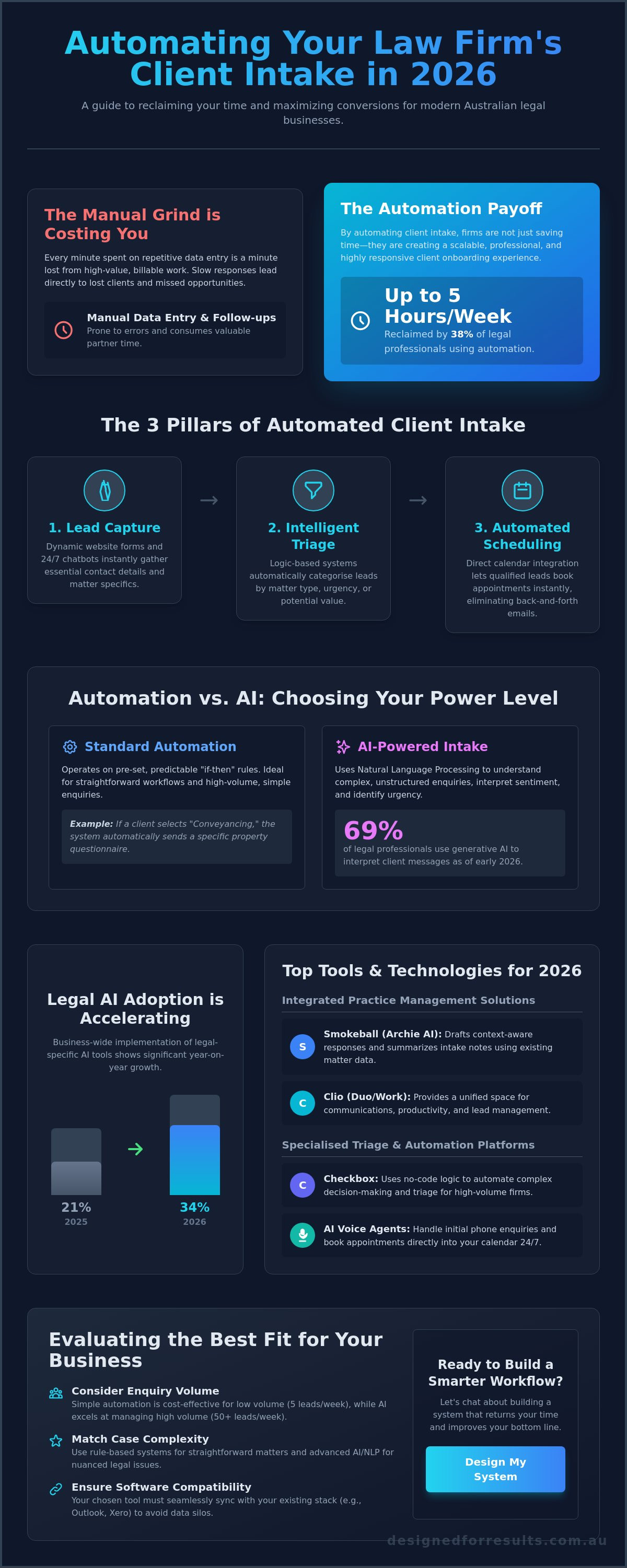
This process relies on three core pillars to eliminate administrative friction:
- Lead Capture: Dynamic website forms or chatbots that gather essential contact details and matter specifics immediately.
- Intelligent Triage: Logic-based systems that categorise leads by matter type, urgency, or potential value.
- Automated Scheduling: Direct integration with your calendar to allow qualified leads to book their own appointments without back-and-forth emails.
These systems function 24/7; they ensure no enquiry is missed during out-of-office hours or busy periods. By removing the need for manual data entry, client information flows directly into your CRM. This transition allows you to reclaim your evenings and focus your energy on high-value billable work rather than administrative overhead. It's a shift from reactive management to a controlled, professional onboarding experience.
The Difference Between Automation and AI in Legal Intake
Standard automation operates on pre-set rules. It executes predictable tasks based on specific triggers. If a client selects "Conveyancing," the system sends a specific questionnaire. AI introduces a layer of natural language processing to understand more complex or unstructured enquiries. As of early 2026, 69% of legal professionals report using these generative tools to interpret sentiment or urgency within messages. Many an Australian business can achieve significant time savings with simple automation alone; the choice depends on the complexity of your typical client interaction.
Why Speed to Lead is Critical for Australian Legal Businesses
Response times directly correlate with conversion rates. A potential client who receives an immediate response is significantly more likely to engage your services. Automated instant replies build professional trust and demonstrate reliability from the first touchpoint. In a competitive market, speed to lead serves as a primary differentiator. It ensures you secure the client before they have the chance to contact another provider. This responsiveness improves the customer journey while protecting your revenue and reputation.
Top Legal AI and Automation Tools for 2026
Selecting technology requires a clear understanding of operational gaps. Purpose-built legal tools offer specific security features that general automation platforms often lack. Australian businesses benefit from solutions designed to handle local data privacy requirements. Dedicated software provides a level of compliance and encryption that generic tools struggle to match. Identifying a tool that aligns with your specific regulatory obligations is the first step toward a more efficient workflow.
Determining which legal ai tools are best for automating client intake? depends largely on your current software stack. Native AI features within practice management systems keep client data in a single environment. This reduces the risk of fragmented information across different platforms. Starting with the AI capabilities already available in your existing software is often the most efficient path for a small business.
Integrated Practice Management Solutions
Smokeball and Clio lead the market by embedding AI directly into the daily workflow. Smokeball’s Archie AI uses existing matter data to draft context-aware responses and summarise intake notes immediately. Clio Duo and the Clio Work features provide a unified space for communications and productivity. These platforms integrate with Australian-specific legal databases to ensure accuracy. Every captured lead is immediately associated with a potential matter, which eliminates the need for manual data entry.
Specialised Triage and Automation Platforms
Checkbox offers granular control for high-volume triage. It uses no-code logic to automate decision-making, ensuring only relevant leads reach your desk. This precision protects your time from being wasted on enquiries that fall outside your scope of practice. Beyond text-based forms, AI voice agents handle initial phone enquiries with human-like nuance. They assist or replace the need for a human receptionist by booking appointments directly into your calendar 24/7.
Adoption of these technologies is accelerating. By early 2026, business-wide implementation of legal-specific AI tools reached 34%, an increase from 21% in 2025. This growth reflects a trend toward increased operational efficiency. Let’s chat about building a system that works for your business.
Evaluating the Best Fit for Your Business Workflow
Determining which legal ai tools are best for automating client intake? requires an objective assessment of your enquiry volume. A business receiving five leads a week operates differently to one managing fifty. Simple rule-based automation provides a cost-effective solution for straightforward intake questions. Complex matters involving nuanced legal issues benefit from the natural language processing found in advanced AI. Compatibility with your existing software stack is essential. Ensure your chosen tool synchronises seamlessly with Outlook and Xero to keep communication and financial records updated automatically.
Deployment speed is a significant consideration for time-strapped owners. Out-of-the-box solutions provide immediate relief from administrative pressure. Custom-built systems offer higher levels of precision tailored to unique services. Start with the solution that addresses your most significant operational bottleneck. Successful implementation follows a logic where the technology supports your specific requirements.
Assessing Your Administrative Burden
Calculate the hours lost to manual follow-up to understand the true cost of your current process. Data from early 2026 shows that 38% of legal professionals save between one and five hours every week through automation. Nearly 25% of users report savings of at least six hours. For an Australian business, this represents a return of personal time previously spent on evening admin. Offload repetitive data entry to an automated system to focus your energy on billable work and business development.
Security and Compliance Considerations in Australia
Adherence to the Australian Privacy Principles (APPs) is a non-negotiable requirement for any new technology. Verify where client information is physically stored. Data residency in Australia is often a requirement for meeting confidentiality obligations. Vet every provider for security credentials such as SOC 2 compliance. Implement "zero data retention" policies where possible to protect sensitive information. Rigorous security standards ensure your automation transition strengthens your professional reputation and protects client privacy.
A Practical Guide to Implementing Intake Automation
Implementation starts with a thorough audit of your current manual journey. Trace every step from the first enquiry to the final signed agreement to pinpoint exactly where leads stall. Determining which legal ai tools are best for automating client intake? is a process of matching software capabilities to these specific friction points. Focus on automating the lead qualification stage first to secure the highest impact. Connect your chosen tool to your CRM immediately to establish a single source of truth for all client data.
Test the new system with a small volume of enquiries before moving to a full-scale rollout. This controlled approach allows you to refine the logic and ensure the transition is seamless for the user. Monitoring the system during this initial phase identifies any technical gaps early. A successful rollout relies on a stable integration that handles data with precision from the very first interaction. This methodical approach ensures your business stays responsive while you focus on billable legal work.
The Role of Process Mapping
Build your automation on a foundation of business process mapping. Visualise the client journey to ensure every touchpoint is captured and accounted for. A clear map ensures the technology supports your specific business goals. This level of planning prevents the automation of inefficient or broken processes. It ensures your new system delivers immediate value to your Australian business by providing a structured path for every new lead.
Connecting Your Ecosystem
Establish a direct and seamless data flow between your website, intake tool, and practice management software. Use webhooks or native integrations to eliminate the need for manual data handling. This connectivity ensures that once a lead is qualified, their details are ready for matter creation without delay. Effective CRM implementation keeps your prospective client database clean and organised. This allow you to track every lead with absolute clarity and move away from repetitive administrative tasks.
Purposeful Automation with Designed For Results
Identifying which legal ai tools are best for automating client intake? is only the first step toward reclaiming your schedule. Technology serves as a tool, but its effectiveness depends entirely on how it integrates with your specific operational needs. Designed For Results specialises in creating custom automation for the Australian business that has outgrown manual processes. We don't just recommend software; we identify the underlying efficiency gaps that force owners to handle administrative tasks during their evenings. By streamlining these touchpoints, we ensure your business remains responsive and professional without requiring your constant presence.
Our approach focuses on measurable outcomes. We look at the data to see where leads are stalling and where manual entry is creating errors. Implementing a system that captures and qualifies leads 24/7 directly impacts your revenue by ensuring no enquiry goes ignored. As of May 2026, the gap between businesses using automated triage and those relying on manual follow-up has widened significantly. Those who adopt these systems see a direct correlation between faster response times and higher conversion rates. We build systems that allow you to focus on high-value billable work while the technology manages the initial customer journey.
Custom AI and Automation Solutions
We develop bespoke AI assistants tailored to the unique terminology and services of your Australian business. These smart AI solutions handle lead follow-up with zero manual effort, ensuring every potential client receives a sophisticated and relevant response immediately. Unlike generic chatbots, these systems are designed to understand the nuances of your specific practice areas. To ensure these systems continue to perform at their peak, we provide ongoing support through monthly managed service retainers. This allows your automation to evolve as your business grows, maintaining a high-performance culture without increasing your internal administrative load.
Getting Started with Your Automation Roadmap
The transition from manual chaos to a structured, automated future is a deliberate choice. It's the difference between struggling to keep up and having a system that generates results while you sleep. The impact on your quality of life is immediate. You gain back the hours previously lost to spreadsheets and repetitive emails. This reclaimed time can be reinvested into business development or personal rest. If you're ready to move away from accidental growth and toward a more efficient way of operating, book a strategy call today. We'll discuss your specific challenges and build a roadmap that gives you your time back while improving your bottom line.
Reclaim Your Focus Through Intelligent Automation
Transitioning to an automated intake process is the most direct way to eliminate the administrative burden that currently consumes your evenings. Response speed dictates conversion rates; 38% of legal professionals are already saving up to five hours every week through these technologies. Selecting which legal ai tools are best for automating client intake? depends on your specific workflow and how well a tool integrates with your existing software stack. Prioritising seamless data flow ensures your Australian business remains competitive and responsive 24/7.
Designed For Results is an Australian-based consultancy specialising in SME automation. We focus on measurable revenue growth and time recovery through expertise in no-code and AI-driven workflow design. We help you move away from manual data entry so you can focus on high-value legal work. Book your free automation strategy call today to discuss your specific business challenges. Your business deserves a system that supports your growth while giving you your time back.
Frequently Asked Questions
How much do legal AI tools typically cost for a small Australian business?
Costs vary depending on the level of integration required. As of May 2026, entry-level platforms like Clio Manage start at $49 per user per month, while more comprehensive intake bundles such as Clio Grow are available for $149 per user per month. Specialised tools like Spellbook offer starter plans at $99 per month, though high-volume businesses may require enterprise tiers that start closer to $199 per month.
Will AI replace the need for a legal secretary or receptionist?
These tools are designed to augment your existing team by handling repetitive administrative tasks. AI manages the initial lead capture and appointment scheduling, which allows your staff to focus on high-value client support and complex matter management. This shift improves the overall customer journey while reducing the administrative burden on your team during peak periods.
Is it difficult to integrate AI intake tools with my existing website?
Most modern intake platforms provide simple, embeddable forms or code snippets that work with common website builders. Connecting these tools to your CRM often requires only a few clicks through native integrations. If you require more complex logic, no-code automation platforms can bridge the gap between your site and your practice management software with minimal technical effort.
How does automated intake improve the client experience?
Responsiveness is the primary driver of client satisfaction in the legal sector. Automated systems provide instant, 24/7 replies to enquiries, ensuring potential clients feel acknowledged immediately. By allowing leads to book consultations directly into your calendar, you remove the friction of waiting for a manual callback, which 94% of legal professionals using AI report as a measurable benefit.
Can these tools handle complex triage for different practice areas?
Advanced platforms like Checkbox use conditional logic to route leads based on the specific details of an enquiry. Determining which legal ai tools are best for automating client intake? often depends on this ability to categorise matters accurately. These systems ask targeted follow-up questions to qualify the lead before they reach your desk, ensuring you only spend time on relevant matters.
What happens if the AI makes a mistake during the intake process?
Human oversight is a mandatory component of any automated system. While modern tools are grounded in verified databases to reduce errors, you must review all captured data before a matter is formally opened. ABA Formal Opinion 512 (2024) reinforces the duty of supervision, meaning the business owner remains responsible for verifying the accuracy of any information gathered by an AI assistant.
Do I need to be tech-savvy to manage an automated intake system?
Most current legal AI tools utilise intuitive, no-code interfaces designed for busy business owners. You can manage workflows and update intake forms using drag-and-drop builders without writing a single line of code. When evaluating which legal ai tools are best for automating client intake?, look for providers that offer robust Australian-based support and clear documentation to ensure you can manage the system with confidence.
