
Building a Business Case for Automation: The 2026 Australian SME Guide

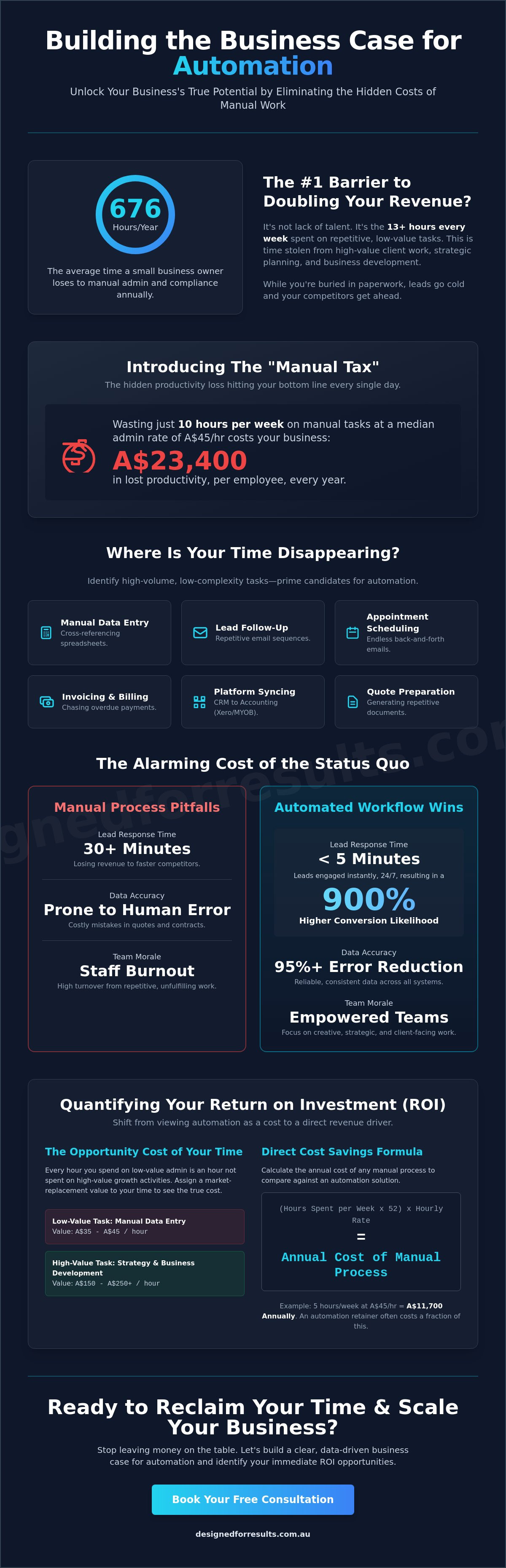
What if the primary barrier to doubling your revenue isn't a lack of talent, but the 676 hours you spend on manual administration every year? Data from the Australian Banking Association in 2023 reveals that small business owners sacrifice over 13 hours each week to compliance and repetitive paperwork. You likely already feel the weight of these lost evenings, where leads go cold and quotes remain unfinished because your current processes cannot keep pace with demand. Building a business case for automation is the essential step to move past this plateau and ensure your business remains competitive in the 2026 Australian market.
You need a reliable method to reclaim your time and improve your customer journey. This guide provides the exact calculations required to quantify the value of AI and automated systems to your stakeholders. You'll learn how to replace repetitive tasks with reliable workflows that capture every lead and improve your bottom line. We will examine the financial impact of manual errors and provide a specific method for measuring ROI so you can transition to a scalable model with confidence.
The Hidden Cost of Manual Processes in Australian Business
The "Manual Tax" isn't a government levy; it's the cumulative loss of productivity that hits Australian businesses every single day. This tax represents the thousands of dollars lost to repetitive tasks that require no human intuition. For a service-based business, these costs manifest in the hours spent on manual data entry, cross-referencing spreadsheets, and chasing overdue invoices. When you're building a business case for automation, you must account for the fact that every minute spent on admin is a minute stolen from high-value client work or business development. In Australia, where the median hourly rate for administrative roles sits around A$35 to A$45, wasting ten hours a week on manual filing costs a business over A$20,000 annually per employee.
Administrative bottlenecks usually emerge in the transition points between lead capture and service delivery. Common culprits include manual calendar management, recurring billing cycles, and the constant back-and-forth of email scheduling. Manual lead follow-up is particularly damaging. It's the most expensive way to run a sales pipeline because it relies on human availability during peak hours. Administrative fatigue doesn't just slow down operations; it degrades the quality of decision-making. A business owner stuck in a loop of repetitive tasks lacks the mental bandwidth to identify new market opportunities or address emerging risks.
Identifying Your Automation Opportunities
Focus on high-volume, low-complexity tasks that follow a predictable logic. These are the prime candidates for optimisation. Common examples include:
- Automated syncing between your CRM and accounting platforms like Xero or MYOB.
- Triggered email sequences for new enquiries to ensure immediate engagement.
- Automated appointment scheduling and reminders to reduce no-shows.
Your business has outgrown its manual systems when "busy work" prevents you from taking on new clients. There's a distinct difference between simple task automation, which moves data from point A to point B, and complex AI solutions that can interpret intent or generate content. Identifying which one you need is the first step in building a business case for automation that delivers a real return on investment.
The Risk of Maintaining the Status Quo
Sticking with manual processes creates immediate lead leakage. Statistics show that businesses responding to a lead within five minutes are significantly more likely to convert than those waiting even thirty minutes. If your team is manually checking emails, you're losing revenue to competitors using AI chatbots for websites to engage visitors instantly. Drafting Your Automation Business Case involves calculating the cost of staff burnout. In 2023, Australian businesses faced billions in lost productivity due to workplace stress and disengagement. Repetitive data entry is a primary driver of this fatigue. Competitors who automate these burdens can reallocate their human talent to building relationships, leaving manual businesses to struggle with high turnover and stagnant growth.
Quantifying ROI: Measuring the Real Impact of Automation
Measuring the success of automation requires a shift from viewing it as a simple time-saving tool to evaluating it as a direct revenue driver. Recapturing hours provides a baseline, but the financial outcome of those hours serves as the primary metric for success. Australian business owners often undervalue their time when working on administrative tasks during evenings. To accurately begin building a business case for automation, you must assign a market-replacement value to your time, typically ranging from A$150 to A$250 per hour for leadership-level output.
Opportunity cost represents the highest price paid for manual administration. When a manager spends four hours a week on manual data entry, the business loses the value of four hours of high-level business development or client retention activities. If your average contract value is A$5,000, and those four hours could have secured one additional lead, the true cost of that manual task comprises the labour expense and the value of lost revenue. Leaders evaluating automation adoption recognise that removing these bottlenecks is essential for scaling without linear headcount increases.
Calculating Direct Cost Savings
Calculate the annual cost of any manual process using this formula: (Hours Spent per Week x 52) x Hourly Labour Rate. A task taking five hours weekly at a labour cost of A$45 per hour costs your business A$11,700 annually. A critical step in building a business case for automation involves comparing this figure against the monthly cost of a managed service retainer. These retainers often cost significantly less than manual labour. Furthermore, automation reduces data entry errors by 95% or more, which eliminates the hidden costs associated with rectifying incorrect quotes or managing costly contract disputes. To further mitigate operational risk, you can discover Align Quality and learn how professional consulting can help you maintain high standards across all business functions.
Measuring Revenue Growth Potential
Automation directly impacts the bottom line by tightening the sales cycle and improving the customer journey. Research indicates that responding to a lead within five minutes increases the likelihood of conversion by 900% compared to waiting 30 minutes. Implementing smart AI solutions ensures that after-hours enquiries receive immediate engagement, preventing potential clients from contacting a competitor.
Database reactivation campaigns also provide immediate cash flow by re-engaging past clients through automated, personalised outreach. This systematic approach ensures no lead is left to cool, directly increasing your conversion rates and total annual turnover. If you want to see how these numbers apply to your specific operations, book a consultation to review your current processes and identify immediate ROI opportunities.
Automation vs. Recruitment: Evaluating Scalability
Australian businesses often default to hiring when workload increases. This reflex is expensive and carries significant financial weight. Building a business case for automation involves comparing the immediate cost of a new salary against the long-term efficiency of software. A comprehensive automation suite typically costs a fraction of a full-time salary while managing the output of multiple staff members. Human-only administrative teams eventually hit a scalability ceiling where every new client requires a proportional increase in headcount. Automation breaks this cycle, allowing your revenue to grow without a corresponding spike in your payroll tax or office overheads.
The True Cost of a New Employee in 2026
By 2026, the Superannuation Guarantee in Australia reaches 12%. When you combine base salaries under the Clerks Private Sector Award with superannuation, workers' compensation insurance, and state-based payroll tax, the actual cost of a new hire is often 25% higher than their advertised salary. There's also the hidden cost of the productivity lag. Data from recruitment specialists suggests new employees take 12 to 20 weeks to reach full operational capacity. This represents thousands of dollars in lost output during the onboarding phase. Automated systems provide 100% output from the hour they're deployed. They don't require sick leave, they don't experience fatigue, and they ensure your client response times remain identical on a Tuesday morning and a Friday afternoon.
Hybrid Models: Empowering Your Current Team
You don't need to choose between technology and people. A hybrid approach uses AI voice agents for small business to manage high-volume, low-value tasks like booking appointments or answering basic FAQs. This allows your existing receptionist to focus on complex client enquiries that require empathy and nuanced problem-solving. Building a business case for automation is about identifying where your staff are currently underutilised. Moving a team member from manual data entry to a client-facing role increases your capacity to generate revenue without adding a single person to the payroll.
- Remove bottlenecks: Automated internal approval workflows ensure quotes and contracts move through your system without waiting for a manager's manual sign-off.
- Improve retention: Staff satisfaction improves when repetitive, mind-numbing administrative tasks are removed from their daily schedule.
- Eliminate errors: Systems don't make "typos" in client addresses or bank details, reducing the time spent on corrective administration.
This shift changes the role of your team from administrative processors to value-adders. It gives the business owner their evenings back by ensuring all daily follow-ups happen automatically during work hours. You gain the ability to scale your client base rapidly because your core processes are no longer tied to human hours available in a day.
Drafting Your Automation Business Case: A Practical Framework
Administrative drag costs Australian businesses thousands in lost productivity every year. To start building a business case for automation, you must first isolate the primary bottleneck causing this drain. For many service-based businesses, this is the manual handling of enquiries or the repetitive generation of quotes. Identify the specific point where your team spends the most time on low-value tasks. Quantify this by tracking manual hours over a two-week period. If an employee spends 12 hours a week on manual data entry at a rate of A$40 per hour, that represents an annual cost of A$24,960 for a single staff member.
Propose a clear technological intervention to solve this specific problem. A CRM implementation that automates lead capture and initial follow-up emails is a common starting point. This solution directly addresses the pain point of working on admin during evenings and weekends. Your proposal should include a three-month implementation timeline with a focus on achieving a positive return on investment within the first six months. Address implementation risks by detailing a phased rollout and a data migration plan that ensures compliance with the Australian Privacy Act 1988.
Setting Measurable Objectives
Establish clear KPIs that reflect your business goals. Focus on speed-to-lead and document turnaround times as these directly impact your conversion rates. Research indicates that responding to a lead within five minutes increases the likelihood of conversion by 391% compared to waiting 30 minutes. Align these objectives with your broader strategy to reclaim time for high-level management and business development. A successful automation project achieves a 60% reduction in manual administrative hours while increasing lead-to-quote conversion rates by 20% within the first quarter of deployment.
Presenting to Stakeholders and Partners
Focus your presentation on the financial outcomes and bottom-line benefits. Stakeholders need to see how the investment reduces overheads and improves the customer journey. Use clear language to describe how a faster response time leads to a better client experience and more won contracts. Address concerns regarding system reliability by highlighting local support and cloud-based security measures. Explain that automation handles the repetitive tasks, allowing your team to focus on complex client needs and revenue-generating activities.
Ready to reclaim your time and scale your operations? Discover how bespoke AI and automation solutions can transform your business efficiency.
Implementing Your Automation Strategy with Designed For Results
Building a business case for automation is the critical first step toward reclaiming your schedule and increasing your bottom line. Success requires more than just buying a subscription to a new tool; it demands a clear understanding of where manual processes are costing you money. A professional bespoke AI automation audit provides this clarity by identifying the exact points where your current workflows fail. Many Australian businesses find that up to 30% of their staff's time is consumed by tasks that a machine could handle. We focus on eliminating these inefficiencies so you can stop working on admin during your evenings.
We move beyond project-based fixes to offer managed service retainers. This shift is vital because the tech landscape changes rapidly. A solution that works today must be optimised to remain effective next year. By providing ongoing support, we ensure your systems continue to deliver measurable outcomes. You shouldn't have to worry about software updates or API changes. Our team handles the technical complexity, allowing you to focus entirely on scaling your operations and improving the customer journey.
The Designed For Results Methodology
Our process begins with a rigorous analysis of your existing operations to identify every bottleneck. We build custom AI solutions specifically for Australian service businesses that struggle with lead follow-up and quote generation. This isn't about software installation; it's about creating a system that generates revenue while you sleep. We measure success through hard data, such as reducing administrative overhead or increasing lead conversion rates. Every step is focused on giving you your time back and ensuring your business runs with precision.
Next Steps for Your Business
You can begin your transformation today by conducting a simple Admin Audit. List every repetitive task you performed over the last 48 hours. If you're manually sending follow-up emails or copying data between spreadsheets, your business is a prime candidate for automation. Transitioning to a streamlined system is simpler than you think. A professional consultation will clarify your path forward and help you finalise your plan for building a business case for automation.
Ready to reclaim your time and focus on growth?
Scale Your Australian Business Through Actionable Automation
Building a business case for automation is the most effective way to eliminate the manual bottlenecks stalling your growth. Australian businesses often lose hundreds of billable hours every year to repetitive admin and missed lead follow-ups. Transitioning to automated workflows ensures your team focuses on high-value tasks while your systems handle the heavy lifting. This shift isn't just about efficiency; it's about creating a scalable model that increases revenue without the immediate overhead of new hires.
Designed For Results is a boutique Australian consultancy that specialises in SME service-based workflows. We deliver measurable time-back and clear revenue outcomes by removing the administrative burden that keeps owners working late into the night. It's time to stop letting manual processes dictate your capacity and start operating with a system built for performance.
Book your free automation strategy call with our Australian experts
Your business has the potential to thrive when you give yourself the time to lead it.
Frequently Asked Questions
Is automation too expensive for a small business with only a few staff?
Entry-level automation tools like Zapier or Make start at approximately A$30 per month. Australian businesses often recover these costs by reclaiming five hours of administrative labour every week. Small operations use these tools to handle lead follow-ups and invoicing, which prevents the need for an additional part-time hire costing upwards of A$35,000 annually.
How long does it typically take to see a return on investment from automation?
Most Australian businesses achieve a full return on investment within three to six months. Initial gains appear immediately through reduced manual data entry and faster quote turnaround times. When building a business case for automation, account for the immediate 20% reduction in administrative overhead reported by the Australian Bureau of Statistics in digital adoption studies.
Will automation replace my existing employees or just change their roles?
Automation reallocates human talent to high-value tasks that drive revenue. Employees move from repetitive data entry to client relationship management and complex problem-solving. This shift improves workplace culture by removing the administrative tasks that cause burnout. Research from the Tech Council of Australia indicates that 70% of workers prefer automated workflows for routine tasks.
Do I need to be tech-savvy to manage an automated business system?
Business owners manage modern automation platforms without coding skills. Most systems use no-code interfaces with drag-and-drop functionality. A disciplined manager focuses on the logic of the workflow rather than the underlying software code. External partners often handle the initial setup to ensure the system delivers measurable outcomes from the first day of operation.
What is the difference between simple automation and AI-driven solutions?
Simple automation follows a strict logic to move data between applications. AI-driven solutions use machine learning to interpret unstructured data, such as the sentiment in a customer email. You'll find that 80% of administrative bottlenecks require only simple automation to resolve. AI adds value when you need to predict demand or generate personalised content at scale.
How do I know which part of my business I should automate first?
Identify the task that consumes the most evening and weekend hours. For most Australian service businesses, this is lead response or invoice reconciliation. Automating your lead follow-up ensures no potential client is ignored while you're on a job site. Start where the friction is highest to see the most immediate impact on your bottom line.
Can automation help me improve my Google Business reviews and reputation?
Automated triggers send review requests immediately after a project is marked as complete in your system. This timing is critical, as customers are 3.5 times more likely to leave a positive review within 24 hours of service delivery. Consistent, automated follow-ups build a high-performance reputation without requiring manual intervention from your team.
What happens if the technology fails or needs an update?
Robust systems include error alerts that notify you instantly if a workflow stops. Cloud-based platforms update automatically, ensuring your business stays compliant with Australian security standards. You should schedule a quarterly review of your automated processes to ensure they remain in strategic alignment with your evolving business goals.
