
Business as Code: The 2026 Guide to Systematising Your Australian Business
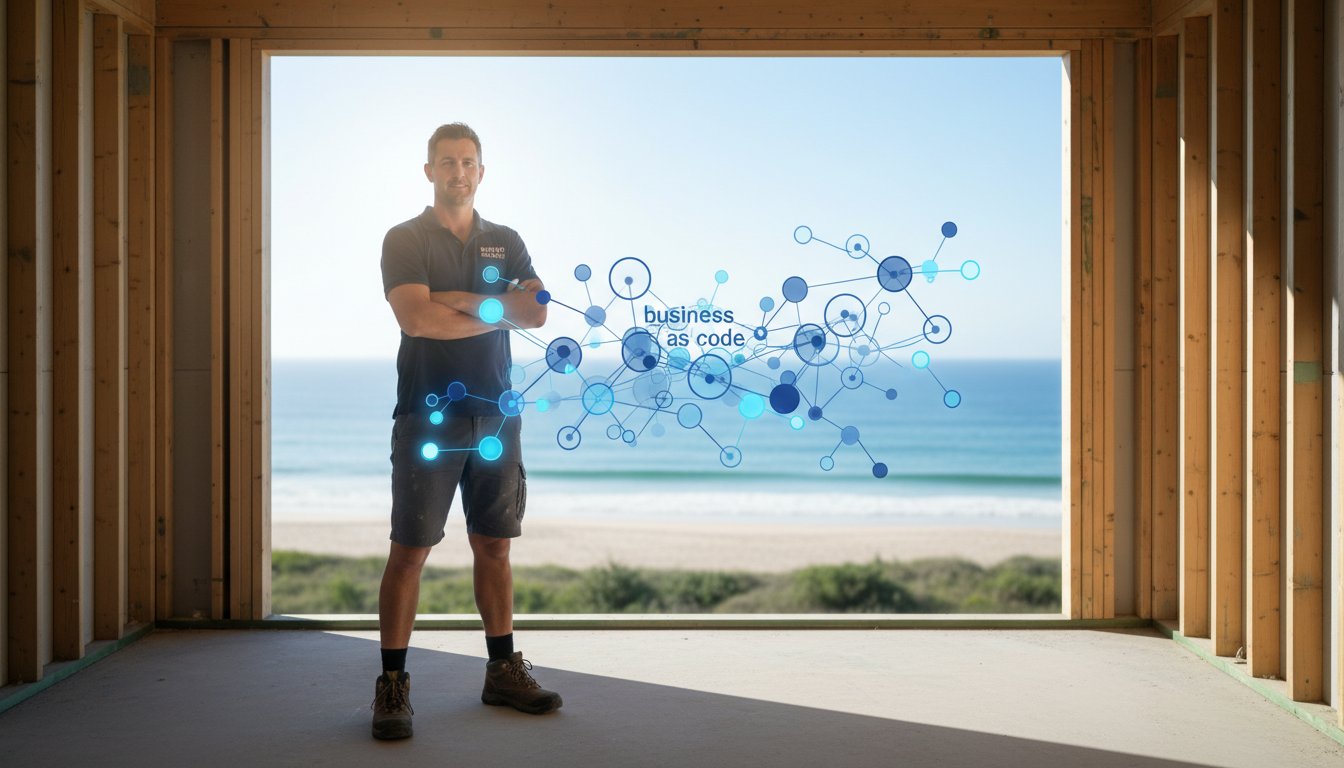
Your business should be a high-performance asset that functions without your constant intervention, yet many Australian business owners still spend their evenings manually following up on quotes or chasing administrative tasks. You feel the weight of every process living inside your head, making it impossible to scale without hiring expensive staff. This is where the concept of business as code changes the trajectory of your operations. Treat your processes as a version-controlled operating system to eliminate the reliance on individual memory and replace it with a scalable, automated infrastructure.
Establish a business that runs on autopilot, providing a single source of truth that ensures consistent lead follow-up and increased revenue with less manual effort. This guide provides the logic to systematise your operations while navigating the 2026 regulatory landscape, such as the 11.5% superannuation guarantee and new AML/CTF obligations for service providers. Implement automation and AI to reclaim your time and ensure your business remains compliant as the Australian Privacy Principles potentially expand to cover all Australian businesses.
What Is Business as Code? Defining the Modern Operating System
Business as code is a management philosophy where your operations are treated as a version-controlled operating system. It translates your business logic from the minds of your staff into a digital repository that executes tasks automatically. This methodology is heavily influenced by Infrastructure as Code (IaC), a practice where developers manage IT systems through configuration files rather than manual processes. For an Australian business, this means your sales follow-up, client onboarding, and compliance reporting are no longer subject to human error or forgetfulness. Software executes instructions with absolute precision, ensuring reliability that manual processes cannot match.
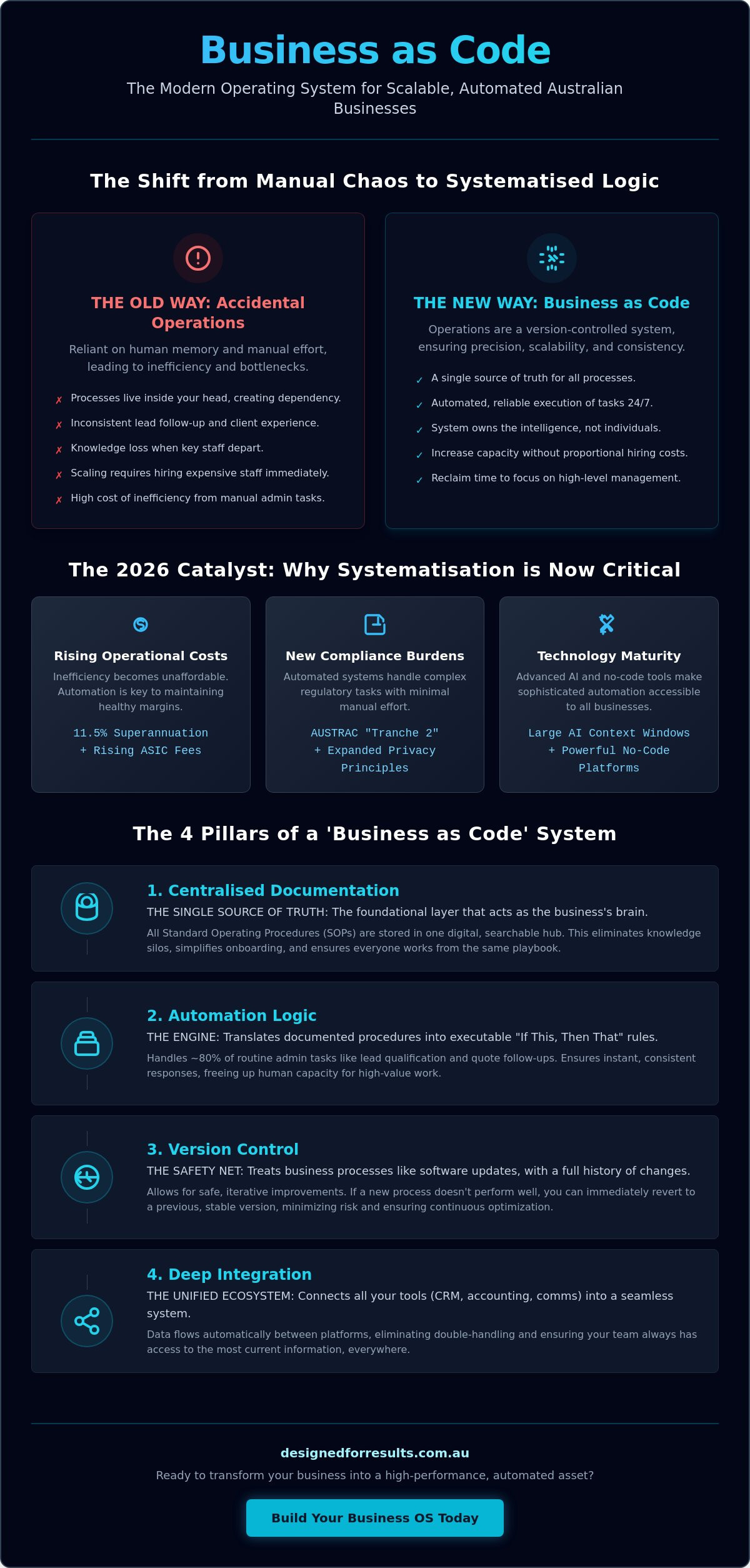
Relying on manual admin is increasingly expensive. With the superannuation guarantee rising to 11.5% in 2026 and the ASIC annual review fee reaching $329, the cost of inefficiency has never been higher. By adopting bespoke AI automation, you move from a model where knowledge is trapped in employees' heads to one where the system owns the intelligence. This creates a scalable asset that functions independently of any single person. A business that runs on code allows you to increase capacity without the immediate need to hire more expensive staff.
The Shift from Accidental to Intentional Operations
Most businesses operate through a series of ad-hoc decisions and manual patches. This leads to inconsistent lead follow-up and knowledge loss when key staff depart. Codifying your business creates a single source of truth for all processes. It ensures that every customer receives the exact same experience, which builds trust and increases revenue. Predictability in service delivery is the foundation of a high-performance culture, and it allows managers to focus on high-level management rather than micro-managing daily tasks.
Why 2026 is the Year of Systematisation
The maturity of no-code tools like Make.com and Zapier has lowered the barrier to entry for complex automation. In 2026, AI context windows are large enough to ingest and understand your entire business logic, allowing systems to "read" your code and execute tasks with human-like nuance and machine-like speed. Regulatory changes also drive this shift. For example, "Tranche 2" entities such as real estate agents and lawyers must register with AUSTRAC by 29 July 2026. Automated systems handle these compliance burdens with minimal manual effort, giving the owner their time back and ensuring the business remains lean and profitable.
The Core Components of a Business as Code System
Building a business as code architecture requires shifting from manual oversight to an integrated technical stack. This system relies on four distinct pillars: centralised documentation, automation logic, version control, and deep integration. Each component works to eliminate the knowledge silos that prevent growth. By 2026, the cost of human-led admin has become a significant drain on profitability; the 11.5% superannuation guarantee and rising operational overheads make efficiency a necessity. You must replace manual effort with technical precision to maintain healthy margins.
Centralised documentation serves as the base layer. It ensures that every standard operating procedure is recorded in a searchable, digital hub. Automation logic then takes these procedures and applies "If This, Then That" rules to execute them. Business Process Automation (BPA) allows these rules to handle repetitive data entry and client communications without human intervention. Version control provides a safety net, allowing you to track every modification made to your business processes. Integration completes the system by connecting your CRM, accounting software, and communication tools into a unified ecosystem.
Version control is a critical yet often overlooked component. It allows you to treat your business processes like software updates. If a new automation for lead follow-up doesn't perform as expected, you can revert to the previous version immediately. This iterative approach ensures that your operations are always improving based on data. Deep integration ensures that data flows seamlessly between your tools. When a client pays an invoice in your accounting software, the system should automatically update the CRM and notify the project team in Slack. This connectivity eliminates double-handling and ensures your team always works with the most current information.
Centralising Your Business Knowledge
Scattered documents in Google Drive or buried Slack messages create operational chaos. When a team member leaves, their specific way of doing things often disappears with them. A centralised hub acts as the brain of your Australian business, providing a single source of truth for every task. This simplifies onboarding; new staff or contractors can access exactly what they need to perform at a high standard from day one. It removes the need for you to spend your evenings explaining basic tasks.
The Logic Layer: Automating the Decision Tree
Most routine business decisions follow a predictable pattern that simple rules can manage. Approximately 80% of administrative tasks, such as qualifying a lead based on budget or scheduling a follow-up after a quote is sent, don't require your direct input. Implementing workflow automation serves as the engine for this logic layer. This ensures that your business responds to opportunities instantly, even while you're off the clock. If you want to see how these systems fit your specific needs, you can book a consultation to discuss your requirements.
Transforming Manual Admin into Systematised Logic
Manual administration is the primary barrier to scale for an Australian business. Tasks like re-keying data from an email into a CRM or manually drafting a quote consume hours that should be spent on high-level management. Adopting a business as code mindset involves mapping these workflows as logical sequences before they are digitised. By automating business processes, you ensure that every step in your operation follows a pre-defined path that requires zero manual intervention. This level of precision improves your professional perception, as clients receive immediate, accurate responses regardless of the time of day. Speed and accuracy are the new benchmarks for trust in 2026.
Mapping your processes requires a clear understanding of the decision points within your service delivery. You must identify where a human currently makes a choice and determine the logic behind that choice. If a lead has a budget over a certain threshold, the system should book a discovery call. If the budget is lower, it should provide a self-service resource. Coding this logic into your operations removes the variability of human performance. It ensures that your business maintains a high-performance culture even during periods of rapid growth or staff turnover.
Automating the Lead and Quote Lifecycle
Speed-to-lead is a critical metric for revenue growth. Research indicates that responding to an enquiry within five minutes makes a business 21 times more likely to qualify that lead compared to a 30-minute response time. Automated lead follow up systems handle this initial contact instantly. Your website can use online calculators to generate instant quotes based on specific client inputs. This provides immediate value to the customer while filtering out leads that don't fit your service profile. The system then schedules a call automatically, moving the prospect through the sales funnel without you lifting a finger.
Streamlining Onboarding and Contract Management
Onboarding is often where the customer journey falters due to administrative delays. You can eliminate this friction by triggering contract generation directly from CRM deal data once a quote is accepted. Automated systems then send the document for electronic signature and follow up until it's returned. For businesses in the community services industry in New South Wales, this automation is vital for maintaining compliance with quarterly returns due in April 2026. Internal approval workflows ensure quality control by notifying a manager only when a specific action is required, preventing the need for constant micromanagement of new staff.
Implementing Business as Code Without a Dev Team
Transitioning to a business as code model does not require a background in software engineering or a dedicated department of developers. Modern tools allow you to build sophisticated systems using visual interfaces and logical connectors. The process begins with a rigorous audit of repetitive tasks that currently rely on "head-knowledge." Identify the processes that keep you working late into the evening, such as manually updating spreadsheets or chasing invoice payments. Once identified, map the logic using simple flowcharts to visualise the decision tree from start to finish.
Execution follows a structured progression of five key steps:
- Audit: List every administrative task performed daily and identify the person responsible.
- Map: Create a visual representation of the workflow, noting every decision point.
- Connect: Use a no-code platform to link your existing software tools.
- Enhance: Deploy AI agents to handle tasks that require natural language processing.
- Refine: Review system performance monthly and adjust the logic to improve outcomes.
Monitoring and testing are vital to ensure the system remains robust. Treat your automations as living assets that require periodic maintenance. Reviewing your logic every 30 days helps identify bottlenecks or errors before they impact the customer journey. This iterative approach ensures your business remains agile and capable of handling increased volume without adding to your headcount.
Leveraging No-Code Integration Platforms
Tools like Zapier or Make.com serve as the connective tissue for your operations, allowing data to flow between disparate applications without manual entry. A well-configured CRM implementation acts as the central database, storing the state of every client interaction. Keep your automations modular and simple. Building small, specific workflows rather than one giant sequence prevents a single error from breaking your entire system. If you need help architecting these connections, book a strategy call to discuss your requirements.
Adding the AI Layer to Your Business Code
Automation handles the "if this, then that" logic, but AI adds the ability to manage nuance and natural language. AI voice agents fit perfectly into this model by handling inbound enquiries or outbound follow-ups with human-like comprehension. Unlike generic AI, these agents follow your specific business rules and use your company knowledge base to provide accurate answers. This ensures that even complex client interactions are handled with the precision of your best staff member, 24 hours a day.
Measuring the Results: Time, Revenue, and Scalability
Measuring the success of a business as code implementation requires looking past simple hourly savings. True ROI manifests in the increased valuation of your Australian business. An operation that relies on the owner's constant presence is a liability; a business that runs on a documented, automated system is a high-value asset. You shift your focus from executing daily tasks to managing the logic that governs those tasks. This transition allows you to exit the cycle of evening admin and move into a role of high-level management. Buyers and investors in 2026 prioritise businesses with clear, automated audit trails that demonstrate consistent performance without owner intervention.
Revenue growth becomes a function of system capacity rather than human endurance. When your lead follow-up and quoting processes are codified, you eliminate the "leaky bucket" where prospects are forgotten during busy periods. This consistency directly impacts the bottom line by increasing conversion rates and shortening the sales cycle. You gain the ability to forecast growth with precision because your operational costs remain stable even as your volume increases. The transition from working in the business to working on the system is the defining characteristic of a scalable enterprise.
Increasing Capacity Without Increasing Headcount
Scalability is often misunderstood as the need to hire more people to handle more work. In an automated environment, you achieve infinite scale for administrative tasks. This allows your current team to focus on high-value work that requires human empathy and complex problem-solving. Automation handles the repetitive data entry and compliance checks, such as the new payday superannuation requirements starting 1 July 2026. Scalability is the ability to handle a 50% increase in leads with 0% increase in admin time. This efficiency ensures that rapid growth doesn't lead to service degradation or staff burnout.
Reclaiming the Owner's Time
The mental load of running an Australian business is the primary cause of decision fatigue. When you must manually oversee every quote or client onboarding step, your capacity for strategic leadership diminishes. Offloading this routine logic to a system ensures the business functions with high precision even when you're off the clock. You reclaim your evenings and weekends, knowing that the system is maintaining a high-performance culture and professional customer journey. This reduction in stress is a tangible result of intentional system design. If you're ready to identify your first automation opportunity and take your time back, book a chat to discuss your specific operational bottlenecks.
Securing Your Operational Future with Systematised Logic
Adopting a business as code mindset ensures your operations remain resilient against rising labour costs and shifting regulatory requirements. You've seen how centralising knowledge and automating the decision tree eliminates the mental load that leads to executive burnout. These systems provide the infrastructure for infinite scale; they allow you to handle a 50% increase in lead volume without adding to your administrative headcount. Reclaiming your evenings is a direct result of replacing manual data entry with reliable, integrated logic.
Designed For Results specialises in Australian SME workflow automation through a no-nonsense, results-oriented implementation process. Our focus remains on immediate time recovery and measurable revenue growth for service-based businesses. If you're ready to stop working in the business and start managing the system, Book an Automation Strategy Call today. Your business is ready to function as a high-performance asset while you focus on high-level leadership.
Frequently Asked Questions
What exactly does Business as Code mean for a non-technical owner?
Business as code means treating your operational workflows as a set of logical instructions that a computer can execute with absolute precision. For a non-technical owner, it involves mapping out how you want your business to function and using software to perform those tasks without human intervention. This ensures that lead follow-ups and administrative duties happen with 100% consistency; even when you are not physically present to oversee them.
Do I need to learn how to code to implement this in my business?
You can implement these systems using no-code platforms that require zero programming knowledge. These tools use visual interfaces to connect your existing software, such as your CRM and accounting package. You focus on the logic of the process while the platform handles the underlying technical execution. This allows you to build sophisticated automations that save up to 15 hours of manual admin each week.
Is Business as Code the same as just using a few Zaps or automations?
It is a comprehensive management philosophy rather than a collection of isolated tasks. While a single automation might move data from a form to an email, business as code involves integrating your entire operation into a unified, version-controlled system. This approach ensures that every part of your Australian business is interconnected; providing a single source of truth that prevents data silos and operational gaps.
How much does it cost to start systematising a business this way?
Starting costs depend on the complexity of your current software stack and the volume of tasks you wish to automate. Subscription fees for no-code platforms often start at a low monthly tier, making it accessible for an Australian business of any size. You must also consider the rising cost of compliance, such as the 11.5% superannuation guarantee rate in 2026, which makes the time saved through automation even more valuable for maintaining your profit margins.
Will my customers feel they are being treated like a number if I automate?
Automation improves the customer journey by providing instant responses and accurate information at any time of day. Customers value speed; responding to an enquiry within 5 minutes makes you 21 times more likely to qualify that lead compared to a 30-minute delay. By automating the routine follow-up, you free up your team to provide high-level, personalised support during the moments that truly require human empathy and expertise.
What happens if the "code" or automation breaks while I am away?
Robust automation systems include error monitoring and alert notifications that inform your team immediately if a process fails. Most modern platforms provide detailed logs that allow you to identify exactly where a workflow stopped. Setting up these systems correctly includes building in failsafes that ensure your business continues to function or notifies a human backup if a technical issue occurs; preventing any disruption to your service delivery.
Can I implement Business as Code if I already have a team in place?
Implementing these systems empowers your existing team by removing the burden of repetitive administrative tasks. It allows your staff to focus on high-performance work that drives revenue rather than spending their days on manual data entry. Codifying your processes also simplifies management, as it provides clear, documented standards that every team member can follow; ensuring consistency across the entire organisation without the need for micromanagement.
How long does it take to see a return on investment from automation?
Most businesses observe a return on investment within the first 30 to 90 days of implementation. The most immediate benefit is the recovery of time, often saving owners 10 to 15 hours per week on evening admin. This reclaimed time allows you to focus on sales activities that increase revenue, while the reduction in errors and improved lead follow-up further accelerate your financial gains within the first quarter of use.
