
Database Reactivation: Turning Forgotten Australian Leads into Revenue in 2026

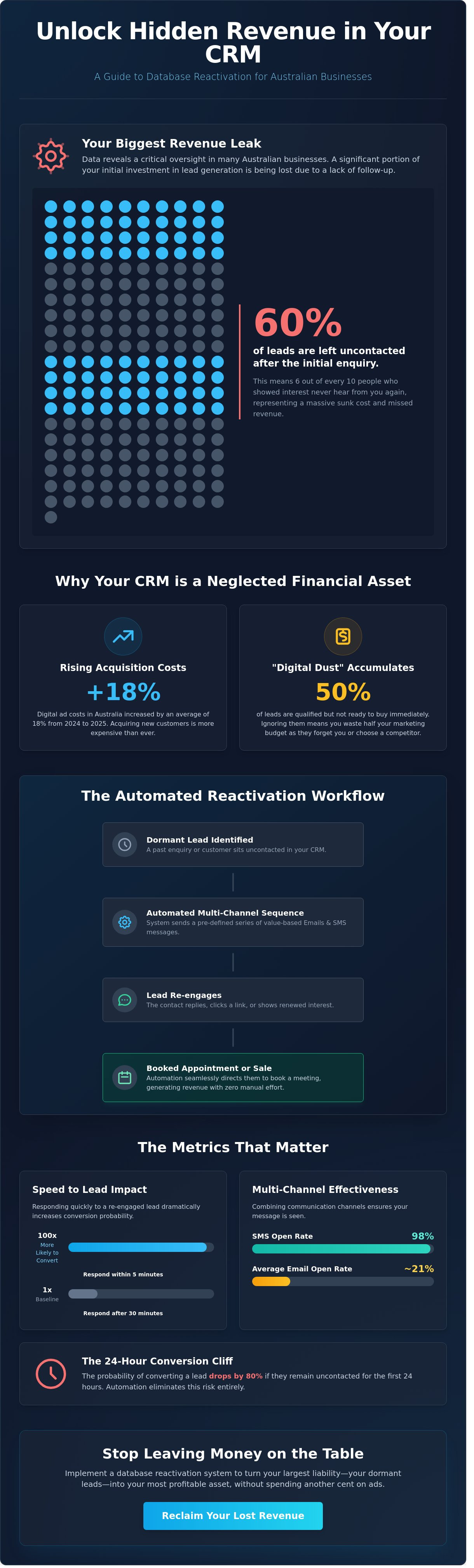
Your most profitable marketing campaign for 2026 isn't on Facebook or Google; it's already sitting inside your CRM. Data from 2024 indicates that 60% of leads in a typical Australian business remain uncontacted after the initial enquiry, representing a massive leak in your potential revenue. You likely feel the weight of these missed opportunities as you spend your evenings caught in a cycle of manual admin and follow-up. Database reactivation provides a direct path to reclaim this lost income without increasing your monthly advertising spend by a single cent.
We recognise that you want a business that generates predictable cash flow while allowing you to focus on high-level tasks. This article demonstrates how to unlock the hidden value in your existing assets to generate immediate sales and improve your customer journey. We'll examine the specific automation tools and logical sequences required to turn forgotten leads into active revenue, ensuring your business thrives on efficiency and clear execution.
The high cost of dormant leads for Australian businesses
Database reactivation is the systematic process of re-engaging past enquiries and previous customers to generate new revenue. Many Australian business owners view older contact lists as a collection of dead leads. This perspective ignores the reality of modern consumer behaviour. Data indicates that 50% of leads are qualified but not yet ready to buy at the point of initial contact. When you stop communicating with these individuals, you waste the initial investment spent on lead generation.
This oversight directly impacts your marketing ROI. In the 2026 market, the financial advantage of selling to an existing contact is undeniable. Acquisition costs in Australia have surged, making it far more profitable to nurture an existing relationship than to bid for new attention in an overcrowded digital market. Effective Lead management methodologies involve maintaining a connection throughout the entire buyer lifecycle, ensuring your business stays top-of-mind when the prospect is ready to commit.
Ignoring your database is a direct drain on profitability. Every uncontacted lead represents a sunk cost that hasn't been recovered. Businesses that fail to implement database reactivation often find themselves on a treadmill of expensive lead acquisition, working harder for diminishing returns. Re-engaging your existing list allows you to bypass the noise of the open market and speak directly to people who already know your brand.
Why your CRM is a neglected financial asset
Customer data is a perishable commodity. It loses value every month it sits idle. This "digital dust" accumulates as contact details change or prospects solve their problems elsewhere. In the Australian service sector, digital advertising costs rose by approximately 18% between 2024 and 2025. This trend forces a shift toward reactivation. Your CRM contains a wealth of untapped capital that requires no additional ad spend to access. For those looking to streamline these processes, bespoke AI automation offers a way to manage these assets without increasing your evening admin load.
Re-engagement vs. spam: The professional approach
Successful outreach relies on relevance. Value-based messaging prioritises the prospect's needs and current challenges. This professional approach protects your brand reputation while moving the contact closer to a transaction. A structured follow-up sequence provides the clarity your customers need. It removes the friction from their journey and demonstrates that your business is a reliable partner. This level of consistency saves you time on manual tasks and ensures no potential revenue slips through the cracks because you were too busy to follow up.
How automated reactivation workflows recapture lost opportunities
Database reactivation relies on a systematic sequence of digital touchpoints. Manual follow-ups often stall due to human memory constraints and limited office hours. Automated workflows provide the consistency required to capture every lead, operating 24/7 without the need for additional administrative staff. When a lead remains uncontacted, the probability of conversion drops by 80% after the first 24 hours. Automation ensures that every dormant contact receives a timely, professional prompt to re-engage.
The mechanics of these systems involve pre-set triggers that deploy messages based on specific lead data. This level of workflow automation allows Australian businesses to maintain high-performance standards while the owner focuses on service delivery. By removing the burden of manual outreach, businesses can scale their lead management without increasing their overheads or working late into the evening on administrative tasks.
The multi-channel approach to re-engagement
Combining SMS and email produces response rates that single-channel efforts cannot match. SMS messages currently see open rates as high as 98%, making them ideal for short, direct questions. Email provides the necessary space to re-establish value and expertise. Adopting a customer-centric philosophy involves reaching out on the platforms where your leads are most active.
Optimal timing is essential to avoid overwhelming the recipient. A standard sequence might include an initial email, followed by an SMS two days later, and a final "break-up" email on day seven. Automated triggers respond to lead behaviours in real time. If a contact clicks a link in an email but doesn't book, the system can automatically send a follow-up SMS within 15 minutes to address any hesitation.
From dormant contact to booked appointment
A simple reply to an automated message can trigger an immediate booking sequence. Speed to lead is a critical performance metric for Australian businesses. Research indicates that responding to a lead within five minutes increases the likelihood of a successful conversion by 100 times compared to waiting 30 minutes. Automation handles this immediacy instantly, regardless of the time of day.
The integration of online calendars removes the friction of manual scheduling. Once a lead expresses renewed interest, the system provides a direct link to book a consultation or quote. This seamless transition from a dormant contact to a confirmed appointment happens without any manual intervention. For business owners looking to reclaim their time, implementing these systems is a logical step toward more predictable revenue. If you're ready to see how these tools apply to your database, let's chat about your current requirements.
Comparing AI voice agents and SMS sequences for database outreach
Effective database reactivation relies on selecting the right communication medium for the specific lead type. Australian businesses must balance the need for speed with the depth of engagement required to convert a dormant contact into a paying customer. Choosing between AI voice agents and SMS sequences depends on the complexity of the service and the desired customer journey.
The power of conversational AI in reactivation
AI voice agents handle initial enquiries at a scale that manual calling cannot achieve. These systems conduct natural, bi-directional conversations to qualify a lead's current needs before a human staff member gets involved. If a lead meets specific criteria during the call, the AI transfers them directly to a salesperson or books a consultation into the calendar. This technology offers significant cost-efficiency compared to hiring a temporary Australian call centre, where rates typically range from A$35 to A$60 per hour. Implementing these agents allows business owners to stop spending their evenings on follow-up calls. For deeper technical context on these systems, refer to the AI voice agents guide.
SMS automation: The high-speed alternative
SMS remains the most direct path for rapid re-engagement. With a 98% open rate and 90% of messages read within three minutes, it bypasses the noise of a crowded email inbox. Concise copy is essential for success. A short, professional message such as "Hi [Name], we have a gap for [Service] this Tuesday, would you like to grab it?" generates immediate replies. Automation logic manages the entire interaction through "if-this-then-that" sequences. If a contact replies with a positive keyword, the system provides a link to book. If they decline, the automation updates the database status instantly. This removes repetitive administrative tasks and ensures no lead is left without a response.
High-touch service businesses, such as solar providers or specialised contractors, benefit from deploying AI voice agents to manage complex questions. Businesses offering routine services, like maintenance or beauty, often find SMS sequences more effective for quick bookings. Using both in tandem provides a comprehensive approach to database reactivation. An initial SMS can filter for interest, while a follow-up AI voice call handles the detailed qualification process. This dual-layered strategy ensures the business owner regains their time while maximising revenue from every forgotten lead.
Preparing your CRM and list for a successful reactivation
Successful database reactivation requires a structured approach to data management. You cannot extract value from a list that is cluttered with invalid entries or generic contacts. Start by auditing your current database to identify high-potential segments, specifically focusing on leads from the last 18 months who engaged but never converted. Statistics suggest that many Australian businesses lose a significant portion of their customer base annually through simple inaction; reclaiming even a fraction of this can significantly impact your bottom line.
- Step 1: Audit. Identify contacts who have interacted with your business in the past two years. Prioritise those who requested a quote but didn't proceed.
- Step 2: Clean. Remove invalid Australian mobile numbers and cross-reference your list against internal unsubscribe records. This prevents wasted spend and protects your sender reputation.
- Step 3: Segment. Group your data by service interest. A customer who enquired about landscaping has different needs than one who needed a one-off lawn mow.
- Step 4: Craft the Hook. Develop a specific, value-driven reason for the contact. This should address a known pain point or offer a genuine update.
- Step 5: Test. Deploy the workflow to a small sample of 50 contacts. Monitor response rates and adjust the messaging before a full-scale rollout.
Data hygiene and compliance in Australia
Adhering to the Spam Act 2003 is mandatory for any Australian business. Every message sent during a database reactivation campaign must include a clear, functional unsubscribe facility. Use automated systems to handle these opt-outs instantly. This maintains professional standards and ensures compliance with ACMA regulations, where fines for serious breaches can exceed A$600,000. Distinguish between warm segments, such as recent quote requests, and cold segments, like three-year-old enquiries. Warm leads require a softer touch, while cold leads need a stronger incentive to re-engage.
Crafting the re-engagement offer
Direct sales pitches often fail because they ignore the lapse in communication. Use a helpful check-in approach instead. For a service-based business, this might be a simple enquiry about whether a previous problem was resolved. If you provide seasonal services, use limited-time updates to spark immediate action. A specific offer for bookings made within a short window can drive quick revenue. Focus on providing measurable outcomes for the client rather than just asking for a sale. This approach respects the reader's time and positions you as a partner in their success.
Ready to turn your stagnant lead list into a revenue-generating asset? Explore our bespoke AI automation solutions to streamline your reactivation process.
Implementing a professional reactivation system with Designed For Results
Database reactivation represents one of the fastest ways to increase cash flow without raising your marketing spend. Many Australian businesses sit on hundreds of dormant leads that cost money to acquire but remain unmonitored in a spreadsheet or CRM. Designed For Results builds custom workflows that target these specific contacts, moving them from a cold list to an active sales pipeline. We focus on replacing manual administrative burdens with a professional system that operates independently of your daily schedule. This transition ensures that your growth is built on a foundation of reliable systems rather than individual effort.
The Designed For Results approach to automation
Our methodology focuses on measurable outcomes rather than vague promises of efficiency. We integrate reactivation sequences directly into your existing CRM to ensure a seamless transition for your team. This eliminates the friction of learning new software while providing a clear view of every lead's status. We prioritise professional system delivery that aligns with your specific operational goals. You can learn more about our commitment to SME efficiency on our about us page.
Our goal is to ensure that no lead is left to expire due to a lack of follow-up. By automating the initial outreach, your team only spends time talking to prospects who've already raised their hand to re-engage. This targeted approach preserves your brand's reputation while maximising the value of every contact you've ever collected.
Reclaim your time and your revenue
Automation allows you to scale your business without the immediate need to increase your headcount. For many business owners, the biggest benefit isn't just the additional revenue; it's the ability to reclaim your evenings. Instead of spending hours after dark manually chasing quotes or sending follow-up emails, you can rely on a system that handles repetitive tasks with precision. Industry data suggests that Australian service-based businesses lose up to 30% of their potential annual turnover through poor lead follow-up. Moving from manual admin to an automated revenue system provides the freedom to focus on high-level management and service delivery.
Success in 2026 requires this level of operational clarity. You shouldn't have to choose between business growth and your personal time. To assess the potential hidden in your own contact list and see how much revenue you're currently leaving on the table, book a strategy chat with our team today. It's time to turn your forgotten data into a consistent stream of new opportunities.
Secure Your Revenue for 2026
Dormant leads in your CRM represent significant capital that hasn't been realised. Australian businesses frequently miss out on substantial revenue because they don't have the capacity to follow up on every old enquiry or expired quote. Implementing a professional database reactivation system allows you to recapture these opportunities through automated SMS and AI voice workflows. This technology handles the repetitive outreach, so you can stop working on admin during your evenings and focus on high-value tasks.
Effective automation requires a clean database and a clear technical structure to deliver consistent results. As specialists in Australian SME automation and no-code workflows, we act as results-oriented advisors to help you streamline your operations. We focus on the bottom line, ensuring your customer journey is improved without increasing your manual workload.
Stop letting valuable leads go cold. Book your free automation strategy call with our Australian team to begin turning your forgotten data into profit. It's time to build a more efficient future for your business.
Frequently Asked Questions
What exactly is database reactivation and how does it differ from email marketing?
Database reactivation is a targeted campaign designed to re-engage dormant leads who previously interacted with your business but didn't convert. It uses specific triggers and high-intent offers to move cold contacts back into the sales pipeline. This approach prioritises immediate revenue by leveraging assets you already own, whereas standard email marketing often focuses on general brand awareness.
Is database reactivation legal under Australian spam laws?
Database reactivation is legal provided you comply with the Spam Act 2003. You must ensure every contact has given express or inferred consent and that every message includes a functional unsubscribe facility. Australian businesses should verify that their contact lists are no older than the industry standard of 12 to 24 months to maintain compliance and avoid penalties from the ACMA.
How much data do I need for a reactivation campaign to be worthwhile?
You can launch a successful campaign with as few as 100 dormant leads. While larger lists provide more statistical significance, a small, high-quality database of past quotes or enquiries often yields better results than 5,000 cold names. Focus on the quality of the previous interaction rather than the total volume of entries in your software.
Will re-engaging old leads annoy my former customers?
Re-engaging old leads provides them with genuine value or solves a current problem. Data shows that 15% of leads don't buy initially because the timing was wrong. By sending a relevant, low-pressure offer, you're providing a service that saves them the effort of searching for a new provider.
What kind of conversion rates can an Australian business expect from reactivation?
Australian service businesses typically see conversion rates between 2% and 7% on database reactivation campaigns. If you have a list of 500 old leads, this translates to 10 to 35 new bookings without any additional ad spend. These results depend on the relevance of your offer and the speed of your follow-up once a lead responds.
How long does it take to set up an automated reactivation workflow?
Building a basic automated reactivation workflow takes approximately 4 to 6 hours. This timeframe includes segmenting your list, writing the message sequence, and configuring the automation triggers in your software. Once established, the system runs autonomously, allowing you to reclaim your evenings instead of manually chasing old quotes.
Do I need expensive AI software to start reactivating my database?
You don't need expensive AI software to begin database reactivation. Simple automation tools are often more effective for service-based businesses looking to streamline their processes. While AI can assist with sentiment analysis, a well-structured sequence of automated SMS and emails is sufficient to generate measurable ROI and recover lost time.
Can reactivation work for service-based businesses like tradies or consultants?
Reactivation is highly effective for tradies and consultants who often have lists of unaccepted quotes or past clients. A plumber can use automation to remind customers about seasonal maintenance, while a consultant might re-engage a lead who stalled on a proposal six months ago. It turns your existing database into a predictable source of new work.
