
Automated Contracts: A Guide for Australian Service Businesses in 2026

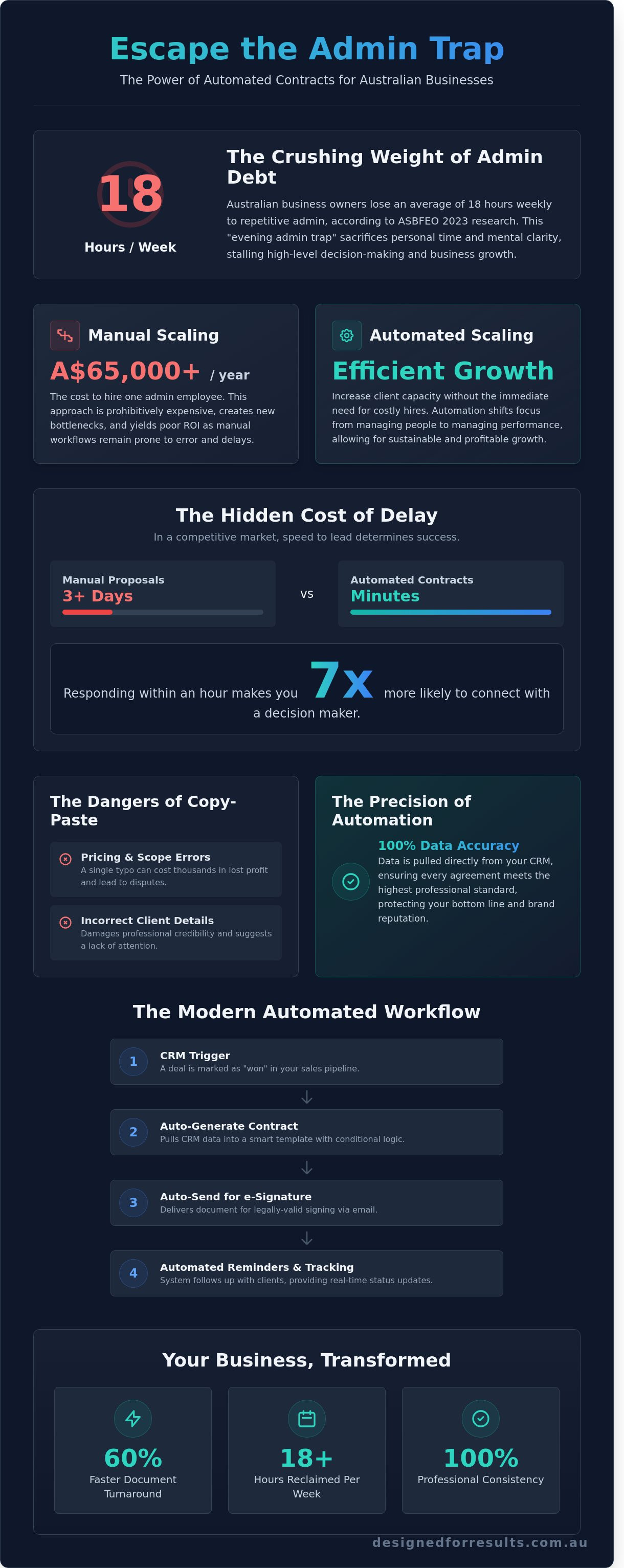
Australian business owners lose an average of 18 hours every week to repetitive administrative tasks according to 2023 research from the Australian Small Business and Family Enterprise Ombudsman. You've likely felt this burden while correcting data entry errors in legal documents or manually chasing signatures after a long day of client work. Using automated contracts is the most effective way to eliminate this manual administrative debt and stop your speed-to-lead from stalling. Relying on manual processes in 2026 is no longer a sustainable way to manage a growing service business.
You'll regain your personal time and accelerate your sales cycle by implementing intelligent systems that handle the heavy lifting for you. This transition ensures professional consistency across every client interaction and removes the friction that often delays project starts. This guide provides a clear path to reducing manual admin and securing faster payments through automation tools tailored for the Australian market. We'll examine how to build a system that moves leads to signed agreements in minutes, ensuring your business stays ahead of the competition and maintains a high-performance culture without the late-night paperwork.
The impact of manual contract management on Australian business growth
Manual contract management creates a heavy administrative debt that stalls Australian business growth. Many owners spend upwards of 12 hours every week on repetitive data entry and document preparation. This creates the evening admin trap, where leaders sacrifice personal time and sleep to manage paperwork that should be handled by systems. When an owner is tethered to a desk at 9 PM, they lack the mental clarity required for high-level management and decision making. This cycle keeps the business stagnant because the person responsible for growth is buried in low-value tasks.
Scaling a service-based business through manual processes is prohibitively expensive. Traditional growth requires adding headcount to manage the increasing volume of paperwork. In Australia, hiring an additional administrative employee costs approximately A$65,000 per year plus superannuation and overheads. This investment often yields a poor return because manual workflows remain prone to bottlenecks. Automated contracts allow a business to increase its client capacity without the immediate need for costly new hires. This shifts the focus from managing people to managing performance.
The transition to modern systems often involves understanding the underlying technology. While the concept of a Smart contract demonstrates how agreements can be self-executing, most Australian businesses benefit immediately from automating the generation and signing phases of their workflow. This ensures every document is a product of intentional engineering rather than a rushed manual effort.
The hidden cost of slow proposal turnaround
Speed to lead is a critical metric in the competitive Australian service market. Research indicates that businesses that respond to a lead within an hour are nearly seven times more likely to have a meaningful conversation with a decision maker than those who wait even 24 hours. A delayed proposal gives competitors a window to intervene and secure the client. When a prospect requests a quote, their intent is at its peak. Delivering a contract three days later is a missed opportunity that results in lower conversion rates and lost revenue. Automated systems ensure that documents reach a lead in minutes, capitalising on high intent and securing the commitment before the prospect looks elsewhere.
Eliminating manual error in client agreements
Manual contract creation relies on copy-paste methods that introduce significant risk. Errors in pricing, scope of work, or client details damage professional credibility and can lead to legal disputes. A single typo in a project fee could cost a business thousands of dollars in lost profit. Beyond the financial risk, sending a document with the wrong client name or outdated terms suggests a lack of attention to detail. Automated contracts pull data directly from a CRM or lead form, ensuring every agreement meets a high professional standard. This level of accuracy protects the bottom line and reinforces the brand as a reliable partner. Using bespoke AI automation further refines this process by ensuring all variables are correctly mapped every time.
How automated contract systems function within a modern workflow
Automated contracts represent a fundamental shift from manual document preparation to self-generating systems. These systems function as dynamic assets that trigger based on specific business milestones, such as a lead moving to the "won" stage in a sales pipeline. Unlike static templates that require manual data entry, these documents pull information directly from existing records to ensure accuracy and speed. This transition from static files to data-driven generation ensures that every contract is a precise reflection of the agreed terms.
Modern Australian businesses use cloud-based platforms to centralise storage and tracking, providing a single source of truth for every legal agreement. This level of centralisation ensures that version control is absolute; stakeholders always access the most current iteration of a document. Industry data shows that businesses adopting these workflows reduce document turnaround times by up to 60 percent, allowing managers to focus on service delivery rather than administrative bottlenecks. Centralised systems also provide real-time visibility into the status of every outstanding agreement, which is essential for maintaining a high-performance culture.
From CRM data to finalised document
Efficiency starts with data integration. When a deal reaches a specific threshold, the CRM transmits client names, project scopes, and pricing structures directly into the contract software. This process utilises conditional logic to tailor the document in real-time. A service agreement for a recurring maintenance contract will automatically exclude clauses relevant only to one-off consultations. Implementing bespoke ai automation creates these sophisticated linkages, ensuring the contract reflects the precise nature of the deal without manual intervention. This structure removes the friction often found in high-volume service environments and ensures that 100 percent of the data is consistent across all systems.
The role of digital signatures and execution
Execution is the final hurdle in the sales cycle. Under the Electronic Transactions Act 1999, electronic signatures hold full legal validity in Australia, providing a secure and efficient alternative to physical signing. Automated systems manage the follow-up process by sending scheduled reminders to clients who haven't yet signed, removing the need for manual chasing during your evenings. You can find detailed standards for these processes in the Australian Government Contract Management Guide.
Once a signature is captured, the system triggers immediate post-execution actions. This includes generating an initial invoice or notifying the onboarding team to begin work. These automated contracts ensure the customer journey remains seamless from the first quote to the start of the project. If you want to see how these workflows can return hours to your week, let’s chat about your specific requirements.
Key features to prioritise in a contract automation solution
Selecting the right technology requires a focus on measurable outcomes. For an Australian business, the highest ROI comes from reducing the time between a quote being sent and a deposit being paid. Automated contracts eliminate the friction of manual drafting and the errors associated with "copy-paste" workflows. A central feature must be a user-friendly interface. Staff without legal or technical backgrounds should generate documents in under three minutes to ensure the system is adopted across the organisation. This accessibility ensures the system is actually used rather than bypassed for old, manual habits.
Maintaining legal consistency is a primary challenge for growing service providers. Implementing a clause library allows teams to pull pre-approved, legally sound language into new agreements instantly. This prevents the risk of rogue terms and ensures every contract aligns with company standards. Referencing the Australian Government Contract Management Guide provides a foundation for these standards, highlighting the importance of consistency throughout the document lifecycle. Finally, mobile-responsive designs are non-negotiable. Data from 2024 indicates that 60% of service contracts are now opened on smartphones. A mobile-responsive interface allows for immediate digital signatures, preventing the delays that occur when clients wait until they are back at a desktop.
Automated follow-up and tracking
Real-time visibility changes the sales dynamic for time-strapped managers. Knowing exactly when a prospect opens a document allows sales teams to time their follow-up calls for maximum impact. Automated contracts track these interactions and send alerts when a quote is nearing its expiry date. This system handles the repetitive administrative chasing that typically consumes four hours of a manager's week. Scheduled reminders ensure no lead is lost to inactivity, maintaining momentum without manual intervention.
Integration with existing Australian business tools
Operational efficiency depends on how well new tools talk to existing systems. Connecting your contract system to accounting software like Xero ensures client data flows seamlessly without manual entry, reducing data errors by up to 30%. Integrating payment gateways like Stripe or Square allows for the immediate collection of deposits at the point of signing. This reduces the risk of non-payment by 25% for many service providers. For more complex requirements, smart ai solutions provide the necessary data mapping to link disparate systems. This level of technical alignment transforms a simple document into a powerful driver of revenue and cash flow.
Steps to implement contract automation without disrupting operations
Audit your current manual workflow to pinpoint exactly where delays occur. Most Australian businesses lose significant time during the transition from a verbal agreement to a signed document. Research from World Commerce & Contracting indicates that inefficient contracting processes can erode up to 9% of a business's bottom line. Start by documenting every touchpoint to isolate bottlenecks like manual data entry or slow internal approvals. Documenting these steps provides the clarity needed to build a better system:
- The initial quote generation in your CRM
- Internal approval cycles for custom terms
- The manual transfer of data into a Word document
- The follow-up sequence for unsigned documents
Select a tool that integrates directly with your existing software stack, such as Xero, HubSpot, or Salesforce. This ensures data flows automatically without manual intervention, reducing the risk of human error. Implement automated contracts by starting with a single service line or a high-volume, low-complexity product. This controlled pilot identifies potential friction points before a full business rollout. Training your team on the new system is the final step. Focus on how the automation gives them back hours of their week by removing administrative burdens and repetitive tasks.
Standardising your document templates
Identify every repetitive variable within your contracts, such as client names, service dates, specific deliverables, and project milestones. Structure these as specific data fields that map directly to your CRM. This alignment ensures that when a deal moves to a certain stage, the contract populates with the correct information instantly. Use clear, plain English to reduce the time clients spend reviewing terms. Clarity accelerates the signing process and reduces the need for lengthy legal explanations.
Testing and refining the automated workflow
Conduct rigorous test runs to verify that every logic trigger functions as intended. Send test documents through the system to ensure variables populate correctly and notifications reach the right stakeholders. Gather direct feedback from your sales team during the initial 30 day pilot phase. They interact with the system daily and can identify if a specific step feels clunky or redundant. Use these insights to refine your templates and workflow logic based on actual client interactions. This iterative approach ensures the final system is robust and ready for scale.
Capturing more revenue with Designed For Results automation
Automation shifts the focus from administrative maintenance to revenue generation. Australian business owners often lose 10 to 15 hours weekly to repetitive paperwork, often sacrificing their evenings to catch up on administrative tasks. Implementing automated contracts reclaims this time, allowing leaders to prioritise high-value activities like lead conversion and service delivery. This transition is about moving away from manual data entry and toward a system that operates independently of the owner's constant supervision.
The cumulative effect of professional, fast, and accurate documentation is substantial. A business that delivers a polished contract within minutes of a discovery call demonstrates a level of operational maturity that manual processes cannot match. Speed directly influences conversion rates; data from 2024 indicates that service providers who send documentation within 24 hours are 60% more likely to secure the project than those who wait three days. Accuracy eliminates the risk of costly errors or missing clauses, protecting the bottom line and establishing a foundation of trust with the client from the outset.
Optimising your business starts with these core workflows. When contracts are handled by logic-based systems, the entire customer journey becomes more predictable. Revenue increases because the friction between a verbal agreement and a signed contract disappears. This efficiency is a requirement for any Australian business aiming to scale without increasing their administrative headcount or overhead costs.
Partnering for professional implementation
Many businesses choose expert consultancy to bypass the technical hurdles of initial setup. Attempting a DIY approach often results in broken integrations or logic errors that frustrate clients. Professional implementation ensures that your systems are reliable and scalable from day one. Managed service retainers provide ongoing support, ensuring your automation evolves as your business grows. For those looking to expand their technological capabilities, this strategic implementation guide offers insights into broader automation opportunities beyond documentation.
Next steps for your business
Start by auditing your current manual processes. Calculate the exact hours spent drafting, sending, and chasing contracts each month. If a manager spends five hours a week on these tasks, that represents over 250 hours of lost productivity annually. Identifying this leak is the first step toward reclaiming your schedule. The path to a more efficient operation is clear and accessible. Reach out via lets-chat to discuss your specific requirements and see how automated contracts can be integrated into your existing workflow to drive measurable outcomes.
Secure Your Business Growth for 2026
Transitioning to automated contracts stops the drain on your billable hours. It's a direct solution to the late-night administrative sessions that often hinder Australian business owners. Research from the Australian Bureau of Statistics indicates that administrative requirements remain a primary concern for small businesses; automation addresses this by streamlining the entire sales cycle. Integrating these systems with your existing CRM and Xero setup ensures that professional agreements reach your clients in minutes rather than days. This level of efficiency captures revenue faster and provides a seamless journey for every customer. As specialists in Australian SME automation, Designed for Results focuses on creating workflows that deliver measurable time and financial outcomes. You deserve a business that operates with precision and allows you to focus on high-level leadership. It's time to remove the friction from your sales process to reclaim your schedule and drive consistent profit.
Book an automation strategy call to reclaim your time
Frequently Asked Questions
Are automated contracts legally binding in Australia?
Yes, automated contracts are legally binding in Australia under the Electronic Transactions Act 1999 and complementary state legislation. These laws establish that a transaction isn't invalid simply because it took place by way of electronic communication. Australian businesses have used digital signatures and automated workflows to execute valid agreements for over two decades. Ensure your chosen platform complies with these standards to maintain high-performance legal protection.
How much time can a small business save with contract automation?
Australian businesses typically reduce contract turnaround time by 75% when moving from manual drafting to automated contracts. Instead of spending three hours drafting, sending, and chasing a bespoke agreement, owners can complete the process in under 15 minutes. This efficiency eliminates the need for admin work during evenings and allows leaders to focus on high-level management tasks. It provides the capacity needed to scale without increasing headcount.
Do I need a developer to set up automated contracts?
You don't need a developer to implement contract automation. Modern software uses drag-and-drop interfaces and logic-based templates that allow business owners to build workflows without writing code. Most platforms integrate directly with existing tools like Xero or Google Workspace. This accessibility ensures you can achieve strategic alignment between your sales process and legal requirements without hiring external technical staff or specialists.
Can I use automated contracts for complex, bespoke proposals?
Automated contracts handle complex proposals through conditional logic and variable fields. You can set specific parameters that trigger different clauses based on the service type, project value, or client location. This ensures every agreement remains accurate and tailored to the specific outcome without requiring manual oversight for every new lead. It transforms a repetitive administrative task into a disciplined, high-performance workflow that supports professional service delivery.
What happens if a client wants to negotiate a clause in an automated contract?
Clients can negotiate clauses directly within the digital document using built-in redlining and commenting features. Most automation platforms track these changes in real-time, providing a clear audit trail of all revisions. This replaces the messy process of emailing multiple versions of Word documents. It maintains a professional customer journey while ensuring all parties reach a consensus on measurable outcomes quickly and efficiently.
Will my clients find automated contracts impersonal?
Clients value the professional speed and ease of use that automated agreements provide. A 2023 survey found that 68% of B2B buyers prefer a digital-first experience that allows them to review and sign documents on any device. Providing a seamless, mobile-responsive contract demonstrates leadership capability and respects the client's time. It positions your business as a modern partner focused on delivering results rather than creating administrative hurdles.
How do automated contracts improve my cash flow?
Automated contracts improve cash flow by reducing the time-to-signature metric, which directly accelerates your billing cycle. Many systems allow you to trigger an initial deposit invoice automatically as soon as the client signs the document. Eliminating the lag between a verbal agreement and a signed contract ensures capital enters the business faster. This financial predictability is essential for maintaining a stable, high-performance culture and funding future growth.
Is my data secure when using contract automation software?
Data security is a core feature of reputable automation platforms, which use AES 256-bit encryption and comply with SOC2 standards. These systems store documents in secure cloud environments with strict access controls and detailed activity logs. This level of protection often exceeds the security of storing physical papers or unencrypted PDFs on a local hard drive. It ensures your Australian business remains compliant with national privacy principles and data protection regulations.
