
DIY Automation vs Hiring an Expert: A Guide for Australian Businesses in 2026
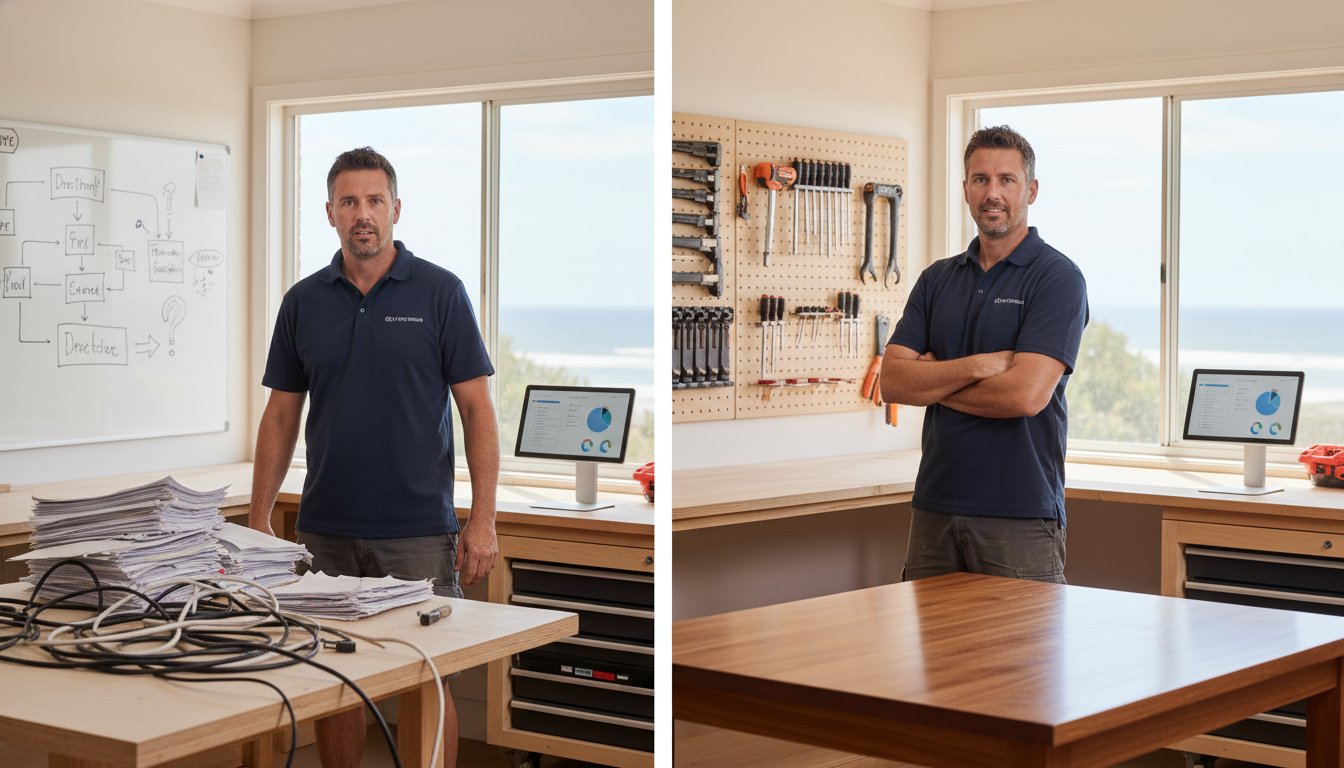
Choosing the zero-cost path for software setup often results in the highest long-term expense for an Australian business. While the initial appeal of diy automation vs hiring an expert lies in immediate savings, the reality often surfaces when a broken integration causes 20% of your leads to disappear into a digital void. Business owners deserve a system that supports high-quality service delivery without requiring technical troubleshooting during their personal time.
It's clear that manual data entry and slow lead follow-up are bottlenecking your ability to scale. This guide provides a transparent comparison of the long-term costs and performance outcomes associated with both paths. You'll learn how to secure a reliable system that operates autonomously, allowing you to reclaim 12 hours of your time every week and significantly accelerate your speed-to-lead. We'll break down the technical requirements for 2026 and identify which approach delivers the most consistent growth for your business.
The Landscape of Business Automation for Australian SMEs
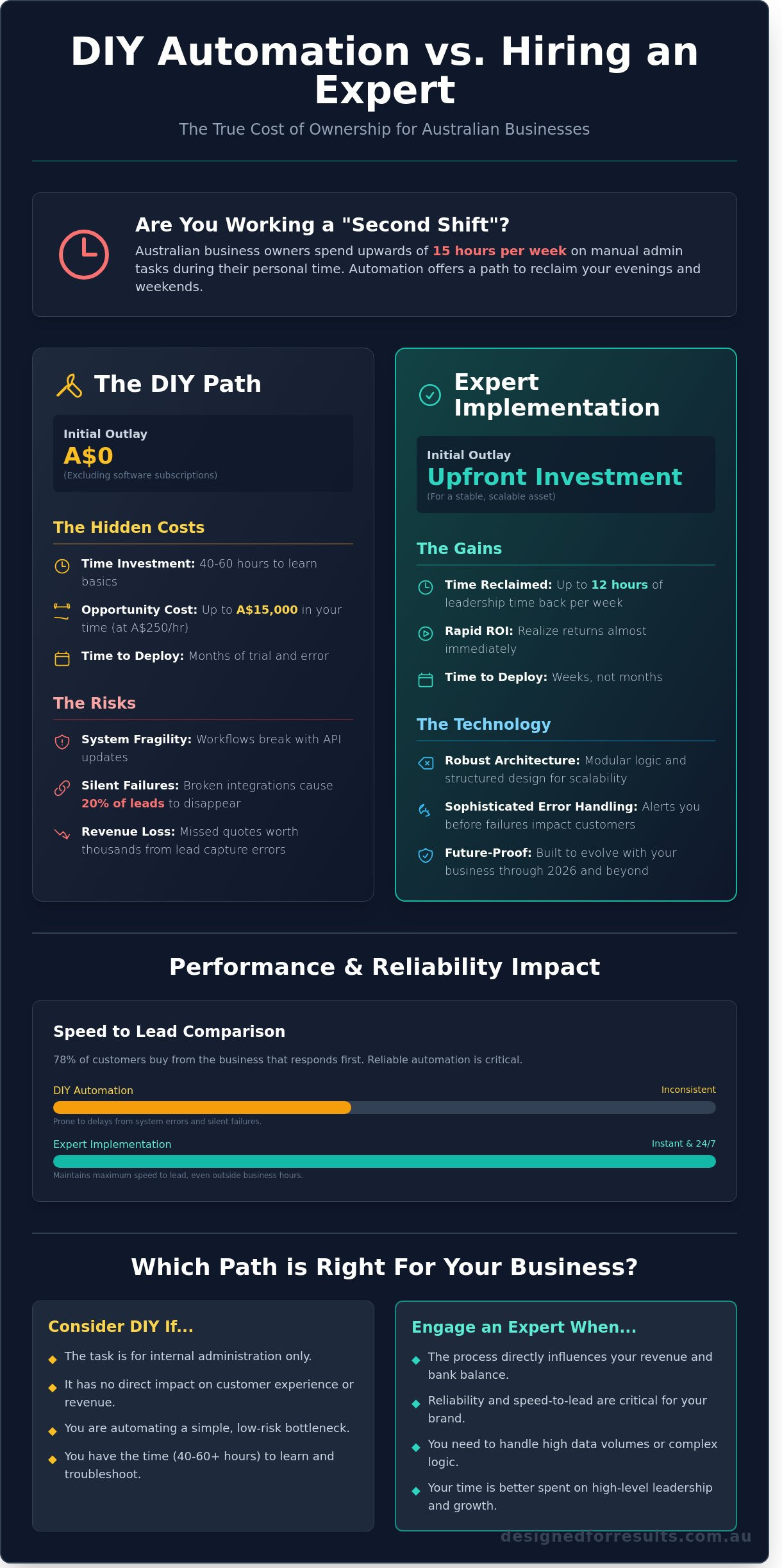
Business automation involves using technology to execute repetitive tasks without manual intervention. For the 2.5 million small businesses operating across Australia, this technology represents a shift from manual labour to digital efficiency. Many business owners currently spend upwards of 15 hours per week on administrative tasks during evenings and weekends. This "second shift" often includes manual data entry, invoice generation, and lead management. Business process automation offers a way to reclaim this time. When considering diy automation vs hiring an expert, many start with the former to address immediate, low-risk bottlenecks.
The choice between diy automation vs hiring an expert often depends on the complexity of the required outcome. Simple tasks, such as move data from a contact form to a spreadsheet, serve as common entry points. These initial steps allow owners to test the technology without significant financial commitment. As the business scales, these workflows must handle higher volumes of data and more complex logic to remain effective.
The Rise of the Citizen Automator
No-code platforms like Zapier and Make have lowered the barrier to entry for non-technical users. Staff members now connect disparate software applications to create functional workflows without writing a single line of code. Common entry-level automations include sending basic email notifications or syncing contact details into a CRM. Australian businesses often choose the DIY path to conserve initial capital. It's a logical starting point for basic tasks that don't require complex logic or high-volume data processing. These tools empower teams to solve small problems quickly, providing immediate relief for overstretched managers.
Why Reliability Matters More Than Ever
Reliability becomes paramount as automation moves from a side project to a core business component. System failures directly disrupt the customer journey and can damage a brand's reputation. In the Australian service sector, lead response times are critical; 78% of customers buy from the business that responds first. Reliable systems ensure "speed to lead" is maintained 24/7. Automation functions as essential infrastructure. A broken workflow leads to lost revenue and missed opportunities. Ensuring these systems operate without interruption is vital for maintaining a high-performance culture and delivering consistent results to clients. Professional oversight ensures that every automated process aligns with the broader business objectives and remains stable under pressure.
Evaluating the Total Cost of Ownership in Automation
The true cost of automation extends far beyond software subscription fees. Australian business owners often overlook the capital value of their own time when debating diy automation vs hiring an expert. Building a custom workflow requires an initial investment of 40 to 60 hours for basic proficiency in logic and API integration. For a leader whose time is valued at A$250 per hour, this represents a hidden cost of A$15,000 before the first automation even goes live. This calculation ignores the ongoing opportunity cost; every hour spent troubleshooting a failing trigger is an hour lost to high-level leadership and revenue generation.
Technical debt is another significant factor in the total cost of ownership. DIY builds frequently lack the documentation and structured architecture required for long-term stability. When a business scales or software providers update their APIs, these fragile systems often collapse. Deciding between in-house vs. outsourced technical development requires a cold analysis of long-term operational efficiency. Professional builds incorporate error handling and modular logic, ensuring the system remains functional as the business evolves through 2026 and beyond.
The Learning Curve vs. Implementation Speed
Mastering multi-step integrations and conditional logic takes months of trial and error. Australian businesses often find themselves trapped in a cycle of rework because the initial DIY setup failed to account for data edge cases. Engaging a professional AI automation agency reduces the deployment window from months to weeks. This speed allows the business to realise a return on investment almost immediately, rather than waiting for a self-taught system to become reliable. Professional implementation ensures the system is correct from the first execution, preventing the administrative backlog that occurs when automated tasks fail silently.
Hidden Costs of System Fragility
System fragility carries a direct financial penalty. A broken lead capture workflow can result in missed quotes worth thousands of dollars in lost revenue. DIY setups often lack the redundancy needed to manage API outages or data formatting changes. Robust systems built through Bespoke AI Automation include sophisticated error handling that alerts the team before a failure impacts the customer journey. This level of technical rigour protects the brand reputation and ensures that customer data remains secure and consistent across all platforms. Leaders looking to reclaim their evenings should book a consultation to audit their current workflow efficiency and identify where fragile systems are costing them time.
Determining When to Build In-House vs. Engaging a Specialist
Categorise your workflows based on their direct impact on the bottom line and the customer experience. Internal administrative tasks that don't touch the customer journey are often suitable for DIY efforts. However, when a process directly influences your bank balance, the stakes change. Deciding between diy automation vs hiring an expert requires a cold assessment of risk versus reward. Australian business owners often find that saving a few hundred dollars on setup costs results in thousands of dollars in lost leads when a DIY system fails during peak periods.
Recommend DIY for internal, non-critical tasks with low complexity. If a failure only results in a minor delay for an internal staff member, it's a safe testing ground for your own skills. Reserve expert intervention for any system that interacts with your clients or handles sensitive financial data. High-stakes systems require a level of reliability that only professional engineering provides.
The Complexity Framework
Define your project scope by its logic density. A simple automation involves a single trigger and a single action, such as saving an email attachment to a folder or sending a basic notification. These are manageable for most managers. Complex systems involve multi-branch logic, API calls, and intricate data formatting. Specialist knowledge is vital for CRM implementation because data integrity is non-negotiable. One incorrect mapping can corrupt years of client history, leading to expensive recovery costs. Understanding The Landscape of Business Automation for Australian SMEs helps identify which tools fit within your technical capability and which require external support.
- Simple: Single trigger, single action, no data transformation.
- Complex: Multiple paths, cross-platform data syncing, custom code snippets.
- High-Risk: Client-facing communications, payment processing, and database migrations.
Revenue-Critical Automations
Prioritise professional investment for systems that generate income. Lead follow-up systems must be bulletproof. Research shows that responding to an enquiry within five minutes increases the likelihood of conversion by 900% compared to waiting thirty minutes. When evaluating diy automation vs hiring an expert, consider the cost of a missed lead. Professional builds ensure every enquiry is captured, segmented, and nurtured without manual intervention.
AI chatbots for websites serve as 24/7 conversational assets, ensuring your business captures quote requests while you sleep. These systems require precise natural language processing to maintain your brand voice and accuracy. Expert builds ensure these tools integrate seamlessly with your existing calendar and sales pipeline, giving you your evenings back while the system handles the heavy lifting of initial qualification.
Managing Risk and Scalability in Your Automation Strategy
The choice between diy automation vs hiring an expert determines whether a system survives the first six months of business growth. DIY builds often rely on static triggers that fail when transaction volumes increase or software updates change field names. Professional systems utilise modular architecture to ensure that every workflow remains functional as the business expands. This approach allows for the addition of new tools without requiring a complete overhaul of existing processes.
Documentation serves as the foundation of long-term system ownership. Many Australian business owners find themselves locked out of their own logic because a DIY setup was never mapped or recorded. Experts provide comprehensive technical documentation that details every integration point and data map. This transparency ensures that the business maintains control over its digital assets even if internal staff members change. Managed service retainers further protect this investment by providing monthly audits and performance tuning to keep workflows running at peak efficiency.
Future-Proofing Your Business Systems
Building for 2026 requires a focus on adaptability. Experts construct systems using independent modules that allow for rapid adjustments when a business pivots or expands its service offering. This flexibility is essential for integrating emerging technologies like AI voice agents into existing customer service channels. These modular systems prevent the total system failure often seen in hard-coded DIY solutions where a single variable change breaks the entire sequence.
Security and Data Integrity
Australian businesses must adhere to strict data handling standards under the Privacy Act 1988 and the Notifiable Data Breaches (NDB) scheme. The Office of the Australian Information Commissioner (OAIC) reported that 44% of data breaches in the latter half of 2023 resulted from cyber security incidents. Professional automation specialists mitigate these risks by implementing secure OAuth2 authentication and encrypted data validation protocols. These measures ensure that sensitive customer information remains protected during every transfer between applications. Securing data at the API level provides the certainty required to scale operations without exposing the business to regulatory penalties or reputational damage.
Ensure your business systems are built for long-term performance and security by exploring bespoke AI and automation solutions today.
Professional Implementation: Securing Reliable Business Outcomes
Professional implementation shifts the focus from managing software to managing results. Many Australian business owners find themselves trapped in a cycle of evening administration; they process quotes and follow up leads long after the standard workday ends. This manual approach limits scalability and leads to burnout. When you weigh up diy automation vs hiring an expert, the primary difference lies in the reliability of the outcome. A professional build ensures that every lead is captured and every follow-up is executed without fail. This systematic precision directly correlates with increased revenue and a superior customer journey.
The Designed For Results Methodology
Our methodology focuses on identifying specific efficiency gaps within your existing operations. We conduct a thorough analysis to determine where manual tasks are draining your resources. Instead of generic software fixes, we recommend technological interventions that align with your specific goals. Every project we undertake prioritises measurable outcomes and a clear return on investment. We act as a partner in your success. You can learn more about our commitment to excellence at About Designed For Results. Our team provides the accessibility and support required to transition from manual administration to a high-performance culture.
Next Steps for Your Automation Journey
Moving beyond the limitations of DIY requires an honest assessment of your current workflow. Start by auditing your daily tasks. Identify which repetitive administrative duties prevent you from focusing on high-value growth activities. Most service-based businesses in Australia find that automating lead management and invoicing saves them upwards of 10 hours per week. If you're ready to reclaim your time and scale your operations, we invite you to Let's Chat for a strategic consultation. We'll discuss your specific pain points and outline a path toward a more efficient business model. Professional automation allows you to focus on growth while your systems handle the administration.
Secure Your Competitive Advantage Through Professional Automation
Australian business owners often reach a crossroads when deciding between diy automation vs hiring an expert. Professional implementation provides the reliability required to handle lead follow-up and repetitive admin tasks effectively. By deploying AI voice agents and automated lead management, you ensure every enquiry is addressed 24/7. This ensures your business remains responsive without requiring your constant attention. Managed systems offer a level of scalability that self-built tools rarely achieve over the long term.
Choosing a specialist allows you to stop working on quotes during your evenings and focus on high-level leadership. Designed for Results specialises in supporting Australian service-based businesses with managed services that guarantee maximum uptime and reliability. You'll see a marked improvement in the customer journey and a direct increase in revenue when your systems are built to perform at scale. It's time to move beyond basic tools and implement a solution that works as hard as you do. Reclaiming your time is possible with the right technical partner at your side.
Ready to reclaim your time? Let's chat about your automation goals today.
Frequently Asked Questions
Is DIY automation really free if I use free software plans?
DIY automation is rarely free because the cost of your time and the limitations of free tiers create hidden expenses. While platforms like Zapier offer free plans, they often restrict users to single-step workflows and 100 tasks per month. Australian business owners frequently spend 10 to 15 hours monthly troubleshooting basic setups. This time investment represents a significant opportunity cost when your personal hourly rate exceeds A$150.
How long does it take to learn how to use tools like Zapier for business?
Expect to spend 20 to 40 hours mastering the fundamentals of business-grade automation. While basic triggers are simple, building multi-step workflows with logic paths and data formatting requires technical proficiency. You'll likely encounter a steep learning curve when mapping fields between different Australian CRMs and accounting tools. Most self-taught users spend three months refining their skills before achieving a reliable, error-free system that doesn't break.
What happens to my automations if the person who built them leaves the business?
Your systems often become "black boxes" that fail without warning if they weren't documented or built using shared credentials. When an employee leaves, they take the logic and troubleshooting knowledge with them. This creates a high operational risk for Australian businesses relying on DIY setups. Professional experts mitigate this by providing technical documentation and using enterprise-level account structures to ensure your business maintains total continuity.
Can an expert fix a DIY automation that is already broken?
Experts can repair existing automations, but they often recommend rebuilding the logic to ensure long-term stability. Poorly structured workflows usually contain technical debt that leads to recurring errors. In many cases, an expert can identify and resolve a specific API conflict or mapping error within two hours. This comparison of diy automation vs hiring an expert highlights how professional intervention prevents the same failure from happening again next month.
How do I know if my business is ready for professional automation services?
Your business is ready for professional help when manual administrative tasks consume more than 10 hours of your leadership team's weekly capacity. If you're missing lead follow-ups or failing to send quotes within 24 hours, the cost of inaction is measurable. Australian service businesses often seek experts once they hit A$500,000 in annual revenue. At this scale, the complexity of managing data across multiple platforms exceeds the capabilities of basic DIY tools.
What is the typical ROI for hiring an automation expert in Australia?
Australian businesses typically see a return on investment within six to nine months through reclaimed labour hours and increased lead conversion. A 2023 industry report indicates that professional automation can reduce administrative overhead by 30%. By automating the lead-to-quote process, you can increase your capacity to handle new clients without hiring additional staff. This shift directly improves your bottom line by converting fixed labour costs into scalable digital assets.
Will hiring an expert mean I lose control over how my business runs?
Hiring an expert increases your control by providing visibility into data and processes that were previously manual and opaque. You maintain ownership of all accounts and have the final say on the logic used to handle your customers. Professional automation creates a standardised way of working that doesn't rely on the memory or whims of individual staff members. It's about building a system that follows your specific business rules every time.
Does professional automation require me to change all my existing software?
Most professional automations work with your existing software stack by using APIs to connect your current tools. Experts evaluate your current software to ensure it has the necessary connectivity for your specific goals. If a tool lacks integration capabilities, an expert will suggest a more compatible alternative. The goal of diy automation vs hiring an expert is to create a seamless flow of data between the systems you already use and trust.
