
How to Improve Lead Response Time: A Guide for Australian Businesses

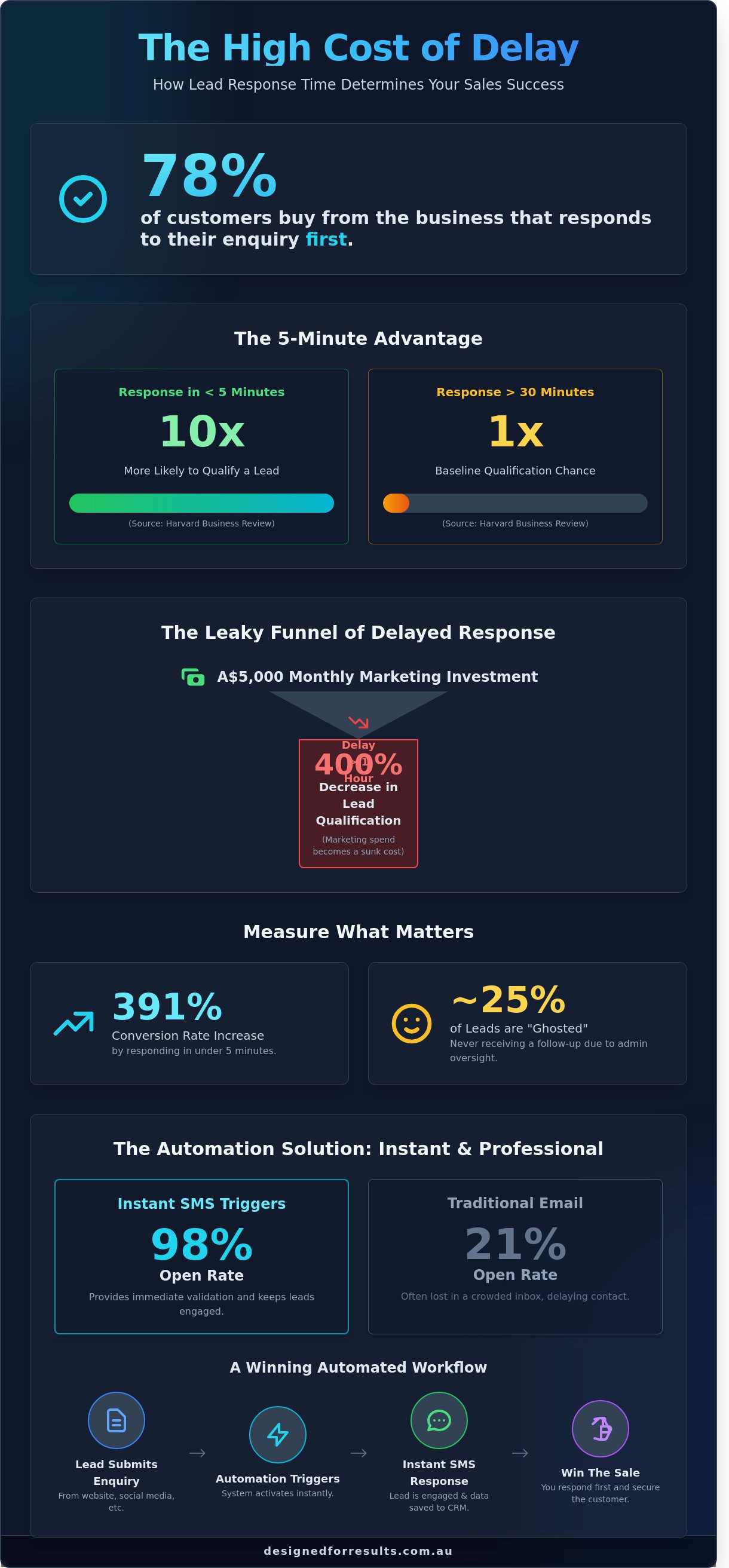
Research from LeadConnect shows that 78% of customers buy from the business that responds to their enquiry first. If you're looking for how to improve lead response time, you likely recognise that every minute a lead sits in your inbox, its value diminishes. It's exhausting to spend your Saturday mornings catching up on admin. Waiting until the end of the day often means losing the sale to a faster competitor.
This guide demonstrates how to eliminate manual bottlenecks through automated lead management. You'll learn how to capture more revenue and provide a professional, instant customer experience that distinguishes your business from the competition. By implementing these solutions, you can recover your personal time while ensuring your sales process operates with total precision. We'll explore the specific automation tools and workflows that allow an Australian business to scale without increasing its administrative burden.
The Financial Impact of Delayed Lead Response
Lead response time is the measurable duration between a prospect submitting an enquiry and your business making the first meaningful contact. It functions as the primary indicator of sales efficiency. Understanding how to improve lead response time begins with acknowledging that every minute of delay directly devalues your marketing investment. Research from the Harvard Business Review indicates that businesses contacting prospects within five minutes are nearly 10 times more likely to qualify that lead than those who wait 30 minutes. In the Australian service sector, this window is even more critical as consumer expectations shift toward instant gratification.
The financial cost of a "leaky" sales funnel is often invisible but substantial. If an Australian business allocates A$5,000 monthly to lead generation but fails to respond within the first hour, they risk a 400% decrease in lead qualification. This inefficiency turns a calculated marketing spend into a sunk cost. By 2026, industry data suggests 85% of Australian consumers will choose the provider that responds first, regardless of minor price differences. Speed is a baseline requirement for maintaining a high-performance culture and securing measurable outcomes.
Why Speed to Lead is Non-Negotiable
Rapid response builds immediate trust. When a lead reaches out, their psychological need for a solution is at its peak. Delaying your contact allows that urgency to dissipate; it often drives the prospect to a competitor who answers the phone first. Winning the contract depends on being the first professional voice the customer hears. This immediate engagement establishes your business as reliable and capable before the formal sales process begins. It demonstrates a level of leadership capability that prospects associate with high-quality service delivery.
The Reality for Australian Small Businesses
Many Australian business owners struggle to balance lead management with active service delivery. Tradies on-site or consultants in back-to-back meetings often find themselves returning calls during evenings when the lead has already gone cold. Manual follow-up becomes a barrier to growth when the volume of enquiries exceeds the owner's capacity to respond instantly. Relying on after-hours admin sessions limits your ability to scale and directly impacts your bottom line. Transitioning toward bespoke automation ensures enquiries are handled while you focus on high-level management and service execution.
Benchmarking and Measuring Your Current Response Speed
Understanding how to improve lead response time begins with a cold, hard look at your current data. You can't fix what you haven't measured. Start by auditing every lead that entered your business over the last 30 days. Trace the exact path from the moment a prospect hit 'submit' on your website to the second a human or system made meaningful contact. This audit reveals the hidden gaps where potential profit leaks out of your business.
Calculate your average response time across every channel, including email, SMS, and social media. Most Australian business owners find their perceived response time is much faster than the reality. If your email leads wait four hours while your SMS leads wait ten minutes, your process lacks the consistency required for growth. Identify exactly where leads stall. It's often in a cluttered inbox or a manual spreadsheet that someone forgot to check during a busy Tuesday morning. High-performing businesses in service industries should target a response time of five minutes or less to stay competitive.
Essential Metrics to Track
Lead Response Time (LRT) is the total number of minutes between an enquiry arriving and your first outbound contact attempt. To calculate this accurately, subtract the lead arrival timestamp from the first contact timestamp. Data from a 2021 LeadSimple study shows that responding within five minutes increases conversion rates by 391% compared to waiting 30 minutes. You must also track the volume of leads that never receive a follow-up. In many small businesses, this "ghosting" rate can be as high as 25% due to administrative oversight. Measuring these figures provides the clarity needed to justify a bespoke automation solution that removes human error from the equation.
Mapping the Customer Journey
List every point where a customer can contact your business, from Google Business Profile messages to specific landing page forms. Note every manual step currently required to move a lead forward. If a manager must manually copy data from an email into a CRM before a quote can be issued, you've identified a primary bottleneck. These administrative tasks often pile up, forcing business owners to handle admin during evenings rather than focusing on high-level leadership. Identify the specific moments where the journey stops because a staff member is on a lunch break or finishing a job on-site. These gaps represent lost revenue that you can recover through better process design.
Implementing Automated Lead Follow-Up Systems
Manual lead handling is a bottleneck for 62% of Australian small businesses. Connecting your website forms directly to a centralised CRM removes the friction of manual data entry and ensures no enquiry is lost in a crowded inbox. You can't afford to let leads sit untouched while you're on a job site or in a meeting. Automation ensures every prospect receives an immediate response. This is the most effective way to understand how to improve lead response time without increasing your personal administrative workload.
The Power of Instant SMS Triggers
Australian consumers demonstrate a 98% open rate for SMS, compared to just 21% for traditional email. Sending an instant text message provides immediate validation to the prospect. It confirms your business is active and attentive. Effective scripts remain short and direct. For example: "Hi [Name], thanks for reaching out to [Business Name]. We've received your enquiry and will be in touch within 30 minutes. To see our latest projects, visit [Link]." This simple automation keeps the lead engaged while you finish your current task.
CRM Integration for Real-Time Management
Successful lead management requires a single source of truth for all data. A professional CRM implementation organises lead information so you never lose a contact in a messy spreadsheet. Automated segmentation further refines this process by tagging leads based on their specific needs or potential value. This allows you to set up internal notifications for high-value opportunities. If a lead requests a quote for a premium service, your team receives an instant alert via Slack or SMS to prioritise that specific follow-up.
Use automated scheduling tools to let leads book discovery calls immediately. This eliminates the repetitive back-and-forth emails that often result in lost revenue and wasted time. By providing a booking link in your initial auto-responder, you lock in the prospect while their intent is highest. A 2023 industry report showed that businesses using automated scheduling saw a 28% increase in held appointments. This directly addresses the pain point of "ghosting" that many Australian business owners face.
Maintain a consistent brand voice across every automated communication. Professionalism should be built into every automated email and text to reflect your high standards. Every message must sound like your business, maintaining a professional and supportive tone that builds trust before the first human interaction. This structured approach is the most reliable method for those wondering how to improve lead response time while reclaiming their evenings from administrative tasks.
Leveraging AI Agents to Manage Initial Enquiries
Lead response speed is the single most important factor in closing a sale. Research indicates that responding within 60 seconds increases conversion rates by up to 391%. AI agents remove the human bottleneck that causes delays. These tools function as digital employees that never sleep, ensuring every prospect receives an immediate, high-quality response. Mastering how to improve lead response time requires moving away from manual replies toward an automated, AI-driven front end.
AI Voice Agents for Immediate Phone Response
Missing a call while you are on a job site often means losing a contract to a competitor who answers faster. AI voice agents solve this by answering calls in a natural, conversational tone. These agents handle complex enquiries, provide preliminary pricing, and book appointments directly into your calendar. They act as a 24/7 receptionist that never misses a detail. You can review the technical implementation in our guide on AI voice agents for small business. This technology allows you to stay focused on your current project while your sales pipeline continues to fill.
Intelligent Chatbots for 24/7 Qualification
Most website visitors expect a response within minutes. If they don't get it, they leave. An intelligent chatbot interacts with these visitors instantly to qualify their needs. These systems filter out tyre-kickers by asking specific questions about budget, location, and timeline. This process moves a lead from a basic enquiry to a confirmed booking without any manual intervention. Find detailed steps in our resource on AI chatbots for websites. By the time you review the enquiry, the AI has already performed the heavy lifting of qualification.
Efficiency extends beyond the initial conversation. AI agents use intelligent scoring to rank leads based on their likelihood to convert. This ensures you prioritise prospects who are ready to buy today. All interaction data flows directly into your sales pipeline, removing the need for manual data entry. This automation can save Australian businesses upwards of 12 hours of administrative work every month. If an owner's time is valued at A$150 per hour, this represents a monthly saving of A$1,800. It provides a clear path on how to improve lead response time while simultaneously reducing your operational costs.
- Deploy AI chatbots to qualify leads on your website 24/7.
- Use AI voice agents to answer phone calls and book appointments instantly.
- Incorporate intelligent lead scoring to prioritise the most ready-to-buy prospects.
- Reduce manual data entry into your sales pipeline by syncing AI conversations directly to your CRM.
Designing a Sustainable Lead Management Workflow
Scale requires structure. A system-led model ensures your business captures every opportunity without demanding more of your personal time. Many Australian business owners spend upwards of 12 hours every week on after-hours administration. This exhaustion limits leadership capability and stalls measurable outcomes. Implementing a structured workflow eliminates the bottleneck of human intervention during the initial contact phase.
Consistency drives conversion. Understanding how to improve lead response time involves removing the variable of human availability. Automated sequences handle the immediate acknowledgement; meanwhile, internal notifications alert your team to high-priority prospects. This shift allows you to monitor performance through hard data. Systems ensure strategic alignment across your sales team. A high-performance culture thrives on these clear metrics, allowing for continuous refinement of your sales process.
- Identify repetitive touchpoints in your current sales cycle.
- Deploy automated triggers for instant lead engagement.
- Set internal alerts to ensure no lead remains unaddressed for more than 5 minutes.
- Review conversion data monthly to identify friction points.
Moving from Manual Effort to Automation
Investing in workflow automation provides a distinct competitive advantage in the Australian market. Business owners should focus on high-value tasks like closing complex deals and developing talent. Recent industry data indicates that businesses automating their lead management see a 14.5% increase in sales productivity. The long-term ROI manifests as both increased revenue and the recovery of your personal evenings. It turns a chaotic inbox into a predictable pipeline. Implementing these changes clarifies how to improve lead response time while protecting your bottom line.
Next Steps for Your Business
Audit your current response speed to identify exactly where leads are dropping off. Many businesses discover that 50% of their leads go cold due to a lack of immediate follow-up. Once you understand these gaps, you can build a system that delivers results 24/7. To discuss a tailored plan for your operations, book an automation strategy call. Secure more revenue and reclaim your time through professional system execution.
Secure Your Competitive Advantage Through Rapid Response
Speed is the primary differentiator in the Australian service sector. When a lead reaches out, the window to convert effectively closes within 5 minutes. Research from the Harvard Business Review indicates that delaying response times beyond this window results in a 400% drop in lead qualification rates. Implementing automated systems allows your business to capture every enquiry instantly, even during evenings when you're away from your desk. By integrating no-code automation and AI agents, you remove the administrative burden that keeps owners stuck in repetitive tasks.
Understanding how to improve lead response time is essential for building a sustainable workflow that protects your time and increases your bottom line. Transitioning to an automated environment ensures no quote is missed and every customer journey starts with professional precision. As Australian-based automation specialists, we focus on no-code and AI integration that delivers measurable revenue outcomes for local businesses.
Book your free automation strategy call with Designed For Results to reclaim your evenings and scale your operations. Your business deserves a system that works as hard as you do.
Frequently Asked Questions
What is a good lead response time for a service business?
Under five minutes is the benchmark for Australian service businesses. Research indicates that responding within five minutes makes you 100 times more likely to connect with a prospect than waiting 30 minutes. If you want to know how to improve lead response time, aim for immediate automated acknowledgement followed by a human or AI-driven follow-up within 15 minutes to secure a 391% increase in conversion rates.
How much does it cost to automate lead follow-up?
Basic automation setups for Australian businesses typically start at A$150 to A$500 per month for software subscriptions. Custom implementation or more advanced AI integrations may require an initial setup fee ranging from A$1,500 to A$5,000 depending on complexity. These systems often pay for themselves within 90 days by capturing leads that would otherwise be lost to competitors during after-hours periods or busy workdays.
Will my customers know they are talking to an AI or automation?
Transparency depends on how you configure the system. Many Australian service businesses choose to identify AI assistants as digital concierges to manage expectations. Modern conversational AI uses natural language processing to provide helpful, human-like responses that 63% of consumers now prefer for simple enquiries. If you use basic automation, clear messaging ensures the customer knows their enquiry is received and when a team member will call back.
Can I integrate automation with my existing website and CRM?
Most modern automation tools integrate directly with popular platforms like WordPress, Shopify, and CRMs such as HubSpot or Pipedrive via API connections. You can use middleware like Zapier or Make to bridge gaps between legacy systems and new automation workflows. This connectivity ensures that 100% of data flows into your central database without manual entry, eliminating the risk of lost lead information or double-handling.
Do I need to be tech-savvy to manage these systems?
You don't need technical expertise to manage professional automation systems once they are configured. User-friendly dashboards allow business owners to monitor performance and update basic messaging with minimal training. Most Australian service providers offer managed support, handling the technical backend so you can focus on high-value tasks. This approach saves approximately 10 hours of administration time per week for the average small business owner.
What happens if the automation fails or sends a wrong message?
System failures are rare, occurring in less than 1% of transactions when built on stable platforms. You can implement fail-safe triggers that alert a human staff member via SMS if the system cannot process a request. Regular audits and testing protocols ensure the logic remains sound. If an error occurs, a quick personal follow-up typically resolves the issue, as 78% of customers appreciate a business that takes immediate responsibility for technical glitches.
How does speed to lead affect my Google Business Profile ranking?
Rapid response times indirectly boost your Google Business Profile visibility by increasing your conversion rate and positive review frequency. Google prioritises businesses that provide a high-quality user experience. When you learn how to improve lead response time, you reduce bounce rates from your profile and increase the number of click-to-call actions. These engagement signals inform Google's algorithm that your business is active and reliable, potentially moving you into the top three local map results.
Can automation help with following up on sent quotes?
Automation handles the repetitive task of chasing outstanding quotes through a series of scheduled SMS and email reminders. Statistics show that 80% of sales require five follow-ups, yet 44% of business owners give up after one attempt. Automated sequences ensure no quote is forgotten, often increasing quote-to-job conversion by 25%. This system operates in the background, allowing you to reclaim your evenings instead of manually emailing prospects.
