
How to Build a Business That Runs Itself in Australia: A 2026 Guide

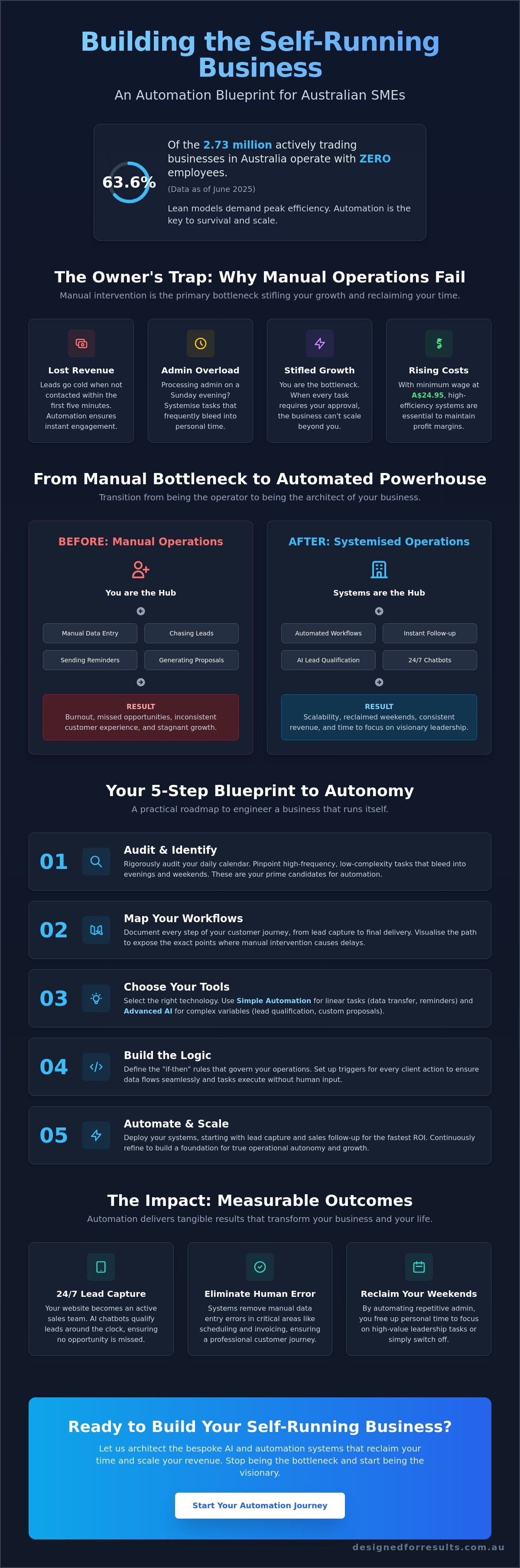
As of June 2025, 63.6% of the 2.73 million actively trading businesses in Australia operate without a single employee. This data highlights a significant shift toward lean models where operational efficiency determines survival. You likely find yourself processing administrative tasks on a Sunday evening or losing revenue because a lead wasn't contacted within the first five minutes. Learning how to build a business that runs itself australia is the only way to escape the limitations of being the primary bottleneck in your own operation.
You recognise that manual intervention is currently stifling your ability to scale and reclaim your personal time. This guide provides the practical steps to implement workflow automation and AI solutions that maintain high-performance standards without your constant supervision. We will examine how to integrate automated lead follow-up systems, CRM workflows, and AI chatbots to ensure your customer journey is seamless. You'll learn to replace manual effort with systems that produce measurable outcomes and consistent revenue.
Defining the Self-Running Business Model for Australian SMEs
A self-running business operates through systems that execute repetitive tasks and logic-based decisions. Understanding how to build a business that runs itself australia requires the perspective of a chief architect. With the national minimum wage at A$24.95 as of 1 July 2025, Australian businesses require high-efficiency systems to maintain margins. These systems provide a buffer against rising labour costs by ensuring every billable hour is maximised while administrative overhead remains static. Success in this model is a product of intentional engineering.
Simple automation handles linear tasks through pre-defined rules. These systems move data between your CRM and accounting software or trigger appointment reminders. Advanced AI solutions provide a higher level of capability by managing complex variables, such as qualifying leads through natural language processing or generating custom proposals from meeting notes. Integrating these technologies allows you to focus on visionary leadership. The objective is to establish a foundation of leadership capability and a high-performance culture.
The Role of Workflow Automation in 2026
Workflow automation serves as the digital connective tissue between your software platforms. It eliminates manual data entry by ensuring information flows from your website form to your CRM and into your invoicing software. Implementing Business Process Automation reduces human error in critical areas such as scheduling and proposal generation. This consistency ensures your customer journey remains professional and predictable. Systems provide clarity and ensure that every lead is handled with precision.
Transitioning from Manual Admin to Systemised Operations
The transition begins with a rigorous audit of your daily calendar. Identify tasks that frequently bleed into your evenings and weekends as these are the primary candidates for systemisation. Prioritising lead follow-up and document collection yields a fast return on time. Leveraging bespoke AI automation allows you to build a foundation for autonomy where the system handles the heavy lifting of client communication and data management. This move allows you to focus on leadership capability and measurable outcomes. Execution allows the business to scale.
Mapping Your Workflows for Full Autonomy
Document every step of your service delivery from the initial lead to final completion. This exercise exposes the specific points where your manual intervention causes delays in your daily operations. Visualising the customer path through your business allows you to see the exact moment a lead goes cold due to slow manual follow-up or missing documentation. Learning how to build a business that runs itself australia involves identifying which steps are purely logical and which require a human touch. Logic-based tasks are the primary candidates for systemisation to ensure your business continues to function without your presence.
Australian small businesses often lose hours to tasks that follow a predictable pattern. Identifying these bottlenecks is the first step toward regaining your weekends. Focus on the areas where you find yourself repeating the same actions or sending the same emails multiple times a week. By mapping these workflows, you create a blueprint for a system that maintains high standards and delivers a consistent customer experience.
Identifying Automation Opportunities
Focus on high-frequency, low-complexity tasks that repeat daily. Document collection and internal approval sequences are common areas where time is lost to manual handling and back-and-forth communication. Implementing workflow automation removes this friction by ensuring information moves between platforms instantly and accurately. This transition allows you to focus on high-value leadership tasks rather than chasing signatures or updating spreadsheets. You can speak with an advisor to identify the most impactful triggers for your specific service model.
Building the Logic for Your Systems
Define the specific rules that govern your business operations to ensure consistency. Ensure data flows seamlessly from your website forms to your CRM by setting up triggers for every possible client action. Workflow logic is the set of rules that trigger actions without human input. These automated sequences ensure that every prospect receives an immediate response, which is critical for maintaining high conversion rates in the competitive Australian market. Establishing these rules creates a reliable environment where the system handles the heavy lifting of lead management and administrative coordination.
Automating Lead Capture and Sales Follow-Up
Speed to lead is the most critical metric for an Australian business in 2026. Data from the first quarter of 2026 indicates that small business sales increased by 7.2%, resulting in a higher volume of enquiries that require immediate attention. Automated lead follow-up systems ensure your business acknowledges every prospect in seconds. This removes the manual burden of monitoring your inbox during evenings or between client meetings. The sales process begins immediately; this is a foundational pillar of how to build a business that runs itself australia.
AI chatbots provide a consistent, 24/7 qualification layer on your website. They handle the heavy lifting of answering frequently asked questions and determining if a prospect meets your ideal client profile. This level of automation ensures your sales pipeline remains active at all times. Integrating these tools with automated appointment booking and SMS reminders reduces no-shows. Your website functions as an active sales team that maintains high standards regardless of the hour. Automated sales ensure consistent revenue.
Leveraging AI Voice Agents and Chatbots
Deploying AI voice agents allows your business to handle initial phone enquiries with professional precision. These agents record and transcribe calls while triggering automated follow-ups based on the conversation context. This technology ensures that every phone lead is captured and categorised. Chatbots complement this by managing text-based interactions, creating a multi-channel approach to lead generation that maintains a professional customer experience around the clock.
The Power of CRM Implementation
Centralise all client communication and data in a single source of truth to maintain operational clarity. CRM implementation allows you to automate nurture sequences that keep your business top-of-mind for prospective clients. This visibility ensures your sales pipeline is updated in real-time, providing a clear view of measurable outcomes. Explore smart AI solutions to see how an integrated database can reclaim your time and increase revenue through consistent execution. Every interaction is logged, ensuring that your leadership capability is supported by accurate data.
Streamlining Admin, Contracts, and Onboarding
Administrative friction often serves as the final barrier to achieving operational freedom. Generating contracts and proposals automatically from CRM deal data ensures every quote is accurate and delivered instantly. This level of efficiency is essential when learning how to build a business that runs itself australia. Recent data shows only 48% of Australian businesses survive their first three years, making operational efficiency a non-negotiable requirement for longevity. Integrating these documents with internal approval workflows ensures that projects move forward through automated logic.
Managing financial workflows through Xero integration automates invoicing and payment tracking. When a client signs a contract, the system triggers an invoice and monitors its status. This maintains cashflow discipline and builds financial resilience. The team focuses on high-level delivery. This transition moves the owner into a leadership role focused on leadership capability and measurable outcomes.
Automated Document Generation
Repetitive drafting of quotes and terms of service drains hours from your week. Template automation ensures that pricing and terms remain consistent across all client interactions. Providing instant quote calculators on your website delivers immediate value to prospects while capturing the data needed for contract generation. You can automate your proposal process to eliminate administrative bottlenecks today.
Client Onboarding on Autopilot
The period immediately following a sale is critical for maintaining customer trust. Triggering welcome emails and information packs automatically ensures the client feels supported. Automated document collection systems request necessary files without manual follow-up. Learning how to build a business that runs itself australia requires systems to execute these touchpoints. Engaging an AI automation agency Australia specialist helps you build sequences that ensure no step is missed. These systems create internal task lists for your team to ensure responsibilities are clear from the start.
Scaling Your Australian Business with Managed Automation
Building an automated system is only the first phase of operational freedom. Achieving a business that functions independently requires ongoing monitoring and optimisation to ensure systems remain aligned with your growth. In the first quarter of 2026, Australian small business sales increased by 7.2% year-on-year, with the construction sector leading at 10.4%. To capture this momentum, your technology must scale alongside your increasing client volume. This ensures that a sudden influx of enquiries doesn't overwhelm your onboarding process or lead to a breakdown in communication. Managed systems provide the resilience needed to handle these fluctuations without requiring the owner to step back into a manual role.
Shift your focus toward high-level business analysis once your primary workflows are automated. Utilise real-time sales dashboards to gain visibility into your pipeline and conversion rates. These tools provide the data-driven insights necessary for making informed growth decisions, replacing intuition with measurable outcomes. This transition from operator to analyst is the final milestone in learning how to build a business that runs itself australia. It allows you to maintain a high-performance culture while focusing on leadership capability rather than daily administrative coordination. Effective scaling is a result of intentional system maintenance rather than accidental growth.
The Value of Managed Service Retainers
Outsource the technical maintenance of your AI and automation systems to ensure long-term stability. Software updates and API integrations evolve rapidly; a managed service retainer ensures your digital infrastructure remains functional as these tools change. This approach allows you to focus on your core service while experts manage the complexities of your backend systems. It prevents the owner from becoming a de facto IT manager, ensuring that the business continues to operate efficiently without your direct technical intervention. Professional oversight ensures that your automated review requests and lead capture systems never experience downtime.
Taking the Next Step Toward Autonomy
Assess your current level of automation to identify the next priority for systemisation. Many Australian businesses find that automating lead magnet delivery or database reactivation campaigns provides the fastest return on investment. Evaluate your specific operational needs against current market conditions to determine where automation can reclaim the most time. You can start your journey toward a self-running business by booking a strategy call to audit your current workflows. Identifying the primary bottlenecks in your current model is the first step toward achieving consistent revenue through automated execution and regaining your personal time.
Achieving Operational Autonomy
Reclaiming your personal time requires a fundamental shift in how you view your daily operations. You have explored how mapping logical workflows and automating lead capture ensures your business remains responsive without your manual input. These systems provide the strategic alignment needed to scale effectively while maintaining a high-performance culture. Mastering how to build a business that runs itself australia allows you to focus on measurable outcomes rather than repetitive administrative tasks.
Designed For Results is an Australian-based consultancy specialising in AI and no-code workflow automation for small to medium-sized businesses. Our focus remains on delivering a clear ROI and significant time recovery for owners who are currently overextended by manual processes. We help you replace haphazard expansion with systems that produce consistent, professional results. Book your free automation strategy call today to evaluate your current systems and identify the most impactful opportunities for automation. Your transition from operator to visionary leader starts with a single, intentional step toward systemisation.
Frequently Asked Questions
Is it really possible for an Australian business to run entirely on autopilot?
Most successful models operate through systems that handle 90% of daily operations rather than achieving 100% total autonomy. The owner remains the visionary leader who focuses on leadership capability and strategic direction. Data from June 2025 indicates that 63.6% of Australian businesses are non-employing, proving that lean, system-driven models are now the standard for achieving operational independence without constant manual oversight.
How much does it cost to build a business that runs itself?
Investment levels depend on the complexity of your current workflows and the volume of leads your business processes. Basic regulatory costs include ASIC fees for registering a business name, which are A$45 for one year or A$104 for three years as of May 2026. Beyond these fees, the cost involves implementing automation systems and AI tools that replace the need for additional administrative staff as you scale.
Can a service-based business use AI without losing the personal touch?
AI actually enhances the personal touch by ensuring immediate responsiveness and accuracy in all client communication. Using AI voice agents to record and transcribe calls ensures every detail of a client's request is captured without human error. This technology allows you to provide a high-performance culture where clients receive instant attention, even during peak periods when a manual response would be significantly delayed.
Do I need to be tech-savvy to implement business automation?
Modern no-code platforms and managed service providers handle the technical complexity on your behalf. Automation tools focus on logic-based triggers rather than complex programming, allowing you to focus on your core service while the digital infrastructure manages lead follow-ups. Success depends on your understanding of your own business processes and measurable outcomes rather than your ability to write code or manage hardware.
What is the first step to automating an existing Australian business?
The first step is a thorough audit of your current daily tasks to identify repetitive administrative bottlenecks. Learning how to build a business that runs itself australia begins with mapping every manual touchpoint from the initial lead capture to final invoicing. Prioritise automating the high-frequency tasks that currently consume your evenings and weekends, such as sending follow-up emails or collecting client documentation for onboarding.
How does automation help with hiring and managing staff?
Automation provides clear internal task lists and approval workflows that guide staff through every project phase with precision. As of 1 July 2025, the national minimum wage is A$24.95 per hour, making efficient labour management essential for maintaining your profit margins. Systems ensure that employees focus on high-value delivery rather than manual data entry, which improves job satisfaction and helps maintain a high-performance culture.
What happens if the automated systems fail or encounter an error?
Managed automation systems include error logging and notification triggers to alert you or your technical partner the moment a workflow pauses. Regular monitoring and managed service retainers ensure that software updates do not disrupt your existing integrations. Having a structured support system in place ensures that any technical friction is resolved quickly before it impacts the customer journey or your bottom line.
Can automation work for very small businesses with only 1-2 employees?
Automation is most effective for small operations where human resources are extremely limited. Implementing how to build a business that runs itself australia allows a solo operator or a team of two to process a volume of leads that would typically require five staff members. It removes the administrative burden, allowing a small team to focus entirely on revenue-generating activities and high-level client strategy.
