
How to Convince Your Business Partner to Invest in Automation

Imagine finishing your final client consultation at 5:00 PM only to spend the next three hours manually drafting quotes and chasing overdue invoices. This scenario is a daily reality for Australian business owners who find themselves buried in administrative tasks while their growth plateaus. A 2023 study by the Australian Chamber of Commerce and Industry found that small business owners work an average of 50 hours per week, with a significant portion dedicated to routine admin. You likely recognise that these manual processes are slowing your response times and causing leads to go cold. Learning how to convince my business partner to invest in automation is about shifting the conversation from technical features to measurable capacity. You will discover how to present a logical, revenue-focused case that addresses your partner's financial concerns and secures their full commitment. This article provides a clear roadmap to demonstrate how automation increases your speed to lead and recovers your personal time without the need to hire additional staff.
Technical risk is another primary hurdle for the cautious partner. Many Australian business owners worry that they lack the internal expertise to manage new software. However, modern no-code and AI platforms operate with enterprise-grade security that matches or exceeds traditional banking systems. Beyond security, automation actually serves as a risk-mitigation tool. A 2022 report by IBM found that human error is the contributing factor in 95% of all data breaches and administrative mistakes. In a service-based business, manual entry errors in contracts or billing can lead to significant revenue leakage. This need for precision is why industrial sectors globally rely on specialists like EdNex Automation to implement robust systems that eliminate human error. Automating these workflows ensures data consistency and protects the business from the 25% of wasted time that Gartner identifies as "rework" caused by manual processing errors.
Quantifying the Cost of Manual Operations in Your Australian Business
Australian business owners often find themselves trapped in a cycle of admin debt, where manual tasks from today overflow into tomorrow's growth opportunities. This debt accumulates every time you manually collect documents or copy data from a website form into a spreadsheet. For an Australian business owner, this often translates to three or four hours of unpaid labour every evening. When you calculate the hourly value of your executive time, these late-night sessions represent a significant drain on the company's bottom line. Understanding the true scale of these hidden expenses is the first step in learning how to convince my business partner to invest in automation.
The Financial Impact of Slow Lead Response
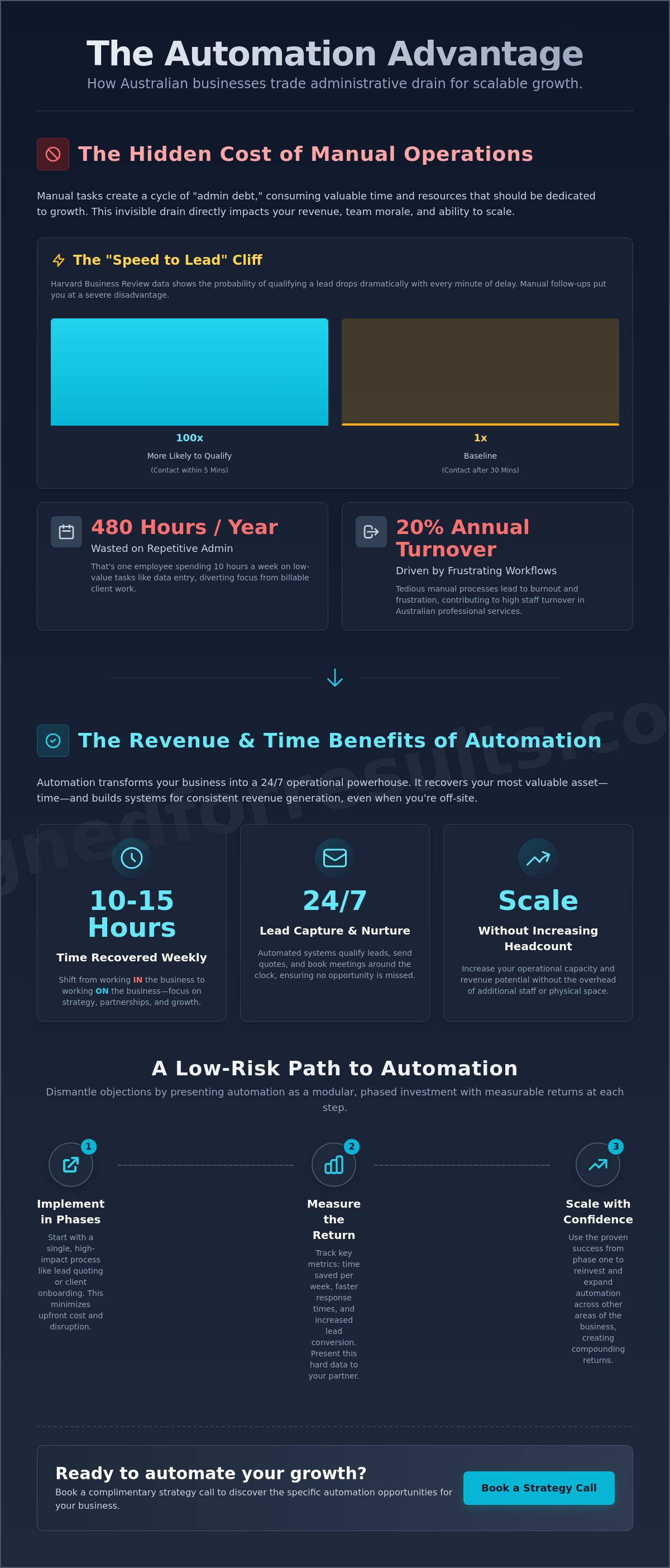
Speed to lead is a critical metric for service-based businesses. Data from the Harvard Business Review indicates that businesses attempting to contact potential customers within five minutes are nearly 100 times more likely to qualify the lead than those waiting 30 minutes. Manual follow-up processes create an immediate bottleneck. While you are busy on-site or in meetings, your competitors use automated systems to send instant quotes or booking links. Every hour a lead sits in an inbox without a response, the probability of closing that deal drops significantly. This delay limits your total monthly revenue capacity by capping how many enquiries you can effectively handle before the quality of service declines.
The Invisible Drain of Repetitive Administration
Repetitive tasks like generating contracts, sending invoice reminders, and following up on missing client information consume a staggering amount of staff time. Business process automation eliminates these low-value activities, allowing your team to focus on billable work. Consider the annual cost of a staff member spending 10 hours a week on basic data entry. Across a 48-week working year, that equals 480 hours diverted from client service to administration. Beyond the direct salary cost, there is a morale cost to consider. High-performance employees often feel frustrated by tedious manual workflows, which contributes to the 20% average annual turnover rate seen in Australian professional services. Retaining talent requires providing tools that remove friction from their daily roles. Transitioning to automated workflows ensures your team remains focused on high-value outcomes rather than data management.
Presenting the Revenue and Time Benefits of Workflow Automation
Automation isn't just about efficiency; it's about revenue resilience. When you are off-site or at home, your business must continue to capture and qualify every opportunity. Transitioning to automated workflows allows your Australian business to operate 24/7 without the overhead of additional staff. This capability is a central talking point when researching how to convince my business partner to invest in automation. By implementing systems that provide instant booking and reminders, you eliminate the back-and-forth emails that often lead to lead attrition and lost revenue.
The customer journey improves immediately when responsiveness is built into the process. Automated document collection accelerates project start dates by removing the friction of manual follow-ups, which directly impacts your monthly cash flow. A 2023 report by Export Finance Australia highlights the benefits and challenges for Australian businesses adopting new technologies, noting that those who integrate these systems see measurable gains in operational capacity. These improvements allow you to scale your operations without increasing your headcount or physical overheads.
Increasing Revenue Through Intelligent Lead Systems
Effective lead follow up systems ensure no enquiry is ignored. AI chatbots and voice agents qualify leads by asking specific budget and timeline questions before they ever reach your desk. This ensures you only spend time on high-probability prospects. Additionally, database reactivation campaigns can re-engage past clients via automated SMS or email, uncovering hidden revenue from your existing contact list without any manual effort. If you want to see how these systems fit your specific model, you can book a strategy call to explore the possibilities.
Recovering Time for Leadership and Growth
Implementing basic automation typically saves an Australian business owner between 10 and 15 hours every week. This recovered time is a key factor in how to convince my business partner to invest in automation. Instead of chasing missing signatures or confirming appointments, you can focus on high-level activities like strategic partnerships, service expansion, or staff development. The shift from working in the business to working on the business is only possible when the underlying administration is handled by reliable software. This transition allows you to scale operations and increase your output based on demand rather than administrative capacity.
Addressing Partner Objections Regarding Cost and Technical Risk
Every business partnership has a natural balance between the visionary who seeks speed and the pragmatist who prioritises stability. This dynamic often surfaces when discussing how to convince my business partner to invest in automation. The most common objections usually centre on the perceived "black hole" of technical spending and the fear that a complex system might fail at a critical moment. You can dismantle these concerns by presenting automation as a modular investment rather than a high-risk overhaul. Modern platforms allow you to implement changes in distinct phases, ensuring each step delivers a measurable return before moving to the next. This approach protects your cash flow while allowing the business to evolve at a sustainable pace.
Technical risk is another primary hurdle for the cautious partner. Many Australian business owners worry that they lack the internal expertise to manage new software. However, modern no-code and AI platforms operate with enterprise-grade security that matches or exceeds traditional banking systems. Beyond security, automation actually serves as a risk-mitigation tool. A 2022 report by IBM found that human error is the contributing factor in 95% of all data breaches and administrative mistakes. In a service-based business, manual entry errors in contracts or billing can lead to significant revenue leakage. Automating these workflows ensures data consistency and protects the business from the 25% of wasted time that Gartner identifies as "rework" caused by manual processing errors.
Managed Services vs. DIY Technical Complexity
Your partner doesn't need to become a technical expert for the business to succeed with automation. Successful implementation relies on professional guidance rather than internal trial and error. Opting for monthly managed service retainers ensures that external specialists handle the performance monitoring and software updates. This model provides your business with a dedicated technical resource without the overhead of a full-time salary. It allows you and your partner to stay focused on high-level leadership while experts ensure your systems remain optimised and secure.
Phased Implementation to Minimise Disruption
Start with a single high-impact workflow to prove the value of the investment without disrupting daily operations. Lead capture and follow-up are excellent starting points because they provide immediate, visible results in your sales pipeline. These systems integrate seamlessly with your existing tools, such as Xero or your current CRM, ensuring that data flows correctly from the first day. Providing your team with structured training and support during this transition minimises friction and ensures that everyone feels confident using the new tools. This staged approach allows your partner to see the benefits in real-time, making the case for future expansions much easier to justify.
Developing a Business Case for Your Automation Investment
When researching how to convince my business partner to invest in automation, the most effective tool in your arsenal is a data-backed business case. Partners who are cautious about spending usually respond best to a logical demonstration of recovered time and increased revenue capacity. Moving beyond general efficiency, you must present a clear comparison between the current manual state and the automated future. This requires a professional automation roadmap that identifies the highest ROI opportunities tailored to your specific operations. By highlighting the direct link between automated systems and bottom-line results, you transform the discussion from a technical expense into a strategic asset acquisition.
One of the most compelling arguments involves comparing the cost of automation against the cost of hiring an additional administrator. In Australia, the average salary for an administrative assistant in 2024 ranges between $60,000 and $75,000 plus superannuation and overheads. Automation provides a fraction of this cost while operating 24/7 without fatigue or human error. Scheduling a demonstration of specific tools, such as AI voice agents, allows your partner to see exactly how technology can handle high-volume enquiries that currently distract your team from billable work.
The Process Audit: Identifying Efficiency Gaps
Start by documenting the top three manual tasks that cause the most friction in your partnership. These often include manual lead entry, chasing clients for missing documents, and the back-and-forth scheduling of appointments. Estimate the total hours your team spends on these activities each month. For many Australian businesses, this audit reveals over 40 hours of monthly administrative leakage. Documenting specific delays, such as a 24-hour gap in lead follow-up, provides concrete evidence of how the current manual approach is capping your growth potential. If you are ready to build this case for your business, book a strategy session to identify your specific ROI opportunities.
Calculating the Return on Investment
A simple ROI calculation should contrast software costs with recovered billable hours. If automation recovers 10 hours a week for a senior partner whose billable rate is $250 per hour, the business gains $2,500 in weekly revenue capacity. You must also factor in the value of increased lead conversion. Reducing your speed to lead from hours to seconds typically results in a 20% to 30% increase in qualified appointments. Focus the conversation on the long-term asset value of having a documented, automated system. Unlike manual processes that live in an employee's head, an automated system is a permanent part of the business infrastructure that increases its eventual valuation.
Partnering with an Australian Automation Specialist
Working with a local specialist provides a distinct advantage for an Australian business. You need a partner who understands the domestic market and the specific expectations of Australian consumers. A specialist ensures that your systems are tailored to your unique service delivery model rather than relying on generic templates that often fail to integrate properly. Choosing bespoke AI and automation ensures that every automated touchpoint reflects your brand voice and maintains high service standards. The 2023 ACS Australia’s Digital Pulse report indicates that businesses adopting advanced digital tools see a 3.5% increase in annual revenue growth compared to those that don't. This level of precision is often the final piece of evidence needed when determining how to convince my business partner to invest in automation.
Professional implementation addresses the critical issue of team adoption. Systems that are difficult to use or poorly explained often go ignored, resulting in wasted investment. A dedicated consultant manages the transition, ensuring that your staff understand the value of the new tools and how they simplify their daily tasks. Ongoing strategic consulting further secures your competitive edge by identifying new opportunities for optimisation as your business scales. This proactive approach prevents your technology from becoming stagnant and ensures it continues to deliver measurable outcomes. By aligning your tools with your long-term objectives, you ensure that every dollar spent contributes to sustainable growth.
Why Expertise Matters in Implementation
Many owners fall into the trap of attempting complex DIY setups that eventually break or create data silos. Professional guidance removes this risk by building reliable, enterprise-grade workflows from the start. Designed For Results simplifies this process by handling the technical architecture, allowing you to focus on leadership. This managed approach provides the peace of mind that your business operations will remain stable and efficient without requiring your constant intervention. You gain access to high-level technical capability without the cost of a full-time hire.
Taking the Next Step Toward Efficiency
Moving from theory to execution requires a clear understanding of your specific requirements. A professional assessment provides the concrete data and performance projections needed to demonstrate value to a cautious stakeholder. This is the most practical step in how to convince my business partner to invest in automation. You should book a strategy call to discuss your current bottlenecks and explore a tailored roadmap. Inviting your partner to join this consultation allows them to ask direct questions and see the logical path toward recovering their time and increasing revenue.
Secure Your Business Future Through Automated Capacity
Transitioning from manual workflows to automated systems is the most effective way to recover your time and increase your business valuation. By auditing your current administrative leakage and presenting a phased, ROI-focused roadmap, you provide your partner with a clear path toward sustainable growth. Success relies on viewing these systems as permanent infrastructure rather than temporary fixes. Understanding how to convince my business partner to invest in automation involves demonstrating that the high cost of manual labour far exceeds the targeted investment in software.
Designed For Results is an Australian-based consultancy specialising in SME automation. We provide deep expertise in no-code workflows and custom AI solutions that focus on revenue growth and time recovery. Our professional implementation ensures your systems are robust and fully adopted by your team from day one. You can take the first step toward a more efficient operation by securing professional guidance. Book an automation strategy call with Designed For Results to build the logical case for your business future. It's time to reclaim your evenings and focus on the high-level leadership your business requires.
Frequently Asked Questions
How much does it cost to implement business automation in Australia?
Implementation costs depend on the complexity of your current workflows and the specific systems required to solve your bottlenecks. A 2023 report by the Australian Small Business and Family Enterprise Ombudsman highlights that digital adoption costs are typically offset by a 15% reduction in operational expenses within the first 12 months. Most projects involve an initial set-up fee followed by ongoing software subscriptions and managed service retainers.
Will automation replace my current staff or just help them?
Automation augments your existing team by removing up to 70% of repetitive administrative tasks. It allows your staff to focus on billable work and high-level client service rather than manual data entry or document chasing. These systems increase the total output capacity of your current headcount, allowing you to scale without the immediate need for additional hiring.
How long does it take to see a return on investment from automation?
Most Australian businesses see a measurable return on investment within three to six months of full implementation. This timeline is driven by the immediate recovery of billable hours and the increase in lead conversion rates. Improving your speed to lead often delivers revenue gains in the first 30 days by capturing enquiries that previously went cold in your inbox.
What if my business partner is worried about data security with AI?
Modern automation platforms utilize enterprise-grade encryption that complies with the Australian Privacy Principles. Professional implementation includes setting up secure permissions and ensuring all data remains within your controlled environment. Addressing these safety protocols is a vital step in how to convince my business partner to invest in automation as it mitigates the risk of manual data breaches.
Can automation work with our existing software and CRM?
Automation integrates with over 90% of modern business tools including Xero, HubSpot, and Google Workspace. Professional specialists use secure APIs to ensure data flows seamlessly between your current platforms without creating disconnected silos. This connectivity ensures your existing software investments remain functional while gaining significant new capabilities.
What happens if the automated system breaks or needs updating?
Managed service retainers ensure your automated systems are monitored and updated by external specialists. Software updates are handled proactively to prevent downtime or integration failures caused by third-party changes. This professional oversight provides the security of a functioning system without requiring any internal technical maintenance from your team.
Do we need to be tech-savvy to use automated workflows?
You don't need technical expertise to manage or use professionally designed automated workflows. The objective of implementation is to create user-friendly interfaces that simplify your daily operations. Your team receives structured training during the transition to ensure everyone feels confident using the new systems to save time.
Is automation only for large companies or can small businesses benefit?
Small businesses often gain more from automation because they have fewer resources to manage high-volume administration. Removing 15 hours of manual work per week has a massive impact on an Australian business with a small team. Knowing how to convince my business partner to invest in automation is crucial for small operations looking to scale revenue without increasing overheads.
