
How to Secure Management Buy-In for Automation: A Guide for Australian SMEs

Management rarely cares about the technical mechanics of a new software tool; they care about the capacity it unlocks and the revenue it protects. You understand the frustration of watching your team drown in repetitive admin while high-value leads slip through the cracks. It's impossible to scale when your evenings are consumed by manual data entry and quote follow-ups. Learning how to implement business automation in a small business australia requires shifting the conversation from software features to measurable fiscal outcomes that resonate with decision-makers.
This guide provides a professional roadmap to transform a technical proposal into a high-level business case that secures executive approval. You'll learn how to present quantifiable ROI projections and reclaim time for high-level strategy while navigating Australian regulatory standards like the 2024 Cyber Security Act. We will cover the specific steps to move from manual bottlenecks to a systematic operation that drives consistent growth and improves the customer journey. By focusing on structural methodology over uncoordinated growth, you can demonstrate exactly how automation serves as a catalyst for long-term profitability.
Quantifying the Invisible Costs of Manual Administration
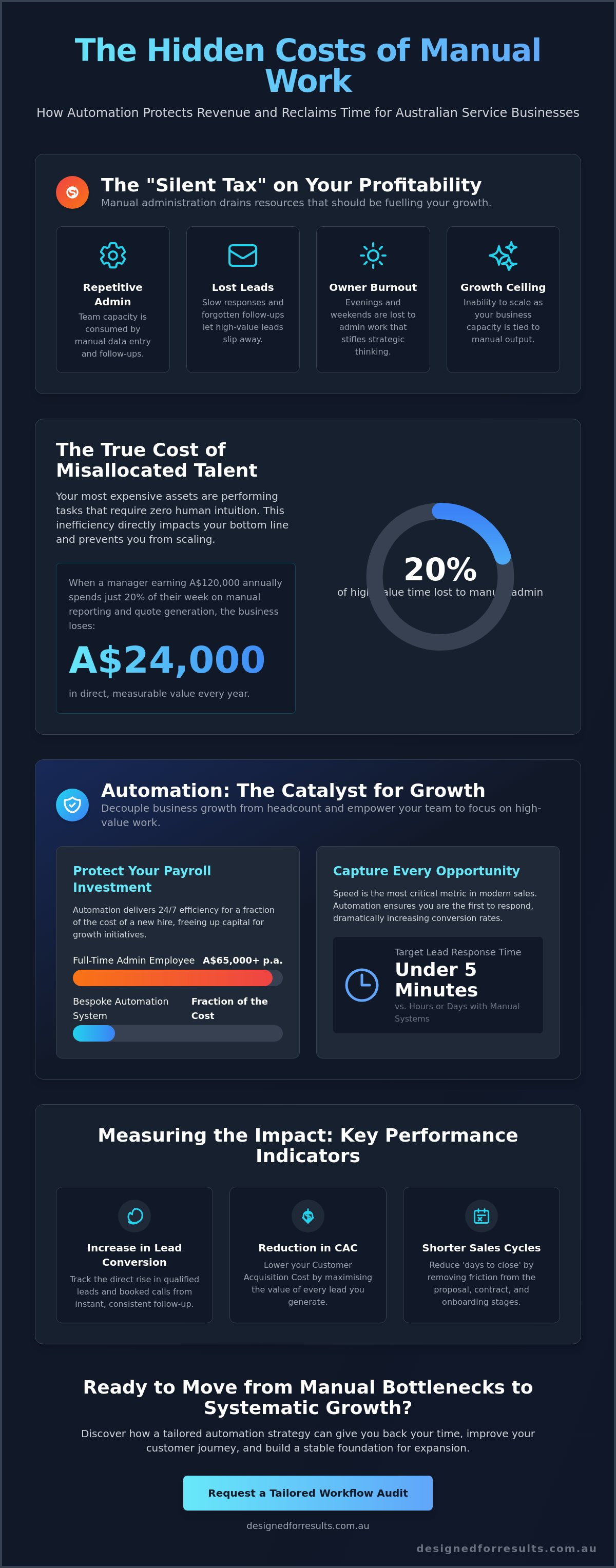
Manual administration acts as a silent tax on your profitability. While many Australian business owners view administrative tasks as a necessary part of the day, these manual workflows represent a significant drain on resources that could be allocated to growth. You must identify the specific hours your team spends on repetitive data entry, lead follow-up, and manual scheduling to see the true impact on your bottom line. When a manager earning A$120,000 annually spends 20% of their week on manual reporting or quote generation, the business loses A$24,000 in direct value every year. This is the opportunity cost of misallocated talent.
Your most expensive assets are currently performing tasks that require zero human intuition. This inefficiency prevents you from scaling because your capacity is tethered to your manual output. Business process automation provides a way to decouple growth from headcount, ensuring your payroll investment yields the highest possible return. Documenting the impact of manual errors is equally vital. A single typo in a quote or a forgotten contract attachment can damage your reputation and cost you repeat business. These mistakes are the inevitable result of asking humans to perform like machines.
The Price of the After-Hours Admin Burden
Working on admin during evenings is a common symptom of a business that has outgrown its manual systems. This burden leads to chronic burnout and a measurable decline in decision-making quality. Processing invoices at 8:00 PM reduces the mental clarity required for long-term planning. Manual bottlenecks also create a ceiling on your revenue. You can only accept new contracts if your current administrative load allows for the extra work. Staff morale suffers when talented employees are trapped in tedious, repetitive cycles, often leading to higher turnover and recruitment costs.
Mapping the Revenue Leakage in Your Sales Pipeline
Speed to lead is the most critical metric for modern Australian service businesses. If a prospect submits an enquiry and waits hours or days for a response, the likelihood of conversion drops significantly. You are paying for lead generation while losing the revenue through slow execution. Manual follow-up systems fail as volume increases, resulting in unquoted leads and forgotten tasks. Understanding how to implement business automation in a small business australia allows you to capture every enquiry instantly, ensuring no potential profit is left on the table due to human oversight or delay. If you want to identify where your specific leaks are occurring, you can book a consultation to review your current workflow.
Constructing a Data-Driven Business Case for Automation
Securing management buy-in requires a departure from technical specifications in favour of quantifiable fiscal impact. When considering digital tools for business, leaders prioritise outcomes that directly influence the balance sheet. A primary objective should be reducing lead response times to under five minutes. Research indicates that speed to lead is a major determinant of conversion; businesses that respond within this window are significantly more likely to qualify a prospect. By establishing these clear benchmarks, you turn a technical proposal into a performance-driven mandate.
Presenting a projected ROI based on reclaimed staff hours is the most effective way to justify the investment. In the Australian market, the cost of hiring an additional administrative employee often exceeds A$65,000 annually when factoring in superannuation and overheads. Implementing bespoke AI automation represents a fraction of that cost while operating 24/7 without fatigue. Intelligent systems, such as automated quote calculators or AI chatbots, capture and qualify leads with a level of consistency that manual processes cannot match. This allows your existing team to focus on closing deals rather than managing data entry. Understanding how to implement business automation in a small business australia requires this shift toward viewing technology as a high-yield asset.
Selecting Key Performance Indicators for Success
Leadership teams resonate with metrics that impact the Customer Acquisition Cost (CAC). Measure how automation reduces the days to close for new sales opportunities by removing friction from the contract and proposal stage. Track the increase in lead-to-booked-call conversion rates as a direct result of automated follow-up sequences. These metrics provide the empirical evidence needed to prove that automation functions as a revenue generator. Reliable data helps transition the conversation from a perceived expense to a necessary operational upgrade.
Presenting the Long-Term Fiscal Benefits
Automation facilitates scalable growth without the traditional requirement for proportional increases in overhead. Real-time pipeline visibility through a sales dashboard allows for accurate financial forecasting, replacing guesswork with data-driven projections. Automated document collection speeds up project commencement by eliminating the back-and-forth typical of manual onboarding. This structural methodology ensures that your Australian business remains agile and profitable as lead volumes increase. Systematic progress replaces uncoordinated growth, providing a stable foundation for expansion. If you want to see how these systems integrate into your current setup, you can request a tailored workflow audit.
Overcoming Common Management Objections and Risk Concerns
Resistance to change often stems from the belief that existing manual processes are sufficient. However, the rising cost of labour and the increasing speed of the Australian market make stagnation a measurable risk. With Australian IT spending forecasted to exceed A$172.3 billion in 2026, competitors are already investing in efficiency. Transitioning to automated systems is a requirement for maintaining a competitive edge in a service-based economy. Modern no-code solutions allow for rapid deployment, enabling your business to modernise without the need for deep technical expertise.
Data security remains a primary concern for leadership, especially with the 1988 Privacy Act reforms introducing stricter obligations for automated decision-making by December 2026. Maintaining CRM integrity during a transition is a priority. Small businesses account for 43% of reported cybercrime in Australia, with the average cost of an incident reaching A$46,000. Implementing systematic automation improves security by reducing human error, which is a leading cause of data breaches. These systems support your team by handling the high-volume, low-value drudge work that leads to burnout. Staff can focus on high-level strategy and client relationships, which are the true drivers of revenue.
Mitigating the Fear of Operational Disruption
Proving value early is the most effective way to quieten concerns about operational downtime. Adopting a phased approach allows you to start with a single, high-impact workflow, such as automated lead follow-up or document collection. This demonstrates immediate ROI without overhaul fatigue. External consultants provide the necessary oversight to ensure a smooth transition, mapping out exactly how to implement business automation in a small business australia while maintaining daily operations. For unique requirements, the process of bespoke AI automation ensures that the technology aligns with your specific service delivery model.
Justifying the Financial Investment
Shifting the internal conversation from software expenses to operational asset development is essential for securing budget. Implementation represents a one-time investment in your business's infrastructure, while monthly managed service retainers ensure the systems remain optimised and secure. These assets operate without the need for office space, superannuation, or payroll tax. High-performance smart AI solutions pay for themselves through increased lead capture and the elimination of missed opportunities. This structural methodology provides the clarity needed to view automation as a catalyst for long-term fiscal health.
Developing a Phased Implementation Roadmap to Minimise Disruption
Successful execution requires a structured sequence that avoids overwhelming your existing operations. Begin with a comprehensive audit of your current processes to isolate the most significant time-wasters. This initial step provides the clarity needed to understand how to implement business automation in a small business australia without causing operational friction. Select a pilot project to serve as a proof of concept. Low-risk, high-reward automations, such as automated lead magnets or appointment reminders, demonstrate immediate value to both management and staff. Establish a clear timeline for the design, development, and deployment phases to maintain momentum and manage expectations. Assigning internal champions, specifically team members who understand the operational benefits, ensures a smooth feedback loop and encourages wider adoption. Finally, review performance data after the first 30 days to validate the business case and prepare for broader scaling.
The Audit: Identifying the Low-Hanging Fruit
Focus your audit on repetitive tasks that consume disproportionate amounts of time. Look for manual workflows like contract generation, feedback collection, and lead segmentation. Prioritise processes that directly impact the customer journey and revenue generation. Many manual steps in your current sales cycle can be eliminated through a professional CRM implementation. This centralises your data and provides the foundation for more advanced automations. By identifying these high-impact areas first, you ensure that your initial investment yields the most significant return in reclaimed capacity.
Training and Onboarding for Maximum Adoption
Resistance to new technology usually stems from a lack of clarity. Design simple internal approval workflows to ensure management retains control over automated outputs. Provide concise training sessions that focus exclusively on how these tools give staff their time back. For example, implementing AI voice agents for small business can handle initial enquiries, allowing your team to focus on high-value consultations. This shift in responsibility reinforces the idea that automation is a supportive asset rather than a replacement for human expertise. Systematic training ensures your team feels confident using these systems to improve their daily output. To begin mapping your specific implementation path, you can book a workflow audit to identify your highest-value opportunities.
Partnering with Automation Experts for Guaranteed Operational Outcomes
Technical execution requires a level of precision that internal teams often lack the capacity to maintain. While the phased roadmap provides the necessary structure, partnering with external experts reduces the risk of expensive implementation errors. DIY attempts frequently result in fragmented systems that fail to communicate, which adds to the administrative burden. A professional AI automation agency Australia provides the technical oversight required to ensure every workflow integrates seamlessly with your existing CRM and sales processes. This expertise is vital when navigating local compliance and evolving data standards.
Custom roadmaps tailored to Australian business needs ensure that technology serves your specific operational goals. Professional automation acts as the catalyst for disciplined, planned growth by replacing manual bottlenecks with scalable, systematic processes. Ongoing monitoring and optimisation are essential components of this partnership. Systems require regular adjustment to maintain peak performance as lead volumes fluctuate and new digital tools emerge. This proactive management ensures your business remains agile.
Why SMEs Benefit from Managed Automation Services
Managed services provide a layer of operational security. These services cover technical updates and provide detailed performance reporting, allowing you to see the exact ROI of your automated workflows. A trusted advisor identifies new efficiency gaps as your business evolves. Understanding how to implement business automation in a small business australia is a continuous process of refinement. This support ensures that your lead capture and follow-up sequences continue to drive revenue while you focus on high-level executive leadership.
Next Steps: Securing Your Strategy Session
Leadership teams are invited to a consultation to see a demonstration of successful systems in action. You can learn more about our results-oriented approach on our about us page. This session provides the opportunity to review your specific workflows and identify the highest-impact areas for immediate automation. Disciplined planning is the only reliable path to reclaiming your time. You can book an automation strategy call to begin the process.
Transitioning from Manual Burden to Systematic Scalability
Securing management approval for automation depends on your ability to present a case rooted in operational performance rather than technical novelty. By quantifying the "admin tax" currently draining your resources and presenting a phased roadmap, you demonstrate a disciplined approach to growth. Understanding how to implement business automation in a small business australia allows you to replace manual bottlenecks with systems that capture every lead and protect your team's capacity. You've seen that success is a product of deliberate planning; now is the time to execute that plan.
As specialists in Australian SME automation, we focus on lead capture and time reclamation through no-nonsense, jargon-free implementation. Our approach ensures your transition is smooth and your ROI is measurable. You can book your free automation strategy call today to identify your highest-impact efficiency gaps and see exactly how these systems integrate with your existing workflows. Establishing systematic progress is the most reliable way to secure your business's future in an increasingly competitive market. You have the roadmap; we have the expertise to help you follow it.
Frequently Asked Questions
How long does it typically take to see a return on investment from automation?
ROI typically manifests within three to six months following the initial deployment phase. This timeline depends on your lead volume and the complexity of the automated workflows. You'll measure success through reclaimed staff hours and an immediate reduction in missed sales opportunities. Most Australian businesses find that the system pays for itself once it captures just a few high-value leads that would have otherwise been lost to slow follow-up.
What if our business processes are too unique for standard automation tools?
Bespoke automation handles unique operational requirements that off-the-shelf tools cannot address. Custom logic allows you to mirror your specific service delivery model while maintaining structural methodology. This ensures that even highly specialised Australian businesses benefit from systematic efficiency without compromising their unique value proposition. Professional implementation focuses on adapting the technology to your business rather than forcing your business to fit the tool.
Do we need a dedicated IT person to manage these new automated workflows?
You don't need a dedicated IT employee to manage these systems. Modern automation platforms and managed service providers handle the technical maintenance, security updates, and performance monitoring. This allows your team to focus on high-level strategy and client service rather than troubleshooting software integrations. Managed services ensure your workflows remain optimised as your business grows.
Can automation really help a small business with fewer than ten employees?
Automation is exceptionally effective for businesses with fewer than ten employees because it acts as a force multiplier. When your team is small, every hour lost to admin tasks directly impacts your ability to scale. Learning how to implement business automation in a small business australia allows you to handle significant enquiry volumes without increasing your headcount. It provides the operational capacity of a much larger team without the associated payroll costs.
What are the most common mistakes businesses make when trying to get buy-in?
The most frequent mistake is presenting automation as a technical upgrade rather than a business case for reclaimed revenue. Management often rejects proposals that lack quantifiable ROI or clear links to customer acquisition costs. You must shift the focus toward how these systems solve specific pain points like lead leakage and after-hours admin work. Focus on fiscal outcomes to secure executive approval.
How do we ensure our team does not feel threatened by the introduction of AI?
Transparent communication regarding the purpose of the technology prevents staff from feeling threatened. Position AI as a supportive asset that eliminates the tedious, repetitive drudgery of their roles. When employees see that automation gives them their time back for high-value work and reduces evening admin, adoption rates increase naturally. It's about augmenting human talent rather than replacing it.
Is it better to automate everything at once or take a gradual approach?
A phased implementation roadmap is the most reliable way to minimise operational disruption. Starting with a single high-impact workflow, such as automated lead follow-up, provides a proof of concept. This gradual approach allows you to refine your systems based on performance data before scaling to other areas of the business. It ensures the team isn't overwhelmed by too much change at once.
How much time will management need to invest in the implementation phase?
Management needs to invest approximately five to ten hours during the initial audit and design phase to define objectives and approval workflows. Once the system is deployed, your involvement shifts to reviewing monthly performance reports. This initial time investment pays for itself through hundreds of reclaimed hours across the financial year. The goal is to move you away from daily technical tasks toward high-level leadership.
