
How to Stop Being the Bottleneck in Your Business: A 2026 Guide for Australian SMEs

Your business isn't stalling because of the 4.35% cash rate or rising operating costs; it's stalling because every critical process requires your personal sign-off. It's a common frustration for the 2.7 million Australian business owners who find themselves trapped in a cycle of evening admin and manual data entry. You likely feel that the entire operation would collapse if you stepped away for a single week. Learning how to stop being the bottleneck in my business is the only way to move beyond this plateau and achieve sustainable growth.
It's exhausting to lose leads to slow follow-up times while you're buried in manual contract generation. You deserve a business that functions with precision; one where automation handles the repetitive tasks that currently consume your day. This guide provides a clear method for identifying owner-dependent friction points and replacing them with automated workflows. We will explore how to reclaim 10 or more hours per week by deploying lead follow-up systems and automated onboarding. You'll gain the clarity needed to transform your role from a daily operator into a focused leader who manages outcomes rather than tasks.
Understanding the Owner Bottleneck in Australian Businesses
A business bottleneck occurs when a specific stage in a process lacks the capacity to handle the volume of work required. In the context of an Australian business, this capacity limit is almost always the owner's personal time and decision-making bandwidth. If lead response times exceed 24 hours or administrative tasks overflow into your weekends, you have reached a structural limit. Every manual approval step represents a potential delay for your customers, creating friction that prevents the business from scaling. Understanding how to stop being the bottleneck in my business requires a shift from personal effort to system architecture.
The Cost of Manual Intervention
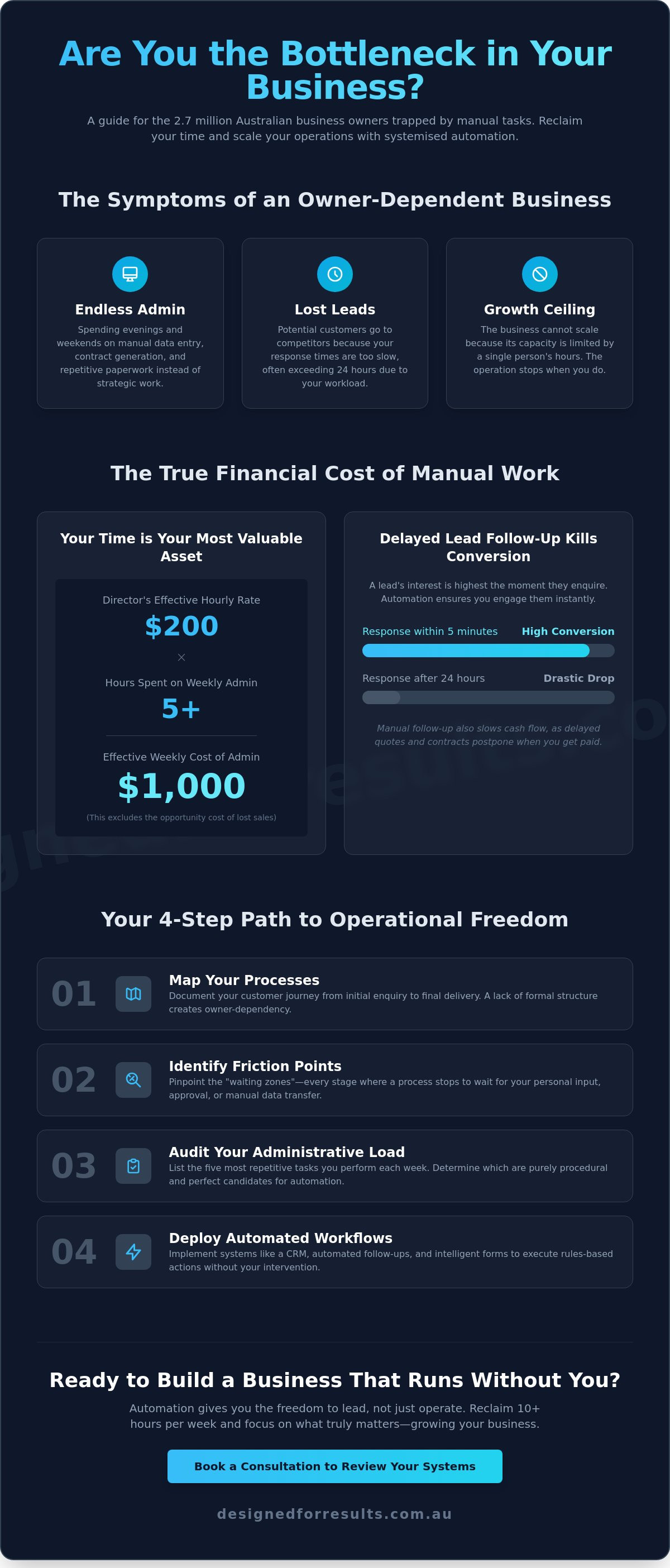
Calculate the hourly value of your time against the administrative tasks you currently perform. If your effective hourly rate as a director is $200, yet you spend five hours a week on manual data entry or contract generation, you are effectively paying $1,000 a week for basic admin. This figure does not include the opportunity cost of lost sales. Delayed lead follow-ups directly impact your conversion rates; a lead that waits 24 hours for a response is significantly less likely to convert than one addressed within minutes. Manual document handling also slows down your cash flow, as delayed invoices and contracts postpone the moment funds enter your account. (Theory of Constraints)
Why Hiring More Staff Is Not Always the Solution
Increasing headcount often adds a new layer of management responsibility to your plate. Every new employee requires training, oversight, and ongoing communication, which can paradoxically reduce your available time. Consider the financial overhead of staff, including the 12% Superannuation Guarantee and the upcoming administrative shift to Payday Super in July 2026. Automated systems provide a level of efficiency that human staff cannot match for repetitive tasks. These systems operate without fatigue or the need for direct supervision, allowing you to scale operations without a proportional increase in management burden.
Mapping Your Processes to Reveal Hidden Friction
Documenting every step of your customer journey, from the initial enquiry to final delivery, is the first step toward operational freedom. Many Australian business owners operate on instinct, yet this lack of formal structure is precisely what creates owner-dependency. When you map these steps, you can clearly see where a process stops to wait for your input or approval. These pauses are the primary reason you find yourself searching for ways on how to stop being the bottleneck in my business. Quantifying the time spent on repetitive data entry across different software platforms reveals the true cost of your current manual methods.
Identify the specific tasks that keep you at your desk after standard business hours. Often, these are not high-level strategic decisions but rather procedural chores like drafting contracts or chasing lead information. Use these insights to prioritise which workflows require immediate attention. A business that relies on the owner's constant presence cannot scale because its growth is limited by a single person's hours. By visualising the flow of work, you move from reactive management to deliberate system design.
Visualising the Customer Journey
Create a simple flowchart showing how a lead moves through your sales pipeline. Mark the "waiting zones" where clients are currently stalled by manual processes, such as waiting for a quote or a booking confirmation. Identify the specific data points that need to move between your website, CRM, and accounting software, such as Xero. In 2026, standard Xero plans for Australian businesses are approximately $65 per month, yet many owners fail to utilise the automated data connections available. Bridging these gaps ensures information flows without manual intervention.
Auditing Your Administrative Load
List the five most repetitive tasks you perform every week without fail. Determine which of these tasks require your specific expertise and which are purely procedural. Many tasks currently on your plate are better suited for workflow automation, which executes rules-based actions without error. To delegate effectively, you must first define the process so it can be handled by a system rather than a person. Categorise your tasks by their potential for automation to see where you can reclaim the most time. If you are ready to identify the friction points in your specific operation, you can book a consultation to review your current systems.
Focusing on procedural clarity allows you to see the business as a series of connected systems. This perspective is essential for any owner who feels the business stops when they take a break. Once you have documented the friction, you can begin the work of deploying technology to handle the load.
Transitioning from Manual Oversight to Automated Workflows
Implement a robust CRM to establish a single source of truth for all business data. This centralisation eliminates the need for you to hunt through emails or spreadsheets for client information. Automated lead follow-up sequences engage new enquiries the moment they arrive, ensuring your business remains responsive while you focus on high-level management. Using lead generation systems allows you to qualify prospects before they ever reach your inbox. This filter ensures your time is only spent on high-value interactions that require your specific expertise.
Automate the collection of client documents and information through intelligent web forms. This step removes the manual back-and-forth that often delays project starts. Effective systems move data directly from the form into your CRM, updating records without manual intervention. This is a fundamental shift in how to stop being the bottleneck in my business, as it replaces your oversight with reliable logic. By removing yourself from the data-gathering phase, you accelerate the entire customer journey.
Eliminating Document and Contract Friction
Deploy automated contract generation that pulls data directly from your CRM deals. This removes the need for manual drafting and significantly reduces the risk of clerical errors. Digital signature platforms facilitate immediate execution, removing the need for printing, scanning, or emailing. Internal approval workflows trigger automatically when specific criteria are met, allowing the process to move forward without your constant sign-off. These systems ensure that contracts are sent and signed while the lead is still highly engaged.
Connecting Your Business Ecosystem
Integrate your CRM with Xero to automate invoicing and payment tracking. This connection ensures your financial records update in real-time as deals close, which is vital for managing cash flow under current economic pressures. Link your appointment booking system to your calendar with automated reminders and reschedules to reduce administrative friction. Ensuring data flows seamlessly between platforms eliminates double-handling and manual entry errors. This connectivity allows you to reclaim hours previously lost to repetitive tasks, providing the freedom to focus on scaling the business.
Deploying AI Agents to Handle Routine Decision-Making
Deploying AI agents moves beyond simple rule-based automation by introducing systems capable of handling routine decision-making. Recent data indicates that 40% of Australian SMEs have already adopted AI agents to manage workflows and improve efficiency. These tools act as functional team members, qualifying leads on your website and booking appointments 24/7 without your intervention. This shift is a critical component of how to stop being the bottleneck in my business, as it ensures the operation continues to move while you are offline or focused on high-level strategy.
Implementing AI voice agents allows your business to handle initial phone enquiries and routine client questions with professional consistency. These agents engage in natural dialogue to resolve queries or route calls based on intent, ensuring prospects receive immediate attention. You can also use AI to transcribe and summarise client calls, which then automatically creates follow-up tasks in your CRM. This level of integration removes the administrative burden of manual note-taking and ensures no detail is lost during the transition from lead to client.
Apply smart AI solutions to sort and prioritise support tickets based on urgency and sentiment. This ensures that critical issues are addressed immediately while routine requests are handled by automated systems. By delegating these functional roles to AI, you eliminate the need for constant manual oversight and reduce the mental load of daily operations.
AI as a Virtual Gatekeeper
Configure AI assistants to answer frequently asked questions without involving your team. These systems provide immediate value to prospects, delivering lead magnets and nurturing leads through automated sequences. This approach ensures your speed to lead is instantaneous, capturing interest before a competitor has a chance to respond. You can then step in only when the prospect is fully qualified and ready for a high-value closing conversation, preserving your time for the most impactful work.
Enhancing the Customer Journey with Intelligence
Personalise email campaigns triggered by specific client behaviours or milestones to maintain engagement without manual effort. Use automated review requests to manage your Google Business reputation, ensuring a steady stream of feedback that builds social proof. Online calculators provide instant quotes by processing complex data behind the scenes, giving potential clients immediate answers while you focus on delivery. If you are ready to see these systems in action, arrange a consultation to discuss your specific requirements.
Structuring Your Business for Independent Operation
Transitioning from a daily operator to a strategic leader requires a fundamental shift in focus. You must move your attention toward high-level business development and oversight, leaving the execution of routine tasks to your established architecture. Maintaining these systems through managed service retainers ensures your workflows stay optimised as the business grows. This long-term approach prevents the re-emergence of friction points that once slowed your progress. Achieving a state where you understand how to stop being the bottleneck in my business means trusting the systems you have built to perform without constant manual intervention.
Review your sales dashboard regularly to maintain real-time visibility into your pipeline. This data-driven approach allows you to monitor performance and identify trends without requesting manual reports from staff. It creates a culture where systems provide the answers to operational questions, ensuring consistency across every client interaction. By relying on objective metrics rather than verbal updates, you maintain control while remaining removed from the micro-management of individual deals. This clarity is essential for making informed decisions about future investments and resource allocation.
Maintaining System Integrity
Schedule quarterly audits of your automated workflows to identify and resolve new friction points. Business needs evolve as you introduce new services or target different audience segments, requiring your automation roadmap to adapt accordingly. Ensure your team receives ongoing training to use the CRM as the primary tool for all client communications. Keeping data centralised prevents information silos and ensures that every team member can provide high-level service without your direct involvement. Consistent system maintenance protects your investment and preserves the time you have reclaimed for high-value leadership tasks.
The Path to Scalable Growth
Evaluate the increase in your business capacity since removing yourself as the primary bottleneck. With manual tasks handled by automation and AI, you can pursue expansion opportunities that were previously impossible due to time constraints. Scaling no longer requires a proportional increase in your personal workload or a massive jump in headcount. You can focus on high-value partnerships and market positioning while the core operation runs smoothly in the background. Take the next step by booking an automation strategy call to finalise your implementation plan and secure your business's future.
Reclaiming Your Leadership Through System Architecture
Scaling an Australian business in 2026 requires more than just hard work; it demands a transition from owner-dependency to a self-sustaining system. You have identified the friction points and explored how automation and AI agents can handle the routine decision-making that currently keeps you at your desk late into the evening. Understanding how to stop being the bottleneck in my business is not a one-time event but a commitment to building a structure that operates independently of your constant input. By deploying bespoke AI and no-code workflow solutions, you ensure that lead follow-up and administrative tasks proceed with precision regardless of your schedule.
Designed For Results are specialists in Australian SME automation who focus on delivering measurable outcomes without the jargon. We provide the technical expertise needed to transform your operations into a high-performance system. Book your free automation strategy call with Designed For Results to finalise your path toward operational freedom. Your business is ready to grow; it's time to provide it with the architecture to do so.
Frequently Asked Questions
How do I know if I am the bottleneck in my business?
You are the bottleneck if the business stops operating effectively when you take a break or if lead response times exceed 24 hours. Look for specific "waiting zones" in your process map where tasks pause for your personal approval or manual data entry. If administrative chores keep you at your desk during evenings, you have reached a capacity limit that prevents further growth. Identifying these friction points is the first step in learning how to stop being the bottleneck in my business.
Can automation really replace the need for a new staff member?
Automation handles repetitive, rules-based tasks such as lead follow-up, document collection, and data entry more efficiently than a human employee. While it doesn't replace high-level strategy, it removes the administrative burden that typically prompts a new hire. This approach allows you to scale operations without increasing your management responsibility or the financial overhead of the 12% Superannuation Guarantee. Systems provide consistent performance without the training and oversight requirements of additional staff.
Is AI too expensive for a small Australian business?
AI is highly accessible for Australian businesses in 2026 with entry-level plans starting at manageable price points. For example, Google Gemini Business costs approximately $35 AUD per user per month; while Microsoft 365 Copilot is around $65 AUD per user per month. These tools provide significant returns by automating routine decision-making and client engagement. You can start with basic workflow automation and scale into more complex AI agents as your revenue and requirements grow.
How long does it take to see results from workflow automation?
Operational improvements are often immediate once an automated workflow is live. You can reclaim ten or more hours in the first week by automating lead capture and contract generation. While full system integration and team training may take several weeks to mature; the reduction in manual oversight provides instant relief for time-strapped owners. This rapid return on investment allows you to quickly shift your focus from daily chores to high-level leadership.
What happens if an automated system makes a mistake with a client?
Automated systems are significantly more reliable than manual entry because they follow strict logic and pre-defined rules. You can include internal approval workflows that act as a safety net for critical documents or high-value quotes. These triggers ensure you maintain oversight of sensitive interactions while the system handles the heavy lifting. This structured approach reduces clerical errors and ensures your business maintains a professional standard across every customer journey.
Do I need to be a technical expert to implement these systems?
Technical expertise is not a requirement for the business owner. Professional implementation services handle the system architecture, CRM integration, and AI configuration on your behalf. Your role is to define the desired outcomes and provide the procedural knowledge of your business. This allows you to focus on strategic leadership while specialists deploy the technical solutions needed to stop being the bottleneck in my business through robust system design.
Will my clients miss the personal touch if I automate my follow-ups?
Clients prioritise speed and accuracy when they first enquire with a business. Automation ensures they receive an instant response and relevant information while your competitors are still checking their inboxes. You preserve your personal touch for high-value conversations that require human empathy and complex problem-solving. By automating the initial "speed to lead" engagement, you provide a better customer journey that reflects a modern and professional operation.
What is the first process I should automate to save the most time?
Automating lead follow-up and appointment booking usually yields the highest immediate return on time. This process removes the need for manual outreach and eliminates the back-and-forth of scheduling meetings. Integrating your website forms with a CRM ensures every prospect is captured and nurtured without your intervention. Starting with lead management provides a clear pathway to increased revenue and reclaimed time, establishing a foundation for further business automation.
