
Systems to Reduce Key Person Dependency: A 2026 Guide for Australian Businesses

Relying on a single team member for critical operations can slash your business valuation by up to 25% when it comes time to exit. You likely started your Australian business to build a valuable asset, yet you often find yourself completing administrative tasks on a Sunday evening because you're the only one who understands the process. It's a common bottleneck where growth stalls because every lead follow up or complex quote requires your direct intervention. Establishing systems to reduce key person dependency is the only way to ensure your business doesn't stop if a specific staff member leaves.
True freedom comes from moving knowledge out of human memory and into automated execution. This guide details how to transition to a system-led operation that functions with precision regardless of who is in the office. You'll learn how to build a business that operates predictably on autopilot, improving the customer journey through consistent workflows. We'll explore how automation gives you your time back while increasing the tangible value of your business through deliberate operational planning.
The Hidden Risk of Key Person Dependency in Australian Businesses
Growth in Australian businesses often creates a dangerous paradox. As revenue climbs, the reliance on the owner or a single senior manager frequently intensifies. This vulnerability, often referred to as What is Key Person Dependency?, describes a scenario where critical knowledge and client relationships reside solely in one individual’s head. Without that person, the business cannot fulfil its promises or maintain its reputation. This dependency is a structural flaw that threatens long-term viability and limits your ability to scale effectively.
In the rapid scaling phase, Australian SMEs prioritise speed over structure. Owners frequently step in to troubleshoot technical issues or manually follow up on quotes to ensure nothing falls through the cracks. While this solves the immediate problem, it creates a culture of individual heroics rather than a culture of systems. The emotional toll on the owner is significant. You find yourself tethered to your laptop during family holidays or working on admin during evenings because the team lacks the clear workflows required to function independently. This constant pressure leads to burnout and prevents you from focusing on high-level leadership and market expansion.
The Valuation Ceiling for Owner-Dependent Businesses
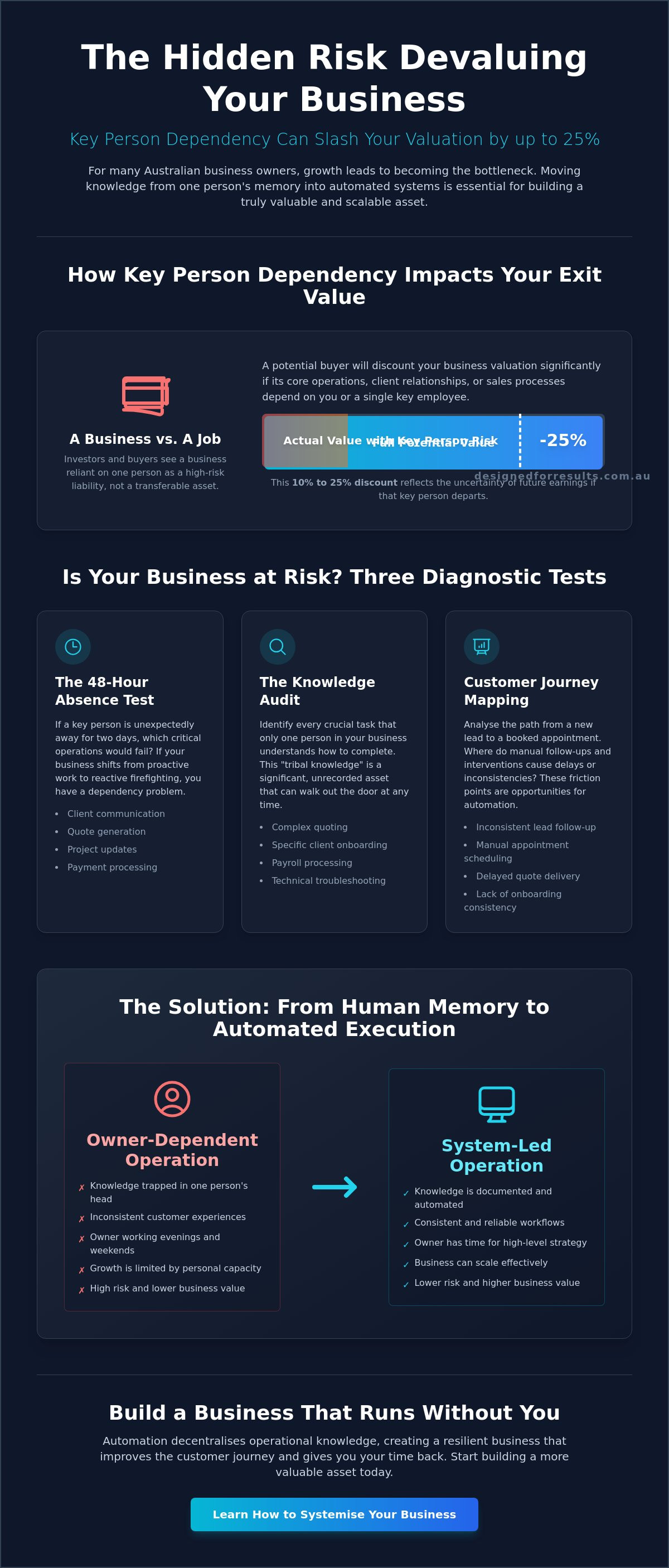
Investors and potential buyers view owner-dependency as a high-risk liability. When an Australian business relies on the owner to close every sale or manage every complex project, it's a job rather than a transferable asset. Current data indicates that key person risk can lead to a discount of 10% to 25% on a business's valuation. This discount reflects the uncertainty of future earnings if the key individual departs. Implementing systems to reduce key person dependency transforms these intangible risks into documented, repeatable processes that exist independently of any one person, making the business far more attractive to acquirers.
Operational Bottlenecks in Service-Based Sectors
Service-based sectors like professional services and trades are particularly susceptible to knowledge silos. Information remains trapped in private email threads or personal notes, making it impossible for other team members to step in during an absence. When you are forced to handle repetitive administrative tasks after hours, it's a clear indicator of a systemic failure. These bottlenecks prevent you from scaling because your personal capacity becomes the hard limit for the entire organisation. With payroll and wages being the primary cost pressure for Australian SMEs in 2026, efficient resource allocation is vital. Transitioning to bespoke AI automation allows you to capture this tribal knowledge and turn it into an automated workflow that delivers consistent results without your constant supervision.
Identifying Single Points of Failure in Your Operations
Operational resilience requires a clinical assessment of where your business relies on individual memory rather than documented logic. You must conduct a knowledge audit to isolate every task that only one person understands. In many Australian businesses, critical functions like payroll processing, complex quote generation, or specific client onboarding steps exist only as unwritten tribal knowledge. This creates a precarious environment where a single resignation or unexpected leave can halt production. Identifying these single points of failure is the first stage in implementing systems to reduce key person dependency.
Review your sales pipeline for "black holes" where lead follow up depends entirely on a staff member's memory or a handwritten notebook. If your team relies on verbal go-aheads or physical signatures for internal approvals, you've built a bottleneck that restricts growth. With a projected shortfall of over 370,000 digitally skilled workers in Australia by 2026, you cannot afford to leave your intellectual property trapped in the minds of a few individuals. Transitioning these unwritten rules into a bespoke AI automation ensures your business logic remains an asset you own, not a liability tied to an employee.
The 48-Hour Absence Test
Perform a mental exercise to identify which processes break first if a key person is away for 48 hours without notice. List the systems required for daily continuity, such as client communication, project management updates, and payment processing. Most owners find that urgent firefighting replaces systemic operation within hours. This test highlights the difference between a business that functions and one that merely reacts. If your business cannot survive a two-day absence of its leader, it isn't yet an independent asset.
Mapping the Customer Journey for Consistency
Examine the transition from lead capture to a booked appointment. Manual intervention at this stage creates delays that kill your speed-to-lead, often resulting in lost revenue as prospects move to more responsive competitors. You should focus on business process mapping to visualise every touchpoint. By identifying where manual follow ups cause friction, you can replace human effort with automated sequences. This ensures a consistent customer journey that operates with precision, regardless of who is in the office. This level of clarity is essential for any Australian business aiming to reclaim time and improve its bottom line.
Essential Automation Systems to Decentralise Knowledge
Manual documentation often fails because it requires human discipline to update and follow. Automation removes this friction. By embedding operational logic directly into your software, you ensure systems to reduce key person dependency are active 24/7 without constant supervision. Centralising client data within a unified platform eliminates the risk of a "digital rolodex" where one staff member holds the only key to a customer relationship. This structural shift ensures that the business owns its data, rather than merely renting it from employees.
Automated lead follow up sequences prevent enquiries from falling through the cracks during busy periods. These systems act as a digital safety net, maintaining speed to lead without manual intervention. You should also deploy automated document collection for contracts and proposals. This removes the repetitive administrative burden from senior staff and ensures that internal approval workflows trigger automatically based on specific deal data. When the logic is built into the system, the need for a specific person's verbal go-ahead disappears.
The CRM as the Central Source of Truth
Effective CRM implementation removes client history from private email inboxes and moves it into a shared environment. This provides real-time pipeline visibility for the entire team, allowing any qualified member to step in and manage an account without a verbal briefing. Sophisticated segmentation enables behaviour-triggered campaigns, ensuring your marketing continues even when the sales manager is unavailable. This transparency is vital for maintaining a consistent customer journey as you scale.
Workflow Automation for Repetitive Admin
Identify high-volume, low-value tasks like data entry, meeting scheduling, and basic reporting. Utilising no-code tools to bridge gaps between existing software allows for seamless data flow without manual handling. Automated quote systems are particularly effective in service sectors. They allow junior staff or website visitors to generate accurate estimates based on predefined logic, reducing the technical load on your most expensive personnel. These systems ensure that expert knowledge is available to the whole organisation at all times.
Recent data from January 2026 shows that 79% of Australian SMBs using AI report productivity gains. This suggests that the competitive advantage is no longer just about having the technology, but how effectively you integrate it into your daily operations. By automating repetitive admin, you give your team the capacity to focus on high-value client interactions, directly contributing to increased revenue and a more resilient business structure.
Leveraging AI and Voice Agents to Ensure Continuity
While basic automation follows predefined rules, AI provides the adaptability required to handle nuanced human interactions. As of January 2026, 69% of Australian SMBs have adopted AI to streamline their operations and protect against internal disruptions. This technology allows you to build systems to reduce key person dependency by delegating complex communication and data retrieval to intelligent agents. These agents function as a permanent repository of your business logic, ensuring that high-level operational knowledge remains accessible even if a key staff member is absent.
AI-assisted phone systems capture critical data that often vanishes after a call ends. These systems record and transcribe client conversations, automatically triggering follow up tasks in your CRM based on the verbal commitments made. This captures the tribal knowledge often lost in unrecorded calls. AI chatbots provide lead qualification 24/7, ensuring your sales pipeline remains active without requiring a human to monitor website enquiries at all hours. These tools ensure your business maintains a professional presence and continues to generate revenue regardless of staff availability.
AI Voice Agents: The 24/7 Digital Receptionist
AI voice agents manage high-volume enquiries and appointment booking with human-like precision. They handle the initial qualification of leads, ensuring your senior team only spends time on high-value conversations. These agents also reduce no-shows by executing automated reminders and handling reschedules through natural voice interaction. For most Australian businesses, deploying a voice agent provides the coverage of a full-time receptionist without the associated payroll and compliance costs. This scalability allows you to grow your enquiry volume without being limited by your current headcount.
Decentralising Knowledge with AI Assistants
Internal knowledge retrieval is a major bottleneck in service-based businesses. New staff often rely on the owner for process guidance, which creates a cycle of constant interruption. Custom AI assistants solve this by reading your internal documentation, past quotes, and project notes to provide instant answers to team queries. When a staff member needs to know a specific procedure, they ask the AI assistant instead of the owner. This decentralises expertise and accelerates the onboarding process for new employees. You'll find that these smart AI solutions turn your company's collective experience into a searchable, interactive asset.
If you're ready to secure your operations against individual dependency, you can book a consultation to discuss your automation requirements.
Building a Scalable Model Through Systemic Automation
Scaling an Australian business doesn't require a constant increase in headcount. With payroll and wages being the primary cost pressure for SMEs in 2026, adding more staff to solve operational inefficiencies often complicates the problem instead of fixing it. You should focus on optimising existing workflows to convert human-led tasks into repeatable, digital assets. This shift allows your business to handle higher volumes of work without a proportional increase in overheads. Implementing systems to reduce key person dependency ensures that your capacity for growth is determined by your technology, not your personal stamina.
Success in this transition is measured through quantifiable metrics like lead response times and hours of manual admin removed from your schedule. A system-led approach improves the customer journey by ensuring every client receives the same high-standard experience, regardless of which team member is handling the account. This consistency builds brand equity and trust. By automating lead follow up and client onboarding, you reclaim the time necessary to focus on high-level business development and market expansion. You move from being the primary engine of the business to being its chief architect.
The Transition from Doing to Leading
Systems provide the granular data you need to make informed executive decisions. When your sales engine runs on autopilot, you gain the mental clarity to look ahead rather than constantly fixing what's behind you. This operational freedom is the hallmark of a mature business. Engaging in professional strategic consulting helps you identify the specific structural changes required to move from daily operations to high-level leadership. This professional guidance ensures your automation efforts align with your long-term financial goals.
Next Steps: Your Automation Roadmap
Effective transformation occurs through deliberate, incremental steps. You should start by identifying the most painful manual bottleneck in your current operation, such as lead follow up or contract generation. Automating one critical process at a time is more effective than attempting a total overhaul, as it allows your team to adapt without disruption. Once the first system is stable, you can move to the next priority. If you're ready to build a business that functions with precision without your constant involvement, you can book a strategy call to identify your automation opportunities. It's time to turn your business into a scalable asset that delivers results on its own terms.
Securing Your Operational Future Through Systemic Resilience
Transitioning your business from a person-dependent operation to a system-led asset is a strategic necessity for long-term survival. You've identified the single points of failure in your current workflow and explored how automation and AI decentralise critical knowledge. Moving tribal knowledge into automated execution protects your business valuation and ensures continuity regardless of staff changes. Implementing systems to reduce key person dependency is the final step in reclaiming your time and shifting your focus toward high-level leadership.
Designed For Results specialises in AI and business automation for Australian SMEs. We deliver bespoke solutions that give owners their time back by focusing on measurable ROI and operational efficiency. Our approach ensures that every aspect of your customer journey is consistent and predictable, allowing you to lead with confidence. Take the first step toward operational freedom today.
Book Your Free Automation Strategy Call
Your business has the capacity to operate with precision on autopilot.
Frequently Asked Questions
What is key person dependency in a business?
Key person dependency is the operational risk where critical knowledge, technical skills, or client relationships reside solely within one individual. If that person is unavailable, the business loses its ability to fulfil promises or maintain its reputation. It effectively creates a single point of failure that prevents the organisation from being a transferable asset.
How do I know if my business is too dependent on me?
Assess your daily involvement in low-value tasks. If you are still completing administrative work during evenings or manually following up on every lead, the dependency is too high. A business that cannot survive a 48-hour absence of its leader without operations stalling is owner-dependent rather than system-led.
Can automation actually replace the need for more staff?
Automation increases your operational capacity by handling repetitive, high-volume tasks like lead nurturing and data entry. This allows your business to grow its revenue without a proportional increase in headcount or payroll costs. By delegating manual admin to software, your current team can focus on high-value client interactions and business development.
What are the first systems I should automate to save time?
Prioritise your lead capture and follow up sequences to ensure no enquiry is missed. Moving from website forms directly to a CRM with automated segmentation provides an immediate return on investment. You should also automate repetitive document collection for contracts and proposals to remove the administrative burden from senior staff.
Is AI too expensive for a small service-based business?
Modern AI solutions provide a clear return on investment through significant time savings and improved lead conversion. Many Australian businesses start with simple workflow automation before moving to more advanced tools like AI voice agents. The cost of remaining person-dependent is often higher than the investment in scalable technology.
How does reducing key person dependency increase business value?
Investors apply a discount of 10% to 25% on valuations for businesses with high key person risk. Implementing systems to reduce key person dependency transforms your operation into a documented, repeatable asset. This transparency proves to potential buyers that the business can generate profit independently of any specific individual.
What is the difference between simple automation and AI?
Simple automation follows fixed rules to execute predictable tasks like sending a reminder email when a form is submitted. AI handles unstructured data and nuanced interactions, such as transcribing client calls or qualifying leads through natural conversation. Both are essential components of a resilient, modern business structure.
How long does it take to implement an automated workflow system?
Initial implementation for a specific bottleneck, such as an automated quote system, can often be completed within a few weeks. Transitioning to a fully system-led model is an incremental process. Each stage of the roadmap delivers immediate time savings, allowing you to reinvest that time into further operational improvements.
