
What is an AI Voice Agent? A 2026 Guide for Australian Businesses

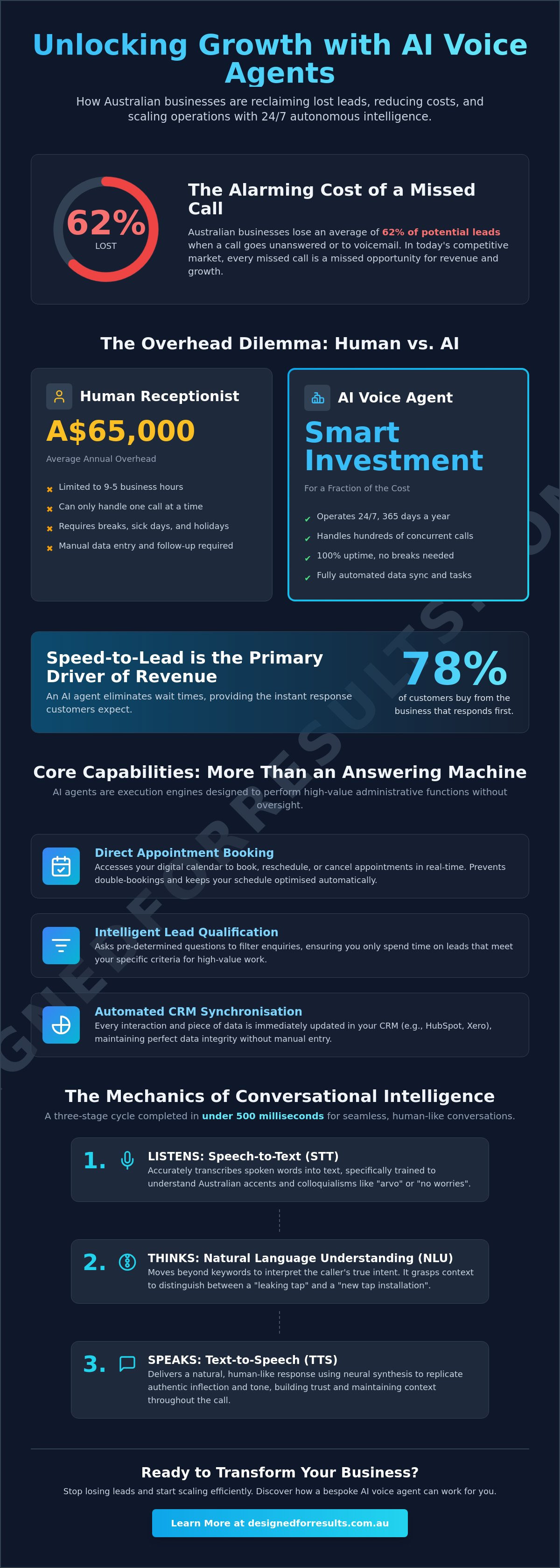
Australian businesses lose an average of 62% of potential leads when a call goes to voicemail. You've likely spent your 8:00 PM evenings returning calls because you were too busy on-site to answer the phone during the day. Understanding what is an ai voice agent is the first step toward reclaiming those lost hours and ensuring every enquiry is handled instantly. This technology functions as a digital receptionist that manages bookings and qualifies leads without the A$65,000 annual overhead of a full-time employee.
You already know that repetitive admin tasks are the primary barrier to scaling your operations. This article provides a clear explanation of how these systems work to eliminate manual phone work and return your focus to high-level leadership. We'll examine the practical differences between simple automation and true AI to help you decide which path will most effectively increase your revenue and improve your customer journey.
Defining the AI Voice Agent in a Modern Business Context
An AI voice agent is a software system designed to conduct natural, spoken conversations to execute specific business tasks. It functions as an Intelligent Agent, processing verbal input and responding with human-like accuracy. Understanding what is an ai voice agent requires looking past basic consumer tools. Unlike Siri or Alexa, which operate on simple command-based logic for personal tasks, business-grade agents manage complex professional workflows. By 2026, these systems have evolved to use Large Language Models (LLMs) that grasp context and subtle nuance. This allows an Australian business to replace manual phone administration with 24/7 autonomous intelligence. The goal is simple: remove the human bottleneck from the phone lines while maintaining a high standard of service.
These agents don't just "talk"; they execute. They operate as a digital extension of your staff, capable of handling enquiries that previously required a dedicated receptionist. For a small business owner in Australia, this means the phone is always answered, even at 2:00 am or during a busy site visit. The technology focuses on outcomes rather than just information delivery, ensuring that every call moves a customer closer to a sale or a completed service.
The Evolution of Business Voice Technology
Voice technology has moved far beyond the rigid "press one for sales" menus of legacy Interactive Voice Response (IVR) systems. Those older systems often frustrated callers and led to high abandonment rates. The 2026 standard for what is an ai voice agent involves turn-based dialogue. This means the agent listens, processes, and responds in real-time, allowing for a fluid conversation that feels indistinguishable from a human interaction.
This shift has a direct impact on the Australian service sector. Research from 2025 shows that 78% of customers buy from the business that responds first. In a competitive local market, speed-to-lead is the primary driver of revenue. An AI agent eliminates wait times entirely. It provides instant gratification for the caller and ensures the business never misses a high-value opportunity because the owner was on another call or driving between jobs.
Core Capabilities of a Voice Agent
Modern voice agents perform high-level administrative functions without human oversight. They are not just answering machines; they are execution engines. Their core capabilities include:
- Direct Appointment Booking: Agents access your digital calendar to book, reschedule, or cancel appointments in real-time, preventing double-bookings.
- Lead Qualification: The system asks specific, pre-determined questions to filter enquiries. This ensures managers only spend time on leads that meet their specific criteria.
- CRM Synchronisation: Every interaction results in an immediate update to your database. This maintains data integrity without the need for manual data entry during the evening.
By implementing bespoke AI automation, businesses can handle hundreds of concurrent calls without increasing headcount. This capability allows small to medium-sized businesses to scale their operations while significantly reducing overhead costs. It transforms the phone from a source of constant interruption into a streamlined channel for revenue and growth.
The Mechanics of Conversational Intelligence
Understanding what is an ai voice agent requires looking beyond the voice interface to the underlying technical architecture. These systems operate through a rapid three-stage cycle: listening, thinking, and speaking. For an Australian business, the efficiency of this cycle determines whether a customer feels supported or chooses to hang up in frustration.
Reliability in these interactions depends heavily on low-latency technology. High-performance agents now achieve response times under 500 milliseconds; this speed eliminates the awkward pauses found in older automated systems. Rapid processing allows the conversation to flow naturally, mimicking the rhythm of a human staff member rather than a rigid computer program.
From Speech to Meaning
The process begins with Speech-to-Text (STT) technology. Modern STT engines are specifically trained to interpret the nuances of Australian accents and local colloquialisms, ensuring that terms like "arvo" or "no worries" are transcribed accurately. Once the audio becomes text, Natural Language Understanding (NLU) takes over to interpret the caller's actual intent.
NLU identifies the purpose of the call even if the customer uses non-standard phrasing. It moves past simple keyword matching to grasp the full context of a request, such as distinguishing between a "leaking tap" and a "new tap installation." Natural Language Understanding (NLU) acts as the bridge between raw audio and actionable business data.
Practical implementation of AI for small business involves connecting these insights to your core operations. A sophisticated agent integrates directly with software like Xero or HubSpot to perform actual work. This might include updating a lead status, checking invoice history, or booking a service call directly into your calendar without any human intervention.
Generating Human-Like Responses
After processing the intent, the system uses Text-to-Speech (TTS) to deliver a response. High-quality, natural-sounding voices are essential for building professional trust with local callers. These voices use neural synthesis to replicate human inflection and tone, which makes the interaction feel authentic and reduces the "robot" stigma.
Maintaining context is a critical component of a successful long-form call. The agent remembers details provided at the start of the conversation, so the customer never has to repeat their name or account number. This capability transforms a basic query into a streamlined service experience. To protect your brand, developers implement strict guardrails that keep the AI focused on business-specific tasks and professional conduct.
Effective systems allow owners to reclaim their evenings by handling routine enquiries automatically. You can explore how these tools integrate with your current workflow through smart AI solutions that prioritise technical accuracy and measurable outcomes.
AI Voice Agents vs. Traditional Phone Systems
Traditional phone systems rely on Interactive Voice Response (IVR) technology, forcing callers to navigate rigid "Press 1 for Sales" menus. This outdated approach creates immediate friction, as 61% of customers report frustration when they cannot reach a human or speak naturally. Understanding what is an ai voice agent requires looking at the shift from these linear menus to dynamic, open-ended conversations. An AI agent greets the caller with a natural voice, listens to their specific request, and provides an immediate response without forcing them through a numerical maze.
The End of the IVR Era
Legacy IVR systems struggle with non-linear enquiries. If a customer has a complex question that does not fit a pre-defined category, the system often fails, leading to dropped calls or irritated customers. Modern Smart AI Solutions allow callers to state their needs in their own words. The system identifies intent instantly. This flexibility reduces average handling time and ensures the customer feels heard from the first second of the call. Research highlights that Building an AI Business Strategy involves moving away from these restrictive legacy barriers to improve the overall customer journey.
Operational efficiency is the most significant differentiator. A human receptionist or a small team can manage a limited number of concurrent calls before wait times spike. An AI voice agent handles 100 calls simultaneously with zero latency. For an Australian business, this means never missing a lead during peak periods or after hours. Every interaction is recorded, transcribed, and summarised automatically. This data collection provides business owners with a clear view of customer pain points without requiring them to listen to hours of call recordings during their evenings.
Supporting the Human Team
AI agents manage repetitive, tier 1 enquiries like booking appointments, checking order statuses, or answering basic FAQs. This delegation allows the internal team to focus on high-value tasks that require emotional intelligence and complex problem-solving. When a situation requires a human touch, the AI performs a seamless hand-off, transferring the call and the relevant transcript to a staff member. This technology facilitates business growth by increasing capacity without the immediate pressure to increase headcount. It transforms the phone system from a simple utility into a tool for lead capture and operational clarity.
Practical Use Cases for Australian Service Businesses
Implementing voice technology isn't about following a trend; it's about solving specific operational bottlenecks that cost Australian businesses money every day. For a local plumber or a busy legal practice, the primary drain on resources isn't the work itself, but the administrative overhead required to secure that work. When you define what is an ai voice agent in a practical sense, it's a tool that manages lead qualification for trades and professional services. This ensures that only high-intent prospects reach the owner, filtering out tyre-kickers who aren't ready to commit. It keeps the calendar full by handling automated appointment booking and rescheduling without the manual back-and-forth that typically clutters an inbox.
After-hours enquiry handling is another critical application. Most leads are generated in the evenings when business owners are finally off-site, yet 50 percent of leads go to the competitor who responds first. An agent captures these opportunities instantly. It also manages outbound follow-ups for quotes, reaching out to prospects while the project is still fresh in their minds, which directly increases conversion rates without requiring the owner to stop work on-site.
Instant Lead Follow-up and Qualification
Speed to lead is the most influential factor in winning new business in the Australian market. Research indicates that responding to an enquiry within five minutes increases the likelihood of conversion by 391 percent compared to waiting just 30 minutes. In a typical scenario, a potential customer fills out a web form at 7 PM. Instead of waiting for a callback the next morning, the voice agent calls the prospect within 30 seconds. It qualifies their needs, checks the technician's availability, and secures the booking immediately. For deeper implementation strategies, refer to our AI Voice Agents for Small Business guide to see how this fits into your existing workflow.
When to Use AI vs. Simple Automation
Not every customer interaction requires a voice conversation. Simple automation, such as a text message or email, is sufficient for confirming a time or sending a receipt. These are low-friction tasks where a quick notification is preferred. AI voice is the superior choice for high-friction points where a conversation builds necessary trust or requires complex logic. If a prospect has questions about a specific service or needs to reschedule a complex multi-stage project, the nuance of a voice interaction is essential. Use this checklist to evaluate your current administrative bottlenecks:
- Does the task require more than three back-and-forth messages to resolve?
- Is the prospect asking questions that influence a high-value purchase decision?
- Are you losing more than five hours a week to manual phone outreach?
- Do you miss more than 20 percent of incoming calls during business hours?
If you answered yes to these points, your business is likely ready to move beyond simple automation. Understanding what is an ai voice agent allows you to deploy the right technology for the right task, ensuring your time is spent on billable work rather than phone tag.
Implementing AI Voice to Reclaim Your Time
Transitioning from working in the business to working on the business requires a fundamental shift in how you handle delegation. Many Australian business owners find themselves trapped in a cycle of answering enquiries during dinner or processing quotes on Sunday mornings. This manual approach limits your capacity to scale; it's a bottleneck that prevents you from focusing on high-level leadership. Understanding what is an ai voice agent allows you to delegate these repetitive interactions to a digital system that never tires.
Success begins with mapping your existing phone-based workflow before selecting any technology. You need to identify exactly where a call originates, what information is required, and where that data must end up. Start small by automating a single, high-impact use case. Implementing after-hours lead capture is often the most effective entry point. It ensures that while you are resting, your business is still qualifying prospects and securing appointments. This simple change can recover up to 10 hours of personal time every week by removing the need for evening call-backs.
The Path to Implementation
A successful rollout starts with an audit of your most frequent phone tasks. Focus on the questions your team answers ten times a day. Once these are identified, professional configuration is essential to ensure the agent maintains your specific business tone. You don't want a generic robotic voice; you need a system that reflects your brand's professionalism. For those requiring a tailored approach, Bespoke AI Automation provides the technical architecture needed to integrate these agents into your existing CRM and booking systems. When you define what is an ai voice agent for your specific operations, you move from reactive to proactive management.
Measuring Success and ROI
Quantifying the impact of an AI voice agent is straightforward when you track the right metrics. Focus on reducing lead response times from hours to seconds. Industry data from 2024 indicates that responding to an enquiry within five minutes increases the likelihood of conversion by 391%. You should also calculate the total hours of admin saved per week and multiply that by your hourly rate. If your average high-value enquiry is worth A$5,000, missing just two calls a month represents a A$120,000 annual loss. Eliminating this leakage provides an immediate return on investment. If you are ready to stop losing leads to voicemail, book a strategy call to discuss how to optimise your business communication.
Modernise Your Australian Business Communications
Understanding what is an ai voice agent represents the first step toward reclaiming your evenings from repetitive administrative tasks. These systems handle inbound enquiries and lead follow-ups with precision; they ensure no potential revenue slips through the cracks while you focus on high-level operations. Integrating intelligent voice technology with your existing CRM eliminates manual data entry and provides a consistent experience for every caller. Australian businesses that adopt these automated workflows see immediate reductions in overhead and measurable improvements in lead conversion rates. Industry data suggests that by 2026, service providers using automated voice solutions will reduce response times by up to 80% compared to traditional manual handling.
Designed For Results is an Australian-based consultancy specialising in SME automation. We possess deep expertise in no-code workflows and CRM integration, focusing entirely on returning time to business owners. Our approach prioritises measurable outcomes over simple activity. Don't spend your nights on admin when you can build a more efficient operation today. You possess the leadership capability to scale your business without increasing your personal workload.
Book an automation strategy call with Designed For Results to see how intelligent automation can transform your daily schedule. Your business deserves a clear path to high performance.
Frequently Asked Questions
Is an AI voice agent the same as a chatbot?
No, an AI voice agent is a sophisticated telecommunications tool that processes spoken language in real-time, whereas a chatbot is limited to text-based interfaces. While both use Natural Language Processing, a voice agent handles the nuances of human speech, including tone and intent. Australian businesses use these agents to manage inbound enquiries and outbound follow-ups, providing a more fluid experience than a standard click-and-type bot.
Will my customers know they are talking to an AI?
Most callers will notice the immediate response speed and consistent professional tone, though modern systems now achieve latency rates below 500 milliseconds. This speed creates a natural conversational flow that mimics human interaction. Transparency is essential, so you should disclose that the caller is speaking with an automated assistant. A 2025 consumer report found that 68% of Australians prefer immediate AI assistance over waiting on hold.
How much does it cost to set up an AI voice agent in Australia?
Costs depend on your specific call volume and the complexity of your workflows, but most platforms operate on a subscription plus usage model. Industry data from 2025 shows that usage fees typically range from A$0.15 to A$0.40 per minute. You should also budget for initial configuration fees to ensure the agent aligns with your specific service offerings and lead qualification criteria.
Can an AI voice agent integrate with my current CRM?
Yes, these agents connect to major CRM platforms like HubSpot, Salesforce, and Zoho through standard API integrations. When you ask what is an AI voice agent, you're looking at a tool that updates lead records and logs call summaries automatically. This direct connection eliminates the need for manual data entry during your evenings, ensuring your customer records stay accurate without additional administrative effort.
What happens if the AI does not understand a customer?
The system uses a structured escalation protocol to prevent customer frustration. If the agent cannot resolve a query after two attempts, it automatically transfers the call to a human staff member or offers to schedule a callback. This fail-safe ensures that complex or sensitive enquiries always reach your team, protecting the customer journey while the AI handles the repetitive, high-volume tasks.
Is my business too small for an AI voice agent?
No Australian business is too small to automate repetitive administrative tasks that stall growth. If you're currently losing leads because you're on-site or busy with clients, an AI voice agent acts as a 24/7 receptionist. It allows small service-based businesses to capture every quote request and book appointments instantly, giving you back hours of time every week to focus on high-value operations.
How long does it take to deploy a voice agent?
A standard deployment typically requires two to four weeks to move from initial setup to a live environment. This period covers the mapping of your specific customer journey, training the AI on your business data, and testing the integration with your existing phone lines. This rapid timeline means you can start improving your lead response times and reducing admin overhead within a single month.
Is the data from these calls secure and private?
Data security is maintained through end-to-end encryption and strict adherence to the Australian Privacy Act 1988. Most professional platforms offer SOC2 Type II compliance and provide options for data residency within Australia. You maintain full ownership of all call transcripts and recordings, ensuring your business remains compliant with local regulations while protecting the sensitive information of your Australian customers.
