
Small Business Automation Ideas 2026: The Essential Australian Guide

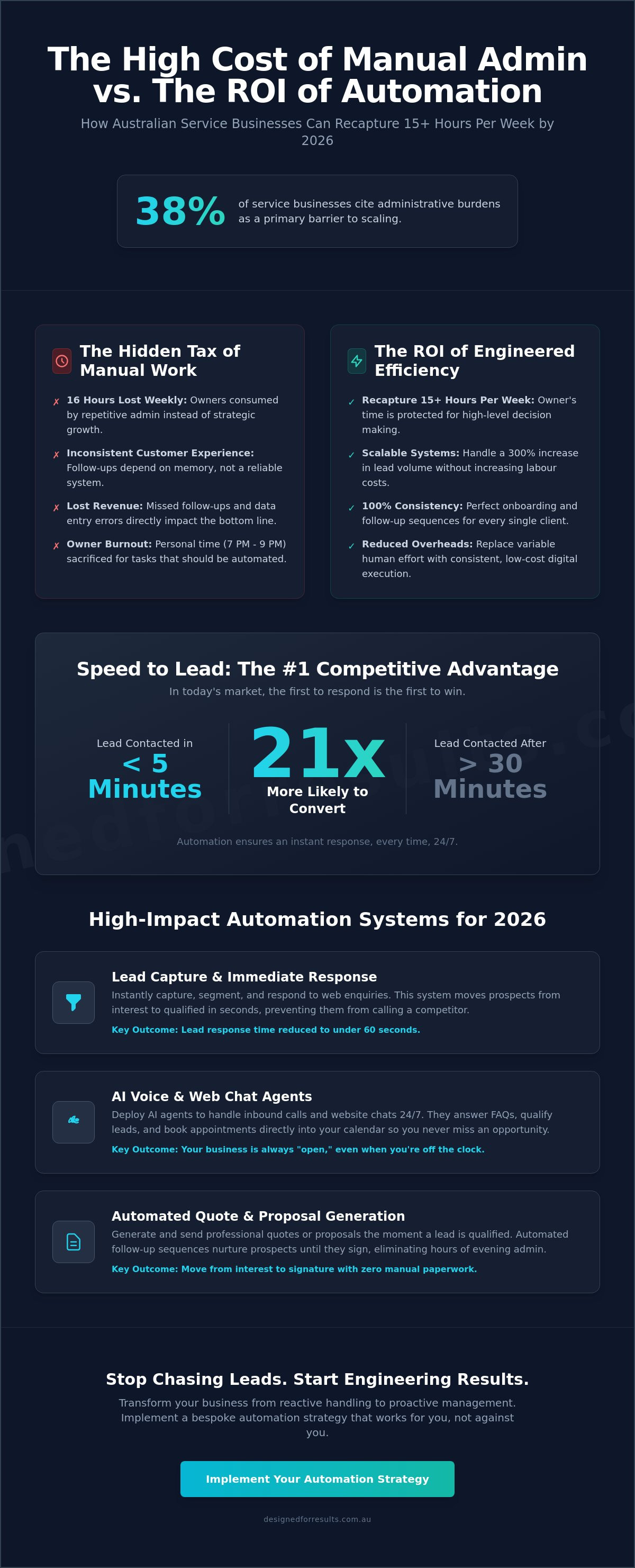
How many hours of your life are currently buried in manual quote generation and evening spreadsheet updates? You likely started your business to gain freedom, yet you're spending your 7:00 PM to 9:00 PM window chasing leads that should've been answered hours ago. It's frustrating to feel that your growth is capped simply because you've run out of hands. Data from the Australian Bureau of Statistics indicates that administrative burdens remain a primary barrier to scaling for 38% of service-based businesses.
This guide identifies high-impact small business automation ideas 2026 that allow you to recapture up to 15 hours per week while ensuring every enquiry receives an immediate, professional response. We'll examine the specific workflows that turn lead capture into revenue and administrative tasks into background processes. By implementing these systems, you ensure your business operates with precision even when you're off the clock. You'll discover how to convert more leads without increasing your headcount or sacrificing your personal time.
The Landscape of Small Business Automation in 2026
Small business automation ideas 2026 revolve around the intentional engineering of systems to eliminate repetitive manual tasks. We have moved beyond basic "if-this-then-that" rules. Modern Business Process Automation integrates AI-aware workflows that interpret data and make decisions in real-time. This transition allows an Australian business to move from reactive handling to proactive management. Efficiency is no longer a luxury; it is a prerequisite for survival in a market where speed defines success.
Manual processes currently represent the single largest bottleneck for local growth. Recent industry data indicates that Australian business owners lose an average of 16 hours per week to administration. "Speed to lead" has become the primary competitive advantage in the local market. A lead contacted within five minutes is 21 times more likely to convert than one contacted after 30 minutes. Automation ensures this response happens every time, regardless of the time of day or staff availability.
Why Manual Administration is Failing Australian Businesses
Human friction in data entry creates a hidden tax on every transaction. Errors in lead management or missed follow-ups result in lost revenue that rarely appears on a balance sheet but severely impacts the bottom line. Owners frequently find themselves working on administration during evenings and weekends. This constant mental load prevents them from focusing on leadership capability and strategic alignment. Inconsistent customer experiences occur when manual follow-ups depend on the owner's daily capacity rather than a reliable system. When a business relies on memory rather than a workflow, growth remains stagnant.
The ROI of Engineered Efficiency
Automation reduces overheads by ensuring a high-performance culture without the immediate need for additional headcount. Scalable systems handle a 300% increase in lead volume without a corresponding increase in labour costs. Implementing bespoke AI automation allows businesses to achieve measurable outcomes by replacing variable human effort with consistent digital execution. This approach transforms the cost structure of the organisation, shifting funds from repetitive admin to revenue-generating activities.
- Reduces lead response time to under 60 seconds.
- Eliminates double-handling of data between CRM and accounting software.
- Ensures 100% consistency in customer onboarding and follow-up sequences.
- Protects the owner’s time for high-level decision-making.
Automation ROI is the combination of hours saved and revenue captured. By removing the ceiling created by manual labour, an Australian business can scale its operations based on market demand rather than staff capacity.
Lead Capture and Immediate Response Systems
Manual lead follow-up is an operational liability. Australian businesses frequently lose potential revenue because they fail to respond to enquiries within the first five minutes. By 2026, the standard for small business automation ideas 2026 has shifted toward a zero-manual follow-up model. This approach ensures that every enquiry receives an immediate, intelligent response without the owner lifting a finger. It moves prospects from initial interest to a qualified state in seconds, preventing them from calling a competitor.
Integration between website forms and your CRM is the backbone of this system. When a lead enters their details, the system instantly segments them based on their specific industry, budget, or service interest. Effective segmentation ensures that your messaging resonates with the specific pain points of the prospect. If a business enquires about maintenance services, they shouldn't receive generic marketing about one-off installations. Automation handles this logic instantly, ensuring the right information reaches the right person at the right time. This level of precision is what separates high-performing Australian businesses from those struggling to keep up with their inbox.
AI Voice Agents and Conversational Lead Capture
Missed calls represent missed revenue. AI voice agents for small business solve this by handling inbound calls and booking appointments directly into your calendar. These agents operate 24/7, providing a professional first impression that many small operations struggle to maintain during busy periods. On the digital front, AI chatbots for websites capture contact details and answer complex FAQs. They qualify leads in real-time, ensuring that only high-value prospects reach your desk. These tools guarantee that your business is always open, even when you're on-site or off the clock.
Automated Quote and Proposal Generation
Speed wins deals. Automated quote systems generate contracts or proposals the moment a lead is qualified in the CRM. For service-based businesses, instant quote calculators allow prospects to get a price estimate immediately. This transparency builds trust and accelerates the decision-making process. If a prospect doesn't sign straight away, automated follow-up sequences nurture them through the sales funnel without any additional effort from your team. Incorporating simple automation tips like these can save hours of evening admin. These small business automation ideas 2026 focus on removing the friction between a lead's interest and their final signature, allowing you to focus on delivery rather than paperwork. If you're ready to stop chasing emails, you can chat with our team about implementing these systems.
Streamlining Backend Operations and Client Onboarding
Operational efficiency is often won or lost in the "hidden" admin that occurs after a sale. While many owners focus on lead generation, the real profit leak happens during the transition from prospect to active client. Manual data entry and chasing documents consume hours that should be spent on high-value delivery. Eliminating this friction requires a shift toward automated document collection and internal approval workflows. When a contract is signed, the system should instantly request necessary IDs or project briefs. This removes the "wait and see" period that stalls project momentum and frustrates new clients.
Implementing a real-time sales dashboard provides immediate visibility into the business pipeline. You can track conversion rates and identify bottlenecks without manually updating spreadsheets. This visibility allows for faster decision-making and ensures no client falls through the cracks during the handover process. Australian businesses that automate these backend triggers often reclaim up to 15 hours of administrative time every week.
Automated Onboarding Workflows
Transitioning a client from a signed contract to an active project should require zero manual intervention. Automated workflows trigger the moment a digital signature is captured. These systems send immediate welcome sequences that provide essential project information and deliver educational lead magnets. This process establishes professional authority from day one. You can also use automated review requests to capture feedback once milestones are met. This builds an online reputation without requiring the owner to remember to ask for a referral or a rating.
- Document Collection: Use automated triggers to request tax file numbers, identification, or project briefs immediately after signing.
- Internal Approvals: Notify relevant team members automatically when milestones are reached to keep the project moving.
- Reputation Management: Schedule automated review requests to go out 48 hours after project completion to build your Google Business Profile.
Financial and Database Automation
Cash flow remains the primary concern for small to medium-sized service businesses. Integrating your CRM directly with accounting software like Xero ensures invoices are generated and sent the moment a deal closes. Automatic payment reminders reduce the time spent chasing late payers, which addresses the average 24-day payment delay often seen in the Australian small business sector. Integrating these small business automation ideas 2026 into your daily operations protects your bottom line and ensures consistent liquidity.
Revenue growth doesn't always require new leads. Database reactivation campaigns using SMS or email can re-engage past clients who haven't booked in the last six months. For more intricate operations, bespoke AI automation manages complex, multi-step backend processes that standard off-the-shelf tools often fail to address. This level of automation ensures your database remains a productive asset rather than a static list of names, allowing you to scale without increasing your headcount.
Developing Your 2026 Automation Roadmap
Successful implementation of small business automation ideas 2026 requires a disciplined sequence rather than a scattered approach. Many Australian business owners lose significant hours to administrative debt that has accumulated over years of manual operation. To reclaim this time, you must map your existing processes before looking at software. Mapping reveals exactly where a lead stalls or where data entry becomes a bottleneck. Start with high-impact, low-complexity tasks. These are the quick wins that provide immediate relief to your schedule and budget without requiring a total overhaul of your current systems.
Step 1: The Administrative Audit
Identify every repetitive action performed within your business. Common time thieves include manual appointment scheduling, transferring data between spreadsheets, and tracking leads across different platforms. Quantify the time spent on these activities. If a staff member spends 6 hours weekly on manual data entry, that equates to 312 hours annually. Categorise these tasks by their requirements. Logic-based tasks, such as sending a confirmation email or updating a status in a CRM, are prime candidates for automation. Tasks requiring human empathy, such as handling a complex client grievance, should remain manual. This audit provides the objective data needed to justify your technology investment.
Step 2: Prioritising for Revenue and Time
Prioritise lead follow-up above all other automation. Data indicates that businesses responding to inquiries within five minutes are significantly more likely to convert a prospect than those waiting even half an hour. Automated lead nurturing ensures no prospect is ignored while you are on-site or in meetings. When selecting tools, determine if an off-the-shelf application meets your needs or if your workflow requires a bespoke build. For complex integrations involving multiple legacy systems, engaging an ai automation agency australia ensures your systems communicate without friction. This structured approach transforms your operations into a high-performance environment where technology handles the volume while you focus on high-value decision-making.
Ready to eliminate the manual bottlenecks in your business? Explore our smart automation solutions.
Achieving Professional Results with Expert Implementation
Implementing small business automation ideas 2026 requires more than a subscription to a SaaS platform. Many Australian business owners attempt a DIY approach, which often results in fragmented data silos and broken workflows. Industry data suggests that 70% of digital transformations fall short of their goals due to poor execution rather than faulty technology. Professional implementation bridges the gap between raw software capabilities and actual revenue. It ensures that your technology stack communicates effectively, preventing the manual data entry that drains your team's productivity.
A professional consultant ensures that every automated sequence aligns with specific performance indicators. They build systems that scale as your customer base expands. An Australian business that automates its lead capture without professional oversight often finds that data doesn't flow correctly into their CRM, leading to lost opportunities. Managed service retainers provide the necessary oversight to adjust these systems as the market evolves. This ongoing optimisation ensures that your operations remain lean and your technology remains an asset rather than a liability.
The risks of unmanaged automation include:
- Data Inconsistency: Duplicate records and mismatched customer information across different platforms.
- Broken Workflows: Automated triggers that fail when software updates occur, leading to missed follow-ups.
- Lack of Scalability: Systems that work for 10 clients but collapse when handling 100.
- Security Vulnerabilities: Improperly configured integrations that expose sensitive customer data.
The Difference Between Tools and Systems
Buying software doesn't solve a workflow problem. A tool is just an instrument; a system is a sequence that produces a predictable result. A consultant ensures that "speed to lead" is achieved, reducing typical response times from several hours to under 60 seconds. Integrating smart AI solutions into these workflows ensures your business remains competitive as we approach 2026. This professional approach moves your business away from reactive troubleshooting and toward a state of operational excellence where technology handles the heavy lifting.
Next Steps for Your Business
Stop accepting manual inefficiency as an unavoidable cost of doing business. Australian businesses that fail to modernise their operations risk being outpaced by more agile competitors. Successful execution of small business automation ideas 2026 demands a shift from manual tasks to integrated systems. Start now to secure your position in the local market and reclaim your evenings from administrative tasks. Book a strategy session today to map out a custom automation plan that delivers measurable time savings and increased profitability for your business.
Future-Proof Your Australian Business Operations
Transitioning from manual processes to automated systems is no longer optional for service-based businesses. By 2026, the gap between businesses that automate and those that don't will widen significantly. Implementing immediate response systems ensures you capture leads while they're hot, while streamlining your backend operations eliminates the evening admin sessions that drain your energy. Integrating these small business automation ideas 2026 provides a clear path toward reclaiming your time and increasing your revenue through efficiency.
Success requires a disciplined approach to workflow engineering. Designed For Results specialises in Australian SME workflow engineering, delivering custom AI solutions tailored specifically for service-based businesses. We focus on measurable time savings and revenue growth; every implementation serves your bottom line. Stop letting repetitive tasks hinder your growth and start building a business that operates with precision.
Ready to see how these systems work for you? Book your free automation strategy call with Designed For Results. It's time to regain control of your schedule and focus on high-value leadership.
Frequently Asked Questions
How much does it cost to automate a small business in 2026?
Implementation costs typically range from A$2,000 for basic setups to A$15,000 for comprehensive systems. Monthly subscription fees for tools like CRM and workflow integrators often sit between A$200 and A$1,200 depending on user count. These investments pay for themselves by reclaiming 10 to 15 hours of administrative time every week. You should budget for both the initial configuration and ongoing software licensing to ensure your systems remain current and effective.
Can automation really replace the need for a receptionist or admin assistant?
Automation shifts the focus from task execution to high-level management rather than total replacement. It handles 80% of repetitive booking and inquiry tasks, allowing your staff to focus on complex client interactions. Tools like AI-driven phone agents and automated scheduling software manage routine calls and appointments without human intervention. This shift reduces the need for additional administrative hires even as your lead volume increases. Your existing team becomes more productive because they're no longer bogged down.
Is my business too small to benefit from AI and automation?
No business is too small; in fact, micro-businesses often see the highest relative gains. Small teams with fewer than five employees experience the most impact from small business automation ideas 2026 because their resources are most constrained. Implementing a simple automated lead response system ensures you never miss a quote while you're on a job site. Even a single-person operation can save five hours weekly by automating invoicing and follow-up emails to clients.
How long does it take to see a return on investment from automation?
Most Australian service businesses see a positive return within three to six months. You can expect to see measurable time savings within the first 30 days of implementation. Financial ROI typically materialises within 90 to 180 days as reduced labour costs and increased lead conversion rates impact the bottom line. According to 2024 industry benchmarks, businesses that automate their sales pipeline see a 20% increase in revenue within the first year of operation.
Will automation make my business feel impersonal to my clients?
Automation improves the client experience by providing instant responses and consistent communication. Clients value speed and reliability over manual, delayed interactions. Automated systems ensure every inquiry receives an immediate acknowledgment, which 78% of customers cite as a key factor in their purchasing decision. Personalisation tokens allow your software to use specific client details, making communications feel tailored. By removing the friction of manual scheduling, you provide a smoother professional journey that reflects well on your brand.
What happens if the automated system breaks or encounters an error?
Robust systems include error-handling protocols and manual overrides to prevent service disruptions. You must build your workflows with logic that alerts you immediately if a step fails. Most modern platforms provide detailed logs and notification systems to flag issues before they affect the customer. Regular audits every quarter ensure your integrations remain stable as software updates occur. Having a clear manual backup process for critical tasks provides a safety net while any technical issue is resolved.
Do I need to be tech-savvy to manage these automated workflows?
Modern no-code platforms are designed for business owners without technical backgrounds. Managing small business automation ideas 2026 requires an understanding of your business processes rather than coding skills. Visual builders allow you to map out workflows using simple drag-and-drop interfaces that are intuitive to navigate. If you can use an online banking app or a basic CRM, you can manage these systems. Many Australian owners choose to partner with an expert for the initial setup.
Which Australian industries benefit the most from these automation ideas?
Service-based sectors such as trades, professional services, and healthcare see the highest efficiency gains. Trades businesses like plumbing and electrical services benefit immensely from automated quoting and dispatching. Professional services, including accounting and legal practices, use automation to manage document workflows and client onboarding without manual data entry. Healthcare providers see significant reductions in no-shows through automated SMS reminders and patient portals. Any industry where time is the primary billable asset will find that automation increases capacity.
