
What Business Tasks Can Be Automated? The 2026 Guide for Australian SMEs

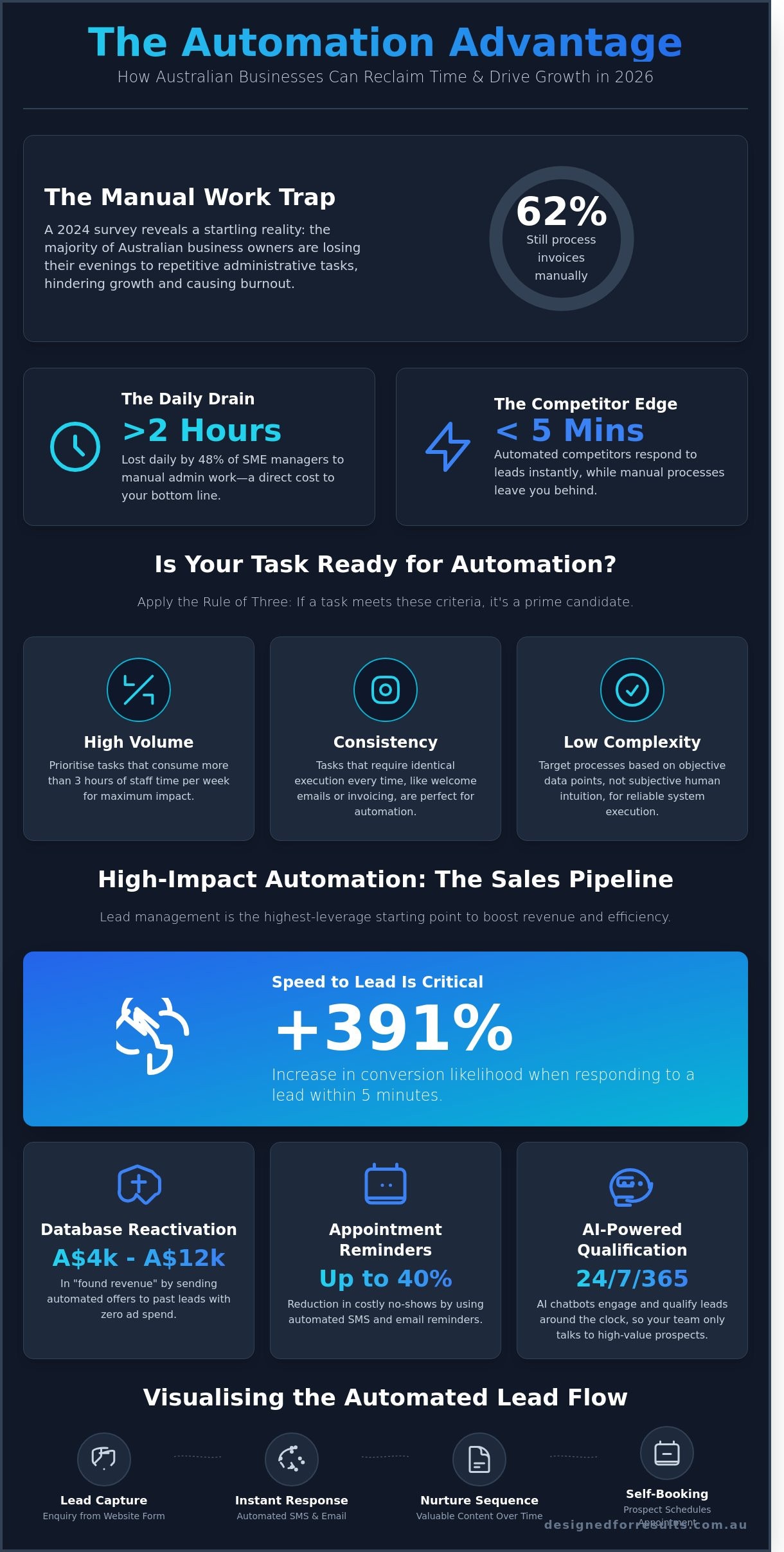
A recent 2024 industry survey found that 62% of Australian business owners still spend their evenings manually processing invoices and entering data. It's a frustrating reality where you're working harder but staying stagnant because your time is consumed by administrative loops. You likely recognise that these repetitive cycles are the primary barrier to your next stage of growth. Identifying exactly what business tasks can be automated is the only way to stop losing revenue to competitors who respond to leads in under five minutes while you're tied up with paperwork.
This 2026 guide provides a clear roadmap to delegate these low-value activities to reliable technology, ensuring no lead ever goes cold and your cash flow remains consistent. You'll discover how to reclaim your evenings by streamlining your sales, finance, and operations. We'll examine the specific processes ready for automation today, allowing you to refocus your energy on the high-level strategy that actually moves the needle for your business.
Identifying Automatable Tasks in Your Australian Business
Business automation involves the deployment of technology to execute recurring tasks with minimal human intervention. It implements reliable systems to manage data entry and workflow progression. Determining what business tasks can be automated requires a logical assessment of your current operations. Most Australian business owners find themselves trapped in repetitive cycles because they manage processes that don't require their specific expertise.
Apply the Rule of Three to identify these opportunities. A task is a prime candidate for automation if it is repetitive, governed by clear rules, and occurs frequently. Recent data from Australian industry reports suggests that 48% of SME managers lose over two hours daily to manual administrative work. This time represents a direct cost to the bottom line. The primary objective is removing the administrative weight that keeps owners at their desks long after the doors close. Reclaiming these hours allows for a focus on high-level leadership and client acquisition.
The Three Pillars of Automation Readiness
- Consistency: Automation thrives on standardisation. Identify tasks that require identical execution every single time, such as sending a welcome email or generating an invoice.
- High Volume: Prioritise activities that consume more than three hours of staff time per week. Small efficiencies in frequent tasks accumulate into significant annual savings.
- Low Complexity: Target decisions based on clear data points. If a process relies on objective facts rather than subjective human intuition, a system can handle it.
Automation vs. Artificial Intelligence: Making the Choice
Distinguish between digital plumbing and cognitive processing. Standard automation acts as the plumbing that moves data between systems like your CRM and Xero. It ensures information flows without manual intervention. Artificial Intelligence functions as the brain. AI handles unstructured data, such as transcribing client calls or drafting initial email replies based on customer sentiment.
Establish a stable foundation with bespoke AI automation before layering on complex AI solutions. This sequence ensures your core data is accurate before the AI begins interpreting it. Successful Australian businesses build their systems on this hierarchy to ensure reliability and measurable outcomes. Identifying what business tasks can be automated is the first step toward reclaiming your evenings and ensuring your growth is a result of clear execution.
Automating the Sales Pipeline and Lead Management
Speed to lead is the primary driver of conversion for service-based Australian businesses. Data from a 2024 LeadResponse study shows that responding to an enquiry within five minutes increases the likelihood of a conversion by 391%. Manual follow-up is no longer a viable strategy when competitors use automation to respond instantly. When considering what business tasks can be automated, lead management is the highest-leverage starting point. Moving lead data from website forms directly into a central CRM eliminates the risk of lost enquiries and removes the need for manual data entry during the evening hours.
AI chatbots now provide 24/7 lead qualification without human intervention. These tools engage website visitors immediately, asking specific qualifying questions to determine if a prospect meets your ideal client profile. This ensures your sales team focuses only on high-value opportunities. Beyond new leads, database reactivation offers a significant revenue opportunity. By automating a simple SMS or email offer to leads from the past 12 months, businesses often generate between A$4,000 and A$12,000 in found revenue without spending a cent on new advertising. This process requires zero manual effort once the workflow is active.
Instant Lead Follow-Up and Nurture Sequences
A robust automation workflow starts with an immediate SMS and email response the moment a prospect submits an enquiry. This instant touchpoint establishes professional authority and stops the prospect from calling the next business on their list. For prospects who aren't ready to commit immediately, automated nurture sequences provide consistent value over time. These sequences keep your brand top-of-mind through educational content and case studies. Implementing automated lead follow up systems ensures no prospect falls through the cracks due to a busy schedule.
Appointment Scheduling and Reminder Systems
Manual scheduling via back-and-forth emails is a significant time sink for Australian business owners. Self-service booking links allow prospects to view live availability and book their own appointments. This simplifies the customer journey and reduces administrative friction. No-shows represent a direct loss of billable time; however, automated SMS and email reminders can reduce these occurrences by up to 40% based on 2023 industry benchmarks. Syncing these tools with team calendars ensures real-time visibility across the organisation, making it a clear example of what business tasks can be automated to protect your profit margins. If you want to reclaim your time and scale your operations, let's chat about your current workflow.
Streamlining Operations and Internal Administrative Workflows
Administrative "drag" is a primary reason Australian business owners find themselves working into the evening. These hidden time-wasters, such as manual document collection and contract drafting, consume up to 15 hours of a manager's week. When evaluating what business tasks can be automated, start with the processes that require the same data to be moved between different software applications. Automating the transition from a "won" deal to an active project ensures no momentum is lost during the handover phase, allowing the team to begin delivery immediately.
Automated Client Onboarding and Document Collection
The moment a digital signature is captured, the system should initiate the onboarding sequence. Automation triggers the delivery of a branded welcome pack and specific request-for-information forms based on the service purchased. This removes the need for staff to manually email checklists or follow-up instructions. Client portals provide a professional, self-service environment where customers upload necessary documentation securely. Automated reminders prompt clients every 48 hours until all requirements are met. This systematic approach reduces project start delays by an average of four days, directly improving cash flow by accelerating the billing cycle.
Contract Generation and Internal Approvals
Manual contract creation carries a 3% to 5% risk of data entry errors, which can lead to legal or financial complications. Automated systems pull data directly from the CRM to generate custom proposals and contracts in seconds. This ensures accuracy and consistency across all client agreements. Internal approval loops further protect the business by notifying managers via mobile notifications to authorise quotes, discount requests, or project expenses. These workflows eliminate the bottleneck of waiting for email responses, which often stalls project momentum. Removing manual intervention from these repetitive sequences increases staff capacity without the need for additional hiring.
For multi-layered operations that require cross-platform logic and complex decision-making, bespoke AI automation offers a way to handle nuanced tasks that standard software cannot manage. This level of technical clarity transforms administrative workflows into a competitive advantage. By understanding what business tasks can be automated, leadership can shift focus from daily maintenance to high-level execution and measurable outcomes.
Financial Management and Customer Experience Automation
Manual data entry remains a significant drain on the productivity of Australian business owners. When considering what business tasks can be automated, the connection between your CRM and accounting software like Xero offers the highest immediate return. Integrating these systems ensures that financial data flows seamlessly without human intervention, reducing the risk of clerical errors that lead to payment delays or tax compliance issues.
The "quote-to-invoice" lifecycle is often where service-based businesses lose momentum. Automation allows a business to convert an accepted quote into a live project and subsequently trigger an invoice the moment a milestone is reached. This eliminates the need for manual reconciliations and ensures the finance department remains in lockstep with operations. Modern AI-assisted phone systems further enhance this workflow by recording and transcribing client interactions. These systems summarise key requirements and automatically attach the notes to the client profile, saving an average of 15 minutes of administrative work per call.
Invoicing, Payments, and Xero Integration
Automating your financial pipeline directly impacts cash flow. You can configure your CRM to generate a Xero invoice automatically when a job status changes to "Completed." This ensures billing happens in real-time rather than during a frantic end-of-month session. Implementing smart AI solutions to synchronise this data across platforms prevents the common issue of fragmented records. Automated payment reminders are equally vital; setting up a sequence to nudge overdue accounts can reduce Days Sales Outstanding (DSO) by up to 20% for the average Australian SME.
Reputation Management and Feedback Loops
A business's online reputation is a primary driver of new leads, yet many owners forget to ask for reviews. You should implement a workflow that sends a Google Business Review request via SMS or email within two hours of job completion. This timing is critical for capturing high customer satisfaction levels. AI tools can now draft initial responses to these reviews, allowing you to maintain a high response rate while only stepping in for a final human review before posting.
Automated surveys play a defensive role in your brand strategy. By sending a brief satisfaction poll before the public review request, you can identify and escalate dissatisfied clients to a manager immediately. This proactive approach allows you to resolve issues privately before they manifest as a negative public comment. Australian businesses using these automated feedback loops often see a 35% increase in positive review volume within the first six months of implementation.
Ready to reclaim your evenings from administrative tasks? Book a consultation to review your automation potential.
Implementing Your Automation Roadmap for 2026
Transitioning from theory to execution requires a disciplined approach that avoids disrupting your daily operations. Success in 2026 depends on selecting the right starting point. Focus on the single most painful manual process before attempting a full scale overhaul. This targeted method provides immediate relief to your team and proves the value of the investment without the risk of system wide failure. Adopt a culture of continuous optimisation. Automation is a living component of your business that requires regular refinement to remain effective as you scale.
The Step-by-Step Audit Process
Determining what business tasks can be automated starts with a rigorous assessment of your current workflows. Use this three step framework to identify your highest value opportunities.
- Step 1: Document every manual task. Require your team to record every repetitive action performed over a one week period. This includes data entry, lead follow ups, and manual report generation.
- Step 2: Assign a "time cost" and "error risk". Calculate the hourly rate of the staff member performing the task. For example, if an administrator spends five hours weekly on manual invoicing at A$45 per hour, the annual cost is A$11,700. Factor in the financial impact of human error, such as incorrect data entry in a quote.
- Step 3: Prioritise for high recovery. Focus on tasks that offer the highest time recovery for the lowest technical effort. High volume, low complexity tasks are the ideal starting point for Australian businesses looking to see immediate ROI.
Partnering for Strategic Execution
Professional implementation ensures your systems are robust and scalable from day one. Many Australian business owners fall into the trap of creating a "franken-system" where disconnected tools fail to communicate with each other. This creates more administrative work rather than reducing it. Expert consulting ensures that every piece of software integrates seamlessly, creating a unified flow of data across your entire organisation.
Ongoing maintenance is vital for long term performance. Managed services keep your automations running smoothly as software APIs change and your business requirements evolve. This proactive oversight prevents technical debt and ensures your team remains focused on high value work rather than troubleshooting broken workflows. You can chat with the team to identify your highest impact automation opportunities and begin the process of reclaiming your time. Clarity in execution is what separates businesses that struggle with admin from those that achieve consistent, profitable growth.
Take Control of Your Business Trajectory
Building a successful Australian business in 2026 requires a shift from manual repetition to structured execution. Identifying what business tasks can be automated allows you to stop handling administrative work during your evenings and focus on high-value leadership. By integrating CRM systems with Xero, many service-based businesses reduce manual data entry by up to 85% while ensuring lead follow-ups occur within minutes. This transition focuses on reliable systems that deliver measurable outcomes for your bottom line.
We're specialists in Australian SME automation with deep expertise in CRM and Xero integrations. Our team provides results-oriented implementation combined with ongoing support to ensure your systems evolve with your needs. We remove the technical barriers that prevent growth, allowing you to reclaim at least 10 hours of your week for business development or personal time. Success in a competitive market is the result of intentional action and the right technical partnerships.
Ready to reclaim your time? Let’s chat about your automation roadmap.
Your business has the potential to scale without increasing your personal workload.
Frequently Asked Questions
How much does it cost to automate business tasks in 2026?
Entry-level automation for an Australian business starts at A$45 per month for basic subscription tools. For a comprehensive setup, expect to invest between A$1,200 and A$4,800 in initial configuration fees during 2026. These costs cover the integration of your lead capture and follow-up systems. Ongoing monthly maintenance usually sits at 15% of the initial setup cost to ensure your workflows remain efficient.
Do I need to be a tech expert to use business automation?
You don't need technical expertise to implement these systems. Modern platforms use visual interfaces that allow you to map out your processes without writing any code. Data from 2025 shows that 68% of Australian business owners manage their own basic automations. You focus on the logic of your business while the software handles the technical execution. This accessibility ensures you remain in control of your operations.
Can automation really replace a human employee?
Automation removes the low-value tasks that lead to burnout. It handles data entry and appointment reminders, giving your team back roughly 12 hours every week. This shift allows your staff to focus on revenue-generating activities like closing sales and improving the customer experience. You increase your operational capacity while maintaining your current headcount and reducing human error in repetitive processes.
Which Australian industries benefit most from workflow automation?
Professional services, trades, and medical clinics benefit most from workflow automation in the Australian market. These sectors often struggle with what business tasks can be automated, such as quote generation and patient onboarding. Implementing automated follow-ups ensures no lead is missed. In 2025, Australian trade businesses using automated quoting saw a 22% increase in conversion rates by responding to enquiries within 5 minutes.
How long does it take to see an ROI from automation?
Most Australian businesses achieve a full return on investment within 5 months of implementation. This ROI is driven by the reduction of administrative errors and the recovery of billable time. If you save 10 hours of admin work per week at a rate of A$150 per hour, you're looking at A$6,000 in monthly value. This measurable outcome proves that automation is a financial necessity for scalable growth.
Is my business data safe when using automation and AI tools?
Your data is secure when you select tools that comply with the Australian Privacy Act 1988 and the Notifiable Data Breaches scheme. Look for platforms that offer local Australian data centres to ensure sovereignty. High-quality automation tools use enterprise-grade encryption and multi-factor authentication. These protocols protect your sensitive client information from unauthorised access while maintaining your professional reputation and legal compliance.
What is the best CRM for small businesses in Australia?
HubSpot and Pipedrive remain the most effective CRM choices for Australian service-based businesses in 2026. Both platforms offer robust integration with Xero and MYOB, which are essential for local financial compliance. They provide the clarity needed to track every lead from the initial enquiry to the final invoice. Choosing a CRM with strong local support ensures you get help when you need it to maintain momentum.
