
Essential Business Tasks to Automate: The 2026 Efficiency Checklist

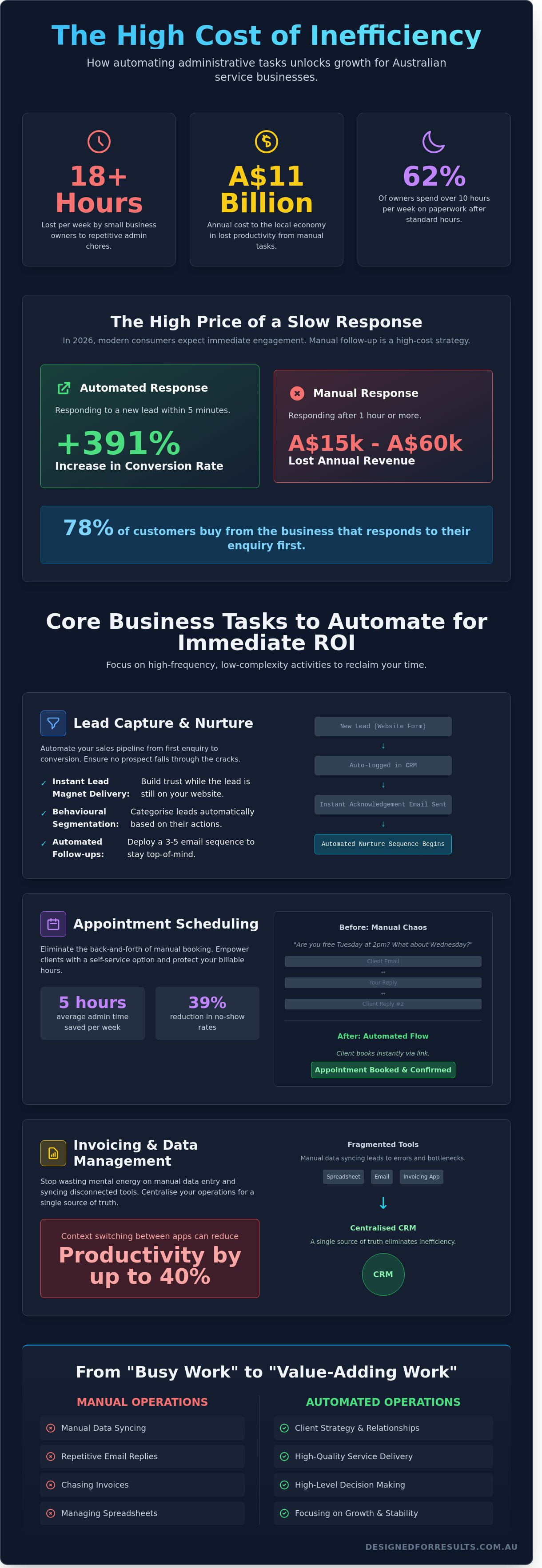
Australian small business owners currently lose over 18 hours per week to repetitive administrative chores, according to 2024 industry benchmarks. This inefficiency costs the local economy approximately A$11 billion annually in lost productivity. When you spend your evenings manually reconciling invoices or responding to basic enquiries, you aren't just losing sleep; you're actively capping your ability to scale. Identifying the right business tasks to automate is no longer a luxury for those with large budgets. It's a fundamental requirement for any service-based leader who wants to maintain high performance without hiring additional staff.
In regulated industries such as real estate, law, and accounting, this automation can be extended to handle complex client onboarding and anti-money laundering (AML) compliance. For a deeper look into how software can manage these specific obligations, click here.
You likely recognise that your time is better spent on billable work than on basic data entry. It's frustrating to watch hot leads go cold because you were too busy on a job site to send a timely follow-up. This guide identifies the specific systems you can implement to reclaim your personal time and ensure your sales pipeline remains active. We'll examine a checklist for 2026 that focuses on high-impact solutions for lead management, invoicing, and client onboarding to lower your overheads and improve your bottom line.
Identifying the High-Cost Manual Tasks in Your Business
Define your business operations through the lens of efficiency to uncover hidden costs. Business automation involves deploying software to execute recurring processes without manual intervention. Adopting Business process automation (BPA) allows leaders to remove themselves from the "evening admin" trap. Statistics indicate that 62% of Australian business owners spend over 10 hours per week on paperwork after standard hours. This habit drains leadership capability and prevents high-level decision-making. Manual data entry creates bottlenecks that restrict revenue growth and lead to avoidable errors. It's vital to distinguish between "busy work," such as manual data syncing, and "value-adding work," like client strategy and service delivery. Identifying specific business tasks to automate ensures your team focuses on measurable outcomes rather than repetitive maintenance.
The Financial Impact of Manual Lead Follow-Up
Speed to lead is a critical metric for any service-based Australian business in 2026. Modern consumers expect immediate engagement. Data shows that responding to an inquiry within five minutes increases conversion rates by 391%. Australian businesses often lose an estimated A$15,000 to A$60,000 in annual revenue when leads go unanswered for over an hour. Manual tracking often results in fragmented sales pipelines where potential clients fall through the cracks. Automation ensures every prospect receives an immediate, professional response. This secures the customer journey before a competitor intervenes. Relying on manual follow-up is a high-cost strategy that limits your ability to scale and compromises your professional reputation.
Repetitive Administrative Burdens
Manual invoicing and appointment scheduling remain significant time-wasters in the service sector. Context switching between disconnected software tools causes mental fatigue and reduces productivity by up to 40%. This fragmentation prevents the development of a high-performance culture. Centralising data through a CRM implementation eliminates these inefficiencies. It provides a single source of truth for the organisation. Streamlining these business tasks to automate allows your team to contribute to strategic alignment rather than managing spreadsheets. Professional operations require a disciplined approach to data management. Eliminating manual administrative burdens provides the time necessary to focus on bottom-line results and long-term stability.
Core Business Tasks to Automate for Immediate ROI
Identifying the right business tasks to automate begins with targeting high-frequency, low-complexity activities that consume your evenings and weekends. Australian business owners frequently lose over 10 hours each week to repetitive administration. These lost hours represent a direct hit to your bottom line and your personal well-being. By focusing on low-hanging fruit, you can reclaim this time and see a return on investment within the first 30 days of implementation.
Efficiency isn't about replacing human talent; it's about removing the friction that prevents your team from performing high-value work. When you automate the journey from the first enquiry to a booked appointment, you create a seamless experience for the customer. Modern smart AI solutions now handle complex data flows that previously required manual oversight, ensuring that information moves accurately between your marketing tools and your core operations without human intervention.
Lead Capture and Nurture Sequences
Speed to lead is a critical metric for any service-based business in Australia. Research indicates that 78% of customers buy from the business that responds to their enquiry first. If you're manually checking emails and typing out replies, you've already lost the race. Automating your website forms to feed directly into your CRM system ensures that every prospect is logged and acknowledged instantly.
- Instant Lead Magnet Delivery: Set up triggers to deliver resources immediately, building trust while the prospect is still on your website.
- Behavioural Segmentation: Use automation to categorise leads based on the pages they visit or the links they click.
- Automated Follow-ups: Deploy a series of three to five emails that keep your business top-of-mind without you having to hit 'send' once.
These sequences maintain engagement during the critical 48-hour window after an initial enquiry. This ensures that your pipeline stays full even when you're busy on-site or in meetings.
Appointment Scheduling and Reminders
The traditional back-and-forth of "Are you free Tuesday at 2:00 PM?" is a significant drain on productivity. Transitioning to an online booking system allows clients to view your availability and secure a slot in seconds. This shift can save an average of five hours of administrative work per week for a typical small business. It also empowers the client by providing a self-service option that fits their schedule.
No-shows are a silent profit killer for Australian service providers. Implementing automated SMS and email reminders has been shown to reduce no-show rates by up to 39% in professional service sectors. By providing a clear, automated path for clients to reschedule or cancel with 24 hours' notice, you protect your billable hours and maintain a predictable schedule. If you're ready to stop chasing calendars and start focusing on delivery, it might be time to connect with an automation specialist to audit your current workflow.
Advancing Beyond Rules: When to Use AI Automation
Standard automation relies on rigid logic gates. It functions through simple "if-this-then-that" sequences. While effective for basic business tasks to automate, this approach fails when a process requires context or interpretation. AI agents represent the next step in operational efficiency. They use natural language processing to understand intent and make decisions based on unstructured data. By 2026, service-based businesses in Australia will use AI to manage approximately 45% of their front-end customer interactions.
AI handles the nuance of human communication. It interprets client phone calls, identifies sentiment in emails, and extracts data from messy documents. This capability allows an Australian business to automate workflows that previously required a staff member to read, think, and respond. For instance, businesses can explore ATS Score Checker options to streamline how they parse and evaluate professional documentation. Transitioning to AI-driven systems reduces the administrative burden that often forces owners to work late into the night. It converts chaotic inputs into structured, actionable outcomes.
AI Voice and Chat Agents
AI voice agents answer enquiries and book appointments 24/7. They provide a professional response at 2:00 AM without the overhead of a call centre. These agents qualify leads by asking specific questions to determine if a prospect meets your criteria. This ensures your sales team only spends time on high-value conversations. Every interaction is recorded and transcribed, allowing for automated follow-up sequences that keep the customer journey moving. For a detailed breakdown of the technology, review the AI voice agents for small business guide.
Automated Document and Contract Generation
Manual drafting of proposals is a primary bottleneck for growth. AI-driven systems generate contracts and professional proposals directly from CRM deal data. This eliminates manual entry errors and ensures every quote is sent within minutes of a request. During the onboarding phase, AI assists in collecting necessary documents from clients. It identifies missing information and sends automated reminders until the file is complete. Internal approval workflows add a layer of security, ensuring every A$5,000 or A$50,000 contract is accurate before it reaches the client's inbox. This level of automation protects your margins and gives you back hours of time every week.
The 2026 Australian Business Automation Checklist
Australian business owners often spend upwards of 15 hours every week on repetitive administrative duties. By 2026, the gap between businesses that scale and those that stagnate will be defined by how they handle these manual burdens. Identifying the right business tasks to automate allows you to shift from reactive fire-fighting to proactive management. This checklist focuses on high-impact areas that improve the customer journey while returning time to the owner.
Sales and Marketing Automation Checklist
- Lead Capture and CRM Synchronisation: Eliminate manual data entry by connecting website forms directly to your CRM. Statistics show that responding to an enquiry within five minutes increases the chance of conversion by 391%. Automated syncing ensures no lead is lost in an inbox.
- Automated lead generation systems: These systems qualify prospects before they reach your calendar. This filter ensures you only spend time on high-value conversations with leads who meet your specific criteria.
- Database Reactivation Campaigns: Use automated Email and SMS sequences to reach out to past clients. A June 2024 industry report indicated that reactivating existing databases costs 80% less than acquiring new leads.
- Automated Review Requests: Trigger a Google Business Review request immediately upon project completion. Consistent, fresh reviews are a primary ranking factor for local SEO in the Australian market.
Operations and Admin Automation Checklist
- Client Onboarding Sequences: Deliver welcome packs, contracts, and initial questionnaires automatically once a deposit is paid. This provides a professional first impression and ensures you have all necessary data before work begins.
- Real-Time Sales Dashboards: Replace manual spreadsheets with a live dashboard. Visibility into your pipeline allows for immediate adjustments to sales activity based on actual performance data rather than guesswork.
- Support Ticket Routing: Use automation to categorise and route support enquiries based on priority and type. This ensures urgent technical issues reach the right person instantly, while general enquiries follow a standard response path.
Implementing these business tasks to automate reduces the mental load on leadership. It's about creating a reliable environment where processes happen without constant oversight. When your operations are structured this way, your business can handle a 25% increase in volume without a corresponding increase in staff costs or owner hours.
Ready to reclaim your evenings and scale your operations? Book a consultation to discuss your automation needs.
How to Implement Automation Without Business Disruption
Successful implementation avoids the "big bang" approach. Trying to overhaul every department simultaneously creates chaos and technical debt. Focus on a single high-impact workflow first. This method validates the technology and builds internal confidence without stalling daily operations. Most Australian businesses find that automating lead responses or invoice reminders provides the fastest return on investment, often saving 10 to 15 hours of manual labour per week.
Implementation is a discipline. It's about refining what works and removing what doesn't. When you select the first business tasks to automate, choose those with the highest frequency and lowest complexity. This builds momentum. It allows your team to adapt to new interfaces without the pressure of a total operational shift. Rapid wins prove the value of the investment to stakeholders and staff alike.
Mapping Your Business Processes
Documentation is the foundation of efficiency. You can't fix what you haven't measured. Start by listing every manual step in your current sales or onboarding process. Identify where delays occur and where human error is most frequent. A 2023 analysis showed that Australian service businesses lose an average of A$12,000 annually per employee due to repetitive data entry and administrative friction.
- Document manual steps: Record the exact path a lead takes from initial enquiry to final invoice.
- Prioritise by value: Rank your business tasks to automate based on the potential hours saved multiplied by your hourly labour rate.
- Align with goals: Ensure every automation step directly supports your three-year growth plan rather than just solving a temporary inconvenience.
The Role of Professional Automation Consulting
Off-the-shelf software often forces you to change your business to fit the tool. Custom solutions do the opposite. They adapt to your established excellence. Professional consulting ensures your systems remain optimised as you scale. Monitoring performance reporting is vital. It's the difference between a set-and-forget tool and a high-performance asset that delivers consistent A$ gains month after month.
Partnering with Designed For Results simplifies this transition. We remove the guesswork, ensuring your automation is engineered for reliability and precision. We focus on the bottom line, turning complex technical requirements into streamlined workflows that run in the background. This allows you to exit the daily grind of admin and focus on high-level leadership.
Don't let administrative tasks dictate your evenings or limit your revenue. Take control of your schedule and your business trajectory. You can book an automation strategy call today to pinpoint exactly where your gaps are and how to close them with precision.
Secure Your Competitive Advantage for 2026
Manual administration costs the average Australian business owner up to 15 hours of personal time every week. Transitioning these repetitive business tasks to automate ensures your operations remain scalable without increasing your overheads or sacrificing your evenings to paperwork. Prioritise high-impact areas like lead follow-up and quote generation to capture the A$12,000 in annual revenue that many service businesses leak through slow response times. Implementation doesn't need to be disruptive; it should be a structured process that protects your existing workflows while increasing your total output.
Designed For Results specialises in Australian SME automation through custom AI solutions tailored to service-based workflows. We provide managed service retainers for ongoing optimisation, ensuring your systems evolve alongside your business requirements. Stop losing billable hours to manual processes and start focusing on high-level client delivery. Book your free automation strategy call with Designed For Results to review your current systems and identify immediate ROI opportunities. You deserve a business that operates efficiently while you focus on the work that matters.
Frequently Asked Questions
What are the best business tasks to automate first?
Start with high-volume, repetitive administrative duties like invoice generation and appointment scheduling. These business tasks to automate provide the fastest return on investment by reclaiming up to 10 hours of manual data entry per week. Focus on lead capture and initial response systems to ensure no potential client waits longer than 5 minutes for a reply.
Is business automation expensive for small Australian businesses?
Entry-level automation platforms typically cost between A$30 and A$150 per month, making them accessible for most Australian businesses. Implementation costs vary, but a basic workflow setup often pays for itself within 60 days through reduced labour hours. You don't need a massive capital outlay to begin removing bottlenecks in your daily operations.
Will automating my lead follow-up make my business feel impersonal?
Automated follow-ups improve the customer experience by providing immediate acknowledgement when a prospect reaches out. Personalisation tokens allow you to insert the lead's name, specific service interest, and local Australian suburb into the message automatically. This ensures your communication feels relevant while maintaining a response speed that manual effort cannot match.
Do I need a full-time IT person to manage these automations?
Most modern automation tools use no-code interfaces that a business owner or manager can navigate without deep technical expertise. You can outsource the initial configuration to a specialist for a one-off fee, which removes the need for a permanent IT salary. Ongoing maintenance usually requires less than 2 hours of oversight per month once the logic is established.
What is the difference between simple automation and AI?
Simple automation follows a strict "if this, then that" logic to move data between apps, such as sending a DocuSign link once a quote is accepted. AI adds a layer of reasoning, allowing the system to interpret sentiment in an email or categorise 500 customer reviews into specific themes. Most Australian businesses achieve 80% of their efficiency gains through simple automation before needing to invest in complex AI models.
How much time can I realistically save by automating administrative tasks?
Australian business owners often reclaim 15 to 20 hours per month by automating core business tasks to automate like bank reconciliation and staff rostering. A 2024 study of service-based SMEs showed that removing manual scheduling reduced administrative overhead by 35%. This reclaimed time allows leadership to focus on high-value billable work rather than evening paperwork.
Can I automate my client onboarding process?
You can automate the entire sequence from the moment a contract is signed to the first project meeting. Systems can trigger welcome emails, send intake forms, and create folders in your cloud storage simultaneously. This ensures every new client receives a consistent experience and reduces the risk of missing critical documentation during the first 48 hours of the relationship.
How do I know if my business is ready for AI voice agents?
Your business is ready if you handle more than 20 routine inbound calls daily that follow a predictable pattern, such as booking requests or status updates. If your team spends 25% of their day answering the same five questions, a voice agent can manage those interactions effectively. Ensure your existing CRM is integrated so the agent can log call notes and update records in real time.
