
AI Automation Roadmap: A Practical Guide for Australian Businesses in 2026

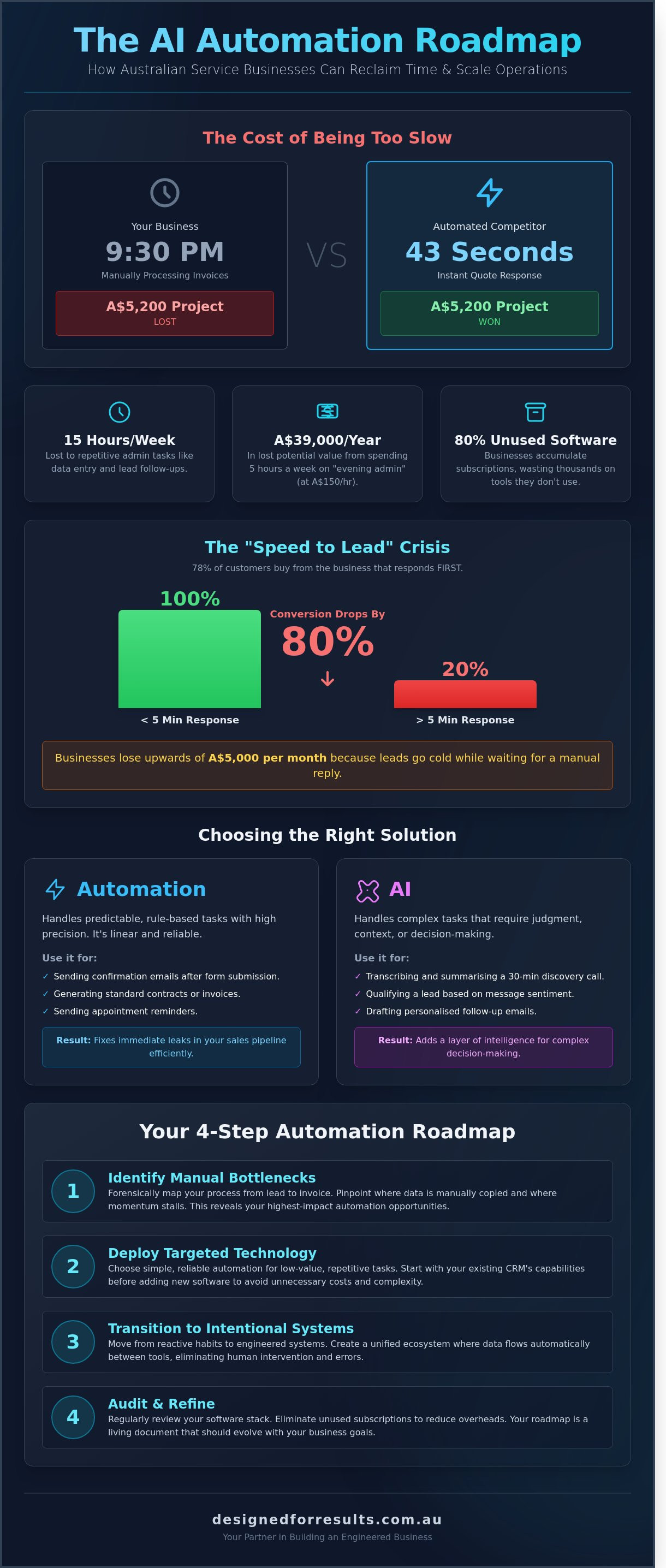
On 14 January 2026, an Australian business owner lost a A$5,200 project because a competitor's automated system responded to a quote request in 43 seconds. While they were stuck manually processing invoices at 9:30 PM, the lead had already moved on. Implementing a clear ai automation roadmap is no longer a luxury but a necessity for local service providers trapped by repetitive data entry and operational bottlenecks. You likely started your business to gain freedom, yet you're spending your evenings tied to a laptop instead of growing your revenue or spending time with family.
You deserve a business that operates with precision and rewards your expertise rather than your stamina. We'll provide a practical, non-technical path to reclaim your personal time and scale your operations through deliberate systems. This guide shows you how to identify high-impact tasks, prioritise your technology investments, and build a system that captures every lead instantly. By the end of this article, you'll have a clear plan to transform your daily workflow and drive measurable outcomes for your business.
What is an AI automation roadmap for an Australian business?
An ai automation roadmap is a structured plan to identify manual bottlenecks and deploy technology to handle repetitive tasks. Many Australian business owners lose 15 hours every week to administrative tasks like lead follow-ups and manual data entry. This plan moves the business from accidental operational habits to intentional business systems. It ensures every software investment serves a specific, measurable purpose. Without this clarity, businesses often accumulate software subscriptions that remain 80% unused, wasting thousands of A$ annually. A bespoke ai automation plan ensures you only pay for what you actually use.
The difference between automation and AI
Automation handles rule-based tasks. If a customer submits a web form, the system sends a confirmation email. It's linear and predictable. AI handles tasks requiring judgement. This includes transcribing a 30-minute discovery call or qualifying a lead based on the sentiment of their message. Many Australian businesses start with automation to fix immediate leaks in their sales pipeline before layering in AI for complex decision-making. Determine the specific output your business requires before committing to new tools. This prevents over-investing in complex technology when a simple automated workflow would suffice.
Why 2026 is the year to systematise
The rising cost of manual labour in Australia makes operational efficiency a competitive necessity. With the national minimum wage increasing by 3.75% in July 2024, the cost of human-led data entry continues to climb. Current no-code tools allow small to medium-sized businesses to build complex systems without hiring expensive developers or software engineers. These tools provide the agility needed to respond to market shifts without increasing headcount. An ai automation roadmap is a living document that evolves with business goals. By implementing these systems now, you secure a foundation that supports higher revenue without the burden of additional evening admin.
- Identify manual bottlenecks in your current lead-to-quote process.
- Deploy technology to handle low-value, repetitive administrative tasks.
- Transition from reactive habits to intentional, engineered systems.
- Audit existing software to eliminate unused subscriptions and reduce overheads.
Identifying high-friction points in your current operations
Every Australian business carries invisible costs within its daily workflows. Building an ai automation roadmap requires a forensic look at the path from an initial enquiry to the final invoice. You must pinpoint exactly where momentum stalls. Mapping this journey reveals data silos where staff manually copy details between a CRM and accounting software like Xero. This manual entry isn't just slow; it introduces errors that 27% of small businesses report as a primary cause of billing delays and customer disputes.
Many owners sacrifice their personal time to handle "evening admin." This typically involves drafting quotes, updating project schedules, or reconciling accounts after the kids have gone to bed. If you spend five hours a week on these tasks, and your billable rate is A$150, you are losing A$39,000 in potential value every year. Identifying these friction points allows you to reclaim your time and focus on high-level leadership. Success in this area is a result of clarity and execution.
The Lead Follow-Up bottleneck
Calculate your "speed to lead" by measuring the minutes between a web form submission and a human response. Research indicates that 78% of customers buy from the business that responds first. If your response time exceeds five minutes, your conversion probability drops by 80%. Businesses often lose upwards of A$5,000 per month in potential revenue because leads go cold while waiting for a manual email. Implementing lead follow up systems ensures no prospect is ignored during the critical decision-making window.
Administrative and repetitive tasks
List every daily task that requires zero creative input. These activities often include:
- Generating standard contracts and service agreements.
- Sending manual appointment reminders and handling rescheduling requests.
- Chasing clients for document collection or identity verification.
Manual reminders are particularly draining; Australian businesses that automate these notifications see a 40% reduction in no-shows. These friction points extend project timelines and inflate overheads. You can explore bespoke ai automation to handle these low-value activities, moving your team toward more impactful work that directly increases your bottom line.
Choosing the right solutions: Automation vs. AI
Selecting the right technology is the most critical phase of your ai automation roadmap. Many Australian businesses waste thousands of dollars on complex large language models when a simple "if-this-then-that" trigger would solve the problem more reliably. Prioritise reliability and cost-effectiveness. Select tools with a proven track record of stability rather than chasing novelties that lack a clear return on investment.
Assess your existing CRM capabilities before adding new third-party software. Most modern platforms already contain powerful automation hooks that go unused. Software subscriptions can easily exceed A$500 per month; choosing the wrong tool is an expensive mistake. Adding unnecessary layers of software increases your tech debt and creates more manual maintenance work. Ensure every chosen tool communicates through open APIs or native integrations. Systems that cannot share data automatically simply trade one manual task for another. The goal is a unified ecosystem where data flows without human intervention.
When simple automation is enough
Workflow automation handles repetitive, logic-based tasks with high precision. Use tools like Zapier or Make.com to connect your business apps, sync customer data, or trigger internal notifications. These platforms are ideal for managing basic email sequences and ensuring your lead data moves from your website to your CRM instantly. Refer to this guide on workflow automation vs custom software to decide which solution suits your operational scale. Simple automation provides the immediate time-savings that many business owners need to reclaim their evenings.
Where AI adds real value to an SME
AI provides the greatest return when tasks require natural language processing or complex decision-making. Deploying AI voice agents allows Australian businesses to handle after-hours enquiries and booking requests without the overhead of a 24/7 call centre. Chatbots powered by AI qualify website leads and provide instant quote calculators, moving prospects through the sales funnel while you sleep. Implementing AI to transcribe client meetings and automatically populate CRM fields can save managers approximately 12 hours of administrative work per month. These applications ensure your ai automation roadmap directly increases your capacity to generate revenue.
The 4-Phase implementation roadmap
Executing an ai automation roadmap requires a logical sequence to ensure stability before scale. Jumping into advanced AI without a solid foundation creates technical debt and fragmented data. Success depends on a structured progression from manual observation to autonomous execution.
Phase 1 & 2: Building the core
Execution begins with a comprehensive audit. Document every manual touchpoint in your core processes, from how a lead enters your system to how an invoice is dispatched. Research shows Australian business owners lose an average of 15 hours per week to repetitive administration. Identifying these specific time-wasters allows you to prioritise tasks with the highest return on investment.
Clean your data before migrating it into an automated CRM system. Automation acts as a multiplier; if your data is messy, you'll simply produce errors at a higher frequency. Establish a single source of truth where customer information is accurate and accessible. Once the system is live, focus on team adoption. Provide clear documentation and training to ensure your staff understands the new workflows. This prevents a return to manual habits that bypass the system and create data silos.
- Identify every repetitive data entry task.
- Standardise lead status definitions across the business.
- Migrate cleaned data into a centralised CRM.
Phase 3 & 4: Scaling efficiency
Shift your focus to high-impact quick wins that generate immediate revenue. Implementation of instant quote calculators on your website captures high-intent leads while they're most engaged. Data from 2023 indicates that 78% of customers purchase from the business that responds first. Automating this initial touchpoint ensures you're always the first to the table.
Scale your efficiency by automating the contract and proposal process. Use deal data stored in your CRM to generate bespoke documents instantly, removing the bottleneck of manual drafting. For complex, industry-specific workflows, introduce bespoke ai automation. This advanced layer handles nuanced tasks like intelligent scheduling, technical report generation, or AI-driven customer support agents that understand your specific service offerings. These tools allow your business to handle a 30% increase in volume without adding to your headcount.
Move beyond simple triggers and integrate agents that can reason through data. This level of automation transforms your operation from a manual grind into a high-performance system. You'll stop spending your evenings on admin and start focusing on high-level growth.
Ready to reclaim your time and scale your Australian business? Book a consultation to start your roadmap today.
Executing your roadmap with Designed For Results
An ai automation roadmap serves as a blueprint, but the true value lies in its execution. Many Australian businesses lose approximately 25% of their weekly capacity to manual data entry and lead management. Designed For Results bridges the gap between high-level strategy and project-based implementation. We provide an external perspective to identify the hidden efficiency gaps that internal teams often miss due to organisational habit. Our partnership accelerates the transition to automated systems, ensuring you don't waste capital on trial and error.
Our results-oriented approach
We focus on two primary metrics: increasing your revenue and giving you your time back. Our team avoids technical jargon, focusing instead on the bottom-line impact of every automation we deploy. For instance, service businesses often see a 30% reduction in operational costs within the initial six months of implementation. Our approach ensures:
- Measurable Outcomes: We track specific KPIs to ensure your investment delivers a clear return.
- Managed Support: We provide ongoing assistance so your systems evolve alongside your business.
- Strategic Alignment: Every automation is designed to support your specific long-term goals and leadership capability.
You can review our methodology by exploring our process, which is built for the specific needs of the Australian market. We move beyond theory into direct action, handling the technical complexities so you can focus on high-level leadership. This professional partnership ensures your transition to automated systems is seamless and profitable.
Start your automation journey today
The struggle to follow up on leads or the burden of evening admin is solved through intentional system design. Most business owners we partner with reclaim 10 to 15 hours every week. This allows for scaling without the need for immediate, expensive headcount increases. You can explore our smart AI solutions which are tailored specifically for service-based businesses in the Australian market.
Taking the first step toward a more efficient operation involves identifying your specific bottlenecks. Reclaim your evenings and scale your operations by focusing on what matters most. Book a consultation to discuss your current challenges and see how a tailored ai automation roadmap can transform your daily operations and improve your customer journey.
Secure Your Operational Advantage for 2026
Building a resilient Australian business requires moving beyond manual administration and late-night paperwork. By 2026, the competitive gap between businesses using a structured ai automation roadmap and those relying on legacy processes will widen. Success starts with identifying high-friction points like delayed lead follow-ups and repetitive data entry that currently drain up to 15 hours of weekly management time. Implementing these systems in clear phases ensures your operations remain stable while you reclaim the capacity needed to drive new revenue.
Designed For Results specialises in supporting Australian SME service businesses through managed service retainers that provide ongoing optimisation. We focus on immediate time recovery and ensuring no quote or lead falls through the cracks. Transitioning to an automated model allows you to focus on high-level leadership while your systems handle the routine tasks. You can transform your daily operations into a precise system that delivers consistent results without your constant intervention.
Let’s chat about your business automation roadmap
The path to a more efficient and profitable operation is within your reach.
Frequently Asked Questions
How much does an AI automation roadmap cost for an Australian business?
An AI automation roadmap for an Australian business typically ranges from A$2,500 to A$10,000 depending on operational complexity. This investment covers the discovery phase, process mapping; and the selection of specific tools. High-performance businesses often recover this cost within 4 months by eliminating 15 hours of manual admin weekly, allowing owners to reclaim their evenings.
Do I need to be a tech expert to use AI in my business?
You don't need technical expertise to implement these solutions. Most modern tools use simple interfaces that allow you to manage workflows without writing code. We focus on building systems that your current team can operate easily; ensuring the technology serves your business goals rather than creating new technical hurdles or requiring expensive new hires.
Will AI and automation replace my existing staff?
Automation replaces repetitive tasks, not people. By automating data entry or quote generation, your staff can focus on high-value client interactions that drive revenue. Research from 2023 shows that businesses using automation see a 20% increase in employee satisfaction because staff no longer spend their evenings catching up on administrative paperwork or repetitive filing.
How long does it take to see results from an automation roadmap?
You'll see initial time savings within the first 14 days of implementing your first automated workflow. A complete ai automation roadmap usually delivers measurable ROI within 90 days. For instance, automating lead follow-up can increase conversion rates by 25% almost instantly by ensuring no enquiry goes unanswered for more than 5 minutes during business hours.
Can I automate my lead follow-up if my sales process is highly personal?
You can automate the initial contact while keeping the core conversation personal. Systems send an immediate, personalised SMS or email to acknowledge the enquiry within 60 seconds. This secures the lead's attention so you can step in for the nuanced, high-level consultation when it suits your schedule, ensuring you never lose a prospect to a faster competitor.
What happens if the automated system fails or makes a mistake?
Every ai automation roadmap includes human-in-the-loop checkpoints to prevent errors. We build notification triggers that alert you if a process stops or encounters an anomaly. Statistics indicate that well-designed automation reduces human error by 85% compared to manual data entry, making your operations more reliable than they are today.
Is my business data safe when using AI and automation tools?
Data security is a primary component of any professional implementation. We select tools that comply with Australian Privacy Principles and use enterprise-grade encryption. Your data remains your property; we ensure it's handled through secure connections that protect sensitive client information from external threats while maintaining strict access controls for your team.
Do I need to change my current CRM to implement a roadmap?
You don't need to scrap your existing CRM if it has an open API. Most Australian businesses use platforms like HubSpot, Pipedrive, or Salesforce, which integrate seamlessly with automation tools. If your current system is outdated, we identify the most cost-effective way to migrate your data without disrupting your daily operations or losing historical client records.
