
Fixing a Leaky Sales Funnel: The 2026 Guide for Australian Businesses

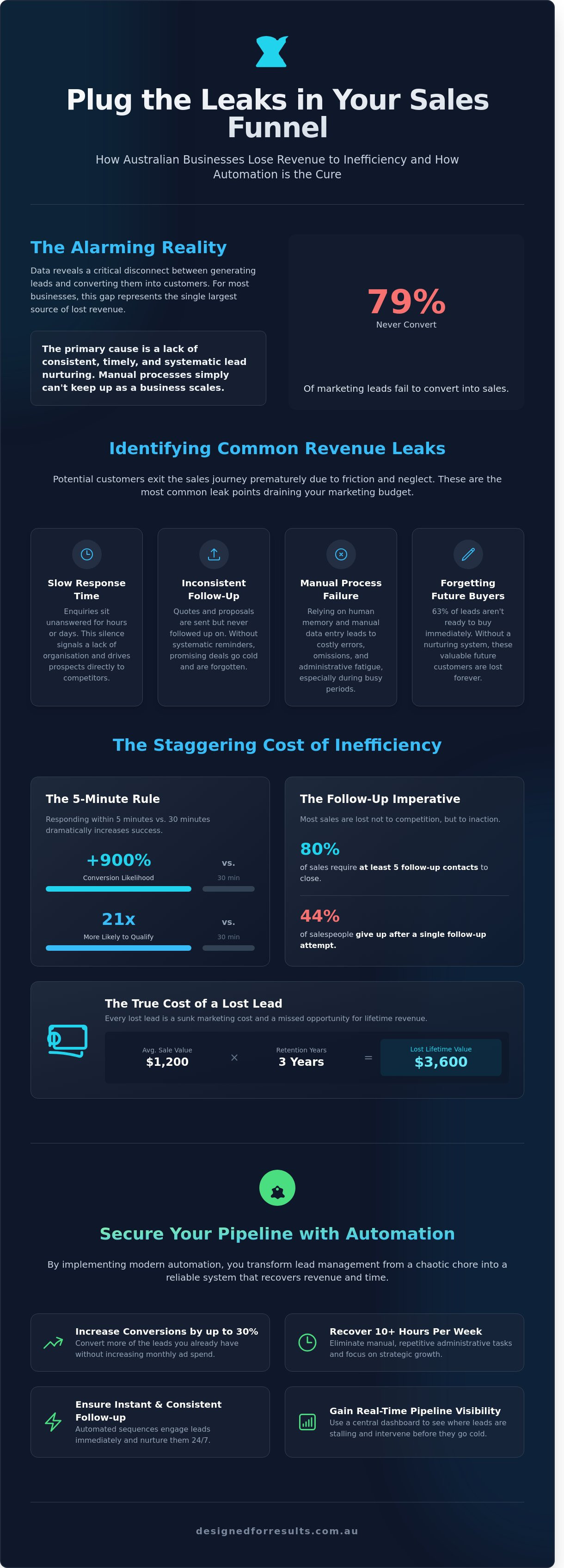
Data from 2024 indicates that 79% of marketing leads never convert into sales, primarily because of a lack of consistent lead nurturing. For many Australian business owners, this loss is the direct result of a leaky sales funnel that drains resources and stifles growth. You've likely felt the pressure of managing manual follow-ups and administrative tasks well into your evening hours while your cost per acquisition continues to climb.
It's exhausting to be too busy to grow; you recognise that your current manual processes aren't sustainable if you want to scale. This guide identifies where your revenue is escaping and demonstrates how to secure your pipeline using modern automation. By implementing these systems, you can expect to increase conversion rates by up to 30% without increasing your monthly ad spend. We'll examine the specific tools and workflows that transform lead management from a chaotic chore into a reliable, automated system that recovers 10 hours of your week.
Understanding the Leaky Sales Funnel Concept
A leaky sales funnel is a system where potential customers exit the journey prematurely due to friction or neglect. Australian businesses often excel at lead generation but struggle with lead management. This distinction is critical. A marketing problem involves a lack of traffic, whereas a process-driven sales leak involves a failure to convert existing interest. Understanding the Leaky Sales Funnel Concept reveals that friction points often occur long after the initial marketing spend has done its job. When lead management relies on memory or inconsistent effort, revenue disappears through the cracks of the pipeline. Manual methods fail as an Australian business begins to scale, turning administrative fatigue into a primary cause of lost revenue.
The Anatomy of a High-Performing Sales Pipeline
A high-performing pipeline moves prospects through a structured journey from the initial enquiry to a signed contract. Consistency drives this progression. Data from industry studies indicates that 80% of sales require at least five follow-up contacts, yet 44% of sales professionals give up after a single attempt. Successful businesses use clear touchpoints to maintain prospect interest without requiring constant manual oversight. Visibility is equally vital. A central sales dashboard provides real-time insights into where prospects stall. This clarity allows managers to intervene before a lead turns cold, ensuring that every enquiry receives the attention it requires to convert into a measurable outcome.
Why Manual Processes Create Revenue Leaks
Human memory is a poor tool for lead management. When an Australian business owner manages quotes during evening hours, administrative fatigue leads to errors and omissions. These mistakes are costly. Research shows that responding to a lead within five minutes increases the likelihood of conversion by 900% compared to waiting thirty minutes. Manual data entry is slow and prone to failure during busy periods. These delays signal a lack of professionalism to the prospect and invite them to contact a competitor. Automating repetitive administrative tasks ensures that no enquiry is ignored, protecting the bottom line from avoidable losses. Transitioning away from manual oversight allows the owner to reclaim their time while maintaining a leaky sales funnel repair strategy that functions around the clock.
Identifying Common Leak Points in the Customer Journey
Most Australian businesses lose potential revenue because they fail to connect lead capture with immediate action. A leaky sales funnel often occurs when a prospect expresses interest but encounters a silence that lasts hours or days. This gap represents a failure in operational design. When enquiries sit in an inbox while the owner manages on-site work, the prospect moves to a competitor who answers their phone. Quantifying the Financial Impact of Inefficient Processes reveals that friction at the top of the funnel compounds as the prospect moves toward a decision.
Unreturned phone calls and unquoted leads are the most visible symptoms of a broken system. Many business owners spend their evenings manually typing quotes or returning calls from ten hours ago. This reactive approach is unsustainable. It leads to burnout and prevents the business from scaling. Prospects who aren't ready to buy immediately are often forgotten entirely, even though 63% of people requesting information about a company won't purchase for at least three months. Without a systematic way to stay in touch, these leads evaporate, leaving the business dependent on the small percentage of people ready to buy today.
The Speed to Lead Factor
Speed to lead is the time elapsed between a prospect submitting an enquiry and a representative responding. In the Australian market, the standard for excellence has shifted from hours to minutes. Research indicates that responding within five minutes increases the likelihood of qualifying a lead by 21 times compared to a 30-minute response. Prospects feel ignored when they don't receive an immediate acknowledgement. This silence signals a lack of professional organisation and drives them to seek alternatives instantly.
Inconsistent Follow-Up on Quotes and Proposals
Many businesses fail to follow up after sending a price estimate because the task requires manual tracking that falls through the cracks during busy periods. Business owners often find themselves performing administrative tasks late at night, which reduces their capacity for strategic leadership. Implementing automated follow-up sequences for new enquiries ensures that no prospect is left wondering about the next steps. Automation maintains momentum without requiring the owner's constant intervention. Addressing these gaps stops the leaky sales funnel from draining your marketing budget and gives you back valuable time. If you want to see how these systems fit your specific needs, you can explore our bespoke automation solutions.
Quantifying the Financial Impact of Inefficient Processes
Inefficiency acts as a silent tax on Australian businesses. A leaky sales funnel does more than lose a single transaction; it erodes the foundation of scalable revenue. Most owners focus on increasing lead volume, yet failing to convert existing traffic is the most expensive mistake a service business can make. Every lead that falls through the cracks represents a sunk cost in marketing and a missed opportunity for long-term profit.
The True Cost of a Lost Lead
Calculate the lifetime value (LTV) of every missed opportunity to understand the true damage. Use the formula: (Average Sale Value x Annual Frequency) x Retention Years. Losing a $1,200 service contract from a customer who would typically stay for three years represents a $3,600 loss in revenue. When 15% of enquiries vanish due to slow follow-ups, your marketing budget effectively carries a 15% surcharge for zero return. Integrating smart AI solutions ensures every enquiry receives an immediate response. This preserves the value of your advertising spend and prevents competitors from winning the business by simply being faster. This shift from a linear process to a continuous cycle of engagement is supported by the Harvard Business Review on the sales flywheel, which highlights how maintaining momentum through better lead management drives compounding growth. Ignoring leads also creates a reputation for unreliability. In a tight Australian market, word-of-mouth travels fast, and a history of non-responsiveness becomes a permanent barrier to acquisition.
Admin Fatigue and the Growth Ceiling
Many Australian business owners spend 10 to 15 hours every week on manual data entry, lead sorting, and quote follow-ups. This admin fatigue creates a hard ceiling on growth. If your hourly value is $200, spending 10 hours on repetitive tasks costs the business $2,000 weekly in lost high-level output. This is a significant opportunity cost that prevents the owner from working on high-level business development or service delivery. Hiring more staff to manage these process gaps often increases complexity and overhead without fixing the underlying inefficiency. Implementing bespoke AI automation removes these manual bottlenecks. It allows the business to handle a higher volume of clients without a linear increase in headcount. This reclaimed time allows the owner to focus on high-value activity rather than being trapped in the evening admin cycle. Plugging a leaky sales funnel is always more cost-effective than increasing marketing budgets because it maximises the utility of the resources you already have.
Strategies to Repair Your Sales Pipeline Using Automation
Securing a leaky sales funnel requires a shift from manual oversight to automated precision. Data from 2024 indicates that Australian businesses lose approximately 27% of potential revenue due to delayed follow-ups and fragmented data storage. Implementing a centralised CRM for small business in Australia provides a single source of truth, ensuring no lead vanishes into an unmonitored inbox or a forgotten spreadsheet. This system serves as the foundation for every subsequent interaction, capturing data points that allow for personalised engagement at scale without increasing the owner's workload.
Accelerate the sales cycle by automating the collection of documents and approvals. Traditional methods involving back-and-forth emails often add five to seven days to a typical closing process, increasing the risk of a leaky sales funnel as prospects lose interest. Digital signature integrations and automated document requests trigger as soon as a deal reaches a specific stage in the CRM, removing the bottleneck of manual chasing. This level of efficiency gives the business owner their evenings back, replacing repetitive admin with high-level decision-making and strategic planning.
Automation also handles the heavy lifting of lead prioritisation. By assigning lead scores based on interaction history, the system identifies which prospects require immediate human intervention and which need further education. This ensures the sales team focuses their energy on the 20% of leads most likely to convert, rather than wasting time on low-intent inquiries that drain resources.
Implementing an Automated Lead Generation System
Connect website forms directly to your CRM to ensure immediate data capture and eliminate manual entry errors. Speed is the primary factor in conversion; responding to a lead within five minutes increases the likelihood of a successful contact by 100 times compared to a 30-minute delay. Set up instant notifications via SMS or internal chat tools to alert sales teams when a high-value lead arrives. For technical implementation steps, refer to this guide on automated lead generation systems.
Nurturing Leads with Automated Sequences
Maintain consistent engagement through behaviour-triggered email and SMS campaigns. These sequences ensure your business stays top-of-mind without requiring manual input for every message sent. Deliver value by sharing case studies or industry insights through automated lead nurturing. Transition prospects from lead magnet delivery to a booked consultation by embedding calendar links directly into the communication flow. This approach turns cold interest into a scheduled appointment, removing the friction of manual scheduling and reducing the back-and-forth of finding a suitable time.
Eliminate the manual burden of sales tracking and start reclaiming your time today. Let's chat about how automation can secure your pipeline and improve your bottom line.
Transforming Lead Management with Intelligent Systems
Modern technology provides a permanent fix for a leaky sales funnel by replacing manual, error-prone tasks with precise automation. Australian businesses often lose 25% of potential revenue simply because enquiries go unanswered during evenings or weekends. Intelligent systems eliminate this gap. They ensure every lead is captured, categorised, and moved through the pipeline without human intervention. This shift allows business owners to stop working on administration during their nights and start focusing on high-level decision-making. Success in 2026 relies on this level of operational precision.
Leveraging AI for Enhanced Lead Qualification
AI assistants now vet leads before they ever reach a human salesperson. These systems ask specific qualifying questions to determine if a prospect has the budget and timeline required for your services. This prevents your sales team from wasting time on low-quality enquiries. Online calculators and automated quote systems provide instant value, satisfying the 82% of consumers who demand immediate responses to sales enquiries. Implementing AI voice agents for small business allows for professional, 24/7 handling of initial phone calls. These agents can book appointments directly into your calendar, ensuring your pipeline remains full even while you are off-site or managing other projects.
Taking the Next Step Toward Efficiency
Fixing your operations begins with a thorough review of your current sales process to identify obvious leaks. Look for stages where response times exceed two hours or where manual data entry causes delays. If your growth is stalled because you are too busy to handle more volume, automation is the solution. You can learn more about Designed For Results to see how we help Australian businesses reclaim 10 to 15 hours of their week. Our approach focuses on measurable outcomes and operational clarity.
When you are ready to stop the leaks in your leaky sales funnel and increase your revenue, book a chat to discuss your specific automation needs. Implementing these systems is the most direct path to scaling your business without increasing your personal workload.
Secure Your Revenue for 2026 and Beyond
A leaky sales funnel costs the average Australian business approximately 20% of its potential annual revenue through missed follow-ups and abandoned quotes. Identifying these gaps is the first step toward reclaiming lost profit. Implementing custom AI and no-code workflow solutions ensures every lead receives a prompt response; this eliminates the need for manual data entry during your evenings. Our Australian-based automation specialists help you recover up to 15 hours of administrative time each week. This shift allows you to focus on high-value tasks while your systems manage the repetitive follow-up processes. Measurable ROI becomes visible within the first 90 days of deploying these intelligent systems. You gain clarity over your customer journey and stop the cycle of working on admin until midnight. Refined lead management systems turn your existing traffic into consistent revenue without increasing your workload.
Secure your sales pipeline and regain your time; let’s chat about your automation needs.
Building a more efficient process creates the space your business needs to grow sustainably.
Frequently Asked Questions
What are the first signs of a leaky sales funnel?
The primary indicator of a leaky sales funnel is a high volume of leads that fail to convert into quotes or bookings. Australian businesses often notice that 40% of their initial enquiries go cold because the owner is too busy to respond within the first hour. If your conversion rate drops by 15% between the initial contact and the proposal stage, your process is losing potential revenue through gaps in communication.
How much revenue is typically lost to a leaky sales funnel?
Research from the Harvard Business Review indicates that businesses lose up to 20% of their potential annual revenue due to poor lead management. For an Australian business generating $500,000 annually, this equates to $100,000 in missed opportunities every year. These losses stem from forgotten follow-ups and manual administrative errors that allow prospects to slip through the cracks while the owner handles back-office tasks during their evenings.
Can automation fix a leaky funnel without a large budget?
Automation is accessible for small businesses with monthly software costs starting as low as $30. You can implement simple triggers that send immediate email or SMS acknowledgements when a lead arrives, ensuring no enquiry is ignored. This level of automation saves owners roughly 10 hours of manual admin each week. It allows them to focus on high-value billable work instead of chasing paper trails or typing out repetitive responses.
How does a CRM help in identifying funnel leaks?
A CRM tracks every interaction from the first click to the final invoice, highlighting exactly where prospects stop moving forward. If 60% of your potential clients drop off after receiving a quote, the CRM identifies this specific bottleneck for you. This data provides a clear view of your sales process. It ensures you know exactly which stages require immediate attention to improve your bottom line and overall efficiency.
Is it better to fix the funnel before increasing ad spend?
Repair a leaky sales funnel before increasing your advertising budget. Doubling your ad spend while your conversion rate is low only increases the cost of acquiring a customer, which erodes your profit margins. Australian businesses that improve their internal processes first often see a 30% increase in ROI from their existing traffic. They achieve this without spending an extra cent on Google or Meta ads by simply capturing more of their existing leads.
What is the difference between lead generation and lead nurturing?
Lead generation is the process of attracting 50 new enquiries through marketing or referrals. Lead nurturing is the subsequent series of automated follow-ups and educational content that builds trust until the prospect is ready to buy. Most businesses fail because they focus 90% of their energy on generation while neglecting the nurturing phase. This leaves the owner to manually chase leads during their evenings instead of enjoying their personal time.
How long does it take to see results from automating a sales funnel?
Most Australian businesses see measurable improvements in their response times and lead engagement within 30 days of implementing automation. By the 90-day mark, the reduction in manual admin tasks typically returns five hours of personal time to the business owner each week. These results are immediate because automation works 24/7. It ensures that every quote is followed up according to a set schedule without any human intervention or manual effort.
Do I need AI to fix my sales funnel or is automation enough?
Basic automation is sufficient for most service-based businesses to close their funnel gaps. While AI can help with content creation, simple automated workflows handle the 80% of repetitive tasks that currently drain your time. You can achieve high-performance outcomes by setting up logic-based triggers for emails and quotes. This provides the consistency your customers expect. It removes the need for advanced AI systems that many small businesses find unnecessary.
