
Presenting an Automation ROI Case to Stakeholders: A 2026 Guide for Australian SMEs

A 2026 survey found that 90% of medium-sized Australian businesses expect to use AI by the end of this year. While the technology is accessible, many leaders still find themselves trapped in manual cycles, processing quotes after hours or watching leads go cold due to delayed responses. Successfully presenting an automation ROI case to stakeholders requires shifting the conversation from technical features to quantifiable financial outcomes. It's about proving that systematic efficiency is the only viable path to scaling without over-extending your payroll.
You understand that manual administration is currently capping your revenue and draining your personal time. Learn how to build a data-backed argument that justifies the investment in workflow automation and lead follow-up systems. We will examine the specific metrics that resonate with decision-makers, including how to leverage the permanent $20,000 instant asset write-off to maximise your financial returns and restore your capacity to lead.
Defining the Value of Automation Beyond Technical Metrics
Automation ROI represents the measurable gain achieved by replacing manual, repetitive tasks with intelligent systems. While the standard formula for Return on Investment (ROI) calculates the net profit divided by the cost of investment, an Australian business must look deeper into operational reality. Successfully presenting an automation ROI case to stakeholders requires a focus on how these systems reclaim the owner’s evening hours and eliminate the administrative friction that stalls scaling. The objective is to quantify the transition from manual data entry to systematic execution.
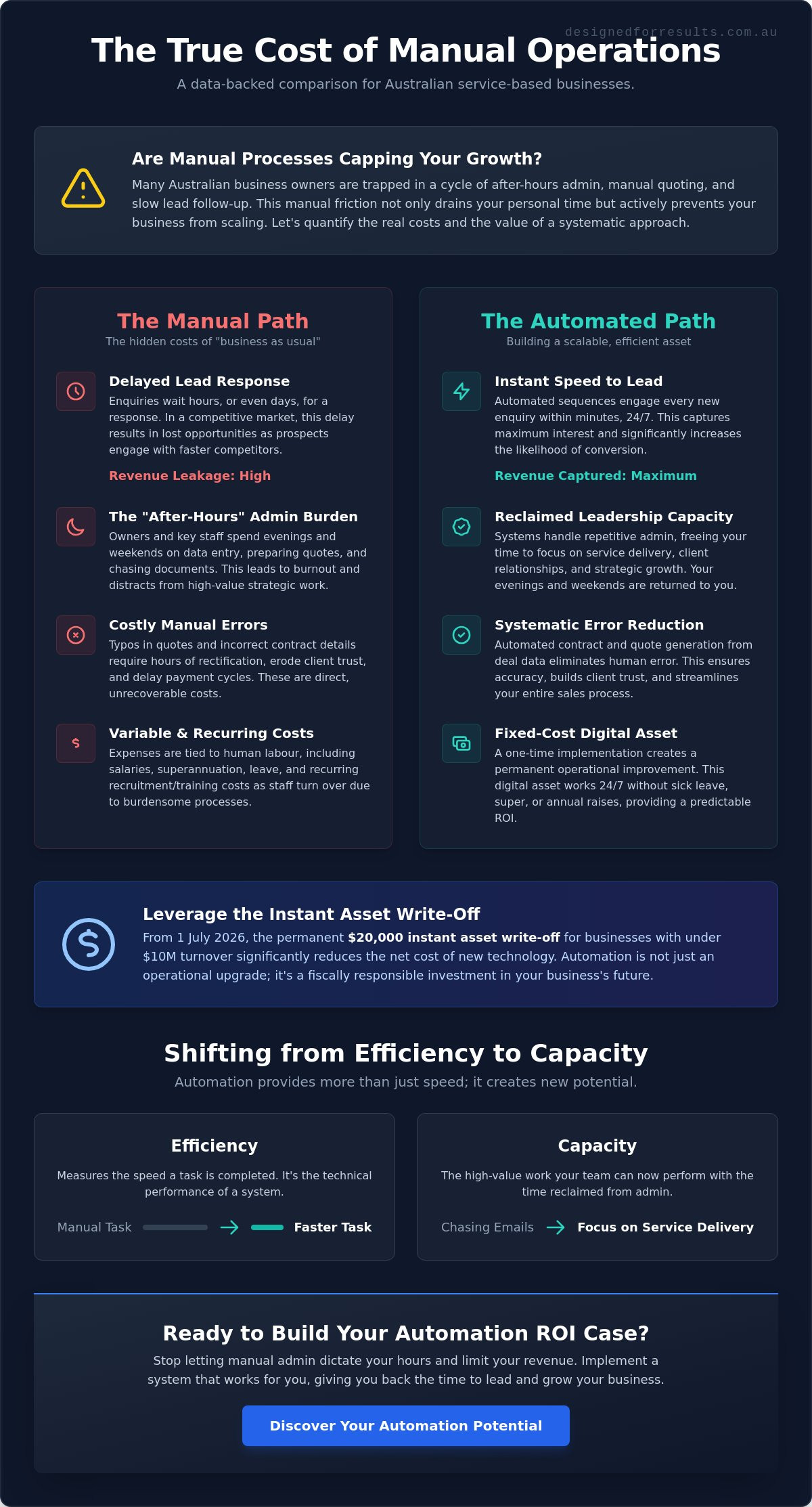
Hard cost savings are easily identified in reduced labour hours. However, the true value often lies in soft capacity gains and improved business outcomes. Consider these primary metrics:
- Lead Conversion Rates: Automated follow-up sequences for new enquiries ensure no lead is lost to a slow response.
- Error Reduction: Systems that handle auto contract generation from deal data eliminate the costly mistakes associated with manual typing.
- Speed to Lead: Instant quote calculators on your website provide immediate value to prospects, significantly increasing the likelihood of a sale.
A 2026 survey found that 42% of Australian SMEs are currently using AI to enhance their marketing and sales. These businesses recognise that automation serves as a scalable foundation. It allows you to increase your output without the immediate requirement to hire more expensive staff.
The Distinction Between Efficiency and Capacity
Efficiency measures the speed at which a specific task is completed by a system. It's the technical performance of your bespoke automation solutions. Capacity refers to the additional high-value work your team can perform when freed from repetitive admin. When you automate document collection from clients, your staff can focus on service delivery rather than chasing emails. This shift in capacity has a direct impact on your ability to onboard new clients and grow your revenue without increasing your overheads.
Shifting the Narrative from Expense to Investment
Automation functions as a digital asset that appreciates through consistent performance. One-time implementation fees for a CRM or a lead generation system result in permanent operational improvements that do not require sick leave or annual raises. The risk of inaction is high. Competitors adopting faster lead response systems will inevitably capture the market share of businesses that remain manual.
The financial case is further strengthened by current Australian tax policy. From 1 July 2026, the permanent $20,000 instant asset write-off allows businesses with a turnover of less than $10 million to immediately deduct eligible assets. This measure reduces the net cost of implementing new technology, making the decision to automate a matter of fiscal responsibility. Clear planning ensures that every dollar spent on technology is a deliberate step toward a more profitable, less stressful operation.
Quantifying the Hidden Costs of Manual Processes
Identify the specific financial leaks in your current operations. Most Australian businesses fail to account for the cumulative cost of repetitive administrative tasks, assuming they are simply part of doing business. When presenting an automation ROI case to stakeholders, you must audit the hours lost to data entry, manual follow-ups, and document preparation. Audit your team's weekly schedule. Calculate the total hours spent by key staff on these activities and multiply this by their hourly rate, including superannuation and overheads. This figure represents the baseline cost of manual operations.
Document the frequency of manual errors. A single typo in a quote or an incorrect detail in a contract leads to hours of rectification. It erodes client trust and delays payment cycles. Quantify these events over a typical month to reveal the true cost of human-led administration. These errors are not just inconveniences; they are direct hits to your bottom line that a systematic approach eliminates.
The Price of the "After-Hours" Admin Burden
Quantify the time you spend on admin during evenings and weekends. This shadow work prevents you from focusing on high-level leadership and critical decision-making. Chronic overwork leads to burnout, which inevitably degrades the quality of your leadership. Compare the ongoing expense of hiring a human assistant against the efficiency of a workflow automation system. A digital asset performs consistently without the recurring overheads of payroll taxes, leave entitlements, or management time. It provides a fixed-cost solution to a variable-cost problem.
Revenue Leakage from Slow Lead Response
Measure your speed to lead with precision. Prospects are most likely to convert when engaged within minutes of their initial enquiry. In the competitive Australian service sector, a delayed response is often a lost opportunity. Identify the average lifetime value of a single client. If manual follow-up delays cause you to lose just two leads per month, the annual impact on your revenue is substantial. Implementing automated follow-up sequences ensures every enquiry is engaged immediately, regardless of the time of day. This systematic responsiveness captures revenue that currently leaks through the cracks of a manual process. If you want to see where your specific leaks are occurring, you can book a brief discussion to evaluate your current lead flow.
Constructing a Defensible ROI Comparison
Presenting an automation ROI case to stakeholders requires a side-by-side comparison of total ownership costs over a 12-month period. In the manual column, you must account for the full expense of human-led operations. This includes gross salaries, superannuation, and the hidden costs of staff turnover and recruitment. Australian businesses often underestimate the price of retraining new staff when manual processes become too burdensome for current employees to manage. In the automation column, list the initial implementation fees and any monthly managed service retainers. This provides a transparent, fixed financial baseline that contrasts with the variable and often escalating costs of manual labour.
Identify the break-even point with precision. This is the specific moment when the cumulative savings from reduced errors and reclaimed time exceed the cost of the technology. A systematic approach allows you to demonstrate exactly how the investment pays for itself. By documenting the frequency of manual errors as established in your previous audit, you can assign a direct value to the accuracy provided by automated systems. The goal is to prove that automation is a fiscal necessity for any business aiming to scale without a linear increase in headcount.
Hard Savings vs. Revenue Capture
Hard savings provide immediate relief to your profit and loss statement. These include the reduction of redundant software subscriptions and the lowering of administrative wages as repetitive tasks are absorbed by the system. Revenue capture represents the income generated by converting a higher percentage of enquiries through AI lead generation systems. When your business implements automated follow-up, you ensure that no quote remains unpursued. This systematic persistence captures revenue that would otherwise be lost to competitors who respond faster. It transforms your lead flow from a leaky bucket into a reliable pipeline.
Modeling the Payback Period
Project your cumulative savings over a three-year period to demonstrate long-term value. While manual labour costs in Australia continue to rise due to inflation and regulatory changes, the cost of automation remains relatively flat after the initial setup. This divergence creates a widening gap of profitability. Identify the specific point in time when the system transitions from a capital expense to a profit-generating asset. With 55% of small businesses planning to increase their technology spending in 2026, the payback period is a critical metric for maintaining a competitive edge. It shows that you aren't just saving money; you're building a more resilient operational structure.
Communicating the Case to Decision-Makers
Presenting an automation ROI case to stakeholders is an exercise in clarity. Stakeholders prioritise operational stability over technical novelty; therefore, your presentation must focus on how systematic workflows protect the business from the volatility of manual errors. Use clear business language that highlights fiscal outcomes. Address the common concern of implementation downtime by explaining the managed rollout process. This phased approach ensures that core operations continue without interruption while new systems are integrated and tested in the background. It moves the business from an owner-dependent model to a resilient, system-led operation.
Visualise the operational shift where the management team regains 10 or more hours per week. This is a common outcome for an Australian business that replaces manual lead follow-up with automated sequences. Real-world examples in the service sector show that businesses adopting these systems often see a measurable increase in capacity without the need for additional recruitment. By focusing on these tangible results, you demonstrate that automation is a practical solution for scaling. You can request a strategy briefing to help structure these specific projections for your stakeholders.
Addressing the Complexity and Risk Concerns
Address the perceived risks of technology adoption by highlighting the role of a managed service retainer. This ensures that your systems receive ongoing maintenance and monitoring to prevent performance drift. Automated systems also improve data security and compliance. Moving sensitive client data from manual spreadsheets into a secure CRM reduces the risk of data breaches and ensures alignment with Australian privacy standards. Confirm that the proposed solutions integrate seamlessly with your existing tools, such as Xero or your current project management software. This connectivity ensures a unified data flow across the entire organisation.
The "Time-Back" Narrative for Stakeholders
Focus the presentation on the human impact of automation for your leadership team. Reclaimed time is a high-value asset that should be reinvested into business development and high-level strategy. When the burden of repetitive admin is removed, managers can focus on improving service delivery and exploring new market opportunities. This shift enhances the customer journey quality. Every interaction becomes instant and professional, which builds trust and encourages repeat business. A 2026 survey found that 55% of small businesses plan to increase their technology spending this year to capture these exact benefits. Aligning your business with this trend ensures you remain competitive while providing your team with the space to lead effectively.
Implementing High-Impact Automation with Designed For Results
Designed For Results specialises in identifying efficiency gaps within an Australian business. We focus on the practical application of technology to solve specific operational bottlenecks. Our process begins with a high-level analysis of your current workflows to develop a custom automation roadmap. This ensures that every implemented system addresses a verified pain point. We provide project-based implementation alongside ongoing managed support to maintain long-term performance. This structured approach ensures that the financial projections made when presenting an automation ROI case to stakeholders are actually realised in your daily operations.
Every solution we deliver is designed to increase revenue while returning time to the business owner. We replace uncoordinated growth with systematic progress. By automating the customer journey from the first enquiry to the final invoice, we eliminate the administrative friction that prevents scaling. Successful implementation relies on the same data-backed logic used when presenting an automation ROI case to stakeholders. It transforms your business into a resilient asset that performs consistently without constant manual intervention.
Bespoke Solutions for Specific Business Needs
Tailored systems address the unique requirements of your industry. You can utilise AI voice agents to handle enquiries without increasing your receptionist costs. As your volume increases, our AI automation agency services provide the scalability required to maintain speed to lead. We also implement custom AI assistants to manage repetitive document generation and contract proposals. These tools ensure your team focuses on high-value service delivery rather than paperwork.
Your Next Steps Toward Operational Clarity
Start your transition by reviewing your current manual processes. Identify the tasks that consume the most time and the points where leads are most likely to stall. Gather the data required to build your own ROI business case using the framework discussed in this guide. Once you have a clear understanding of your requirements, you can move toward a more efficient operational model. Book a strategy session to discuss your specific needs and see how systematic automation can restore your time. Let’s Chat.
Securing Your Operational Future
Transitioning from manual administration to systematic execution is a requirement for any Australian business aiming to scale in 2026. By quantifying hidden costs and leveraging permanent tax incentives like the $20,000 instant asset write-off, you transform technology from an expense into a high-yield asset. Successfully presenting an automation ROI case to stakeholders is the final step in reclaiming your evenings and ensuring no lead is lost to delayed follow-up. This shift moves your organisation from an owner-dependent model to one defined by consistent, scalable performance.
Designed For Results provides the strategic rigor needed to navigate this transition. As an Australian-owned and operated specialist in SME workflow automation, we deliver tailored solutions backed by managed service retainers for ongoing peace of mind. Our focus remains on increasing your revenue while restoring your capacity to lead. Stop losing time to repetitive admin and start building a more resilient, profitable operation today.
Book Your Free Automation Strategy Call
Frequently Asked Questions
What is the most common mistake when presenting an automation ROI case?
The most common error is focusing on technical features rather than financial outcomes. Stakeholders prioritise how a system affects the bottom line and operational stability. When presenting an automation ROI case to stakeholders, you must demonstrate how reclaiming leadership capacity translates into measurable business growth. Avoid discussing software architecture. Instead, focus on how systematic workflows eliminate the manual errors that currently drain your profit margins every month.
How do we measure the ROI of automation if we don’t plan to reduce staff?
Measure ROI through increased capacity and revenue per employee. If you aren't reducing headcount, your return comes from the ability to scale your client base without a linear increase in labour costs. Automation allows your existing team to focus on high-value billable work rather than repetitive administration. This shift increases the total output of your business, making each staff member more profitable to the organisation over time.
Can we calculate the ROI for AI voice agents compared to a human receptionist?
ROI for AI voice agents is calculated by comparing their fixed operational cost against the fully loaded hourly rate of a human employee. You must include superannuation, insurance, and the cost of missed opportunities when a human is unavailable to take a call. An AI agent captures every enquiry instantly. This speed to lead ensures that you don't lose potential revenue to competitors who are faster to answer the phone.
How long does it typically take to see a positive return on an automation investment?
Most Australian businesses see a positive return within three to six months of implementation. Immediate gains often come from speed to lead improvements and the elimination of manual data entry errors. While the initial setup requires an investment, the reduction in administrative friction provides a fast payback period. This allows the system to transition into a profit-generating asset that supports long-term scaling without further significant expenditure.
What "soft benefits" should be included in a business case for stakeholders?
Soft benefits include improved customer journey quality and reduced leadership burnout. Professional, instant responses build trust and enhance your brand's reputation in the market. Reclaiming the owner's evenings from administrative tasks also improves decision-making quality. These factors are critical when presenting an automation ROI case to stakeholders because they address the long-term health and stability of the business beyond simple cash flow metrics.
How do we account for the cost of software updates and system maintenance in our ROI model?
Treat maintenance and updates as a fixed operational expense within a managed service retainer. This approach ensures your systems remain functional and secure without unexpected repair costs. By including these recurring fees in your initial ROI model, you provide stakeholders with a transparent view of the total cost of ownership. It protects the business from technical drift and ensures the automation continues to deliver measurable value.
What happens if our stakeholders are resistant to new technology?
Address resistance by highlighting the measurable risk of inaction. If stakeholders are hesitant, provide a comparison between your current manual lead response times and the instant engagement offered by automated systems. Show how competitors are already using technology to capture market share. Shifting the focus to lost revenue and missed opportunities often clarifies the necessity of the investment for those prioritising fiscal stability.
Is it possible to automate lead follow-up without losing the "personal touch" for clients?
Personalisation is maintained through intelligent CRM segmentation and behaviour-based triggers. Automation handles the requirement for immediate response, ensuring the prospect feels valued. You can use data from your CRM to tailor follow-up messages based on the specific service a client requested. This systematic approach provides a more consistent and professional experience than a manual process that often suffers from delays or forgotten details.
