
The Future of Business Automation in Australia: A 2026 Guide for SMEs

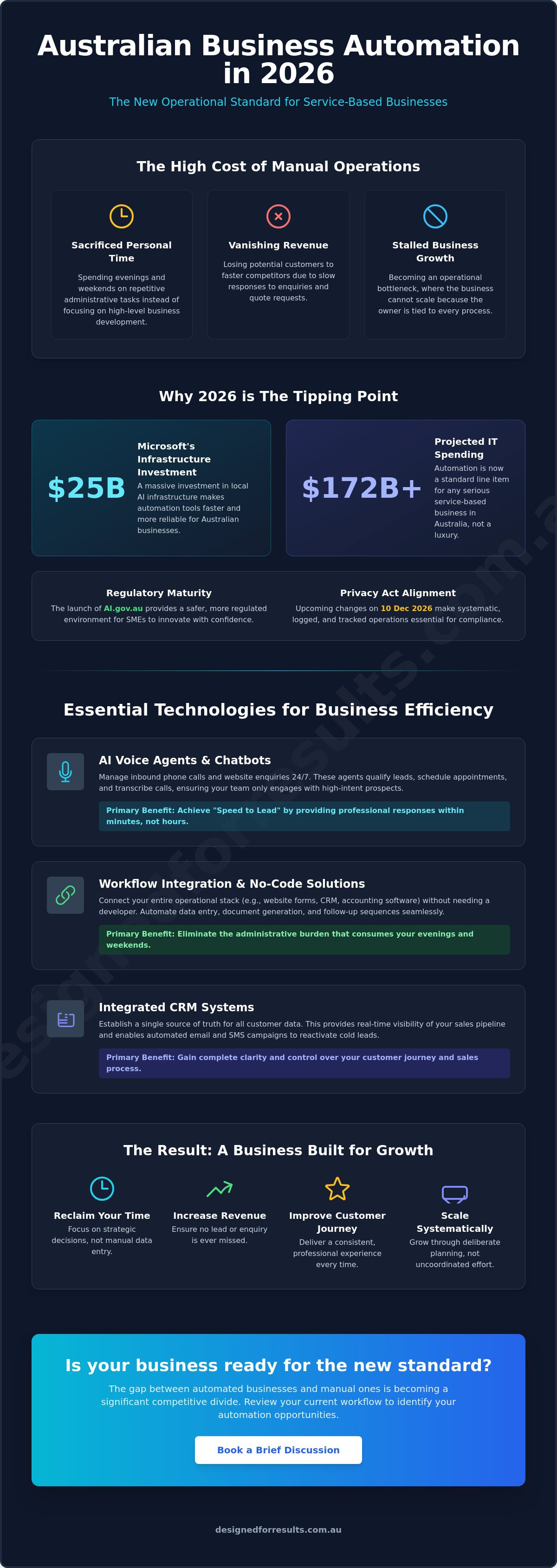
Why are you still sacrificing your evenings to administrative tasks when Microsoft is currently investing $25 billion into Australian infrastructure to solve exactly this problem? The future of business automation in australia has arrived in 2026. It is a fundamental requirement for Australian businesses looking to maintain a competitive edge. It's exhausting to watch potential revenue vanish because you couldn't respond to an enquiry fast enough or to feel that your growth is stalled because you're personally tied to every repetitive process.
You'll discover how to implement lead follow up systems and automated quote calculators that operate while you sleep, effectively removing yourself as the operational bottleneck. This guide outlines the transition to invisible, integrated workflows and explains how to align your operations with the Privacy Act changes taking effect on 10 December 2026. Adopting these systems ensures your business scales through deliberate planning and structural methodology, allowing you to reclaim time for high-level business development.
The Landscape of Australian Business Automation in 2026
Automation is no longer a peripheral technology for the Australian business; it is a baseline operational requirement. In 2026, business automation is defined as a system of integrated workflows that execute repetitive tasks without manual intervention. This shift has been accelerated by the democratization of software, as the market now offers accessible no-code integrations. You can connect your entire operational stack with minimal technical friction. The future of business automation in australia focuses on protecting margins against rising labour costs. By automating the routine, you ensure your payroll is dedicated to work that requires human judgement and emotional intelligence. With IT spending in Australia projected to exceed $172.3 billion this year, investment in these systems is a standard line item for any serious service-based organisation.
The Shift from Manual to Systematic Operations
Relying on manual processes creates an inherent ceiling on your ability to scale. When growth is uncoordinated, the owner often becomes a bottleneck, spending evenings chasing quotes and managing basic admin. Transitioning to systematic operations involves replacing these manual touchpoints with Business process automation (BPA). This transition ensures a consistent customer journey regardless of your current team size. Australian businesses find the fastest ROI by automating lead qualification and document collection. These systems remove the human error variable. Every prospect receives a professional response within minutes. It's about moving to a controlled, predictable environment where every action is logged and tracked in real time.
Why 2026 is the Tipping Point for SME Automation
Technological maturity has reached a critical mass this year. AI voice agents handle inbound enquiries with a professional tone, while deep integration between Xero and modern CRMs provides instant financial clarity. The availability of bespoke AI automation means that sophisticated solutions are accessible to businesses of all sizes. You can deploy tailored systems that fit your specific service model. With Microsoft investing $25 billion into local AI infrastructure, the tools you need are faster and more reliable than ever before. This infrastructure expansion, combined with the launch of AI.gov.au in May 2026, provides a safer and more regulated environment for SMEs to innovate. This is the year where the gap between automated businesses and manual ones becomes a significant competitive divide.
Essential Technologies Driving Business Efficiency
Efficiency in 2026 rests on three pillars: AI agents, no-code workflows, and integrated CRMs. These technologies allow you to bypass the traditional requirement for expensive custom software development. Instead, you can build a systematic environment using modular tools that scale with your volume. This shift is mirrored in Australia's major digital projects, where government infrastructure is moving toward similar interoperable systems. The future of business automation in australia is no longer about isolated software; it is about a unified ecosystem where data flows without friction. Every Australian business must prioritize these integrations to protect their margins from rising operational costs.
AI Voice Agents and Chatbots
AI voice agents now manage phone systems with high precision. They record and transcribe client calls while simultaneously triggering automated follow-ups in your CRM. On your website, chatbots provide 24/7 lead qualification, ensuring that every enquiry is vetted before it reaches your inbox. This speed to lead is critical. It eliminates the delay that typically causes an Australian business to lose sales to faster competitors. By handling appointment scheduling and initial vetting, these agents ensure your team only speaks with high-intent prospects. This reclaim of time allows you to focus on high-level business development rather than filtering through unqualified leads.
Workflow Integration and No-Code Solutions
Modern workflow integration uses no-code bridges to connect disparate software. You don't need a developer to ensure your website forms talk to your accounting software or your project management tool. These smart AI solutions reduce manual data entry across the entire sales pipeline. Every proposal and contract can be generated automatically from deal data. This removes the administrative burden that usually consumes your evenings. When your CRM is the single source of truth, your sales dashboard provides real-time pipeline visibility. This clarity is the result of deliberate planning and structural methodology rather than uncoordinated growth. The future of business automation in australia relies on this seamless connectivity to drive measurable productivity gains.
Don't ignore your existing database. Automated email and SMS campaigns can reactivate cold leads without manual effort. This creates a consistent revenue stream from assets you already own. If you want to see how these systems fit your specific model, you can book a brief discussion to review your current workflow.
Solving the Lead Follow-Up and Administrative Burden
Managing day-to-day operations while attempting to follow up on quotes manually is a recipe for missed revenue. In 2026, "Speed to Lead" has become the primary revenue driver for any Australian business. Prospects expect a professional response within minutes, not hours. If you wait until the evening to reply to a morning enquiry, that lead has likely already engaged with a competitor. The future of business automation in australia addresses this by implementing automated follow-up sequences that trigger the moment a form is submitted. These systems ensure no enquiry falls through the cracks, allowing you to maintain a high-touch sales process without manual effort. This transition moves the business owner from the role of an overextended admin worker to a strategic lead focused on high-level direction.
Automated Sales Pipelines and CRM Strategy
Modern CRM implementation involves moving beyond a simple digital rolodex. You need an active system that segments leads automatically based on their specific interactions. Integrating ai chatbots for websites allows you to capture visitor intent and trigger personalised email or SMS nurture sequences instantly. This systematic approach keeps your pipeline moving while you focus on service delivery. Automated lead generation systems provide real-time visibility into your sales dashboard, ensuring that every prospect receives the right information at the right time. This level of precision is only possible through deliberate planning and the use of integrated workflows that handle the heavy lifting of lead qualification.
Eliminating the "Evening Admin" Routine
Administrative tasks often bleed into personal time because they are treated as manual chores rather than automated processes. You can reclaim your evenings by using auto contract generation from deal data. Once a quote is accepted, the system produces the necessary documentation and initiates automated document collection for client onboarding. This removes the need for repetitive data entry and chasing clients for paperwork. Internal approval workflows further reduce management bottlenecks by notifying the correct team members automatically when their input is required. Implementing these systems ensures that your business operates with structural methodology, allowing for scalable progress that is not limited by your personal bandwidth.
Every administrative touchpoint you automate is a direct investment in your own time. By removing yourself as the operational bottleneck, you create the capacity required for sustainable growth. If you are ready to see how these systems can be applied to your specific workflows, you can book a brief discussion to explore your options.
Transitioning to an Automated Operational Model
Successful implementation starts with identifying high-friction, low-value tasks that consume your time without generating significant revenue. Buying software in an uncoordinated manner often leads to a fragmented tech stack that creates more work than it saves. You need a clear implementation plan that prioritises systems based on their immediate impact on your bottom line. The future of business automation in australia is built on scalable tools that expand alongside your volume, ensuring your operational capacity never becomes a constraint. Once these active systems are live, ongoing monitoring and optimisation are required to maintain peak performance and adapt to changing market conditions. This systematic approach ensures that every technological investment serves a specific, measurable purpose.
Step 1: Process Mapping and Efficiency Gaps
Document your current customer journey from the initial lead capture to project completion. This exercise reveals exactly where manual intervention causes delays or introduces errors. Focus on the low-hanging fruit first. Automated appointment reminders and lead qualification bots provide immediate relief for your schedule. By mapping these gaps, you move toward systematic progress rather than uncoordinated growth. This clarity allows you to see which repetitive administrative tasks are currently acting as bottlenecks in your workflow. Identifying these friction points is the first step toward reclaiming your evenings and focusing on high-level business development.
Step 2: Selecting the Right Automation Partner
Choosing an ai automation agency australia that understands the specific needs of service businesses is critical for long-term success. You must distinguish between one-time implementation projects and managed service retainers. A one-time setup might solve a current pain point, but a managed partnership ensures your systems evolve with your business. Local Australian support and strategic consulting provide the context necessary to navigate the domestic regulatory landscape, including the upcoming Privacy Act changes. Professional guidance ensures your automation is a product of deliberate planning. This partnership approach allows you to leverage deep expertise without needing to become a technical specialist yourself.
If you are ready to eliminate repetitive tasks and reclaim your time, you can book a brief discovery call to discuss your specific operational gaps and identify the most impactful starting point for your business.
The Result: Reclaiming Time and Driving Revenue
Integrating systematic automation transforms your business from a collection of manual tasks into a scalable asset. The primary benefits manifest as increased revenue, a frictionless customer journey, and the reclamation of your personal time. The future of business automation in australia allows you to scale operations without the traditional requirement for a linear increase in headcount. This structural methodology ensures that your overheads remain controlled while your capacity expands. You gain the peace of mind that comes from knowing lead follow-up and administrative workflows are handled on autopilot, regardless of your personal availability. With Microsoft investing $25 billion into local infrastructure and the Privacy Act changes approaching in December 2026, starting this transition now is a necessity to remain competitive.
Quantifiable Business Outcomes
The impact of automation is measurable through specific fiscal and operational metrics. Implementing speed to lead protocols significantly reduces lead response times, often moving from hours to seconds. This responsiveness directly correlates with increased quote-to-close ratios because you engage prospects while their intent is at its peak. Systematic operations also enhance the long-term valuation of your business. Potential buyers or successors prioritise businesses with documented, automated workflows over those reliant on the owner's daily presence. About Designed For Results provides further insight into how we prioritise these specific fiscal outcomes for our clients, ensuring every automation serves a clear financial purpose.
Taking the First Step Toward Automation
Technological intervention should be a deliberate act based on identified efficiency gaps. You must assess your current readiness for AI and automation to determine which systems will provide the highest immediate ROI for your specific service model. This involves looking at your existing workflows and pinpointing where manual data entry or slow follow-ups are costing you money. The path to operational freedom begins with a single, well-planned implementation that addresses your most significant bottleneck. Once the first system is successful, you can expand your automation footprint with confidence. You can book an automation strategy call to identify your specific bottlenecks and begin the transition toward a more efficient operational model.
The current adoption rate of 35% among Australian businesses indicates that automation is no longer a niche advantage. It is a standard for operational excellence. Delaying the move toward these systems risks leaving your business behind in an increasingly efficient marketplace. By choosing to implement these workflows now, you secure both your market position and your personal freedom. Build a business that operates through structural methodology and delivers consistent results without your constant manual intervention.
Secure Your Operational Freedom in 2026
The future of business automation in australia is defined by integrated systems that prioritise speed to lead and owner freedom. AI voice agents and no-code workflows eliminate repetitive administration, allowing your business to scale through systematic growth. Transitioning to this model is a strategic necessity for any Australian business aiming to protect margins and reclaim personal time. This approach ensures that your operations remain predictable and efficient as you grow.
We specialise in helping Australian SME service businesses implement these results-oriented systems. Our expertise in AI voice agents and no-code workflows ensures that your implementation is focused on measurable ROI. By following a clear plan, you ensure that your operations are systematic and ready for the regulatory landscape of late 2026. Let’s chat about your business automation roadmap to identify your efficiency gaps and start your journey toward operational clarity. Build a business that supports your lifestyle through systematic execution.
Frequently Asked Questions
What is the difference between business automation and AI?
Business automation follows pre-set rules to execute repetitive tasks, such as sending a confirmation email after a form is submitted. AI uses machine learning to perform tasks that require human-like interpretation, such as transcribing a client call or qualifying a lead through a natural conversation. Most Australian businesses benefit from a combination of both to handle different operational needs.
How much does it cost to implement business automation in Australia?
Costs vary significantly based on the complexity of your workflows and the number of software integrations required. You should view this as a capital investment that offsets future labour costs and prevents lost sales from slow follow-ups. Specific costs involve software subscriptions and professional implementation, which are tailored to your specific operational requirements.
Will automation replace my current staff members?
Automation reallocates your team to higher-value tasks rather than eliminating their roles. It handles the repetitive administrative chores that often lead to burnout and human error. This allows your staff to focus on client relationships and complex problem-solving, increasing the overall productivity and revenue potential of your business without increasing headcount.
How long does it take to see an ROI from workflow automation?
Most businesses experience measurable improvements in lead response times and a reduction in administrative hours within the first 30 to 90 days. The future of business automation in australia is built on the rapid deployment of high-impact tools like automated quote systems. Long-term financial gains accumulate as you scale your volume without adding significant operational overhead.
Do I need technical skills to manage an automated CRM?
You don't need deep technical knowledge to operate modern, no-code CRM systems. These platforms are designed with intuitive interfaces for business managers and owners. While the initial setup requires professional implementation to ensure structural methodology, daily management involves simple dashboard monitoring and lead oversight to ensure your pipeline remains healthy.
Can automation help with lead follow-up for service businesses?
Automation is the most effective solution for the speed to lead challenge faced by service businesses. Systems can trigger instant SMS and email responses the moment an enquiry arrives on your website. This ensures you engage every prospect immediately, even if you are currently on-site or managing other aspects of the business.
What are the best automation tools for Australian SMEs in 2026?
The future of business automation in australia prioritises tools with strong local integrations, such as Xero for accounting and high-performance CRMs. Essential tools for this year include AI voice agents for phone systems and automated document platforms for contracts and proposals. The ideal selection depends on your specific service model and your existing software stack.
